
- 320 pages
- English
- ePUB (mobile friendly)
- Available on iOS & Android
eBook - ePub
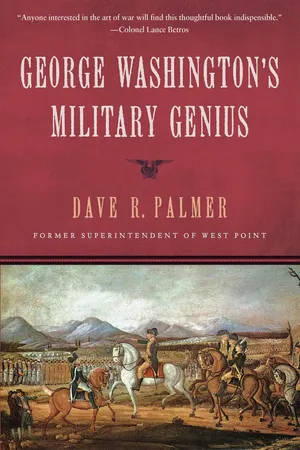
George Washington's Military Genius
About this book
Confronting the critics who say George Washington's victories were due to luck, not skill, Palmer proves why the father of our country also deserves the title of America's pre-eminent military strategist.
Frequently asked questions
Yes, you can cancel anytime from the Subscription tab in your account settings on the Perlego website. Your subscription will stay active until the end of your current billing period. Learn how to cancel your subscription.
No, books cannot be downloaded as external files, such as PDFs, for use outside of Perlego. However, you can download books within the Perlego app for offline reading on mobile or tablet. Learn more here.
Perlego offers two plans: Essential and Complete
- Essential is ideal for learners and professionals who enjoy exploring a wide range of subjects. Access the Essential Library with 800,000+ trusted titles and best-sellers across business, personal growth, and the humanities. Includes unlimited reading time and Standard Read Aloud voice.
- Complete: Perfect for advanced learners and researchers needing full, unrestricted access. Unlock 1.4M+ books across hundreds of subjects, including academic and specialized titles. The Complete Plan also includes advanced features like Premium Read Aloud and Research Assistant.
We are an online textbook subscription service, where you can get access to an entire online library for less than the price of a single book per month. With over 1 million books across 1000+ topics, weâve got you covered! Learn more here.
Look out for the read-aloud symbol on your next book to see if you can listen to it. The read-aloud tool reads text aloud for you, highlighting the text as it is being read. You can pause it, speed it up and slow it down. Learn more here.
Yes! You can use the Perlego app on both iOS or Android devices to read anytime, anywhere â even offline. Perfect for commutes or when youâre on the go.
Please note we cannot support devices running on iOS 13 and Android 7 or earlier. Learn more about using the app.
Yes, you can access George Washington's Military Genius by Dave Richard Palmer in PDF and/or ePUB format, as well as other popular books in History & Early American History. We have over one million books available in our catalogue for you to explore.
Information

PART I

STRATEGY DESCRIBED


CHAPTER ONE
STRATEGY BEFORE CLAUSEWITZ
âStrategyâ was not a word George Washington ever used. It entered the language after his death, at about the same time Napoleonâs startling triumphs expanded the understanding of warfare itself. And not until even later, when Carl von Clausewitz wrote his landmark treatise, On War, would the world have a working definition for the term.
But that is not to say that there was no strategy before Clausewitz, any more than there was no sex before Freud or sea power before Mahan.
Although they did not codify or articulate the concept of strategy, all the great battle captains of historyâand probably all the near greatâobviously understood and implemented it.1
If the theory of strategy suffered in the eighteenth century from a lack of definition, it has suffered more recently from an excess of definition. The very term has so expanded in meaning that it has become impressively imprecise. Authors of the 1972 version of the Department of Defenseâs Dictionary of Military and Associated Terms felt obliged to differentiate between âtactics,â âstrategy,â âmilitary strategy,â and ânational strategy.â But even that array of expressions is apparently insufficient, for the Army War College decided at about the same time to insert âhigher tacticsâ between tactics and strategy so that its soldier-students could conceive of still more subtleties of intent. And in what may be the unexcelled example of obfuscation, the 23 June 1974 issue of Newsday used the phrase âstrategic strategy.â Verbiage has increased apace with the proliferation of meanings. Strategy, the Dictionary of Military and Associated Terms tells us, is âthe art and science of developing and using political, economic, psychological, and military forces as necessary during peace and war, to afford the maximum support to policies, in order to increase the probabilities and favorable consequences of victory and to lessen the chances of defeat.â It is debatable whether such a mouthful of jargon is useful in helping us comprehend warfare today; it almost surely is of no utility in trying to understand strategic concepts of a war two centuries in our past.
The problem is that strategy is dynamic. Warfare is a reflection of society; as societies have evolved, growing incredibly complex, so too have the methods of waging war. We must not try to understand strategy in the eighteenth centuryâwhen the term itself did not even existâas we understand it today. We must first understand what strategy is, how it developed, where it stood in its process of evolution when redcoats and minutemen began shooting at one another, and how it was viewed by those then charged with implementing it. Then, and only then, will we be prepared to study and evaluate strategy as devised and executed by Americans in their struggle for independence.

Our word âstrategyâ is derived from the Greek strategos, meaning âleader of troops.â The antiquity of its origins is fitting, for the concept was known in all the intervening centuries even though the term itself is relatively new. Modern warfare began with Napoleon, and modern strategy began with his interpreters, Jomini and Clausewitz, but neither war nor strategy is the sole possession of modern man. Both have been around at least since the beginning of recorded history.
Until the nineteenth century, war was the sport of kings, and strategy the rules of the game. Those rules were recorded largely in the form of maxims, the knowledge of which was confined to the kingâs inner circle. They were âhow toâ lists, and only that handful of men privy to the rulerâs secrets needed to know how to use them. Sun Tzu, who may have been a committee rather than an individual, provides the earliest and best collection, but his works were not read in the West until 1772âand he does not mention strategy. Vegetius, another frequently quoted ancient, wrote of training, organization, dispositions, fortifications, and naval operationsâbut not of strategy. Others through the centuries added to that type of literature, but the fundamental concept of strategy remained hidden in histories, maxims, and memoirs. Strategy was a secret passed on from one prince to another. Gustavus learned from Maurice of Nassau and Frederick from Eugene of Savoy, just as Alexander had understudied Philip of Macedon and Hannibal had been tutored by his own father and uncles. As a method to perpetuate the principles of war, it worked well so long as warfare remained relatively simple and the ruler himself served as his own first soldier. It flourished when the prince was a man of genius, faded when he possessed lesser talents. But, withal, it sufficed.
By the eighteenth century, however, warfare stood at the threshold of a new era. Gunpowder and other technological advances had restructured the battlefield; increases in wealth and population had made larger armies feasible; diminishing dynastic ambitions had brought more form and precision to the battle arena; intensifying national rivalries had widened the horizon of hostilities; and a series of successful navigators had extended the scene of conflict to shores beyond the oceans. The political leader who personally led troops in battle had become the exception rather than the rule; Frederick and Napoleon were the last of the great warring princes, and, at that, Napoleon won renown as a warrior before he crowned himself emperor. By the end of the Age of Reason, philosophers and soldiers were beginning to seek out the various rules of the art (or science?) of warfare. War had become too complicated to be left to kings and privy counselors.
But how to begin? Where was the key to the trunk of secrets? Napoleon believed the histories of seven great leadersâAlexander, Hannibal, Caesar, Gustavus, Turenne, Eugene, and Frederickâwould constitute âa complete treatise on the art of war.â An aspiring soldier could only profit from a study of the exploits of the great captains, to be sure, but the campaigns of the past, even if other famous battle leaders were included, would hardly contain all the clues of combat, much less provide an elementary theory of warfare. Some better sort of synthesis was needed. Neither would a simple listing of maxims or principles be adequate. Distilling all the maxims down to a few commandments or principles had both biblical precedent and the advantage of simplicity, but, like a study of the great captains, it was not the ultimate answer. A general who knew intimately, say, how Hannibal employed certain principles of war to win at Cannae might be unable to relate that knowledge to operations in the age of gunpowder. What was missing was more basic yet. Somehow, the searchers had to get at the very essence of warfare itself; they had to break it down into its core components. Then they could see how to reassemble it. Only then could they grasp its underlying theory.
We can point to no single figure in history as the one who began the process that brought us to our modern understanding of war. Many thinkers began grappling with the problem at about the same time. Nevertheless, V. D. Sokolovsky, marshal of the Soviet Union, claims that the pioneering work was done on Russian soil:
... the birth of scientific knowledge of war is usually attributed to the middle of the eighteenth century, when the Englishman Henry Lloyd, serving in Russia, in his introduction to the history of the Seven Yearsâ War, systematized and put forth a number of general theoretical concepts and principles of military strategy.2
Whether Sokolovsky stretches the point out of national pride, the truth is that many men, working independently, were doing the kind of thinking in the eighteenth century that would produce an intellectual breakthrough in the nineteenth. Warfare had begun to take on its modern shape and dimensions by the time of the American Revolutionary War. The terms âhigher tacticsâ and âelementary tacticsâ had come into use, the latter referring to those formations taught on the drill field and employed by units in battle. Higher tactics was everything above that, such as selection of terrain or the science of fortifications.
In his Essai gĂ©nĂ©ral de tactique, published in 1772, the Comte de Guibert lumped both those types of tactics under the heading âthe art of the generalâ and proposed that raising and training troops was the other essential aspect of warfare. But Guibert, Lloyd, and others never quite found the combination. It was not until Napoleon had catapulted warfare into an entirely new epoch that a Prussian professional soldier isolated and defined the basic elements of war. Born during the American Revolutionary War, Carl von Clausewitz fought in the Napoleonic Wars and wrote in the years after Waterloo. His own life thus fittingly bridged the abrupt chasm separating modern warfare from the old.
The first man to classify the primary components of warfare, Clausewitz was not sure his ideas about strategy would be accepted. âNo doubt there will be many readers,â he wrote, âwho will consider superfluous this careful separation of two things lying so close together as tactics and strategy.â Accordingly, he felt compelled to define the new term repeatedly: âStrategy fixes the point where, the time when, and the numerical force with which the battle is to be foughtâ; âStrategy is the employment of the battle to gain the end of the warâ; âTactics is the theory of the use of military forces in combat. Strategy is the theory of the use of combats for the object of the war.â In a word, Clausewitzian strategy was the assembly of forces in terms of time and space.3
Writing more than a century later, the British historian and military theorist Sir Basil H. Liddell Hart took exception to Clausewitzâs definition of strategy, claiming it was too narrow. He argued that Clausewitz failed to separate governmental policy from military activities, thus implying âthat battle is the only means to the strategical end.â Sir Basilâs criticism is perhaps unjust, as he himself obliquely admitted; nevertheless, he made a valid point that there is yet another dimension of warfare: higher, or grand, strategy. âAs tactics is an application of strategy on a lower plane,â Liddell Hart explained, âso strategy is an application on a lower plane of âgrand strategy.ââ Grand strategy is policy in execution. Its role is âto co-ordinate and direct all the resources of a nation, or band of nations, towards the attainment of the political object of the warâthe goal defined by fundamental policy.â More recently, an American scholar, John M. Collins, said grand strategy âlooks beyond victory toward a lasting peace.â4
For the purposes of this bookâunderstanding the art of war as it existed in Washingtonâs timeâit is appropriate to identify three major elements of warfare: tactics, strategy, and grand strategy. (Modern soldiers would want to insert the operational level between tactics and strategy, a level that essentially bridges tactics on one end and strategy on the other. But operational level theory, however useful today, was mostly subsumed in the simpler world of the eighteenth century in the concept of strategy.)
The dividing lines between tactics and strategy on the one hand, and strategy and grand strategy on the other, are indistinct. Although distinctions are convenient for discussion, practically speaking there is always an influence of one on the other where they meet. Tactics and strategy overlap in the conduct of a campaign, while its planning would be considered both strategy and grand strategy. To oversimplify, we can say that grand strategy prescribes why to fight, strategy prescribes where and whether to fight, and tactics prescribes how to fight once the battle is joined.
At first glance, those distinctions might seem rather academic. Yet to investigate American strategy in the Revolutionary War, we need to understand the meaning of the term.

George Washington, who lived and led entirely in the eighteenth century, probably knew something of the eraâs intellectual ferment concerning the principal ingredients of warfare. But he almost certainly lost no sleep over such questions, which he would have perceived as largely theoretical and of no immediate practical advantage. He was not a philosopher. Washingtonâs formal education was meager, and his skill in warfare came not so much from books or formal military training but from common sense and uncommon wisdomâboth sharpened on the stone of experience. When the Second Continental Congress appointed him commander in chief, neither he nor the delegates could have defined strategy. Nevertheless, it was a concept they could sense if not describe. And they must also have sensed that the outcome of the war would in large measure be influenced by how well the general would perform as a strategist.
Clausewitz, who was not born until after Washington had served five years as commander in chief, believed that the ability to operate in the realm of strategy was a supreme talent that only a few possessed. To execute the correct strategy of a war, he wrote, ârequires, besides great strength of character, great clearness and steadiness of mind; and out of a thousand men who are remarkable, some for mind, others for penetration, others again for boldness or strength of will, perhaps not one will combine in himself all those qualities which are required to raise a man above mediocrity in the career of a general.â5

CHAPTER TWO
THE PRUSSIAN SHADOW
Soldiers of the 1770s and 1780s plied their trade in the awesome shadow of Frederick the Great. The warrior kingâs campaigns were widely acclaimed as classics, and he himself as a battle leader of the first order. His techniques were universally studied and openly copied. He had perfected the prevailing theory of tactical deployment, demonstrating to the wonder of all that it was possible to win decisive victories in the age of limited warfare.
Ironically enough, the existing system of warfareâwhich had begun with Gustavus Adolphus and had been employed and improved upon by such outstanding soldiers as Marshal Turenne, Prince Eugene, and the duke of Marlboroughâwas moribund even as Frederick took it to the very pinnacle of its achievement. It was about to be swept aside by the military revolution Napoleon Bonaparte would ride to fame. But when British colonists ignited rebellion in America, the French Revolution still lay some fourteen years in the future. For George Washington and other generals of his generation, the only living oracle held court in Berlin.

The structure of warfare in any era is the sturdy offspring of the union of society and technology. It consequently acquires characteristics of both, usually the face of the former and the physique of the latter. In the eighteenth century, society was stratified and technology stagnant, a combination giving monster-birth to a deformed system of fighting. Linear tactics, epitomized by Frederickâs marvelously rigid, precisely formed Prussian lines, was the battlefield embodiment of that defective system. Methods had become standardized, if not solidified, rules of conduct were well known, procedure was strictly followed, formations were highly stylized and completely structured. In a word, tactics was stereotyped. An inflexible system had evolved as a direct result of the technological standstill.
The weaponry of war had not changed in the lifetime of any participant in the American Revolution. The last important advance had taken...
Table of contents
- Cover
- Title Page
- Copyright
- Dedication
- Contents
- List of Illustrations
- Introduction
- Part I: Strategy Described
- Part II: Strategy Executed
- Conclusion
- Acknowledgments
- Notes
- Selected Bibliography
- Index