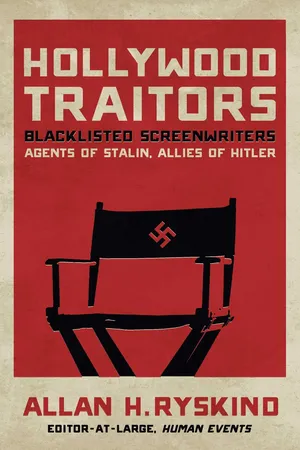
Hollywood Traitors
eBook - ePub

Hollywood Traitors

Blacklisted Screenwriters - Agents of Stalin, Allies of Hitler

  1. 538 pages
  2. English
  3. ePUB (mobile friendly)
  4. Available on iOS & Android
eBook - ePub

Hollywood Traitors

Blacklisted Screenwriters - Agents of Stalin, Allies of Hitler

About this book

"This is the book we've been waiting for!The true story of the much mythologized 'Hollywood Ten' by a scion of Hollywood royalty." —Ann Coulter, author of twelve New York Times bestsellers, including Adios America: The Left's Plan to Turn Our Country Into a Third World Hell-Hole "Coming from one who has not only studied the postwar period in Hollywood but actually lived in it, Hollywood Traitorsoffers a rare perspective that is sure to prompt discussion and re-examination of the time when Stalin drew higher praise in some U.S. motion pictures than he did in Russian films."— John Gizzi, White House correspondent and chief political colunist, Newsmax "A real-life thriller about the movies, exploding the fifty-year myth that the Hollywood were innocent victims of a witch hunt. Must readfor students of Cold War history."— M. Stanton Evans, author of Blacklisted by History: The Untold Story of Senator Joe McCarthy and His Fight against America's Enemies
There is a myth about the Hollywood Blacklist. The "Hollywood Ten" were dragged before the House Un-American Activities Committee (HUAC) and grilled on their associations with Communism, hid behind their Fifth Amendment rights, and refused to name names of Hollywood Communists. They were completely shut out from the filmmaking industry by Congress and considered the heroes of the hour by many in Hollywood. But it's time to set the record straight. In Hollywood Traitors: Blacklisted Screenwriters—Agents of Stalin, Allies of Hitler, Allan Ryskind reveals how the alleged "victims" of the Hollywood Blacklist were actually ideological thugs: enthusiastic Stalinists committed to bringing about a socialist utopia in America—even by violent revolution. Ryskind, a long-time editor of Ronald Reagan's favorite publication, Human Events, tells the true story of how these screenwriters prostituted their talent in the service of anti-American, pro-Communist propaganda. Ryskind pens the riveting report from an insider's perspective. His father, Morrie Ryskind, was a screenwriter in Hollywood and was joined by Ronald Reagan, John Wayne, Walt Disney, and others at the forefront of the anti-Communist movement in Hollywood—even at the expense of their careers and reputations. In Hollywood Traitors you will learn:

  • How the Hollywood Communists took their orders straight from the Party headquarters in New York, which in turn took them directly from Stalin's Comintern, responsible for promoting international revolution
  • How Communists attempted to take over Hollywood trade unions to control the American film industry
  • Many major films clearly toed the Soviet line, including Casablanca, Arise my Love, Paris Falling, and Mission to Moscow.

Frequently asked questions

Yes, you can cancel anytime from the Subscription tab in your account settings on the Perlego website. Your subscription will stay active until the end of your current billing period. Learn how to cancel your subscription.
No, books cannot be downloaded as external files, such as PDFs, for use outside of Perlego. However, you can download books within the Perlego app for offline reading on mobile or tablet. Learn more here.
Perlego offers two plans: Essential and Complete
  • Essential is ideal for learners and professionals who enjoy exploring a wide range of subjects. Access the Essential Library with 800,000+ trusted titles and best-sellers across business, personal growth, and the humanities. Includes unlimited reading time and Standard Read Aloud voice.
  • Complete: Perfect for advanced learners and researchers needing full, unrestricted access. Unlock 1.4M+ books across hundreds of subjects, including academic and specialized titles. The Complete Plan also includes advanced features like Premium Read Aloud and Research Assistant.
Both plans are available with monthly, semester, or annual billing cycles.
We are an online textbook subscription service, where you can get access to an entire online library for less than the price of a single book per month. With over 1 million books across 1000+ topics, we’ve got you covered! Learn more here.
Look out for the read-aloud symbol on your next book to see if you can listen to it. The read-aloud tool reads text aloud for you, highlighting the text as it is being read. You can pause it, speed it up and slow it down. Learn more here.
Yes! You can use the Perlego app on both iOS or Android devices to read anytime, anywhere — even offline. Perfect for commutes or when you’re on the go.
Please note we cannot support devices running on iOS 13 and Android 7 or earlier. Learn more about using the app.
Yes, you can access Hollywood Traitors by Allan H. Ryskind in PDF and/or ePUB format, as well as other popular books in Politics & International Relations & Communism, Post-Communism & Socialism. We have over one million books available in our catalogue for you to explore.
CHAPTER ONE
THE STALINIST TEN
According to liberal legend, richly embroidered by the media, Hollywood was a wonderfully happy town until the year 1947, when something terrible, on the order of the San Francisco earthquake, took place. Ten members of the movie colony—men bursting with innocence and idealism—were suddenly hauled before the wicked House Un-American Activities Committee (HUAC), where they were pilloried for their “progressive” views by publicity-hungry, bigoted, and venal politicians who accused them of being Communists. With a dash of bravado and belligerence, they refused to respond to any questions about their political beliefs, insisting they were protected by the Bill of Rights and, in particular, the First Amendment.
With a wave of “McCarthyite” hysteria sweeping the nation (in point of fact, Joe McCarthy had been in the Senate for less than a year and had yet to surface in the national media), they were indicted and eventually sent to prison for contempt of Congress. The Ten were also “blacklisted”—that is, they were barred from working in the motion picture industry for refusing to cooperate with the Committee. What’s more, the HUAC hearings set off yet another wave of anti-Red hysteria in which hundreds of writers, actors, and directors were driven from the entertainment media in violation of their “freedom of thought.” For the Dream Factory, the Dark Night of Fascism had descended. Though the memory of those years has faded, the Hollywood community has neither forgotten nor forgiven.
In a lengthy series for the Los Angeles Times, Patrick Goldstein claimed that historians now view the institution of the blacklist as a “seismic shift from the progressive ideals of the New Deal to the anti-Communist paranoia of the Cold War.” Patrick McGilligan, author of an insightful book, Tender Comrades: A Backstory of the Hollywood Blacklist, goes so far as to say that Hollywood during this time suffered a “cultural holocaust.”1
Liberals and those further to the Left have been monotonously regurgitating this version of events over the years, with even numerous conservatives now embracing a major portion of what has become the consensus history. But there is clearly another side to this story.
The Hollywood Ten, as they became famously known to history, are no longer household names, though Dalton Trumbo has been making a comeback, and Ring Lardner Jr., the last surviving member of the tribe (he died in 2002), is still mentioned as an important “martyr” to HUAC’s “inquisition.”
Many were talented men who left their mark on politics and film and, contrary to accepted wisdom, often succeeded in putting their Communist convictions into their work. Lardner may be best known for his post-blacklist movie M*A*S*H, which was vigorously opposed to the Vietnam War and became the basis for a hugely successful TV series with Alan Alda.
John Howard Lawson enforced the Stalinist line in Hollywood, so it was not surprising that he also penned the 1930s film Blockade, which favored the Soviet side during the Spanish Civil War, and Action in the North Atlantic, a World War II film starring Humphrey Bogart in which the Russians are shown as the heroes in the rescue of an American supply ship. Alvah Bessie, who fought on the Communist side in Spain, was hired to write a small but highly acclaimed piece of pro-Soviet dialogue for Action.
Trumbo is remembered for many excellent films, including Roman Holiday (with Gregory Peck and Audrey Hepburn), Spartacus (with Kirk Douglas), and Papillon (with Steve McQueen and Dustin Hoffman), and he became the first of the Hollywood Ten to break the blacklist in 1960, which meant he was the first of those officially banned from Hollywood to receive screen credit for his work without ever having to name a fellow Red conspirator or say he was sorry for siding with Joseph Stalin and Adolf Hitler against his homeland.
Trumbo is less well known for a script that never made it to the screen: An American Story, whose plot outline, in the words of film historian Bernard F. Dick, goes like this: North Korea finally decides “to put an end to the border warfare instigated by South Korea by embarking upon a war of independence in June 1950.”2 (In his papers at the Wisconsin Historical Society, Trumbo says he “dramatized” Kim Il-sung’s supposedly righteous war for a group of fellow Communist screenwriters, including at least two Hollywood Ten members.)
Trumbo also seemed to think that Stalin needed a bit of a reputation upgrade. So one finds in his papers a proposed novel, apparently written in the 1950s, in which a wise old Russian defends Stalin’s murderous reign as necessary for the supposedly grand achievements of Soviet socialism.
Those celebrating Trumbo today as a sort of saintly curmudgeon do not feel obligated to mention this aspect of his Red ideology, nor do they point to his writings during the Soviet-Nazi Pact, when he was excusing Hitler’s conquests. “To the vanquished,” he airily dismissed the critics of Nazi brutality, “all conquerors are inhuman.” For good measure he demonized Hitler’s major enemy, Great Britain, insisting that England was not a democracy, because it had a king, and accused FDR of “treason” and “black treason” for attempting to assist the British in their life-and-death struggle against the despot in Berlin.
Stalin, Hitler, Kim Il-sung? This is a trifecta of barbarous dictators, all supported by Trumbo, whose reputation as a champion of liberty is rising in Hollywood even as I write.
Writers Albert Maltz, Lester Cole, Herbert Biberman, and Samuel Ornitz—each a Hollywood Ten figure—also left their mark in both radical politics and films, as did producer Adrian Scott and famed director Edward Dmytryk.
Several of the Ten have written about their ordeal in well-received autobiographies. All of them—save Dmytryk, the only one to renounce Communism completely—have been celebrated in countless articles, interviews, and TV documentaries. Numerous movies, including The Majestic, with Jim Carrey, and The Front, starring Woody Allen and the late Zero Mostel, have dramatized the plight of the blacklisted writer, with the “victims” of the 1947 and 1950s hearings customarily elevated to icon status.
Screenwriter Philip Dunne, who organized a star-studded committee including Humphrey Bogart and Lauren Bacall to defend the Ten, tells an informative story in his memoir, Take Two. Dunne recalls that his young daughter, while attending a boarding school in Arizona, blurted out: “Daddy, my friends honor you.” Why? he wondered in astonishment. “Because you were blacklisted.”
Dunne had never been a Communist and was never blacklisted, despite his penchant for radical politics. But his kid’s remarks were revealing. “My daughter’s friends who paid me this unearned compliment,” Dunne writes, “were mostly sons and daughters of doctors, lawyers, writers, professors, and artists from Los Angeles, San Francisco and New York: a fair cross section within the intellectual community.” This community, he reflects, had elevated the Hollywood Ten and other blacklistees “to the status of national heroes.”3
WHITEWASHING THE BLACKLISTED
In truth, they remain heroes—and not only among America’s intellectual elite. Some of the accused may have been Communists, it is conceded by some HUAC critics, a proposition hard to deny since every one of the Ten has been revealed to have been a Communist through public confession or incontrovertible evidence. But not all had necessarily joined the Party, critics initially contended, and what evidence HUAC produced was allegedly weak or even doctored. As Larry Ceplair and Steven Englund suggest in their classic volume on the screenwriters, The Inquisition in Hollywood, there is “reason to believe” that the Communist Party cards of the Ten introduced into the hearing record “were fabrications.”4
Even if some of the Ten did join the Party, they were not “subversives,” as the Committee’s members alleged, but good Americans who had become CP members out of a zeal to battle such pressing issues as poverty, fascism, and the oppression of the black race. Indeed, they proved their loyalty to this nation during World War II when they joined the military or wrote some of our best war pictures or spent enormous time and energy boosting the war effort on the home front. HUAC, in fact, had no legal—and certainly no moral—authority to subject these well-meaning citizens to the kind of public condemnations they received.
Such is the customary case for the Ten.5 The truth about the HUAC investigations is quite different. The Hollywood Ten, far from being “radical innocents,” far from having just “flirted with Communist ideas,” as their sympathizers so frequently insist, had all been committed to a Soviet America. Each had been an active Communist for several years. Each was participating in Communist activities during the year of the 1947 hearings.
Each was pledging loyalty to Stalin and the American Communist Party at the very moment a large segment of the liberal community was vehemently condemning Stalin, kicking Communist Party members out of both labor and liberal organizations, and forming new groups barring CP members from holding office or even joining.6
Each had paid dues to the Party, met in secret CP gatherings, embraced CP projects, adorned various CP fronts, and lavished money or time or both on Party projects, and each had been issued a Communist Party USA card or a Communist Political Association card (the Communist Political Association was the name of the Party for fourteen months during WWII). The cards produced by the Committee were not “fabrications,” as Ceplair and Englund falsely suggest.7
These men, along with hundreds of their comrades in the movie industry, were determined to transform Hollywood into a colony of the Kremlin. Indefatigable, they recruited Party members, taught radicals of all stripes their craft at Marxist “academies,” indoctrinated colleagues with their ideology, and schooled fellow writers on how to insert Red propaganda into American films.
They deeply penetrated or aided others in penetrating the screenwriters’, directors’, and actors’ guilds, and they worked feverishly to help fellow Reds seize control of the labor side of Hollywood through Herb Sorrell’s Conference of Studio Unions. If they could gain control over the guilds and the unions, they reasoned, they could then compel the producers to meet not only the economic and political demands of the Left, but the “content” demands as well—that Hollywood make radical, pro-Communist films. They never did subdue Hollywood completely, but they wielded enormous influence. And it took a determined anti-Red contingent in Hollywood and the long-scorned House Un-American Activities Committee to finally break their power.
By October of 1947, when the hearings began and the Soviet Union posed an obvious threat to the West, Hollywood’s Communists had been active in a subversive party that was entirely controlled by Moscow, had thoroughly penetrated American society, and was engaged in massive espionage on behalf of the Soviets (including the filching of atomic secrets).
The Party they wholeheartedly embraced had placed agents at the highest levels of our government to shift policy in favor of the Soviet empire, was furiously working for the destruction of our economic and political freedoms, and was pledging to overthrow the U.S. government, by force and violence if necessary. Many of the radical writers, including such high-octane screenwriters as Donald Ogden Stewart, for one, eventually admitted as much.
Nothing the Communist Party in America ever did was without direction from the Kremlin. Nothing. When Hitler initially threatened Russia, Hollywood’s Party members, under Moscow’s orders by way of Party headquarters in New York, were passionately anti-Nazi; when Hitler turned his guns against the West—enabled by his 1939 Pact with Stalin—they devoted the whole of their lives to crippling the capacity of the anti-Nazi nations to survive.
Only when the Nazis double-crossed Stalin with their “surprise” invasion of the Soviet Union in 1941 did Hollywood’s Reds—with Moscow still cracking the whip—renew their rage against Hitler. They were not honorable anti-fascists or patriotic Americans, as their defenders argue, but loyal Soviet apparatchiks, a fifth column working for Stalin inside our homeland.
None of this appears to bother Hollywood or the Ten’s supporters a whit. Nor is it much dwelt upon—though I cite one conspicuous exception below—in the unrelenting apologias. Hollywood cannot get enough of celebrati...

Table of contents

  1. Cover
  2. Title Page
  3. Copyright
  4. Contents
  5. Cast of Characters
  6. Preface: Morrie Ryskind: Hollywood Anti-Communist (and My Father)
  7. Chapter 1: The Stalinist Ten
  8. Chapter 2: The Birth of the Screen Writers Guild
  9. Chapter 3: “Communism . . . Must Be Fought For”
  10. Chapter 4: Anti-Fascist, or Pro-Stalin?
  11. Chapter 5: The Hollywood Anti-Nazi League
  12. Chapter 6: The Pro-Hitler Congress
  13. Chapter 7: Red and Brown Sabotage
  14. Chapter 8: The American Peace Mobilization Goes to War
  15. Chapter 9: Red Propaganda in Films
  16. Chapter 10: Blockade: The Party Targets Spain
  17. Chapter 11: Ninotchka Slips through a Red Filter
  18. Chapter 12: Red Heyday in Hollywood
  19. Chapter 13: Mission for Stalin
  20. Chapter 14: The Great Escape
  21. Chapter 15: The Anti-Communists Weigh In
  22. Chapter 16: The Cold War Begins
  23. Chapter 17: Screenwriters Embrace a Comintern Agent
  24. Chapter 18: HUAC
  25. Chapter 19: More Friendly Witnesses
  26. Chapter 20: Phil Dunne’s Strange Crusade
  27. Chapter 21: The Writers Self-Destruct
  28. Chapter 22: Portents of Disaster
  29. Chapter 23: The Screen Writer: Red as a Rose
  30. Chapter 24: Emmet Lavery’s Critical Turnaround
  31. Chapter 25: The Blacklist Begins
  32. Chapter 26: Game, Set, Match
  33. Chapter 27: Herb Sorrell and the CSU Strike
  34. Chapter 28: Reagan Outwits the Reds
  35. Chapter 29: The Silencing of Albert Maltz
  36. Chapter 30: Dalton Trumbo, Communist Conformist
  37. Chapter 31: From Pacifist to Holy Warrior
  38. Chapter 32: Lillian Hellman: Scarlet Woman, Scarlet Lies
  39. Chapter 33: Donald Ogden Stewart: Hollywood Revolutionary
  40. Chapter 34: John Howard Lawson: The CP’s “Grand Pooh-Bah”
  41. Chapter 35: Elia Kazan Deserved His Oscar
  42. Chapter 36: Arthur Miller—Was He or Wasn’t He?
  43. Chapter 37: The Curious Case of Michael Blankfort
  44. Chapter 38: Reds on the Blacklist
  45. Chapter 39: Rehabilitating Ex-Reds
  46. Chapter 40: Red Reminiscences
  47. Chapter 41: Hollywood Today
  48. Appendix A: The Communist Cards of the Hollywood Ten
  49. Appendix B: Selected Filmography
  50. Appendix C: Scrubbing Robert Taylor’s Name
  51. Acknowledgements
  52. Notes
  53. Index