
- 300 pages
- English
- ePUB (mobile friendly)
- Available on iOS & Android
eBook - ePub
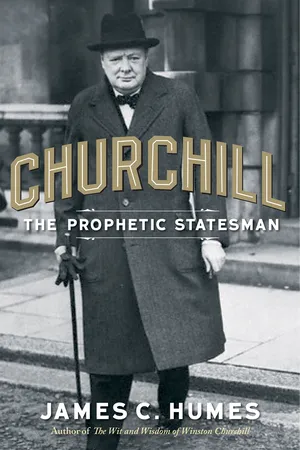
About this book
"Perhaps it is a cliche that a politician thinks of the next election and a statesman of the next generation, yet my grandfather found merit in the maxim. He had known leaders he esteemed as the greatest of statesmenâŚChurchill, however, was the leader he admired above allâŚIn hundreds of studies of Churchill, no one else, remarkably enough, has focused on Churchill's predictions and prophecies. James Humes has produced a book that is unique as well as necessary for an understanding of statesmanship." âDavid Eisenhower, author and senior fellow at the Foreign Policy Research Institute
Frequently asked questions
Yes, you can cancel anytime from the Subscription tab in your account settings on the Perlego website. Your subscription will stay active until the end of your current billing period. Learn how to cancel your subscription.
No, books cannot be downloaded as external files, such as PDFs, for use outside of Perlego. However, you can download books within the Perlego app for offline reading on mobile or tablet. Learn more here.
Perlego offers two plans: Essential and Complete
- Essential is ideal for learners and professionals who enjoy exploring a wide range of subjects. Access the Essential Library with 800,000+ trusted titles and best-sellers across business, personal growth, and the humanities. Includes unlimited reading time and Standard Read Aloud voice.
- Complete: Perfect for advanced learners and researchers needing full, unrestricted access. Unlock 1.4M+ books across hundreds of subjects, including academic and specialized titles. The Complete Plan also includes advanced features like Premium Read Aloud and Research Assistant.
We are an online textbook subscription service, where you can get access to an entire online library for less than the price of a single book per month. With over 1 million books across 1000+ topics, weâve got you covered! Learn more here.
Look out for the read-aloud symbol on your next book to see if you can listen to it. The read-aloud tool reads text aloud for you, highlighting the text as it is being read. You can pause it, speed it up and slow it down. Learn more here.
Yes! You can use the Perlego app on both iOS or Android devices to read anytime, anywhere â even offline. Perfect for commutes or when youâre on the go.
Please note we cannot support devices running on iOS 13 and Android 7 or earlier. Learn more about using the app.
Yes, you can access Churchill by James C. Humes in PDF and/or ePUB format, as well as other popular books in Politics & International Relations & Political Biographies. We have over one million books available in our catalogue for you to explore.
Information
PART I
WORLD WAR I
dp n="28" folio="14" ?dp n="29" folio="15" ? CHAPTER I
PRESCIENT AS A SCHOOLBOY
CHURCHILL ENVISIONS A 1914
TRANSCONTINENTAL WAR
âCHURCHILL TO BOURKE COCKRAN, NOVEMBER 30, 1899
When contemplating the whole of Churchillâs great career, it is important to look past the most spectacular chapterâhis âfinest hourâ leading Britain in World War IIâand recognize that the central issue of Churchillâs entire career was the problem of scale in war and peace. As his letter to Bourke Cockranâwritten on his twenty-fifth birthday, a few weeks before he escaped from a Boer POW campâattests, Churchill saw how changes in technology, wealth, and politics not only would create the conditions for âtotal warâ but also would transform war into an ideological contest over the status of the individual.
Churchill was writing to Cockran, a Democratic congressman from New York City, about the economic problem of the âtrusts,â which was then front and center in American politics. As we shall see, Churchill had strong views about how governments would need to respond to social changes in the twentieth centuryâindeed, that question was the focus of his early ministerial careerâbut from his earliest days, even before he entered politics, he saw that the new scale of things in the modern world would be felt most powerfully in the area of warfare. His observations about the âterrible machinery of scientific warâ in The River War led him to ask what would happen when two modern nationsânot Britain and the Sudanese Dervishesâconfronted each other with the modern weapons of war. It was a question no one else was asking.
Nearly every politician and military commander associated with the 1898 Sudan campaign regarded it as just another in a series of minor military skirmishes or border clashes necessary to maintaining the British Empire in the late nineteenth century. The era of epic continental warfareâof megalomaniacal ambition like that of Napoleon or Louis XIVâwas thought to be over. âIt seemed inconceivable,â Churchill wrote later in The World Crisis, âthat the same series of tremendous events, through which since the days of Queen Elizabeth we had three times made our way successfully, should be repeated a fourth time and on an immeasurably larger scale.â1
This was no mere flourish of retrospection. In fact, Churchill himself had first conceived the possibility of intense conflict among the continental powersâoccurring in 1914 no lessâwhen he was a schoolboy. It was the first of several astonishing predictions of World War I.
dp n="31" folio="17" ?
One of the persistent misconceptions of Churchill is that he was a poor student. It is more accurate to say he was, by his own admission, a rebellious student, often bored with the curriculum and chafing under the standard teaching methods of the time. It was obvious from his earliest days in school that he was extremely bright and facile with the English language, a prodigy at learning history and extending its lessons. Still, he was often âon report,â or ranked near the bottom of his class at the end of the term.
One of Churchillâs instructors at Harrow, Robert Somervell, recognized the boyâs abilities. In fact, Somervell thought Churchill ought to attend one of Britainâs prestigious universities rather than the military academy at Sandhurst, where he eventually enrolled. When Churchill was fourteen, Somervell challenged him to write an essay on a topic of his own choosing. He wanted to give his pupil free range to see what his imagination and comprehensive knowledge of history might produce. Churchillâs father, Lord Randolph, had been chancellor of the exchequer, and some speculate that Somervell, expecting an equally illustrious political career for the son, wanted to have a record for the school of Churchillâs early prowess.
Churchill framed his essay as a report of a junior officer from a battlefield on which the British army was fighting Czarist Russia. The date he chose: 1914.
The Engagement of
âLa Maraisâ
July 7th, 1914.
By an Aide de Camp of Gen. C.
Officer Commanding
H.M. Troops in R.
âLa Maraisâ
July 7th, 1914.
By an Aide de Camp of Gen. C.
Officer Commanding
H.M. Troops in R.
In his essay, which filled seventeen lined pages, Churchill manifested his knack for map-making and his knowledge of geography. He appended five pages of maps on a scale of two inches to a mile depicting the placement and movement of batteries, trenches, artillery, convoys, tents, and regiments of cavalry and infantry, as well as topography.
Churchillâs essay is a personal, first-hand account of two days of combat, interspersed with personal asides. The aide-de-camp is exhausted after two days: âI am so tired that I canât write anymore now. I must add that the cavalry reconnaissance party found that there is no enemy to be seen. Now I wish for a good night, as I donât know when I get another sleep. Man may work. But man must sleep.â
He describes a meeting of the junior officer with senior officers: âAide-de-camp,â said General C., âorder these men to extend and advance on the double.â On another occasion, the general is smashed in the head with a fragment of an artillery shell. Churchill wrote, âGeneral C. observing his fate with a look of indifference turns to me and says âGo yourselfâaide-de-camp.ââ
At times, Churchillâs descriptions of battlefield carnage are suggestive of the American novelist Stephen Crane, who published his classic The Red Badge of Courage a few years later. The astonishing number of men killed in a single encounter foreshadowed the numbers in World War I, a quarter of a century later.
The fields which this morning were green are now tinged with the blood of 17,000 men.... Through the veil of smokeâthrough the stream of woundedâover the corpses, I ride back to our lines in safety.
And a crackle of musketry mixes with the cannonade. Smoke clouds drift and gather on the plain or hang over the marsh.... Bang! A puff of smoke has darted from one of their batteries and the report floats down to us on the wind; the battle has begun.
The aide-de-camp reports of his near escape from injury or death when he was dismounted in a clash with Cossack cavalry.
I jumped on a stray horse and rode for my life. Thud! Thud! Thud! And the hoofs of a Cossackâs come nearer and nearer behind me. I glance backâthe point of a Cossackâs lanceâahead smoke. The Cossack gains on me. A heavy blow on my backâa crash behind. The thrust strikes my pouchâdoes not penetrate me. The Cossack has fallen over a corpse.
As might be expected, the English army eventually routs its Russian adversaries. Despite the Czaristsâ initial success in a skirmish, the British infantry pushes back their counterparts on the second day of battle.
The enemy retreated slowly and deliberately at first but at the river Volga, they became broken and our cavalry, light and heavy, executed a most brilliant charge which completed the confusion. And thus, the 63,000 Russians fled across the Volga in disorder pursued by 6,000 cavalry and 40,000 infantry.
Churchill concludes with an observation of âthe superiority of the English lion over the Russian bear.â
Churchillâs Harrow essay is exhibited today in the underground War Rooms in London, where Churchill managed World War II during the Blitz.
dp n="34" folio="20" ?dp n="35" folio="21" ? CHAPTER 2
WARNINGS FROM A YOUNG MP
DEMOCRATIC WARFARE WILL BE ALL-ENCOMPASSING
Churchillâs youthful essay predicting an epic military clash on the continent was only the first instance of his foreseeing the First World War. The second occurred at the beginning of his long political career.
Taking his place in 1901 as the youngest member of Parliament and a member of his fatherâs Conservative Party, Churchill immediately made his mark with several notableâsome critics said impertinentâspeeches about the Boer War and other colonial affairs.
As did his service in the Sudan, his service in the Boer War awakened his imagination to the possibilities of modern warfare, and he was not sanguine about them. His experience in the battle of Spion Kop in January 1900 was notably different from that in the battle of Omdurman in the Sudan less than two years before because of one simple factor: the Boers, unlike the Dervishes, had modern armaments, which exacted a terrible toll on the attacking British forces, despite Britainâs superior numbers. In fact, Churchill thought the Boers had superior battlefield rifles, and as for artillery Churchill observed that âone Boer gun usually managed to do to our men as much harm as six British guns do harm to the Boers.â1 It was the first glimmer of a central principle that Churchill stressed in World War Iâthe superiority of defensive positions. It was a principle he could not get the British generals to absorb sufficiently.
After Britainâs initial success storming the heights of Spion Kop, the ferocious Boer counterattack forced a costly retreat. The dead piled up three deep on the slope. Lieutenant Winston Churchill was in the middle of the fight, trying to rally the troops. âThe scenes on Spion Kop were among the strangest and most terrible I have ever witnessed,â Churchill wrote to a friend. âCorpses lay here and there. Many of the wounds were of a horrible nature. The splinters and fragments of the shell had torn and mutilated in the most ghastly manner.â2 It was yet another small-scale preview of the dreadful character of the Great War that would come in the following decadeâright down to the all-important detail of the lack of battlefield leadership by the junior officer corps on the spot.
Churchillâs experience in these previews of the mass slaughter of modern warfare was complemented by what he had learned of the American Civil War from his motherâs side of the family. While the British had not yet suffered the trauma of the young manhood of whole towns being decimated by war, Churchill had seen first hand, in his North American visits, the hundreds of stone markers bearing the names of the Civil War dead in upstate New York towns, some with populations of only a thousand.
dp n="37" folio="23" ?From his own experience in the British army in India, the Sudan, and South Africa, Churchill gained two insights that would become important in his long political career: a recognition of the increasing horrors of modern warfare and a disdain for what he saw as the shortsightedness of much of the military establishment. It is often said of Churchill in World War II that âhe interfered with the generals.â Quite true! In his third major speech to the House of Commons in 1901, Churchill said âI had always been led to believe that the generals existed for the Army, and not the Army for the generals.â He had acquired some of his instincts from his father, Lord Randolph Churchill, who had warned with extraordinary prescience in 1886, âA wise foreign policy will extricate England from Continental struggles and keep her outside of German, Russian, French, or Austrian disputes.â
It should not have been a surprise that the young MP would openly oppose his own partyâs proposal for an expansion of the army. In the spring of 1901, the secretary of state for war, St. John Brodrick, proposed a scheme of army âreformâ that amounted to a significant increase in expenditures in order to equip six additional army corps. If adopted, the additional expense would represent a near doubling of the armyâs budget over the previous eight years.
Churchill thought the proposal was unsound on multiple grounds. First, the Conservative Party, if it were worthy of its name, ought to stand for frugality. The proposal seemed to open the way to profligate spending by every department of the government. On May 13, 1901, Churchill took to the floor of the House to deliver a stinging attack on what he called âthe costly, trumpery, dangerous military playthings on which the Secretary of State for War has set his heart.â
Churchill asked: âHas the wealth of the country doubled? Has the population of the Empire doubled? Have the armies of Europe doubled? Is there no poverty at home? Has the English Channel dried up and we are no longer an island?â At this point in his political career, Churchill was more concerned with social reform and the establishment of social insurance programs, as we shall see. Separately Churchill had complained, âI see little glory in an Empire which can rule the waves and is unable to flush its sewers.â This puts in relief his argument against increasing spending on a secondary component of national security.
I hold it is unwise to have no regard to the fact that in this reform we are diverting national resources from their proper channel of development. It may be argued that if other nations increase their armed forces so must we. If you look into the tangled mass of figures on the subject you will find that while other nations during the last fifteen years have been increasing their navies we have been increasing our expenditure on our Army, which is not after all our most important weapon.... My contention is that we are spending too much money on armaments, and so may impair our industries; but that if the money has to be spent, then it would be better to spend it on the Fleet than on the Army.
This last comment was based on Churchillâs view that England and its Empire depended first and foremost on the navy for its defense. This was another minor prophesy of Churchillâs that would soon find vindication. In just a few years, Churchill was running the Royal Navy as First Lord of the Admiralty, and his most pressing challenge was Germanyâs sudden and aggressive buildup of its navy.
âThis is not an Army reform,â Churchill continued, âbut an Army increase.â The needs of defending âthe minor emergenciesâ that occur on âthe varied frontiers of the Empireâ could easily be accomplished with one more army corps, but the expansion Brodrick wanted would be wholly inadequate for a general European war. âBut we must not expect to meet the great civilized Powers in this easy fashion. We must not regard war with a modern Power as a kind of game in which we may take a hand, and with good luck and good management may play adroitly for an evening and come safe home with our winnings. It is not that, and I rejoice that it cannot be that. A European war cannot be anything but a cruel, heartrending struggle....â Brodrickâs additional army corps, Churchill added, would not protect Britain in the event of a European war, because they were too small: âIf we are in danger, they will not make us safe. They are enough to irritate; they are not enough to overawe.â
It was not merely that European war would be larger in scale than the frontier wars of the Empire that Churchill had witnessed in India and Africa. England had successfully prosecuted such European conflicts against Napoleon just a century before. The wars of the twentieth century would be different for two reasonsâscience and democracy. These would make for a century of Total War. As Churchill noted, âif we are ever to enjoy the bitter fruits of victory, [a European war] must demand, perhaps for several years, the whole manhood of the nation, the entire suspension of peaceful industries, and the concentrating to one end of every vital energy in the community.â Churchill professed himself âastonished... to hear with what composure and how glibly Members, and even Ministers, talk of a European war.â
Gone were âthe former daysâ when the causes of war were the ambitions, passions, or petty political intrigues of kings or ministers, whose wars âwere fought by small regular armies of professional soldiers,â whose style and smaller scale of warfare made it âpossible to limit the liabilities of the combatants.â Continuing with his theme of science and scale, Churchill came to his climax:
But now, when mighty populations are impelled against each other, each individual severally embittered and enflamedâwhen the resources of science and civilization sweep away everything that might mitigate their fury, a European war can only end in the ruin of the vanquished and the scarcely less fatal commercial dislocation and exhaustion of the conquerers.
Churchill then uttered one of the most incisive prophecies of his long career: âDemocracy is more vindictive than Cabinets. The wars of peoples will be more terrible than those of kings.â
Churchillâs speech thrilled the Liberal Party opposition (w...
Table of contents
- Title Page
- Dedication
- Foreword
- Introduction
- PART I - WORLD WAR I
- PART II - MODERN MILITARY WEAPONS
- PART III - DOMESTIC AFFAIRS
- PART IV - THE AGE OF TOTALITARIAN IDEOLOGIES
- PART V - WORLD WAR II
- PART VI - THE COLD WAR
- Acknowledgments
- NOTES
- INDEX
- Copyright Page