Emptiness
eBook - ePub

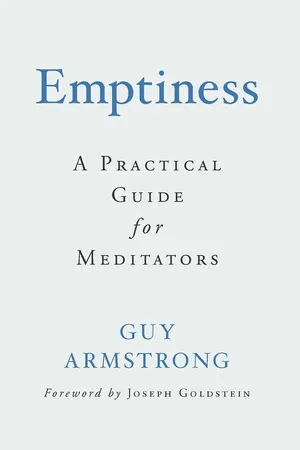
Emptiness

A Practical Guide for Meditators

  1. 328 pages
  2. English
  3. ePUB (mobile friendly)
  4. Available on iOS & Android
eBook - ePub

Emptiness

A Practical Guide for Meditators

About this book

If everything is empty, then what ceases in Nirvana and is born in rebirth? How can you live in the world without feeling trapped by it? Guy Armstrong tackles these questions and more in this richly informed, practical guide to emptiness for the meditator.

It may seem odd for emptiness to serve as the central philosophy of a major religion. In fact, emptiness points to something quite different than “nothingness” or “vacancy.” And by developing a richer understanding of this complex topic, we can experience freedom as we live consciously in the world.

Guy Armstrong has been a leading figure and beloved teacher of insight meditation for decades. In this book, he makes difficult Buddhist topics easy to understand, weaving together Theravada and Mahayana teachings on emptiness to show how we can liberate our minds and manifest compassion in our lives.
PART I:
SELF
1. THE WORLD IS EMPTY OF SELF
All yogas have only one aim: to save you from the calamity of separate existence.
— Sri Nisargadatta Maharaj1
WE LIVE IN AN AGE when concern for the self has risen to unprecedented levels. Families and communities are disintegrating, and with them go our nearest opportunities for generosity and service. The social contract to care for one another is under attack. The planet’s environmental health is in crisis, while many remain oblivious or indifferent. Materialism is widely honored and rampant. Compromise is becoming a distant memory. In our culture now it sometimes seems that all that matters is me: my wants, pleasures, needs, opinions, and rights.
Excessive self-concern is, of course, not a new phenomenon. It has always been a destructive aspect of human nature. But social structures that once limited its expression are now breaking down, and we are left more and more to face the naked manifestation of this force. There was once a time when no one would have dared to say, “Greed is good,” but now this expression is seen as little more than the frank admission of a common ethic.
Buddhism views excessive self-centeredness as the primary source of suffering, causing us to act in ways that harm ourselves and others, from infidelity and dishonesty to murder, terrorism, and war. The habit of self-concern creates pain in our closest relationships, gives rise to greed and hatred, and torments our hearts on a daily basis. There is no way to a true and lasting happiness without seeing into and eventually overcoming this force.
Fortunately Buddhism doesn’t stop with the diagnosis. It offers a radical therapy for overcoming self-centeredness by questioning the very idea of a self. Throughout his teaching career, the Buddha returned to this point again and again. He said that in our obsession with self, we are like a barking dog tied to a post, running endlessly and fruitlessly around a single point,2 yet we fundamentally misunderstand what it is. “In whatever way they conceive of self,” he said, “the fact is ever other than that.”3
THE LANGUAGE OF SELF AND NOT-SELF
As we’ve seen, the self is designated by words like I, me, and mine. This sense of self, or “I,” seems unmistakably real, yet when we look for it directly, it is elusive. William James said, “When I search for my self, all I can find is a funny feeling at the back of my throat.” The Dalai Lama said that when something seems clear to us but we can’t find it, that is a sure sign of delusion. The self is not real in the ways we take it to be.
The Buddha was asked by his cousin and longtime attendant, Ānanda, “Venerable sir, it is said, ‘Empty is the world, empty is the world.’ In what way is it said, ‘Empty is the world’?” The Buddha replied, “It is, Ānanda, because it is empty of self and of what belongs to self that it is said, ‘Empty is the world.’”4
The world is empty of self. Sometimes this is explained as the Buddhist teaching of no-self. Yet it seems inarguable that someone has written these words and someone else is reading them! What is the meaning of the puzzling assertion of no-self? This is the question I’ll try to answer in part 1 of this book. To the extent that we can intuit the absence of a self, as opposed to merely believing in it as a doctrine, we will understand a key aspect of emptiness. The two understandings — (1) the absence of self and (2) emptiness — are mostly used synonymously in this part of the book.
THE CONVENTIONS OFIANDMINE
As we explore the assertion that the world is empty of self, we need to distinguish between our everyday use of the words I and mine and the reality these words point to. The Buddha did not tell us never to say these words in any type of conversation. He said that a wise person can use these terms without being confused by them.5 Our speech would sound absurd if we did not use the words I or mine out of a fear of being “dharmically incorrect.” We’d have to resort to cumbersome expressions like “the speaker” or “the one standing here.”
It’s fine to say “I” and “mine,” “you” and “yours,” as long you understand that these terms are merely conventions of our social contract that identify where an activity is taking place or where ownership is assigned. With these useful conventions, you end up in your home and I end up in mine, after driving our respective cars. Life would be too chaotic without these conventions and the language we use to communicate about them.
Similarly, there is a conventional manner in which we can talk about an individual having a unique way of being that we might call an identity. We all have characteristics of height, weight, age, ethnicity, gender identity, sexual orientation, and personality that allow us to describe ourselves in meaningful and authentic ways. The teaching on the absence of self does not take away or disregard these useful forms of description. But it does point to the need not to stop at the conventional description and take it as an ultimate truth — because doing that will lead to suffering.
The problem arises when we take conventional language to mean more than it can. By repeating “I” and “mine,” and describing ourselves as being a certain way, we’ve come to believe that something real is being pointed to that isn’t actually there. Buddhist practice helps us free ourselves from this delusion and see things as they actually are. In the process we find a more expansive and generous way to relate with the world.
NO-SELF VERSUS NOT-SELF
There is a debate in the Western Buddhist world on how to translate this key teaching on the absence of self. Some teachers call it “no-self” and others call it “not-self.” The Pali term is anattā and could be translated either way: attā means “self” and the prefix an- is a negation. Those who translate it as “no-self” say this is a pithy expression that directly points to the insight that the world is empty of self, that no self can found anywhere. Those who call it “not-self” are fond of saying (and as far as I know, this is true) that there is no passage in the Pali Canon in which the Buddha categorically states, “There is no self.” They quote a particular discourse in which the Buddha is asked by a wanderer from another sect whether there is a self or not, and he refuses to answer. The reason he later gives for his silence is tied to a subtle philosophical principle in vogue in his day.6
I think these points are interesting but not terribly significant. Philosophically, saying “the world is empty of self” is a clear statement of absence, and so I believe the translation “no-self” is a valid interpretation. However, the most compelling argument for using “not-self,” I find, is that it shifts the discussion from a philosophical position (“There is no self”) to a point-by-point investigation of one’s direct experience (“The body is not the self”). A philosophical position can be taken as something we ought to believe, and if we don’t we’re not good Buddhists.
Buddhism is not particularly concerned with beliefs, because beliefs don’t liberate us. The Buddha was interested in having us develop understanding to lead us out of suffering. When we consider statements such as “The body is not self” or “Anger is not self,” we have specific objects to contrast with what we take a true self to be. That is why I find the “not-self” language more inviting and provocative, and I will use this translation most of the time in this book.
Our misunderstandings around the nature of the self are reflected in and also conditioned by the way we use language. In this section we’ll look at some of the ways we use the words I and my in English that don’t make logical sense. We’ll also explore what is considered real in Buddhism so that we have a reliable foundation for investigation, and we’ll see how the sense of self gets constructed again and again out of these foundational building blocks. We will see why the Buddha said that we don’t need to see these basic realities as self and what our experience might be if we stop doing that. When we know for ourselves the emptiness of self that the Buddha pointed to, we will be in accord with the old Sri Lankan monk who said, with great amusement, “No self, no problem!”
MEDITATION
Mindfulness of Breathing
Here I’ll begin to introduce some simple meditation exercises that can help clarify key points in the text. Most of these meditations involve mindfulness, an important factor of mind that we might define simply as “knowing what your experience is in the present moment.” This first exercise focuses on the experience of breathing.
Sit quietly on a cushion on the floor or in a chair. Keep your back fairly straight but not rigid, so you feel alert but also relaxed. Let your hands rest in your lap or on your thighs. Gently close your eyes.
Feel your body in this sitting posture. You know that this is your experience of sitting in the present moment, so we can call this “mindfulness of body posture.”
As you feel your body, pay attention to what happens when you breathe in. Just feel the body as an in-breath enters. Now pay attention to what happens when you breathe out. Feel the body as the out-breath exits.
Continue to feel the body as you notice each in-breath and out-breath. If your attention wanders off into a train of thoughts, don’t worry. When you notice that has happened, gently return the attention to connect with the next in-breath or out-breath. Continue paying full attention to breathing as you feel it in the body. This is called “mindfulness of breathing.”
2. THE FAULTY LOGIC OF “I”
Of course the bird we see and hear exists. It exists, but what I mean by that may not be exactly what you mean.
— Shunryu Suzuki Roshi1
WESTERN CULTURE DOES NOT GENERALLY QUESTION the substantial nature of the self. The self seems self-evident (as it were) and inarguable. We may find it absurd when someone suggests that perhaps the self doesn’t exist: there are trees, there are birds, there are people, and there is me.
Buddhism is not disputing the basic reality of the existence of different objects or beings — but there is more subtlety to this question than we may at first realize. In fact significant problems arise if we take at face value the existence of “I” as suggested by our culture. Let us explore what we mean when we use this word “I.”
SELF-IDENTIFICATION
Suppose I were to ask, “How old are you?” You might answer promptly, “I’m thirty-seven,” or whatever. Then let me ask, “What color are your eyes?” And again the answer comes easily, “My eyes are blue,” or brown or green. The answers arise naturally and immediately. But if we look at each of these responses in detail, we discover something odd. If you say, “I’m thirty-seven,” you really mean this body is thirty-seven years old — don’t you? You don’t necessarily mean that all of you is thirty-seven. Are your thoughts that old? What is the age of the mood you’re feeling right now? Perhaps it came on today, an hour ago. So when we say, “I’m thirty-seven,” “I” is taken to be the body. This tendency to equate oneself with an aspect of our experience is called identification — in this case, identification with the body.
When you say, “My eyes are blue,” however, the “I” is not the body (“eyes”) but the owner of the body: “my eyes.” “I” as owner is a different form of identification. Feel into the sense of “I” as the owner of the body — “it’s my body” — and inquire, “Where is that owner located?” Are you able to pin down an owner? Is the owner inside the body or outside? Is the owner all the space inside? These are some of the questions the Buddha pointed to 2,500 years ago. Which are you really — the body or something separate that somehow owns the body? These are two different things. Is it possible to be both?
We can find the same confusion around the mind. If you say, “I am happy,” you are equating “I” with happiness, an emotion or a state or mind. A minute later you might talk about “my joys and my sorrows.” Now you are the owner of the emotions. These are two more ways to self-identify. Are you the emotion or are you its owner? Can you be both?
IAS THE OBSERVER
There is one more place the “I” lays claim. “I” is sometimes felt as the observer of the whole show. It can feel as though there’s a small entity located inside the head, a couple inches behind the eyes. This being is the center of everything; it watches sights, hears sounds, smells odors, thinks thoughts, and feels emotions. This “I” seems to stay the same over time through many changing experiences. It appears to accomplish this by remaining separate from what is observed. It feels as though this observing “I” was with us in grade school, is here today, and will be a couple of inches behind our eyes until we die.
The identification here as the observer is, in reality, taking as “I” the activity of consciousness, the faculty of mind that receives or knows the sense impressions that arise moment after moment. Consciousness may feel like a permanent, stable aspect of our experience, but the Buddha said that consciousness arises and passes with each new sense impression and that we can verify this through meditative insight. We will return to this type of identification later — because it is perhaps the most difficult to see through. For now we’ll simply note it as another way the “I” is equated with an aspect of experience.
We’ve now found five meanings for “I” — as the body, the owner of the body, the emotions, the owner of the emotions, and the observer. Which are you, really? You might reply, “I’m all of them. I’m my body, and it belongs to me. I’m my thoughts and feelings, and they belong to me. And I’m something apart from them, watching it all. I’m everything you’ve said all wrapped up in one.”
QUESTIONING THE LOGIC OFI
We’ve now arrived at the conventional understanding of the self. In this culture, when we talk about what “I” am, it’s this whole package. This is what we mean by “a person,” and it’s what we mean by “I.”...

Table of contents

  1. Cover Page
  2. Title Page
  3. Dedication
  4. Epigraph
  5. Contents
  6. Foreword
  7. Preface
  8. Introduction
  9. Part I: Self
  10. Part II: Phenomena
  11. Part III: Awareness
  12. Part IV: Compassion
  13. Acknowledgments
  14. Sources and Abbreviations
  15. Notes
  16. Glossary of Pali and Sanskrit Words
  17. Index
  18. About the Author
  19. Copyright

Frequently asked questions

Yes, you can cancel anytime from the Subscription tab in your account settings on the Perlego website. Your subscription will stay active until the end of your current billing period. Learn how to cancel your subscription
No, books cannot be downloaded as external files, such as PDFs, for use outside of Perlego. However, you can download books within the Perlego app for offline reading on mobile or tablet. Learn how to download books offline
Perlego offers two plans: Essential and Complete
  • Essential is ideal for learners and professionals who enjoy exploring a wide range of subjects. Access the Essential Library with 800,000+ trusted titles and best-sellers across business, personal growth, and the humanities. Includes unlimited reading time and Standard Read Aloud voice.
  • Complete: Perfect for advanced learners and researchers needing full, unrestricted access. Unlock 1.4M+ books across hundreds of subjects, including academic and specialized titles. The Complete Plan also includes advanced features like Premium Read Aloud and Research Assistant.
Both plans are available with monthly, semester, or annual billing cycles.
We are an online textbook subscription service, where you can get access to an entire online library for less than the price of a single book per month. With over 1 million books across 990+ topics, we’ve got you covered! Learn about our mission
Look out for the read-aloud symbol on your next book to see if you can listen to it. The read-aloud tool reads text aloud for you, highlighting the text as it is being read. You can pause it, speed it up and slow it down. Learn more about Read Aloud
Yes! You can use the Perlego app on both iOS and Android devices to read anytime, anywhere — even offline. Perfect for commutes or when you’re on the go.
Please note we cannot support devices running on iOS 13 and Android 7 or earlier. Learn more about using the app
Yes, you can access Emptiness by Guy Armstrong in PDF and/or ePUB format, as well as other popular books in Theology & Religion & Eastern Philosophy. We have over one million books available in our catalogue for you to explore.