- 280 pages
- English
- ePUB (mobile friendly)
- Available on iOS & Android
eBook - ePub
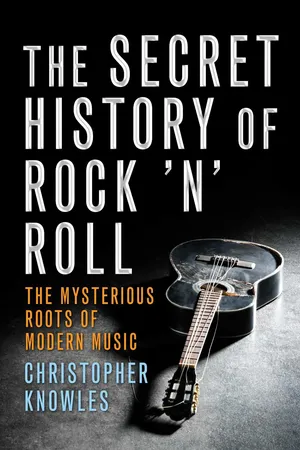
The Secret History of Rock 'n' Roll
About this book
Sex. Drugs. Loud music. Wild costumes. Dazzling light shows. These words can all describe a great rock concert or a hot dance club, but they were also part and parcel of the ancient cultural phenomenon known as the "Mystery religions." In this book, author Christopher Knowles shows how the Mystery religions got a secular reincarnation when a new musical form called rock 'n' roll burst onto the scene. The Secret History of Rock 'n' Roll traces the history of the Mysteries â their rise, their fall, and their survival through long centuries of repression. Knowles shows how the Mysteries prefigured subcultures as diverse as Santeria, Freemasonry, Mardi Gras and even the Holiness churches of the American frontier, and explains exactly how ancient rituals and music found their way to the New World. In the process, The Secret History of Rock 'n' Roll traces the development of rock's most popular genres such as punk and heavy metal, and reveals how many of rock's most iconic artists play the same archetypal roles as the ancient gods. You'll see how many of the rituals and customs and even musical styles of our postmodern society have stunning ancient parallels. You'll meet history's first pop
Frequently asked questions
Yes, you can cancel anytime from the Subscription tab in your account settings on the Perlego website. Your subscription will stay active until the end of your current billing period. Learn how to cancel your subscription.
No, books cannot be downloaded as external files, such as PDFs, for use outside of Perlego. However, you can download books within the Perlego app for offline reading on mobile or tablet. Learn more here.
Perlego offers two plans: Essential and Complete
- Essential is ideal for learners and professionals who enjoy exploring a wide range of subjects. Access the Essential Library with 800,000+ trusted titles and best-sellers across business, personal growth, and the humanities. Includes unlimited reading time and Standard Read Aloud voice.
- Complete: Perfect for advanced learners and researchers needing full, unrestricted access. Unlock 1.4M+ books across hundreds of subjects, including academic and specialized titles. The Complete Plan also includes advanced features like Premium Read Aloud and Research Assistant.
We are an online textbook subscription service, where you can get access to an entire online library for less than the price of a single book per month. With over 1 million books across 1000+ topics, weâve got you covered! Learn more here.
Look out for the read-aloud symbol on your next book to see if you can listen to it. The read-aloud tool reads text aloud for you, highlighting the text as it is being read. You can pause it, speed it up and slow it down. Learn more here.
Yes! You can use the Perlego app on both iOS or Android devices to read anytime, anywhere â even offline. Perfect for commutes or when youâre on the go.
Please note we cannot support devices running on iOS 13 and Android 7 or earlier. Learn more about using the app.
Yes, you can access The Secret History of Rock 'n' Roll by Christopher Knowles in PDF and/or ePUB format, as well as other popular books in Media & Performing Arts & Music Theory & Appreciation. We have over one million books available in our catalogue for you to explore.
Information
Subtopic
Music Theory & AppreciationPART I:
A BRIEF PREHISTORY OF ROCK âNâ ROLL
dp n="17" folio="" ?dp n="18" folio="" ?
PRELUDE
Did rock ânâ roll spring up like some postwar mutant and emerge fully formed with the release of âRocket 88â or âRock Around the Clockâ? Were the parents of the Fifties and Sixties right; was this some degenerate intruder that disrupted the sanctity of Americaâs suburban utopia? Or is rock ânâ roll something much older, much deeper and much more profound than the dozy sounds of the silken-voiced Rat Pack crooners it replaced?
You can draw a line backward in time at the point of your choosing; pick your favorite rock ânâ roll song or album and trace its roots through the various forms of African American dance music or rural folk. Youâll find most of the basic building blocks of the rock ânâ roll sound. But you wonât find the true precedent for the psychedelic youth explosion of the rock era. You wonât find the fantasy, the revolutionary ambitions, or the larger-than-life drama of the Aquarian Age in the juke joints or honky-tonks of the early 20th century. You wonât find the distinctly religious intensity that gripped tens of thousands of teenage girls whose screams drowned out the Beatles as the band struggled to hear itself over the hysteria at Shea Stadium.
No, in order to understand rock ânâ roll you have to go backâall the way backâto the earliest days of human civilization. The drugs, the drums, the noise, the wild costumes, the pyrotechnics, the controversy, and the outrage of 20th-century rock ânâ roll are waiting for you there, in temples filled with your horny, blissed-out ancestors who believed that if they got out of their heads and away from the ego, they could actually meet the spirits that their neighbors could only talk about. In the pages to come weâll learn their secrets and discover an ancient culture startlingly similar to our own. Weâll learn how ancient cults organized themselves around specific archetypes, and how those same archetypal themes would reemerge largely intact in the rock era, among the various subcultures and genres that evolved out of a musical form itself derived from the pounding music of these ancient cults.
Rock ânâ roll isnât just another form of musicâitâs an indelible part of the human experience. It may well be the oldest form of cultural expression in human history. It didnât spring up like some Atom Age mutant in the 1950s; it simply shook off the dust of centuries of repression, took on a new incarnation, and picked up where it left off.
INITIATION
Nearly everyone who was a teenager sometime between 1964 and 1992 has that one concert that âchanged my life.â From the time the Beatles touched down at JFK airport to the time Nirvana topped the charts with Nevermind, rock ânâ roll was the center of gravity for youth culture. So much so that serious people once described it as a new religion. Social critics threw around terms like Dionysian and Bacchanalia, terms that most rock fans probably didnât understand.
I actually had two concerts that changed my life. The first was the Clash on the London Calling tour in 1980. Being a 13-year-old punk rocker, I was extremely confused by the album, which took away my beloved Clash blitzkrieg and replaced it with radio-friendly pop-rock tunes. But none of that was on display at the Boston Orpheum that nightâthose same songs sounded like the Invasion of Normandy. I couldnât account for the difference. Sometime later, Joe Strummer would explain that something often took hold of him onstage, something that caused him to lose all sense of himself and drive him into a sweaty, howling rage. A shamanic state, anthropologists might say.
The other concert that changed my life was kind of a sequel: U2 at the Orpheum in November of 1981. I hadnât taken anything beforehand, but the excitement and noise fired up my adrenals and endorphins and put me straight out of my head. The funny thing is that at both concerts I had only the barest sense that I was in a room with thousands of other people having a similar kind of experienceâI was somewhere else, inside the music. Iâd later come to realize what an appropriate venue the âOrpheumâ was for that kind of experience.
But there was something else at workâthe Clash and U2 werenât just bands back then, they were heroesâgods, even. These concerts were major eventsâlandmark dates in the calendar of my youth. Those bands stood outside the parade of ordinary rock groups and promised to âchange the worldâ with their music.
dp n="21" folio="6" ?Something profound also struck me at a later concertâNirvana in 1994 at the old New York Coliseum on Columbus Circle. I saw throngs of kidsâthe same age I had been when I saw the Clash and U2âwandering around the lobby or loitering in the bathroom while the hottest band in rock ânâ roll was a hundred feet away blasting through their biggest hits. Why? Nirvana was certainly doing its part, but something was missing. What was missing was meaning, a reason to stand around in a hideous concrete barn and endure the painfully loud noise bouncing off the tiles. After a decade-plus of 24-hour-a-day music and video on demand, something got lost.
While trying to understand what happened to me in 1981âand what happened to rock ânâ roll in 1994âI eventually discovered where the terms Dionysian and Bacchanalia came fromâthe ancient Mystery religions of the eastern Mediterranean. Over time, Iâd come to realize that rock ânâ roll is in fact the direct descendant of the Mysteries, which had evolved and adapted to suit the needs and customs of postwar American secular culture.
What did the Mysteries offer that other cults of the time did not? Almost exactly what rock ânâ roll would, thousands of years later. Drink. Drugs. Sex. Loud music. Wild pyrotechnics. A feeling of transcendenceâleaving your mind and your body and entering a different world, filled with mystery and danger. A personal connection to something deep, strange, and impossibly timeless. An opportunity to escape the grinding monotony of everyday life and break all the rules of polite society. A place to dress up in wild costumes and dance and drink and trip all night.
Mystery cult centers were the ancient equivalents of todayâs clubs and concert halls, which may be why so many of the old pagan place-names are still in useâthe âOrpheum,â the âApollo,â the âAcademy,â the âPalladium,â and on and on. Just as in the Aquarian Age of the Sixties, some Mystery cults were relatively socially acceptable (think the Beatles) and some were seen as a sign that the world was going to hell in a hand-basket (think the Rolling Stones).
As weâll see, traces of the Mysteries survived long after they were put down by the Christian emperors, even within the Church itself. And with the rise of colonialism and empire in the 17th century, a purer extract of the Mysteries would emerge on the plantations of the New World and slowly begin to exercise its dominance over the popular music and culture of the Western world. Nothing in our societyâreligion, culture, politicsâwould ever be the same again.
BUILDING A MYSTERY
I like to think of the history of rock & roll like the origin of Greek drama. That started out on the threshing floors during the crucial seasons, and was originally a band of acolytes dancing and singing. Then, one day, a possessed person jumped out of the crowd and started imitating a god.
âJim Morrison
Most historians believe that the Mysteries began at the end of the Neolithic Age (also known as the New Stone Age, roughly 9000 to 4500 BCE), making them one of the earliest cultural developments known to humanity. Coinciding with the development of agriculture, the rituals were designed to appeal to the grain gods of the Underworld by acting out their myths, which celebrated the cycles of planting, growth, and harvesting. The earliest distinct Mysteries were practiced in Egypt, which depended on the yearly flooding of the Nile to fertilize its soil. This process was at the center of all the various (and often contradictory) regional cults that made up what we now generically refer to as âEgyptian religion.â From Egypt, the Mysteries migrated into western Asia and the Mediterranean basin, and eventually to the farthest frontiers of the known world.
The Mysteries were known by many names in Greece, including mysteria, teletai, bakchoi, and orgia (where the modern word orgy comes from). Adjectives like âunspeakableâ or âforbiddenâ were often used, adding to their mystique. Mysteries are generally distinguished from other cults by a number of features. The initiates worshipped âsuffering gods,â and experienced their various deaths and dramas through ritual theater and music. Myths were retold and often acted out on those agricultural themes. These cults practiced secret initiations which were not to be shared with outsiders, sometimes on pain of imprisonment, or even death.
The Mysteries were usually centered on a single god, but they were not technically monotheistic. Instead they were henotheistic , meaning they recognized the existence of other gods but focused their energy on one. Most importantly, the Mystery religions werenât about dogmaâthey were about experience. Music and dance were essential to the rituals themselves, which usually took place at night. And sexual symbolsâor practicesâwere often a crucial part of the process.
The gods of the Mysteries were usually believed to have come from distant lands. Foreign gods have always had that exotic appeal, a cosmic variant on the âgrass is always greenerâ adage. This was especially true before the rise of mass communications, but idealizing someone elseâs gods was popular in the Victorian era and the Sixties. At its core, religion has always been about escape.
Most of the Mystery religions were distinctly countercultural, offering a direct, personal relationship to a god without a priest as middleman. Their voluntary nature was radical for their time, reflecting an overall trend toward individualism in Classical Greece. But even with their wild rituals, the Mysteries required a high degree of discipline and loyalty. These werenât hippie stoners as we would understand themâas with the Central American shamans, the actual Mystery ritual would be the climax of a long period of study, sacrifice, and self-purification.
Less is known about the actual rituals themselves. But songs and dances were performed, usually fast and wild, with crashing drums and screaming flutesârock ânâ roll, in other words. Simple pyrotechnics were often used (torches, sometimes treated with chemicals for different effects) and public sex often broke out among the wilder cults such as the Roman Bacchanalia. As the eminent German historian Walter Burkert wrote, Mystery festivals were designed to be âunforgettable events casting their shadows over the whole of oneâs future life, creating experiences that transform existenceâ (which brings us back to that one concert that changed your life). The initiates fully expected to meet their gods in the flesh, and by all accounts, they usually werenât disappointed. The Greek philosopher Proclus wrote that the gods didnât always take human shape, but would âmanifest themselves in many forms, assuming a great variety of guises; sometimes they appear in a formless light, again in quite different form.â
dp n="25" folio="10" ?Like Christianity sometime later, Mystery religions centered on concepts of death and resurrection. The Mysteries prepared believers for their death and descent to the Underworld, where oneâs favorite god would guide the believer on her voyage. That was part of the pitch; an inscription at the Mystery temple Eleusis declared, âBeautiful indeed is the mystery given to us by the blessed Gods: Death is for mortals no longer an evil, but a blessing.â
Aside from the usual nocturnal gatherings, Mystery cults also ran more conventional temples for the uninitiated, which were remarkably similarâif not nearly identicalâto liturgical Christianity, offering communion and holy water (imported from the Nile), and preaching doctrines such as salvation, resurrection, and judgment of the dead.
This uncomfortable similarity is the reason early Christian fathers went on the warpath against the Mysteries in their writings, calling their gods demons and their goddesses the whores of Hell. (See Revelation 17:5: âMystery, Babylon the Great.â) But even when the Church became the official cult of state and began literally wiping out the competition, it took a very long time to stamp out the Mysteries. In fact, the Church opted instead to simply adopt many of their rituals, beliefs, and practices.
Ancient historians have cited books and scriptures used in the Mysteries, yet very few of them seem to have survived, other than as fragments. But thereâs an extensive record of secondary material detailing the Mysteriesâ beliefs, practices, and influence, which gives a clear picture of the history and power of this remarkable movement. And as is so often the case with Western civilization, our story begins in Egypt.
dp n="26" folio="11" ?ISIS AND OSIRIS
Named Esi or Aset in the Kemetic language of ancient Egypt, Isis first appeared in sacred texts in the third millennium BCE. A synthesis of several older goddesses, Isis (whose name means âthroneâ) became one of the Ennead, the nine major gods of the Egyptian pantheon. All these gods were masturbated into existence by the supreme being Atum, who later became Atum-Ra, who then morphed (sort of) into Amun-Ra, and finally (roughly) Ra-Horakhty, a synthesis of Ra and Horus, gods of the Sun. However, Egyptian religion was in constant flux, a reflection of shifting political realities and various priesthoods rising and falling in power and influence. All of which makes it challenging even for experienced scholars to wade through.
Isis and her brother/husband Osiris absorbed the identities of other gods over the millennia in which they were worshipped, but were always associated with agriculture and the yearly flooding of the Nile. Osiris was also lord of the Underworld and judge of the dead and Isis was the goddess of motherhood and magic, as well as the cereal grains that formed the basis of the Egyptian diet. Another brother, Set, represented heat, disease, and storms, and his sister/wife Nephthys was associated with the night, rain, and death.
Boasting a soap opera-worthy plot, the drama of Isis and Osiris was reenacted in a mystery play performed at festivals every year. Set was said to be variously sterile, impotent, or gay, so Nephthys disguises herself as Isis, gets Osiris drunk, and seduces him. Nephthys is impregnated and gives birth to Anubis, the jackal-headed god of the dead. Set freaks out when he hears about all this, and plots to kill Osiris. The dark god throws a dinner party for his brother, where he produces a beautiful sarcophagus that heâll give to anyone it fits. When Osiris gets in, Set nails the lid shut and tosses the coffin into the Nile.
Isis then goes in search of the sarcophagus, which washes ashore in Tyre (modern-day Lebanon). She poses as a nurse-maid for the royal family, whoâve taken the beautiful casket into their home as a decoration. Isis heals a young prince by burning away his mortality every night. Things go awry when the Queen discovers Isis putting the baby into the fireplace, but the goddess reveals herself and demands the casket be handed over to her. Isis takes the casket back to Egypt, and with help from Anubis, Osiris is magically revived. Set has Osiris killed again and orders his body parts chopped up and scattered. Isis, along with Thoth and Nephthys, finds all the parts except for Osirisâs penis, which Isis recreates from wood (or stone, or clay, or gold, depending on the telling). She then takes the form of a bird and impregnates herself, and Osiris descends to his new throne in the Underworld.
With Set on the warpath, Isis flees to a salt marsh and gives birth to Harpocrates (âHorus the Childâ), who as god of silence was seen as the personal embodiment of the Mysteries. Harpocrates grows up to become god of the Sun, saves the world by defeating Set in battle, and takes back his fatherâs throne. Drop the curtain and bring up the house lights.
Mystery religions had a special allure for women, and part of the appeal of these Isis plays is that they allowed housewives an opportunity to vent. Respectable housewives could scream and beat their breasts after the death of Osiris, and then sing and dance after his resurrection. Isis festivals also made for a great night out, complete with torchlight processions and entertainers, as well as loud music, dancing, and endless barrels of beer. (Isis was the patron goddess of brewers.) The Egyptians also had their very own pop stars in the form of sult...
Table of contents
- BOOKS BY CHRISTOPHER KNOWLES
- Title Page
- Dedication
- Acknowledgements
- Introduction
- PART I: - A BRIEF PREHISTORY OF ROCK âNâ ROLL
- PART II: - THE MODERN MYSTERIES OF ROCK âNâ ROLL
- ABOUT THE AUTHOR
- TO OUR READERS
- Copyright Page