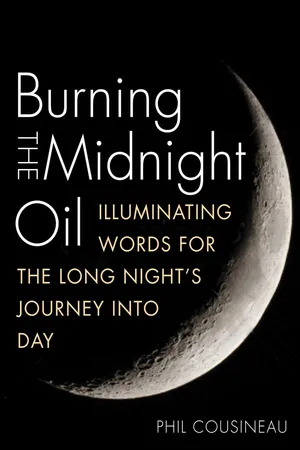
Burning the Midnight Oil
eBook - ePub

Burning the Midnight Oil

Illuminating Words for the Long Night's Journey Into Day

  1. 244 pages
  2. English
  3. ePUB (mobile friendly)
  4. Available on iOS & Android
eBook - ePub

Burning the Midnight Oil

Illuminating Words for the Long Night's Journey Into Day

About this book

In Burning the Midnight Oil, word-wrangler extraordinaire Phil Cousineau has gathered an eclectic and electric collection of soulful poems and prose from great thinkers throughout the ages. Whether beguiling readers with glorious poetry or consoling them with prayers from fellow restless souls, Cousineau can relieve any insomniac's unease. From St. John of the Cross to Annie Dillard, Beethoven to The Song of Songs, this refreshingly insightful anthology soothes and inspires all who struggle through the dark of the night. These "night thoughts" vividly illustrate Alfred North Whitehead's liberating description of "what we do without solitude" and also evoke Henry David Thoreau's reverie, "Our truest life is when we are in dreams awake." The night writers in Cousineau's vesperal collection range from saints, poets, and shamans to astronomers and naturalists, and tells of ancient tales and shining passages from the most brilliant (albeit insomniac) writers of today. These poetic ponderances sing of the falling darkness, revel in dream-time, convey the ache of melancholy, conspire against sleeplessness, vanquish loneliness, contemplate the night sky, rhapsodize on love, and languorously greet the first rays of dawn. Notable night owls include Rabandranath Tagore, Mary Oliver, Manley Hopkins, Jorge Borges and William Blake.

Frequently asked questions

Yes, you can cancel anytime from the Subscription tab in your account settings on the Perlego website. Your subscription will stay active until the end of your current billing period. Learn how to cancel your subscription.
No, books cannot be downloaded as external files, such as PDFs, for use outside of Perlego. However, you can download books within the Perlego app for offline reading on mobile or tablet. Learn more here.
Perlego offers two plans: Essential and Complete
  • Essential is ideal for learners and professionals who enjoy exploring a wide range of subjects. Access the Essential Library with 800,000+ trusted titles and best-sellers across business, personal growth, and the humanities. Includes unlimited reading time and Standard Read Aloud voice.
  • Complete: Perfect for advanced learners and researchers needing full, unrestricted access. Unlock 1.4M+ books across hundreds of subjects, including academic and specialized titles. The Complete Plan also includes advanced features like Premium Read Aloud and Research Assistant.
Both plans are available with monthly, semester, or annual billing cycles.
We are an online textbook subscription service, where you can get access to an entire online library for less than the price of a single book per month. With over 1 million books across 1000+ topics, we’ve got you covered! Learn more here.
Look out for the read-aloud symbol on your next book to see if you can listen to it. The read-aloud tool reads text aloud for you, highlighting the text as it is being read. You can pause it, speed it up and slow it down. Learn more here.
Yes! You can use the Perlego app on both iOS or Android devices to read anytime, anywhere — even offline. Perfect for commutes or when you’re on the go.
Please note we cannot support devices running on iOS 13 and Android 7 or earlier. Learn more about using the app.
Yes, you can access Burning the Midnight Oil by Phil Cousineau in PDF and/or ePUB format, as well as other popular books in Literature & Poetry. We have over one million books available in our catalogue for you to explore.

Information

Publisher
Viva Editions
Year
2013
eBook ISBN
9781936740772
Subtopic
Poetry
PART I:
THE TWILIGHT ZONE
“There is nothing in the dark that
isn’t there when the lights are on.”
—ROD SERLING
004
dp n="29" folio="" ?
INTRODUCTION
Swiftly, night comes on. Dusk is upon us. Darkness rushes in. The crepuscular voices in this opening section remind us that night is more than earth’s dark turn away from the sun. It is the first step in the long journey into the original twilight zone, the liminal world between night and day that has haunted human beings since the red dawn of time. Through the soulful picture language of mythology, the Greek poet Hesiod tells us why. Out of the Chaos at the moment of creation, he writes in The Theogony, came the first gods, the personification of the powers of the world. One was Eros, god of love and desire; another was Erebus, the face of darkness, and also Nyx, goddess of the night. The numinous imagery tells us that night was born of desire, which the Greeks believed to be one of the great forces of nature, and darkness. It is the love of darkness—soul work—and night brings forth light and day, but not for the usual reasons.
dp n="30" folio="4" ?
“Last night / the rain / spoke to me,” writes Mary Oliver, “slowly saying / what joy / to come falling / out of the brisk cloud / to be happy again.” This world of fog and shadows, which we are exploring here, alternates between loneliness and exultation, yearning and the white-stripe fever of driving in the dark. What the contributors here share in common is an embrace of endarkenment.
Usually regarded as a poet of crystalline light and clarity, Sappho captures the often lacerating loneliness of sleeping alone while granting it dignity. The Indian polymath Rabindranath Tagore offers a short poem about nature’s own lamps, in “Fireflies.” The bard of New Hampshire, Robert Frost, calls for us to befriend or become “acquainted” with the night, while Emily Dickinson offers an astonishing insight, that the night is vital because “Either the Darkness alters—/ Or something in the sight / Adjusts itself to Midnight…” The transcendent nature writer and novelist Annie Dillard describes how the very stars “trembled and stirred” with her breath. The English novelist and poet Thomas Hardy hauntingly evokes the central theme of this opening section, in “Afterwards,” where he writes that night is full of mysteries and a poet is one of whom it is said, “He was a man who used to notice such things.” The labyrinthine Argentinean Jorge Luis Borges has a vision in “Baruch Spinoza” of the medieval philosopher “building God in the twilight.” Irish novelist and musicologist P.J. Curtis encounters an old traveling man who describes “the book of the night sky, every night a different page.” The Milwaukee poet Antler sees the stars as the beautiful breasts of a cosmic mother. Poet and novelist Linda Watanabe McFerrin explores a different kind of ecstasy in “A Little Night Music.” Her sentences are an exercise in heavy breathing: “Later, his arms still around me, we sat for a while, like nesting boxes, braced against nightfall, looking out toward the shadowed horizon.” She captures not only the elusive frisson of freedom at night, but also the way that romance can act as a bulwark against the loneliness of the long-distance traveler who is alone at night.
Not only desire but fear is aroused by the fall of light, as we learn in historian Huston Smith’s dramatic telling of his terror of lions on the Serengeti Plains as darkness began to fall.
Writer and teacher Jane Winslow Eliot tells about following in the footsteps of her grandmother, straight to the edge of the Grand Canyon, on her honeymoon.
“There had been a rhythm of the day and now there was a rhythm of the night,” wrote the Irish poet Padraic Colum. Nightfall can accompany astronomers, lovers, and comedians alike, as we learned from George Carlin: “Tonight’s forecast: dark. Continued dark tonight turning to partly light in the morning.”
The question of the dark mysteries hovers, so it is helpful to learn what the noctivagators, the night walkers, have to say about their own encounters with the world of tumbling light, the twilight, just before dark.
Clearly, there are light and dark secrets. The night moves on, revealing stars and sleep and the darkness that restores.
“This will do,” Annie Dillard thought. “This will do.”
It will, it will.
dp n="32" folio="6" ?
BUT I SLEEP ALONE
The moon is set. And the Pleiades.
It’s the middle of the night.
Time passes.
But I sleep alone.
SAPPHO, GREEK POET, 625-570 B.C.E.
TRANSLATED FROM THE GREEK BY WILLIS BARNSTONE
EVENING STAR
Hesperos, you bring home all the bright dawn
scattered,
bring home the sheep,
bring home the goat, bring the child home
to her mother.
SAPPHO, GREEK POET, 625-570 B.C.E.
TRANSLATED FROM THE GREEK BY WILLIS BARNSTONE
dp n="33" folio="7" ?
FIREFLIES
My fancies are fireflies—
Specks of living light
twinkling in the dark.

“Let me light my lamp,”
says the star,
“And never debate
if it will help to remove the darkness.”
RABINDRANATH TAGORE,
INDIAN POET AND PHILOSOPHER, 1861–1941
TRANSLATED FROM THE BENGALI BY THE AUTHOR
ACQUAINTED WITH THE NIGHT
I have been one acquainted with the night.
I have walked out in rain—and back in rain.
I have outwalked the furthest city light.

I have looked down the saddest city lane.
I have passed by the watchman on his beat
And dropped my eyes, unwilling to explain.

I have stood still and stopped the sound of feet
When far away an interrupted cry
Came over houses from another street,

But not to call me back or say good-bye;
And further still at an unearthly height,
A luminary clock against the sky

Proclaimed the time was neither wrong nor right.
I have been one acquainted with the night.

ROBERT FROST, AMERICAN POET, 1874–1963
WE GROW ACCUSTOMED TO THE DARK
We grow accustomed to the Dark—
When light is put away—
As when the Neighbor holds the Lamp
To witness her Goodbye—

A Moment—We uncertain step
For newness of the night—
Then—fit our Vision to the Dark—
And meet the Road—erect—

And so of larger—Darkness—
Those Evenings of the Brain—
When not a Moon disclose a sign—
Or Star—come out—within—

The Bravest—grope a little—
And sometimes hit a Tree
Directly in the Forehead—
But as they learn to see—

Either the Darkness alters—
Or something in the sight
Adjusts itself to Midnight—
And Life steps almost straight.
EMILY DICKINSON, AMERICAN POET, 1830–1886
dp n="36" folio="10" ?
LAST NIGHT THE RAIN SPOKE TO ME
Last night
the rain
spoke to me
slowly, saying,

what joy
to come falling
out of the brisk cloud,
to be happy again

in a new way
on the earth!
That’s what it said
as it dropped,

smelling of iron,
and vanished
like a dream of the ocean
into the branches

and the grass below.
Then it was over.
The sky cleared.
I was standing

under a tree.
The tree was a tree
with happy leaves,
and I was myself,

and there were stars in the sky
that were also themselves
at the moment
at which moment

my right hand
was holding my left hand
which was holding the tree
which was filled with stars

and the soft rain—
imagine! imagine!
the long and wondrous journeys
still to be ours.
MARY OLIVER, AMERICAN POET AND ESSAYIST
dp n="38" folio="12" ?
AFTERWARDS
When the Present has latched its postern behind my tremulous stay,
And the May month flaps its glad green leaves like wings,
Delicate-filmed as new-spun silk, will my neighbors say,
“He was a man who used to notice such things”?

If it be in the dusk when, like an eyelid’s soundless blink,
The dewfall-hawk comes crossing the shades to alight
Upon the wind-warped upland thorn, a gazer may thunk
“To him this must have been a familiar sight.”

If I pass during some nocturnal blackness, mothy and warm,
When the hedgehog travels furtively over the lawn,
One may say, “He strove that such innocent creatures should
come to no harm,
But he could do little for them; and now he is gone.”

If, when hearing that I have been stilled at last, they stand at
the door,
Watching the full-starred heavens that winter sees,
Will this thought rise on those who will meet my face no more,
“He was one who had an eye for such mysteries”?

And will any say when my bell of quittance is heard in the gloom,
And a crossing breeze cuts a pause in its outrollings,
Till they rise again, as they were a new hell’s boom,
“He hears it not now, but used to notice such things”?


THOMAS HARDY,
ENGLISH NOVELIST AND POET, 1840–1928
dp n="40" folio="14" ?
BARUCH SPINOZA
A haze of gold, the Occident lights up
The window. Now, the assiduous manuscript
Is waiting, weighed down with the infinite.
Someone is building God in a dark cup.
A man engenders God. He is a Jew.
With saddened eyes and lemon-colored skin;
Time carries him the way a leaf, dropped in
A river, is borne off by waters to
Its end. No matter. The magician moved
Carves out his God with fine geometry;
From his disease, from nothing, he’s begun
To construct God, using the word. No one
Is granted such prodigious love as he:
The love that has no hope of being loved.
JORGE LUIS BORGES,
ARGENTINE POET, NOVELIST, LIBRARIAN, 1899–1986
TRANSLATED FROM THE SPANISH BY WILLIS BARNSTONE
dp n="41" folio="15" ?
EACH BREATH OF NIGHT
Like any out-of-the-way place, the Napo River in the Ecuadorian jungle seems real enough when you are there, even central. Out of the way of what? I was sitting on a stump at the edge of a bankside palm-thatch village, in the middle of the night, on the headwaters of the Amazon. Out of the way of human life, tende...

Table of contents

  1. Title Page
  2. Dedication
  3. Foreword
  4. PROLOGUE
  5. PART I: - THE TWILIGHT ZONE
  6. PART II: - NIGHTHAWKS
  7. PART III - A HARD DAY’S NIGHT
  8. PART IV - THE DREAM FACTORY
  9. PART V - MORNING HAS BROKEN
  10. Acknowledgments
  11. REFERENCES
  12. ABOUT THE AUTHOR
  13. Other books by the author
  14. TO OUR READERS
  15. Copyright Page