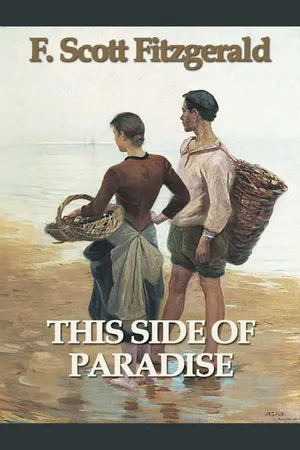
This Side of Paradise
eBook - ePub

This Side of Paradise

  1. 225 pages
  2. English
  3. ePUB (mobile friendly)
  4. Available on iOS & Android
eBook - ePub

This Side of Paradise

About this book

This Side of Paradise is the debut novel of F. Scott Fitzgerald. The book's critical success was driven in part by the enthusiasm of reviewers. For example, H. L. Mencken wrote that This Side of Paradise was the "best American novel that I have seen of late." The book examines the lives and morality of post-World War I youth. Its protagonist, Amory Blaine, is an attractive Princeton University student who dabbles in literature and has the book's theme of love warped by greed and status-seeking.

Frequently asked questions

Yes, you can cancel anytime from the Subscription tab in your account settings on the Perlego website. Your subscription will stay active until the end of your current billing period. Learn how to cancel your subscription.
No, books cannot be downloaded as external files, such as PDFs, for use outside of Perlego. However, you can download books within the Perlego app for offline reading on mobile or tablet. Learn more here.
Perlego offers two plans: Essential and Complete
  • Essential is ideal for learners and professionals who enjoy exploring a wide range of subjects. Access the Essential Library with 800,000+ trusted titles and best-sellers across business, personal growth, and the humanities. Includes unlimited reading time and Standard Read Aloud voice.
  • Complete: Perfect for advanced learners and researchers needing full, unrestricted access. Unlock 1.4M+ books across hundreds of subjects, including academic and specialized titles. The Complete Plan also includes advanced features like Premium Read Aloud and Research Assistant.
Both plans are available with monthly, semester, or annual billing cycles.
We are an online textbook subscription service, where you can get access to an entire online library for less than the price of a single book per month. With over 1 million books across 1000+ topics, we’ve got you covered! Learn more here.
Look out for the read-aloud symbol on your next book to see if you can listen to it. The read-aloud tool reads text aloud for you, highlighting the text as it is being read. You can pause it, speed it up and slow it down. Learn more here.
Yes! You can use the Perlego app on both iOS or Android devices to read anytime, anywhere — even offline. Perfect for commutes or when you’re on the go.
Please note we cannot support devices running on iOS 13 and Android 7 or earlier. Learn more about using the app.
Yes, you can access This Side of Paradise by F. Scott Fitzgerald in PDF and/or ePUB format, as well as other popular books in Literature & Classics. We have over one million books available in our catalogue for you to explore.

Information

Spires and Gargoyles


At first Amory noticed only the wealth of sunshine creeping across the long, green swards, dancing on the leaded window-panes, and swimming around the tops of spires and towers and battlemented walls. Gradually he realized that he was really walking up University Place, self-conscious about his suitcase, developing a new tendency to glare straight ahead when he passed any one. Several times he could have sworn that men turned to look at him critically. He wondered vaguely if there was something the matter with his clothes, and wished he had shaved that morning on the train. He felt unnecessarily stiff and awkward among these white-flannelled, bareheaded youths, who must be juniors and seniors, judging from the savoir faire with which they strolled.
He found that 12 University Place was a large, dilapidated mansion, at present apparently uninhabited, though he knew it housed usually a dozen freshmen. After a hurried skirmish with his landlady he sallied out on a tour of exploration, but he had gone scarcely a block when he became horribly conscious that he must be the only man in town who was wearing a hat. He returned hurriedly to 12 University, left his derby, and, emerging bareheaded, loitered down Nassau Street, stopping to investigate a display of athletic photographs in a store window, including a large one of Allenby, the football captain, and next attracted by the sign ā€œJigger Shopā€ over a confectionary window. This sounded familiar, so he sauntered in and took a seat on a high stool.
ā€œChocolate sundae,ā€ he told a colored person.
ā€œDouble chocolate jiggah? Anything else?ā€
ā€œWhy—yes.ā€
ā€œBacon bun?ā€
ā€œWhy—yes.ā€
He munched four of these, finding them of pleasing savor, and then consumed another double-chocolate jigger before ease descended upon him. After a cursory inspection of the pillow-cases, leather pennants, and Gibson Girls that lined the walls, he left, and continued along Nassau Street with his hands in his pockets. Gradually he was learning to distinguish between upper classmen and entering men, even though the freshman cap would not appear until the following Monday. Those who were too obviously, too nervously at home were freshmen, for as each train brought a new contingent it was immediately absorbed into the hatless, white-shod, book-laden throng, whose function seemed to be to drift endlessly up and down the street, emitting great clouds of smoke from brand-new pipes. By afternoon Amory realized that now the newest arrivals were taking him for an upper classman, and he tried conscientiously to look both pleasantly blase and casually critical, which was as near as he could analyze the prevalent facial expression.
At five o’clock he felt the need of hearing his own voice, so he retreated to his house to see if any one else had arrived. Having climbed the rickety stairs he scrutinized his room resignedly, concluding that it was hopeless to attempt any more inspired decoration than class banners and tiger pictures. There was a tap at the door.
ā€œCome in!ā€
A slim face with gray eyes and a humorous smile appeared in the doorway.
ā€œGot a hammer?ā€
ā€œNo—sorry. Maybe Mrs. Twelve, or whatever she goes by, has one.ā€
The stranger advanced into the room.
ā€œYou an inmate of this asylum?ā€
Amory nodded.
ā€œAwful barn for the rent we pay.ā€
Amory had to agree that it was.
ā€œI thought of the campus,ā€ he said, ā€œbut they say there’s so few freshmen that they’re lost. Have to sit around and study for something to do.ā€
The gray-eyed man decided to introduce himself.
ā€œMy name’s Holiday.ā€
ā€œBlaine’s my name.ā€
They shook hands with the fashionable low swoop. Amory grinned.
ā€œWhere’d you prep?ā€
ā€œAndover—where did you?ā€
ā€œSt. Regis’s.ā€
ā€œOh, did you? I had a cousin there.ā€
They discussed the cousin thoroughly, and then Holiday announced that he was to meet his brother for dinner at six.
ā€œCome along and have a bite with us.ā€
ā€œAll right.ā€
At the Kenilworth Amory met Burne Holiday—he of the gray eyes was Kerry—and during a limpid meal of thin soup and anaemic vegetables they stared at the other freshmen, who sat either in small groups looking very ill at ease, or in large groups seeming very much at home.
ā€œI hear Commons is pretty bad,ā€ said Amory.
ā€œThat’s the rumor. But you’ve got to eat there—or pay anyways.ā€
ā€œCrime!ā€
ā€œImposition!ā€
ā€œOh, at Princeton you’ve got to swallow everything the first year. It’s like a damned prep school.ā€
Amory agreed.
ā€œLot of pep, though,ā€ he insisted. ā€œI wouldn’t have gone to Yale for a million.ā€
ā€œMe either.ā€
ā€œYou going out for anything?ā€ inquired Amory of the elder brother.
ā€œNot me—Burne here is going out for the Prince—the Daily Princetonian, you know.ā€
ā€œYes, I know.ā€
ā€œYou going out for anything?ā€
ā€œWhy—yes. I’m going to take a whack at freshman football.ā€
ā€œPlay at St. Regis’s?ā€
ā€œSome,ā€ admitted Amory depreciatingly, ā€œbut I’m getting so damned thin.ā€
ā€œYou’re not thin.ā€
ā€œWell, I used to be stocky last fall.ā€
ā€œOh!ā€
After supper they attended the movies, where Amory was fascinated by the glib comments of a man in front of him, as well as by the wild yelling and shouting.
ā€œYoho!ā€
ā€œOh, honey-baby—you’re so big and strong, but oh, so gentle!ā€
ā€œClinch!ā€
ā€œOh, Clinch!ā€
ā€œKiss her, kiss ā€˜at lady, quick!ā€
ā€œOh-h-h—!ā€
A group began whistling ā€œBy the Sea,ā€ and the audience took it up noisily. This was followed by an indistinguishable song that included much stamping and then by an endless, incoherent dirge.
ā€œOh-h-h-h-h
She works in a Jam Factoree
And—that-may-be-all-right
But you can’t-fool-me
For I know—DAMN—WELL
That she DON’T-make-jam-all-night!
Oh-h-h-h!ā€
As they pushed out, giving and receiving curious impersonal glances, Amory decided that he liked the movies, wanted to enjoy them as the row of upper classmen in front had enjoyed them, with their arms along the backs of the seats, their comments Gaelic and caustic, their attitude a mixture of critical wit and tolerant amusement.
ā€œWant a sundae—I mean a jigger?ā€ asked Kerry.
ā€œSure.ā€
They suppered heavily and then, still sauntering, eased back to 12.
ā€œWonderful night.ā€
ā€œIt’s a whiz.ā€
ā€œYou men going to unpack?ā€
ā€œGuess so. Come on, Burne.ā€
Amory decided to sit for a while on the front steps, so he bade them good night.
The great tapestries of trees had darkened to ghosts back at the last edge of twilight. The early moon had drenched the arches with pale blue, and, weaving over the night, in and out of the gossamer rifts of moon, swept a song, a song with more than a hint of sadness, infinitely transient, infinitely regretful.
He remembered that an alumnus of the nineties had told him of one of Booth Tarkington’s amusements: standing in mid-campus in the small hours and singing tenor songs to the stars, arousing mingled emotions in the couched undergraduates according to the sentiment of their moods.
Now, far down the shadowy line of University Place a white-clad phalanx broke the gloom, and marching figures, white-shirted, white-trousered, swung rhythmically up the street, with linked arms and heads thrown back:
ā€œGoing back—going back,
Going—back—to—Nas-sau—Hall,
Going back—going back—
To the—Best—Old—Place—of—All.
Going back—going back,
From all—this—earth-ly—ball,
We’ll—clear—the—track—as—we—go—back—
Going—back—to—Nas-sau—Hall!ā€
Amory closed his eyes as the ghostly procession drew near. The song soared so high that all dropped out except the tenors, who bore the melody triumphantly past the danger-point and relinquished it to the fantastic chorus. Then Amory opened his eyes, half afraid that sight would spoil the rich illusion of harmony.
He sighed eagerly. There at the head of the white platoon marched Allenby, the football captain, slim and defiant, as if aware that this year the hopes of the college rested on him, that his hundred-and-sixty pounds were expected to dodge to victory through the heavy blue and crimson lines.
Fascinated, Amory watched each rank of linked arms as it came abreast, the faces indistinct above the polo shirts, the voices blent in a paean of triumph—and then the procession passed through shadowy Campbell Arch, and the voices grew fainter as it wound eastward over the campus.
The minutes passed and Amory sat there very quietly. He regretted the rule that would forbid freshmen to be outdoors after curfew, for he wanted to ramble through the shadowy scented lanes, where Witherspoon brooded like a dark mother over Whig and Clio, her Attic children, where the black Gothic snake of Little curled down to Cuyler and Patton, these in turn flinging the mystery out over the placid slope rolling to the lake.

Princeton of the daytime filtered slowly into his consciousness—West and Reunion, redolent of the sixties, Seventy-nine Hall, brick-red and arrogant, Upper and Lower Pyne, aristocratic Elizabethan ladies not quite content to live among shopkeepers, and, topping all, climbing with clear blue aspiration, the great dreaming spires of Holder and Cleveland towers.
From the first he loved Princeton—its lazy beauty, its half-grasped significance, the wild moonlight revel of the rushes, the handsome, prosperous big-game crowds, and under it all the air of struggle that pervaded his class. From the day when, wild-eyed and exhausted, the jerseyed freshmen sat in the gymnasium and elected some one from Hill School class president, a Lawrenceville celebrity vice-president, a hockey star from St. Paul’s secretary, up until the end of sophomore year it never ceased, that breathless social system, that worship, seldom named, never really admitted, of the bogey ā€œBig Man.ā€
First it was schools, and Amory, alone from St. Regis’, watched the crowds form and widen and form again; St. Paul’s, Hill, Pomfret, eating at certain tacitly reserved tables in Commons, dressing in their own corners of the gymnasium, and drawing unconsciously about them a barrier of the slightly less important but socially ambitious to protect them from the friendly, rather puzzled high-school element. From the moment he realized this Amory resented social barriers as artificial distinctions made by the strong to bolster up their weak retainers and keep out the almost strong.
Having decided to be one of the gods of the class, he reported for freshman football practice, but in the second week, playing quarter-back, already paragraphed in corners of the Princetonian, he wrenched his knee seriously enough to put him out for the rest of the season. This forced him to retire and consider the situation.
ā€œ12 Univeeā€ housed a dozen miscellaneous question-marks. There were three or four inconspicuous and quite startled boys from Lawrenceville, two amateur wild men from a New York private school (Kerry Holiday christened them the ā€œplebeian drunksā€), a Jewish youth, also from New York, and, as compensation for Amory, the two Holidays, to whom he took an instant fancy.
The Holidays were rumored twins, but really the dark-haired one, Kerry, was a year older than his blond brother, Burne. Kerry was tall, with humorous gray eyes, and a sudden, attractive smile; he became at once the mentor of the house, reaper of ears that grew too high, censor of conceit, vendor of rare, satirical humor. Amory spread the table of their future friendship with all his ideas of what college should and did mean. Kerry, not inclined as yet to take things seriously, chided him gently for being curious at this inopportune time about the intricacies of the social system, but liked him and was both interested and amused.
Burne, fair-haired, silent, and intent, appeared in the house only as a busy apparition, gliding in quietly at night and off again in the early morning to get up his work in the library—he was out for the Princetonian, competing furiously against forty others for the coveted first place. In December he came down with diphtheria, and some one else won the competition, but, returning to college in February, he dauntlessly went after the prize again. Necessarily, Amory’s acquaintance with him was in the way of three-minute chats, walking to and from lectures, so he failed to penetrate Burne’s one absorbing interest and find what lay beneath it.
Amory was far from contented. He missed the place he had won at St. Regis’, the being known and admired, yet Princeton stimulated him, and there were many things ahead calculated to arouse the Machiavelli latent in him, could he but insert a wedge. The upper-class clubs, concerning which he had pumped a reluctant graduate during the previous summer, excited his curiosity: Ivy, detached and breathlessly aristocratic; Cottage, an impressive milange of brilliant adventurers and well-dressed philanderers; Tiger Inn, broad-shouldered and athletic, vitalized by an honest elaboration of prep-school standards; Cap and Gown, anti-alcoholic, faintly religious and politically powerful; flamboyant Colonial; literary Quadrangle; and the dozen others, varying in age and position.
Anything which brought an under classman into too glaring a light was labelled with the damning brand of ā€œrunning it out.ā€ The movies thrived on caustic comments, but the men who made them were generally running it out; talking of clubs was running it out; standing for anything very strongly, as, for instance, drinking parties or teetotalling, was running it out; in short, being personally conspicuous was not tolerated, and the influential man was the non-committal man, until at club elections in sophomore year every one should be sewed ...

Table of contents

  1. Cover
  2. Title Page
  3. Copyright Page
  4. Table of Contents
  5. Amory, Son of Beatrice
  6. Spires and Gargoyles
  7. The Egotist Considers
  8. Narcissus Off Duty
  9. Interlude
  10. The Debutante
  11. Experiments in Convalescence
  12. Young Irony
  13. The Supercilious Sacrifice
  14. The Egotist Becomes a Personage