The Dirty Little Secrets of Getting Your Dream Job
eBook - ePub

The Dirty Little Secrets of Getting Your Dream Job

  1. 192 pages
  2. English
  3. ePUB (mobile friendly)
  4. Available on iOS & Android
eBook - ePub

The Dirty Little Secrets of Getting Your Dream Job

About this book

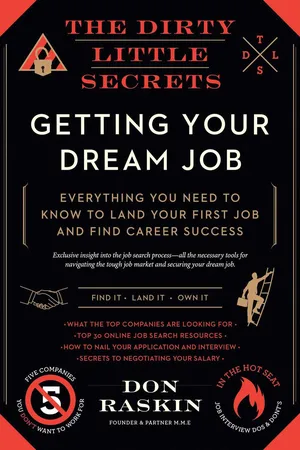
Drawing on his extensive experience evaluating applicants for his marketing agency, and featuring stories based on real-life situations, sample cover letters, resumes, and straightforward advice, Don Raskin’s The Dirty Little Secrets of Getting Your Dream Job offers all the necessary tools for navigating the tough job market and securing your dream job.

Don Raskin owns and operates MME, an advertising and marketing agency in New York City. During his twenty-five years at the agency he has interviewed hundreds of new college graduates for positions within his agency and has placed a strong emphasis on entry-level recruitment for positions in creative, account management, traffic, and production. Raskin has also mentored countless students and their parents on best practices for the job search. Over the years, Raskin has kept exceptionally detailed notes on the interviews he has conducted, observing the good, the bad, the ridiculous, the irreverent. He also has a treasure trove of over-the-top cover letters, resumes, interviews, and post interview follow-ups he has conducted and received. Now, he wants to share all the wisdom and insider secrets he has gathered to help students and first-time job seekers find a job in this economy.

Based on his remarkable expertise, Raskin's book provides exclusive insight into the job search process and lets readers in on all of the dirty little secrets to landing their first job—or a new one—and finding career success.
Frequently asked questions

Yes, you can cancel anytime from the Subscription tab in your account settings on the Perlego website. Your subscription will stay active until the end of your current billing period. Learn how to cancel your subscription.
At the moment all of our mobile-responsive ePub books are available to download via the app. Most of our PDFs are also available to download and we're working on making the final remaining ones downloadable now. Learn more here.
Perlego offers two plans: Essential and Complete
  • Essential is ideal for learners and professionals who enjoy exploring a wide range of subjects. Access the Essential Library with 800,000+ trusted titles and best-sellers across business, personal growth, and the humanities. Includes unlimited reading time and Standard Read Aloud voice.
  • Complete: Perfect for advanced learners and researchers needing full, unrestricted access. Unlock 1.4M+ books across hundreds of subjects, including academic and specialized titles. The Complete Plan also includes advanced features like Premium Read Aloud and Research Assistant.
Both plans are available with monthly, semester, or annual billing cycles.
We are an online textbook subscription service, where you can get access to an entire online library for less than the price of a single book per month. With over 1 million books across 1000+ topics, we’ve got you covered! Learn more here.
Look out for the read-aloud symbol on your next book to see if you can listen to it. The read-aloud tool reads text aloud for you, highlighting the text as it is being read. You can pause it, speed it up and slow it down. Learn more here.
Yes! You can use the Perlego app on both iOS or Android devices to read anytime, anywhere — even offline. Perfect for commutes or when you’re on the go.
Please note we cannot support devices running on iOS 13 and Android 7 or earlier. Learn more about using the app.
Yes, you can access The Dirty Little Secrets of Getting Your Dream Job by Don Raskin in PDF and/or ePUB format, as well as other popular books in Personal Development & Careers. We have over one million books available in our catalogue for you to explore.

Information

Publisher
Regan Arts.
Year
2016
Print ISBN
9781942872764

CHAPTER ONE

Being Prepared at College Graduation

Let’s face it. College is an amazing time. For four years, you will learn from great professors, meet friends you will have for the rest of your life and, oh yeah, you will have lots of fun. While you are soaking up all that college has to offer, you should also be planning for your professional future. Freshman year is a time to start thinking about the type of career you can picture for yourself, and senior year is the time to identify industries and companies where you want to work. You will then prepare a professionally written rĂ©sumĂ©, cover letter, and e-mail cover note in order to get yourself ready for the job search process. You must be prepared at college graduation for your job search so that you can be in the best position possible to land your first job. Here are the things you need to pay attention to while in college.
GPA: Your grade point average matters to a prospective employer. Remember your ACT and SAT exams in high school? The colleges you applied to reviewed those scores and used them as part of a process to determine if they would admit you. Employers will look at your GPA in a similar fashion to decide if they are interested in calling you in for an interview.
You need to keep up your GPA for all four years of college. Freshman year counts every bit as much as senior year. Do not fall into the trap of scaling back on the time and effort you put into your classes for a semester because you feel you need to take a mental break from school. If you do feel this way, you would be better off to leave school for a semester and come back recharged. A 2.0 in any given semester will drag down your overall GPA. Think about it. If you get a 2.0 in the first semester of your freshman year, you will have to get a 4.0 in your second semester just to maintain a 3.0 for the year. It simply isn’t worth sitting in front of a recruiter when you are looking for your first job and explaining why your GPA was less than stellar freshman year when that recruiter can choose a candidate that kept their grades up all four years.
If you do find yourself in a situation where your overall GPA is lower than you would like, be honest and explain to the person you are interviewing with what happened. “I was a chemistry major freshman year and realized it wasn’t for me,” you might say. “My grades suffered as a result. I switched my major to journalism and found my passion in writing. After switching majors, my GPA rose considerably.” No fair-minded employer would hold a situation like that against you.
College major: You should major in something you love, but make sure it will lead to a successful career as well. Why spend all that money on a college education only to find out that you are unable to land a job after graduation? Make sure that you do research on the job market within the field you have chosen to study. If you love philosophy but also enjoy writing, and don’t think you can get a job with a philosophy degree, pursue a double major with English, write for the school paper, and get a job after graduation as a journalist.
You don’t want any surprises after you graduate. There is no reason to find out after you leave college that there are few jobs for graduates in your major. If you do find yourself in this situation, tell a potential employer why your major is in fact relevant to the job you are interviewing for. I had a candidate tell me that he selected a liberal arts college because at eighteen years of age he thought it would offer him the best opportunity for a broad-based education. Once in college, he realized he wanted to major in business, but his liberal arts college didn’t have a business program. So he loaded up on economics and writing classes, and during his interview he told me that his economics classes gave him an understanding of business and the economy and his writing classes polished his ability to communicate, two things that were valuable to me in my search for a candidate.
Today, there are undergraduate and graduate majors that have been around forever, including business, social sciences, and education. Take a look at how many degrees are conferred within each of these majors in a year:
Undergraduate degrees
Business—367,000
Social sciences and history—179,000
Health professions and related programs—163,000
Psychology—109,000
Education—106,000
Master’s degrees
Business—192,000
Education—178,000
Doctoral degrees
Health professions and related programs—62,100
Legal professions and studies—46,800
Education—10,000
Engineering—8,700
Biological and biomedical sciences—7,900
(U.S. Department of Education Institute of Education Sciences, National Center for Education Studies, 2011–12)
Tomorrow, however, this will change. There are many emerging fields that are being driven by trends in technology. (For example, this has been a period of great prosperity for those entering careers in digital media: app developers, coders, programmers, web designers, social media experts, and much more.) Look into each and every one of these fields. Can you see yourself with a career in one of them? If so, try to talk to people in that field and find out how you can best prepare for a career. What should you major in? What should you minor in?
You will not be competitive if your major has little or no value when it comes to landing in-demand jobs. Don’t put yourself in that position. If you love a field of study in which very few jobs are available, you should minor in it. This way you can still fulfill your passion while putting yourself in a better position to land a job after graduation by majoring in a field with available jobs.
In addition, you must develop an understanding of the entry-level salary range for the job you want. This will allow you to negotiate the best starting salary for yourself by establishing a baseline requirement based upon your research and understanding of salaries for the jobs for which you are interviewing. Your starting salary will be critical to your financial well-being, especially if you have taken out student loans to finance your education.
Internships: After your sophomore and junior years, you should secure a summer internship in the field you want to work in after graduation. This will give you an advantage over the competition when you graduate.
If you want to work in account management for a public relations agency after graduation, get a summer internship assisting account managers at a public relations agency. This way, when you graduate and start interviewing for this position, you are way ahead of others who do not have this experience. Many companies are actually requiring candidates have one to two internships in order to be considered for a full-time entry-level position after graduation. In addition to being great résumé material, the companies you intern for are the first companies you should apply to for full-time work after you graduate. Many companies like hiring their own summer interns, because they know exactly what they are getting, so the risk of making a hiring mistake is low.
Zero in on exactly the type of job you want to land after graduation and get an internship that matches the job you want.
I cannot stress enough the importance of having a relevant internship during college. Think about it. Not everybody is going to get a job in the field they have chosen to study. There are just too many applicants and not enough jobs. So you need to do everything in your power to make yourself an attractive candidate once you begin your job search. There is nothing that makes a new college graduate more attractive than a relevant internship. When looking through new college graduate rĂ©sumĂ©s, I always put those who have done an internship into the “consider” pile. Of course, the rest of their rĂ©sumĂ© has to be in order as well. At the same time, if a candidate has no internship or relevant work experience, no matter how high his or her GPA, I am unlikely to be interested in that candidate.
Some resources for internships that are very helpful include:
Images
But don’t stop there. If you have a college professor who has been a mentor, ask if he or she knows of any opportunities. If you have a network of friends and family who either work in your desired field or know of people who do, reach out to them. If you are on Facebook, post something that tells your friends you are looking for a summer internship and highlight exactly what type of internship you are looking for. Ask them to message you if they know of a job or a contact person who works in your desired field. Landing an internship is like landing your first job—it takes a lot of work, so push hard and don’t give up.
In terms of pay, there are summer internships that will pay you, but many others will not. Instead of pay, you will be offered the opportunity to work for college credit. Clear this with your university, and be sure that it will in fact accept your internship for credit. If you are given an amazing summer internship opportunity that will help you land a full-time job when you graduate, but it’s unpaid, do what you can to find a way to afford it. The money can and will be made up down the road.
Once you start your internship, you should sit down with your supervisor and let him or her know exactly what you hope to get out of your time spent with the company. For example, if you want to get better at social media, ask if you can get involved with content development for the company’s social media platforms. Companies often have flexible job responsibilities for interns and can fine-tune an internship for someone who demonstrates a strong motivation to pick up specific skills.
If you tell the company up front what skills and experience you would like to get out of your internship, the company may be able to weave that into your responsibilities.
While you are at your internship, take a look around at the full-time employees and start to get an idea about what makes people successful and valuable to the company. Figure out who the hard workers are and observe how they put their work ethic on display. See who has leadership skills and how those skills are reflected in their actions. Such insights will be valuable when you are working at your first full-time job.
‱ A strong understanding of the field you want to work in after you graduate.
‱ How the workplace operates—the do’s and don’ts of daily work life.
‱ What a strong work ethic in the workplace looks like and how you can display that work ethic.
‱ Professional contacts for when you begin your full-time job search.
‱ A letter of recommendation from your internship boss.
At the end of your internship, the most important thing you can do is leave with a letter of recommendation from your supervisor. When you do start applying for your first full-time job after graduation, you will want to include this letter along with your e-mail cover note, cover letter and résumé when applying for jobs. It is an extra piece of information that will help you stand out.
Many entry-level candidates wonder if they should take an internship after they graduate from college. Companies are paying ten to fifteen dollars an hour to college graduates to fill various internship positions. My answer to this question is you should do this only if you must.
One reason to take an internship after college is because you have no experience in the field you want to get into. Let’s say you have a degree in history (it seemed like a good idea at the time) and, after graduating, you have decided to work in public relations. The entry-level public relations jobs are going to go to graduates who have degrees in either public relations or communications and who participated in a summer internship in the field. If you really want to get into public relations, you may have to start by accepting an internship position so that you can build your rĂ©sumĂ©, knowledge base, and credibility. After a year, you will have solid experience and can either ask for a full-time position or find a full-time job at another firm.
Or perhaps you graduated in May and now it’s November and you have yet to land a full-time job. This could be a matter of bad luck, timing, a crowded job market, or any number of other factors. At this point, your strategy should be to get employed. Somehow, somewhere, you need to get to work. The experience and confidence boost will do you wonders. If you excel in your internship, the company...

Table of contents

  1. Cover
  2. Dedication
  3. Introduction
  4. Chapter One: Being Prepared at College Graduation
  5. Chapter Two: The Job Search—There Are Jobs Out There
  6. Chapter Three: Mastering the Interview Process
  7. Chapter Four: What Happens When You Get the Job Offer?
  8. Chapter Five: Five Companies You Don’t Want to Work For
  9. Chapter Six: How to Be a Star Your First Year on the Job
  10. Chapter Seven: Getting Through Your First Performance Review
  11. Chapter Eight: Career Planning—Looking Beyond Your First Job
  12. Afterword: The Candidate Who Did Everything Right
  13. Acknowledgments
  14. About the Author
  15. Resources
  16. Index
  17. Copyright