Good Day!
eBook - ePub

Good Day!

The Paul Harvey Story

  1. 291 pages
  2. English
  3. ePUB (mobile friendly)
  4. Available on iOS & Android
eBook - ePub

Good Day!

The Paul Harvey Story

About this book

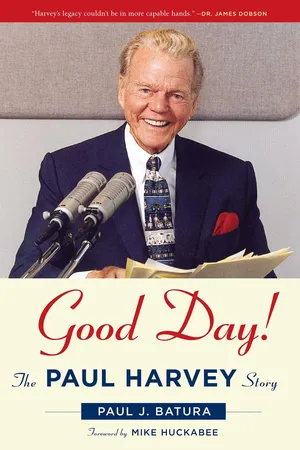
Good Day!, the critically-acclaimed biography about the legendary Paul Harvey, is now in paperback! In this heartwarming book, author Paul J. Batura tells the all-American story of one of the best-known radio voices in history. From his humble beginnings to his unparalleled career of more than 50 years with ABC radio, Paul Harvey narrated America's story day by day, through wars and peace, through the threat of communism and the crumbling of old colonial powers, through consumer booms and eventual busts.
Frequently asked questions

Yes, you can cancel anytime from the Subscription tab in your account settings on the Perlego website. Your subscription will stay active until the end of your current billing period. Learn how to cancel your subscription.
At the moment all of our mobile-responsive ePub books are available to download via the app. Most of our PDFs are also available to download and we're working on making the final remaining ones downloadable now. Learn more here.
Perlego offers two plans: Essential and Complete
  • Essential is ideal for learners and professionals who enjoy exploring a wide range of subjects. Access the Essential Library with 800,000+ trusted titles and best-sellers across business, personal growth, and the humanities. Includes unlimited reading time and Standard Read Aloud voice.
  • Complete: Perfect for advanced learners and researchers needing full, unrestricted access. Unlock 1.4M+ books across hundreds of subjects, including academic and specialized titles. The Complete Plan also includes advanced features like Premium Read Aloud and Research Assistant.
Both plans are available with monthly, semester, or annual billing cycles.
We are an online textbook subscription service, where you can get access to an entire online library for less than the price of a single book per month. With over 1 million books across 1000+ topics, we’ve got you covered! Learn more here.
Look out for the read-aloud symbol on your next book to see if you can listen to it. The read-aloud tool reads text aloud for you, highlighting the text as it is being read. You can pause it, speed it up and slow it down. Learn more here.
Yes! You can use the Perlego app on both iOS or Android devices to read anytime, anywhere — even offline. Perfect for commutes or when you’re on the go.
Please note we cannot support devices running on iOS 13 and Android 7 or earlier. Learn more about using the app.
Yes, you can access Good Day! by Paul Batura in PDF and/or ePUB format, as well as other popular books in Media & Performing Arts & Journalist Biographies. We have over one million books available in our catalogue for you to explore.

Information

Chapter One
A Boy of Tulsa
Forty-four-year-old Harry Harrison Aurandt stepped out onto his front porch at 1014 East Fosteria Street 1 in Tulsa, Oklahoma. The light of the late summer morning was beginning to brighten the eastern sky. Clouds were scattered. Temperatures would soar to nearly 90 degrees by the day’s end. The clatter of a car from the Tulsa Street Railway Company rolled by, ferrying area residents into the downtown business corridor. Bending down to pick up his copy of the Tulsa Daily World, Aurandt saw a two-tiered headline bringing news from across the Atlantic, “British Sweep Continues With Enemy in Hurried Retreat as Line Crumbles.”2 Just above the fold, news out of El Paso, Texas reported the death of 200 Mexicans at Pilar de Concho in a clash between the federal command of General Ernesto Garcia and Francisco Villa. In lighter news, Tulsa county roads expert E. B. Guthrey had grabbed headlines that morning for being the first person to drive a locally manufactured automobile up to the summit of Pike’s Peak out west in Colorado Springs, Colorado. A local high-profile murder trial was ending, a conviction likely. Coverdale’s, “The Popular Price Store,” on Main Street, was advertising dress shirts for 50 cents, cotton blankets for $3.45, and women’s fall suits ranging in price between $27.50 and $49.75. A car dealership at 316 East 2nd Street was highlighting a 1917 Studebaker for $500. An elegant 1917 Marmon touring car was listed for only $2,500.3
Walking back up the steps to the house, past the porch swing, Harry Aurandt was distracted. His adrenaline was high and his excitement was mounting. His beautiful wife of fifteen years, Anna Dagmar Aurandt, was resting inside the gray clapboard residence and would give birth to his only son by the day’s end. Nobody knows if Harry took the time to turn the page of the paper on this particular Wednesday morning. If he had done so, he would surely have seen two items with almost prophetic relevance. Just under the heading “Daily Food” were printed the words of the prophet Jeremiah: “Call unto me and I will answer thee and shew thee great and mighty things, which thou knowest not.”4 The daily horoscope was even more prescient, “Children born on this day are likely to be clever and intelligent—but erratic and changeable.”5
Later that evening, Paul Harvey Aurandt entered the world.
002
If a producer was casting the role of an old-time radio newsman who could hear and identify with the heartbeat of Middle America, care a little about a lot of things, appreciate the value of hard work, marvel at the eccentricities of mankind, admire the scrappy, and respect the wealthy—he probably would have scripted Tulsa, Oklahoma as his boyhood hometown. Established by the Muskogee Native American tribe in 1826, “Tallasi,” meaning “old town,”6 would prosper as a cattle town until the discovery of oil in 1901 transformed it into a “little New York,” full of fortune seekers and home to a symphony, ballet, and opera. By the time Oklahoma entered the Union in 1907, the city of Tulsa boasted a population of just over 7,000 people.7
Paul Harvey Aurandt’s birth in booming Tulsa on September 4, 1918 came at a tumultuous point in world history. The Spanish influenza pandemic was just beginning, destined to claim over 25 million lives in six short months, with well over a half a million of those in the United States.8 After four years and 116,000 American deaths, World War I was on the verge of ending.9 The Russian Empire was still reeling from its raucous and deadly revolution a year earlier. The United States Congress voted standard time zones into law,10 and the House of Representatives passed an amendment allowing women to vote, which would lead to women’s suffrage two years later.11 Of less consequence but no less interest, baseball’s Boston Red Sox would defeat Chicago’s Cubs, claiming their last World Series title until 2004.12 In addition to Aurandt, the “birth class of 1918” included such notables as evangelist Billy Graham, broadcasters Howard Cosell and Mike Wallace, future first lady Betty Ford, retail mogul Sam Walton, advice columnist Abigail Van Buren, baseball great Ted Williams, and entertainers Ella Fitzgerald and Art Carney.13
Paul’s father, Harry H. Aurandt, was born on January 27, 1873 in Martinsburg, Pennsylvania. He was descended from John Aurandt who had arrived in the United States in 1753.14 John served with George Washington’s Army in the Revolutionary War, a fact the family embraced with great pride.15 Harry was tall, handsome, resourceful, and considered by all accounts to be affable and gregarious—a friend to all. Aurandt would eventually find his way to Tulsa via career stops in Harrisburg City, Pennsylvania and Sedgwick City, Kansas. According to the 1900 U.S. Census records, Aurandt listed his occupation as a “Passenger Breakman” on the railroad.16 Those same Census records appear to indicate that Harry was married once before, in 1893, to a woman named Elizabeth. They resided in Harrisburg, Pennsylvania and listed a daughter, Susan, six years of age.17 It’s not clear what became of either Elizabeth or Susan—or if Paul Harvey was even aware of his father having a first marriage.
By 1910, Aurandt was employed as a “Yard Master”18 in Sedgwick City, a town in southern Kansas approximately 135 miles west of the Missouri line and just two counties north of the Oklahoma border.
Anna Dagmar Christensen was born in Denmark in 1883. She and her parents emigrated from Denmark in 1890, enduring a horrific storm at sea that seemed to foreshadow the challenges their strong and resilient Danish daughter would face in the years to come.19
She met and married Harry, a man nine years her senior, in Princeton, Missouri, a town along the Iowa border in 1907. By 1910, they had settled in Wichita, Kansas where they had a girl, Frances. Just prior to Paul’s birth in 1918, the Aurandts relocated to Tulsa, Oklahoma for a job opportunity. Harry took a position as a secretary, a fairly common male occupation prior to World War II, in one of the hundreds of oil offices in town.20 They quickly began putting down roots.
The Aurandt home was humble but neat, tidy, and more than adequate for a growing family of four. Two stories high, with an open-air porch and a balcony gracing its front exterior, it was ideally located just a block and a half from red-bricked Longfellow Elementary School that sat at 1249 East Fifth, and a few blocks from downtown Tulsa. The neighborhood was full of working class families; the Aurandts’ immediate neighbors were a bookkeeper and a watchman for a local tool shop. Tulsa had grown up along class lines by income, profession, and race—and the neighborhoods reflected it.
Years later Paul would reflect, speaking in the third person, on the modest accommodations of his home as compared to many of his wealthy high school friends whose parents had found success in the oil fields and boardrooms of Tulsa.
“It was in that house that a well-meaning mother arranged a surprise birthday party when he was sixteen; invited his school friends, including delicate Mary Betty French without whom he was sure he could not live. He hated that party for revealing to her and them his house, so much more modest than theirs.”21
Was the Aurandt family poor? “Anyone who grew up in the terrible Depression still feels a little insecure,” he would offer in retrospect. “It left terrible scars. As kids, we cried if we lost a dime in the grass on the way to the store.”22 Taking off the rose-colored glasses, Harvey would eventually shoot straight. “We were poor, but we didn’t know it,” he remembered. “There were no government bureaus in those days presuming to determine where poorness begins and ends, but I don’t remember ever being hungry.”23
When Paul was two years old, Harry Harrison Aurandt transitioned from his position as a secretary in a Tulsa oil office to the more prominent role of Secretary and Purchasing Agent to James Moore Adkison, Tulsa’s Commissioner of Police and Fire.24 By 1921, the 47-year-old father of two had found favor and friendship in his new department and had settled into the rhythm of Commissioner Adkison’s busy but predictable routine at the downtown Police Headquarters.
The political and social climate of the city had been heating up for several years by the time Paul’s father started his job. Being on the inside, Harry Aurandt would have been aware of rising tensions, overheard unsettling conversations, fielded urgent phone calls, and seen confidential reports. It was a sensitive time, and the simmering dysfunction was becoming obvious. Burglaries, hold-ups, and violent racial disputes between whites and blacks were rising. A general sense of lawlessness and civil disorder began creeping into the daily fabric of life. Tulsa was living up to its billing as a Wild West town. But Harry Aurandt could not have conceived how soon the simmering cauldron of crime would boil over in the most terrifying manner imaginable.
dp n="20" folio="7" ?
CHAPTER TWO
Riot
The fabric and composition of America’s citizenry was changing. The end of the first World War dramatically accelerated the pace and rate of immigration to the shores of the United States. On average, over 2,000 individuals were arriving in the country’s ports each day.1 While the last half of the nineteenth century brought predominantly English, Irish, and Scottish arrivals, the crammed ships were now carrying a much more diverse mix of men, women, and children. The entire world had now warmed to the promise and hope of America. They came in droves. Germans, Italians, Russian Jews, Poles, and Czechoslovakians would clear Customs in record numbers.2
For many of those already established in the United States, the infusion of unfamiliar races was unsettling. To a few, it was outright unacceptable. At the time of Paul Aurandt’s birth, Madison Grant was a popular and outspoken critic of immigration, publishing a best-selling book entitled, The Passing of the Great Race.3 In his stunningly populist creed, the Yale University graduate advocated for a separation and purifying of the races. It was nothing short of a page from the future playbook of Nazi Germany’s Adolf Hitler. Yet he struck a chord. His message was warmly welcomed by supporters of the “nativism” movement that was gaining steam in several sectors, primarily among white-Anglo Protestants. World War I had turned many Americans against those of German descent. There was also opposition to the arrival of low-skilled immigrants from Italy and Poland. Today, Grant’s words are chilling, but in the 1920s they were considered by some in the intelligentsia to be enlightened:
We Americans must realize that the altruistic ideals which have controlled our social development during the past century, and the maudlin sentimentalism that has made America “an asylum for the oppressed,” are sweeping the nation toward a racial abyss. If the Melting Pot is allowed to boil without control, and we continue to follow our national motto and deliberately blind ourselves to all “distinctions of race, creed, or color,” the type of Native American of Colonial descent will become as extinct as the Athenian of the age of Pericles, and the Viking of the days of Rollo.4
Although the sentiments expressed by Grant represented an extreme element who despised the arrival of a new breed of immigrant, suspicion among the races existed in communities across the country. Post-Civil War Reconstruction led to many blacks leaving the south in pursuit of work in the north and midwest; some viewed their arrival with fear and distrust. Meanwhile, newly enfranchised blacks distrusted their access to equal rights in a system that had viewed them as property only a generation previously. Lingering resentment would occasionally manifest itself in cities like Tulsa.
dp n="22" folio="9" ?
The reemergence of the Ku Klux Klan in Atlanta at the start of 1915 only exacerbated an already volatile environment.5 More than two dozen racial disturbances and riots broke out across the nation in the year of 1919 alone. The rioting was so rampant between April and October that the six months became known as “Red Summer.”6 Between 1911 and 1921, twenty-three black Oklah...

Table of contents

  1. Title Page
  2. Dedication
  3. Foreword
  4. PROLOGUE
  5. Chapter One - A Boy of Tulsa
  6. CHAPTER TWO - Riot
  7. CHAPTER THREE - An Incalculable Loss
  8. CHAPTER FOUR - Stars in His Eyes
  9. CHAPTER FIVE - Good Advice!
  10. CHAPTER SIX - On the Air
  11. CHAPTER SEVEN - Climbing the Ladder
  12. CHAPTER EIGHT - Meet Me in St. Louis
  13. CHAPTER NINE - Aloha
  14. CHAPTER TEN - Moving On
  15. CHAPTER ELEVEN - Leaning into the Winds of War
  16. CHAPTER TWELVE - Hello, Chicago!
  17. CHAPTER THIRTEEN - From Sea to Shining Sea
  18. CHAPTER FOURTEEN - Britches on Barbed Wire
  19. CHAPTER FIFTEEN - Birth of a Salesman
  20. CHAPTER SIXTEEN - Drive It or Park It
  21. CHAPTER SEVENTEEN - The Rest of the Story
  22. CHAPTER EIGHTEEN - Give Me Some of That Old Time Religion
  23. CHAPTER NINETEEN - Speechless
  24. CHAPTER TWENTY - An Angel Departs
  25. CHAPTER TWENTY-ONE - American Original
  26. EPILOGUE
  27. APPENDIX - Remembering Paul Harvey
  28. Acknowledgments
  29. Notes
  30. Index
  31. Copyright Page