The China Threat
eBook - ePub

The China Threat

How the People's Republic Targets America

  1. 280 pages
  2. English
  3. ePUB (mobile friendly)
  4. Available on iOS & Android
eBook - ePub

The China Threat

How the People's Republic Targets America

About this book

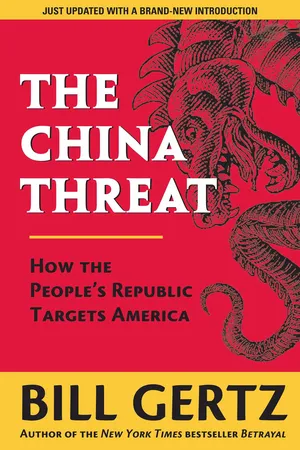
The devastating terrorist attacks on the World Trade Center and the Pentagon and America's first domestic bio-terrorism mail attacks have shifted America's attention and resources to the immediate threat of international terrorism. But we shouldn't be fooled. Since the publication of the hardcover edition of The China Threat in November of 2000, one thing remains very much the same: the People's Republic of China is the most serious long-term national security challenge to the United States. In fact, after the events of September 11, the China threat should seem all the more real, for Communist China is one of the most important backers of states that support international terrorism.
— From the new introduction by the author
Frequently asked questions

Yes, you can cancel anytime from the Subscription tab in your account settings on the Perlego website. Your subscription will stay active until the end of your current billing period. Learn how to cancel your subscription.
No, books cannot be downloaded as external files, such as PDFs, for use outside of Perlego. However, you can download books within the Perlego app for offline reading on mobile or tablet. Learn more here.
Perlego offers two plans: Essential and Complete
  • Essential is ideal for learners and professionals who enjoy exploring a wide range of subjects. Access the Essential Library with 800,000+ trusted titles and best-sellers across business, personal growth, and the humanities. Includes unlimited reading time and Standard Read Aloud voice.
  • Complete: Perfect for advanced learners and researchers needing full, unrestricted access. Unlock 1.4M+ books across hundreds of subjects, including academic and specialized titles. The Complete Plan also includes advanced features like Premium Read Aloud and Research Assistant.
Both plans are available with monthly, semester, or annual billing cycles.
We are an online textbook subscription service, where you can get access to an entire online library for less than the price of a single book per month. With over 1 million books across 1000+ topics, we’ve got you covered! Learn more here.
Look out for the read-aloud symbol on your next book to see if you can listen to it. The read-aloud tool reads text aloud for you, highlighting the text as it is being read. You can pause it, speed it up and slow it down. Learn more here.
Yes! You can use the Perlego app on both iOS or Android devices to read anytime, anywhere — even offline. Perfect for commutes or when you’re on the go.
Please note we cannot support devices running on iOS 13 and Android 7 or earlier. Learn more about using the app.
Yes, you can access The China Threat by Bill Gertz in PDF and/or ePUB format, as well as other popular books in Politics & International Relations & International Relations. We have over one million books available in our catalogue for you to explore.
CHAPTER SEVEN
Kindred Spirit
“Knowledge of the enemy’s dispositions can only be
obtained from other men.”

—Sun Tzu


Two FBI agents sat in Notra Trulock’s town house in Falls Church, Virginia, just outside of Washington, D.C. The tone of their questioning was hostile. “Do you have classified information in the house?” one of them asked. For the former Energy Department counterintelligence chief, it was the ultimate insult. Trulock was being accused of disclosing classified information improperly in a manuscript he had submitted to the CIA for publication in its journal, Studies in Intelligence. Instead of publishing it, the CIA had referred it to the FBI for investigation—which is why the agents were now in Trulock’s home on this hot Friday evening, July 14, 2000. When Trulock asked to see a search warrant, the agents said they didn’t need one, since they claimed to have the permission of the town house’s owner, Trulock’s friend Linda Conrad, who worked in the Energy Department’s intelligence office. At one point during the raid, one of the agents went into a bedroom, started up a desktop computer used by Trulock, and downloaded the contents of its hard drive to a disk. The agents continued probing Trulock for over an hour, asking accusatory questions about classified information. He told them the truth: He had none.
“Screwed, blued, and tattooed,” Trulock would later describe the interrogation, which came only days after his abrupt dismissal from the defense contractor TRW, Inc., a move Trulock is convinced was the work of political enemies. “This is what happens to whistle-blowers who speak truth to power in the Clinton administration,” he told me.
dp n="149" folio="124" ?
In truth, Trulock had submitted the manuscript the FBI was now looking for to the Energy Department for security review, but the department had declined even to look at it.
The FBI raid on Trulock’s house was harassment for his role in exposing one of the most damaging espionage cases in American history. He had uncovered Chinese espionage in the heart of the U.S. nuclear weapons complex. Chinese spies had scored a major coup; they had walked off with information on how to build Chinese versions of every warhead in the American nuclear arsenal. And the spying continues today.
The Trulock investigation was authorized by FBI Director Louis Freeh in consultation with Energy Secretary Bill Richardson, one of Bill Clinton’s closest advisers. Trulock suspected that they singled him out because he had just published a shorter version of the manuscript as an article for National Review magazine. The article was highly critical of the Clinton-Gore administration’s utter failure to aggressively pursue Chinese spying.
The administration wasn’t interested in catching spies. Its highest priority was repressing its critics, especially those in American intelligence who had exposed the deception and politicization within the U.S. national security community under Bill Clinton. Trulock had been a major target ever since he quit the Energy Department after being pressured into a meaningless job and finally having his intelligence judgments questioned by an inspector general report that went to great lengths to cover up the entire Chinese espionage debacle.
The story began eighteen years earlier.
004
The telephone rang at the home of Gwo Bao Min, a former nuclear weapons engineer at Lawrence Livermore National Laboratory. It was December 2, 1982. The caller was Wen Ho Lee, another scientist who designed nuclear weapons at a second Department of Energy nuclear weapons laboratory in Los Alamos, New Mexico. Min was in trouble. He had been fired from his job at Livermore under suspicion of having passed nuclear weapons secrets to China. The conversation between Min and Lee was intercepted by the FBI, which was investigating Min. Lee guessed it must have been someone in China who revealed Min’s identity to the FBI, and he promised Min he would uncover the informant. Although Min was never prosecuted and today lives in northern California, the exchange between Lee and Min would be at the heart of the most damaging espionage case in U.S. history, more damaging to American national security than the case involving Julius and Ethel Rosenberg, who passed nuclear secrets to Moscow in the early years of the Cold War. China had stolen the keys to unlocking the secrets of America’s nuclear arsenal.
The first hints about the extent of the danger came on September 25, 1992, when the ground shook beneath the Chinese nuclear weapons test site about 120 miles north of Lop Nur, a town in the remote northwestern province of Xinjiang. The explosion was the first successful test of a small, compact warhead similar in design to the U.S. W-88. The fact that China had succeeded in building so small a warhead so quickly shocked many officials inside the U.S. intelligence community.
A spy working secretly in China for U.S. intelligence had revealed important details about the test. In short, China had made a quantum leap in the killing power of its nuclear forces. The spy revealed that during the 1992 test the Chinese had set off a relatively small 150-kiloton explosion using a special oval-shaped core. The shape of the core was the tip-off to analysts that China had discovered one of the most important secrets about American nuclear weapons.
And the Chinese had succeeded in doing so through espionage. The spying, which occurred under several earlier administrations, is continuing today. But the magnitude of the problem was kept secret and only became public in the late 1990s. The reaction to the espionage—or, really, the lack of a response—was the result of a pro-China policy that caused serious damage to U.S. national security interests. The inaction sent a signal to any would-be nuclear power: American nuclear secrets are up for grabs. Under the so-called “engagement” policy of President Bill Clinton, Chinese spying was ignored, minimized, and ultimately covered up. Nothing would be allowed to interfere with the deliberate policy of pretending China poses no threat to the United States. The story of how Chinese nuclear spies stole U.S. nuclear warhead secrets is about the failure of the United States government to protect its long-term national security interests.
China today is engaged in a major strategic nuclear weapons buildup. It is a buildup targeted at a single nation: the United States. Strategically, it includes two new road-mobile intercontinental ballistic missiles, the Dong Feng-31 and the Dong Feng-41; at least four new strategic nuclear missile submarines; and a host of exotic high-technology weapons including lasers capable of shooting down or blinding satellites. It also includes computer-based information warfare for launching crippling attacks on everything from electrical power to the computer networks used to keep commercial aircraft flying safely.

DECODING THE BOMB

Intelligence analysts working at the Department of Energy’s Los Alamos National Laboratory wrote a classified analysis of the 1992 Chinese explosion that said the Chinese nuclear device tested near Lop Nur was shaped differently from any other known Chinese warhead. The device looked like an American warhead, and the scientists were concerned that the Chinese had obtained strategic secrets from the United States.
In April 1995 the Los Alamos analysts sent their classified memorandum to Notra Trulock, a political scientist by training who had worked at Los Alamos and who was director of intelligence for the Department of Energy. Four years later, Trulock would be hounded out of the department for his efforts to expose Chinese nuclear spying. No good deed goes unpunished, as they say. He had dared to challenge the pro-China policies of Bill Clinton. He had spoken bluntly about the Chinese strategic nuclear threat to the United States. He had revealed China’s decades of nuclear-related espionage, and that the spying continues today.
Chinese espionage efforts against the weapons laboratories were not new to security officials. “But we were beginning to uncover the outlines of a broad and very successful Chinese intelligence assault against our nuclear weapons laboratories,” Trulock told me. “These labs are the repositories of the secrets underlying the U.S. nuclear deterrent, accumulated through decades of U.S. nuclear weapons experience at the cost of billions of dollars.” Trulock explained that he had tried to alert U.S. government officials ranging from his immediate superiors at the Department of Energy all the way to White House National Security Adviser Sandy Berger. Their responses were always “appropriate,” but their actions never matched their expressions of concern. The Clinton-Gore administration viewed Chinese nuclear spying as a mere inconvenience, since the only strategy was to “engage” China’s communist leaders—a policy that was ridiculed by China’s communist leaders as the abject weakness of a decaying Western society.
“If our assessments of their perspective on their deterrent in the mid-’80s were correct, I think the Chinese now are moving much closer to having what they consider to be a credible deterrent,” Trulock concluded. “And if they think the credibility of their deterrent is solid again, then that to me seems to open up a lot of other options for them, like Taiwan. The whole idea behind their deterrent is to keep us from intervening in the achievement of China’s regional objectives.”
Energy Department intelligence analysts learned that China had acquired U.S. secrets on at least seven of America’s most modern thermonuclear warheads. The damage was known to key officials in the Clinton White House, the CIA, and the Pentagon, but the information was kept hidden from the American people to protect the Clinton-Gore policy of engagement.
It took a special congressional committee, one formed in 1998 to investigate Chinese acquisition of U.S. missile technology, to bring the story into public view. The Clinton-Gore administration fought the committee for five months, trying to prevent the release of classified intelligence information that exposed Chinese espionage, but in the spring of 1999 the committee’s report was finally made public.
“The credentials of the scientists conducting the assessment, the nature of the evidence, and the quality of the technical judgments made for a compelling case,” Trulock said. “Some of the nation’s most experienced nuclear scientists participated in this work. Their contributions have never been recognized or acknowledged by their government.”
The CIA, supposedly the nation’s premier intelligence service, was “politicized” in the debate over Chinese spying. Its analysts tried hard to play down, minimize, and ignore the damage caused by the spying. The CIA even insisted that what the Chinese obtained by espionage could have been obtained in other ways, such as from leaks of classified information or from public documents.
But Notra Trulock gave me an inside account of the Chinese espionage case that revealed otherwise. The real issue was not whether a damaging spy scandal had occurred, but how the White House managed to contain the political fallout so that it touched anyone but the administration. The White House went into its “war room” media damage control mode. James Kennedy, the White House lawyer who handled the president’s impeachment, was now put on the China spying story. The spin: Chinese spying was not our fault; it all happened in the 1980s. To influence news reporters and their coverage, he emphasized that the story was “old news,” and if anyone were to blame, it would be the Republicans who were in power in the 1980s. When the Select Committee’s bipartisan report was finally made public, the administration privately—and falsely—warned the major television networks that the report did not reflect the version based on classified information. If the media “went hard” with the story, the White House promised it had the means to discredit the report. So there was no story, or, at least, very little criticism of the Clinton-Gore administration.
“As the director of DOE [Department of Energy] intelligence, I was the talking head for the DOE group and bore most of the brunt of these attacks,” Trulock recalled. “To his credit, Energy Secretary Bill Richardson did present me with a $10,000 (before taxes) bonus, but this didn’t offset the fact that I had been demoted, relegated to a meaningless job, and eventually forced out of the department. Routine stuff for whistle-blowers in this administration. But I also came under media fire of the type normally reserved for Ken Starr or someone involved in the president’s public scandals. I read that I was a ‘dangerous demagogue,’ a ‘great imposter,’ ‘obsessed,’ that my ‘style’ was abrasive, and a host of other epithets. Reporters attributed a variety of motives to explain my involvement in this case, including imputations of racism and xenophobia. This was pretty heavy stuff for someone who has spent most of his career trying to stay out of the public eye. Of course, most of these allegations came from the very officials within DOE and the White House responsible for the cover-ups and stonewalling of the Congress and who had fought so hard to kill any meaningful security reform at the labs. Many of these were the perpetuators, if not the creators, of the very security lapses that made Chinese espionage possible in the first place.”

TARGET: NUCLEAR ARMS

A classified U.S. intelligence report produced in late 1998 that I obtained revealed that the Department of Energy is under a major intelligence and espionage attack from a range of foreign intelligence services, not just the Chinese. The report, titled “Foreign Collection Against the Department of Energy: The Threat to U.S. Weapons and Technology,” was stamped “Secret” and restricted from distribution to all foreign governments. According to the classified document, “The U.S. Department of Energy is under attack by foreign collectors—intelligence officers, as well as scientists, academics, engineers, and businessmen—who are aggressively targeting DOE nuclear, sensitive and proprietary, and unclassified information. The losses are extensive and include highly classified nuclear weapons design information to the Chinese.”
The intelligence assessment was produced by the National Counterintelligence Center, a relatively new agency based at CIA headquarters in Langley, Virginia. The center includes counterintelligence specialists from various agencies charged with thwarting the activities of foreign spies. Officials from the CIA, DOE, FBI, the National Security Agency, and the Department of Defense are part of it. The secret report stated that China, Russia, and India “pose the most immediate threat and are dedicating extensive resources in the United States and abroad to gain knowledge of DOE information.” The report made clear that the DOE facilities were seemingly oblivious to the threat. “DOE records show that over 250 known or suspected intelligence officers from 27 countries have visited or been assigned to DOE facilities in recent years.” The report also noted that foreign intelligence agencies have engaged in “cyber” information collection—eliciting intelligence from e-mail communications and therefore allowing foreign spies to gain information “freely and repeatedly.” The main target of the spying was the Department of Energy’s primary product: nuclear weapons information. “Foreign collectors of nuclear information are interested in all facets of U.S. capabilities and past experience in the design of nuclear explosive devices,” the report stated. “While the modern U.S. stockpile has tended to coalesce around a fairly narrow set of technical approaches to weapons design, the vast storehouse of information contained in the storage vaults and in the minds of personnel involved in all phases of the U.S. program represents a lucrative target for collectors.”
The Energy Department is in charge of all aspects of developing and maintaining nuclear weapons. Its scientists and engineers lead the world in breakthrough research in high-energy physics, energy sciences, technology, superconducting material, accelerator technology, materials sciences, and environmental sciences. It has thirty-five sites around the United States, and the sensitivity of its work ranges from ultrasecret Special Access Programs to sensitive research and proprietary work with U.S. corporations. There are 10,500 DOE federal workers and another 120,000 contractors and support personnel. A total of 66,000 people hold “Q” level security clearances, giving them access to top secret data on the design, manufacture, or use of nuclear weapons.
Under the Clinton-Gore administration, foreign visitors were welcomed to this secret-rich environment with little concern for the security of U.S. nuclear weapons data. According to the classified intelligence report, foreign visitors from countries seeking nuclear arms data jumped more than 200 percent from the mid-1980s to the mid-1990s. In 1998 alone, some 25,000 foreign scientists visited or were assigned to Energy Department facilities. In one case in 1997, Russia’s intelligence service ordered an agent working inside a U.S. weapons laboratory to find out about counterintelligence and security procedures, “including those used to screen and investigate foreign visitors and clear personnel for security clearances,” the report stated.
dp n="156" folio="131" ?
The security at the Energy facilities was bad, and the department’s ability to counter foreign spies was almost nonexistent. Trulock told me that when he took over Energy intelligence, counterintelligence was extremely poor. “Underfunded, understaffed, internecine warfare,” he said. “The field counterintelligence people loathed and despised headquarters. Counterintelligence itself was starved. I thought it was a mess.”
The intelligence report also highlighted the problem. The DOE counterspy program “has been undermined by a series of structural and systemic problems, including a lack of programmatic accountability and ineffectual centralized control over CI [counterintelligence] resources in the field,” the report said. “These problems stymied efforts to assess, understand, and reduce the foreign intelligence threat.”
The report outlined how China had scored major espionage coups. “During the period 1984 to 1988, China obtained through espionage the design information on a current U.S. warhead,” the report said, referring to the W-88. “To obtain this information, the United States conducted tens of nuclear tests. Once obtained, the Chinese were able to accelerate their research and advance their nuclear weapons program well beyond indigenous capabilities.”
China’s methodology is unique. “Rather than send its intelligence officers out to recruit knowledgeable sources at facilities such as the national laboratories, China prefers to exploit over time the natural scientist-to-scientist relationships,” the report said. “Chinese scientists nurture relationships with national laboratory counterparts, issuing invitations for them to travel to laboratories and conferences in China.”
China’s main intelligence service, the Ministry of State Security, or MSS, “encourages U.S. scientists to visit China,” the report said, “expediting arrangements to enable Chinese experts to assess and develop these contacts. During the visit, the U.S. target is introduced to several senior officials and receives VIP treatment. The Chinese services’ involvement is often not exposed and frequently will not lead to official recruitment of the individual, even though valuable information is obtained.”
In addition, China is one of several nations that engage in electronic eavesdropping to obtain nuclear weapons information. China’s electronic spies, along ...

Table of contents

  1. Title Page
  2. Dedication
  3. Introduction
  4. INTRODUCTION
  5. CHAPTER E - The China Threat
  6. CHAPTER TWO - The Plan
  7. CHAPTER THREE - China Wars
  8. CHAPTER FOUR - From Satellites to Missiles
  9. CHAPTER FIVE - Panama Red
  10. CHAPTER SIX - Proliferation Subversion
  11. CHAPTER SEVEN - Kindred Spirit
  12. CHAPTER EIGHT - Flashpoint Taiwan
  13. CONCLUSION
  14. APPENDIX - The Documents
  15. Acknowledgments
  16. INDEX
  17. Copyright Page