
eBook - ePub
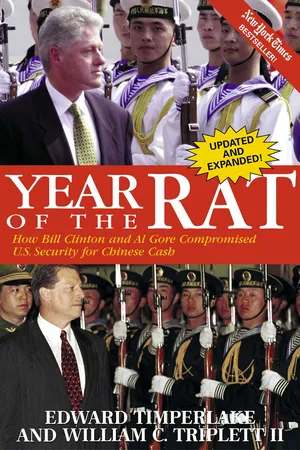
Year of the Rat
How Bill Clinton and Al Gore Compromised U.S. Security for Chinese Cash
- 314 pages
- English
- ePUB (mobile friendly)
- Available on iOS & Android
eBook - ePub
Year of the Rat
How Bill Clinton and Al Gore Compromised U.S. Security for Chinese Cash
About this book
In this sequel to Year of the Dog, Pacy has another big year in store for her. The Year of the Dog was a very lucky year: she met her best friend Melody and discovered her true talents. However, the Year of the Rat brings big changes: Pacy must deal with Melody moving to California, find the courage to forge on with her dream of becoming a writer and illustrator, and learn to face some of her own flaws. Pacy encounters prejudice, struggles with acceptance, and must find the beauty in change.Based on the author's childhood adventures, Year of the Rat, features the whimsical black and white illustrations and the hilarious and touching anecdotes that helped Year of the Dog earn rave reviews and satisfied readers.
Frequently asked questions
Yes, you can cancel anytime from the Subscription tab in your account settings on the Perlego website. Your subscription will stay active until the end of your current billing period. Learn how to cancel your subscription.
No, books cannot be downloaded as external files, such as PDFs, for use outside of Perlego. However, you can download books within the Perlego app for offline reading on mobile or tablet. Learn more here.
Perlego offers two plans: Essential and Complete
- Essential is ideal for learners and professionals who enjoy exploring a wide range of subjects. Access the Essential Library with 800,000+ trusted titles and best-sellers across business, personal growth, and the humanities. Includes unlimited reading time and Standard Read Aloud voice.
- Complete: Perfect for advanced learners and researchers needing full, unrestricted access. Unlock 1.4M+ books across hundreds of subjects, including academic and specialized titles. The Complete Plan also includes advanced features like Premium Read Aloud and Research Assistant.
We are an online textbook subscription service, where you can get access to an entire online library for less than the price of a single book per month. With over 1 million books across 1000+ topics, we’ve got you covered! Learn more here.
Look out for the read-aloud symbol on your next book to see if you can listen to it. The read-aloud tool reads text aloud for you, highlighting the text as it is being read. You can pause it, speed it up and slow it down. Learn more here.
Yes! You can use the Perlego app on both iOS or Android devices to read anytime, anywhere — even offline. Perfect for commutes or when you’re on the go.
Please note we cannot support devices running on iOS 13 and Android 7 or earlier. Learn more about using the app.
Yes, you can access Year of the Rat by Edward Timperlake,William C. Triplett in PDF and/or ePUB format, as well as other popular books in Politics & International Relations & Conservatism & Liberalism. We have over one million books available in our catalogue for you to explore.
Information
CHAPTER 1
THE FAUSTIAN BARGAIN
On a wall in the basement of the United States Capitol in Washington, a bas-relief depicts a Greek warrior engaged in mortal combat with a snake. The artist captures the moment when the man raises his weapon to strike the deathblow. Across the tableau is one word: Courage.
Artistically, physical courage is easy to depict. Moral courage is another matter. Moral courage requires taking a cold, hard look at the world and then acting, accepting the consequences, and knowing that the greatest good will ultimately be served. Moral courage demands sacrifice—the subordination of self-interest to the interests of others. To be morally or intellectually courageous requires a basic sense of honesty and integrity coupled with the will to act decisively on those principles. Moral character is of great matter in a leader and will inevitably affect the substance of his performance. Courage, character, and performance cannot be separated.
In these areas we have found President Clinton and his administration wanting. They have failed in their duty to the national interest. What is happening on Bill Clinton’s watch while he serves as president and commander in chief is rapidly becoming a matter of history, and the devastating repercussions of his actions will be felt by Americans for generations to come.
Our thesis is simple: The Clinton administration has made a series of Faustian bargains and policy blunders that have allowed a hostile power to further its aims in Washington. In the main, Bill Clinton and Al Gore did it for money.
The hostile power is the People’s Republic of China (PRC). It is the only foreign regime currently targeting American cities for nuclear destruction.1
The PRC, under the direction of the Chinese Communist Party (CCP), is engaged in four major lines of activities, all of which are contrary to the interests of the Chinese people, neighboring countries , U.S. friends and allies around the world, and ultimately the American people.
The Clinton administration sold out America’s national security to one of our most dangerous adversaries merely to raise campaign cash.
First, arms dealers associated with the CCP’s military arm, the People’s Liberation Army (PLA), have transferred weapons of mass destruction and the means to produce them to terrorist nations, threatening Israel, our Gulf allies, and even Europe.
Second, the PLA itself is suppressing the Chinese people’s legitimate desire for democracy and human rights.
Third, the PLA has a history of aggression against neighboring countries, including Tibet and India, and in recent times has shown a willingness to bully others, including Japan Vietnam, the Philippines, and the Republic of China on Taiwan.2
Finally, the PRC’s unjustified military modernization and expansion program threatens America’s foreign policy interests and national security.
Before Bill Clinton took office, the United States was the prime obstacle to the CCP’s ambitions to dominate East Asia. After he was elected, the CCP expressed two major needs—political and economic intelligence on the United States, and assistance with its military modernization program. The Clinton administration has met both Communist Chinese goals.
In these pages, we will show that, in order to gain and hold onto power, the Clinton administration has acted recklessly, allowing the wrong people to gain access to our most important political and economic secrets. Any number of Chinese arms dealers, spies, narcotics traffickers, gangsters, pimps, accomplices to mass murder, communist agents, and other undesirables will appear in these pages… all associated one way or another with the White House and money.
The most favorable explanation for this betrayal is incompetence. As the president said, “Mistakes were made.” But it is far more likely that in order to gain campaign contributions and pay hush money to witnesses, the Clinton-Gore administration turned a deliberate blind eye to these threats to our national interests.
Moreover, we believe that the Clinton administration’s help to the Chinese military and the cover-ups of Chinese arms proliferation were motivated by equal parts corruption and classic appeasement.
How we intend to show this rests on evidence. And here we ran into a number of initial stumbling blocks:
■ Two crucial witnesses, Commerce Secretary Ron Brown and Assistant Commerce Secretary Charles Meissner, perished together in a plane crash.
■ At least eighteen critical witnesses have fled the country.
■ Another seventy-nine witnesses have taken the Fifth Amendment, deciding that telling what they know would tend to incriminate them.
■ The higher one gets in the political structure at the White House, the more its people suffer from memory loss.
■ Document tampering has been shameless. As the New York Times noted, “Much remains missing: Mr. Huang’sa Democratic National Committee (DNC) telephone logs, most of his outgoing correspondence, his travel records, details of visits to the White House and Clinton-Gore campaign headquarters, and accounts of business he conducted from locations other than his office at the Democratic Committee.”3
■ Some of the most compelling evidence is highly classified and can only be discussed inferentially.
■ And, we must admit, the White House has been fortunate in having incompetent members of the political opposition.
That having been said, our account is not without proof. Most of it will be direct. We have, for example, the records of John Huang’s entry into the Executive Office of the president. We know how many times he went there and at least who authorized his entrance. We also know how many long distance calls he made to his former employers from his new desk at the Commerce Department. We can document at least some of his visits to the Chinese embassy in Washington. We can document the wire transfers to the DNC from Macau criminal syndicate figure Ng4 Lapseng. We have the Treasury Department records of the hundreds of thousands of dollars in cash Ng brought into the United States and his trips to the White House.
Other evidence will be circumstantial. A common layman’s misunderstanding is that circumstantial evidence is in some way lacking. On this point the courts are clear: The United States Court of Appeals has ruled, “A conviction can rest solely on circumstantial evidence, which is intrinsically as probative as direct evidence.”5 We will present a mountain of circumstantial evidence to show corrupt motivation and opportunity to harm the national interests of the United States.
Did the Clinton administration sell out America’s national security to one of this country’s leading and most dangerous adversaries merely to raise campaign cash? In the pages that follow, we will prove our answer, which is: yes.
dp n="16" folio="5" ?
PART ONE:
LIPPO LIES
dp n="17" folio="6" ?dp n="18" folio="7" ? CHAPTER 2
LIPPO AND THE RIADYS
Who was the biggest contributor to the Clinton-Gore ticket in 1992? Not a corporation, not a labor union, not a Hollywood mogul, but Indonesian businessman James Riady and his wife, who gave $450,000 to elect Bill Clinton.
During the final weeks of the campaign, the Riady family, its associates, and executives at Riady companies gave an additional $600,000 to the DNC and Democratic state parties.1
The patriarch of the business empire is Mochtar Riady, a frequent visitor to the United States. Of his three sons, James was a permanent resident of the United States, Stephen was educated here, and Andrew worked in California in the early 1980s. All, however, have fled the United States. Any Riady employee with detailed knowledge of the family’s activities in the United States has likewise stolen away in the night. Even James Riady’s secretary has vanished.2 Only John Huang, the family’s former U.S. operative, remains in the United States—and he has pleaded the Fifth Amendment, maintaining that telling what he knows might incriminate him.3
Who are the Riadys? They originally come from China’s coastal province of Fujian, opposite Taiwan; the Riady family’s Chinese name is “Lee.” At some point the family relocated to Jakarta, the capital of Indonesia. Ethnic Chinese make up 5 percent of the Indonesian population but control at least 75 percent of the corporate assets in the country, a dangerous combination.4 Ethnic Chinese have often been targets in times of unrest, and the May 1998 riots protesting Indonesian President Suharto quickly became anti-Chinese riots, forcing hundreds of desperate ethnic Chinese to flee to Jakarta’s international airport.5 The ethnic rioting in South Jakarta destroyed a branch of the Riady-controlled Lippo Bank,6 and elsewhere in the country, the Indonesian army had to send 360 soldiers to protect Riady property from anti-Chinese mobs.7
The twenty-year friendship between James Riady and Bill Clinton has spread a web of intrigue, financial corruption, and foreign influence into American government.
Mochtar Riady has a new Bell helicopter with long-range fuel tanks. If things go bad in Jakarta, he can easily fly to Singapore six hundred miles away.8 Son James’s three-story manor house and helicopter pad in Jakarta are ringed by a moat.9 The Riadys aren’t taking any chances.
The Riady empire, centered on its Lippo Group, is, as one financial analyst in Jakarta describes it, “a carefully balanced house of cards.”10 Newsweek has noted, “Moving cash around the globe in tangled webs of transactions has always been the Riady way,” and the Asian Wall Street Journal accuses the Riadys of “ramping”—buying large numbers of shares in their own companies in order to support prices.11
In Indonesia the Riadys have gone in for grandiose development projects where their connections can facilitate governmental approval of crucial licenses and permits. For example, their billion-dollar “Lippo Village”12 project is a walled community for opulent Indonesians with its own private school, country club, and other amenities. Tuition at the school runs to $15,000-a-year, way out of reach for ordinary Indonesians, but attractive to the superrich who don’t want to educate their children abroad.13 The school even has a horse show ring.14 Interestingly, the school received its operating license after James Riady took the Indonesian education minister to the White House for an Oval Office visit. 15
The Riadys’ corporate flagship is the Lippo Group. “Lippo” is a Chinese word that means “energy.”16 The Riadys began in banking, branched out into securities, and later into land development. In Indonesia, the company has its fingers in many pies, making textiles and electronics, mining coal, selling insurance, and building shopping centers, housing developments, and hospitals.17 Though precise figures are difficult to determine due to the complex relations among Riady-associated companies, the Lippo Group as a whole has been quite successful, and the Riadys are extremely wealthy.
Dr. Mochtar Riady18 (also known as “Dr. Man Tjin Lee”19) has moved from chairman of various Lippo entities to “honorary chairman,” reflecting his declining health. His second son, James, runs the Indonesia operation, while the youngest son, Stephen, is in charge of Hong Kong and China affairs.20 The mysterious oldest son, Andrew, is alleged to have lost millions on the foreign exchange markets, and has disappeared from view completely.21
In 1977 Mochtar Riady tried to buy the National Bank of Georgia. He failed, but one of the brokers in the deal was Jackson Stephens of Little Rock, Arkansas, who tried to interest a disappointed Riady in joining Stephens, Inc., one of America’s largest private investment banks outside of Wall Street—and one with which the Riadys would have an extended relationship, as we will see. Mochtar Riady agreed, and his son James, then aged twenty, arrived to intern at Stephens, Inc.22
Through Jackson Stephens, James Riady met a rising politician, Arkansas Attorney General Bill Clinton. Thus began a friendship that has lasted twenty years, and has spread a web of intrigue, financial corruption, and foreign influence into American government.
In early 1984 James Riady and Jackson Stephens became co-owners of Arkansas’s largest bank, the Worthen Bank. James was installed as the bank’s chief operating officer,23 and a whole team of ethnic Chinese from Indonesia came to work in Little Rock.24
In the first year under Riady/Stephens management, the bank lost tens of millions of dollars in Arkansas ...
Table of contents
- Title Page
- Preface
- CHAPTER 1 - THE FAUSTIAN BARGAIN
- PART ONE: - LIPPO LIES
- PART TWO: - TRIADS AND OTHER CROOKS
- PART THREE: - CHINA’S CONTINUING THREATS
- PART FOUR: - UPDATE
- NOTES
- Copyright Page