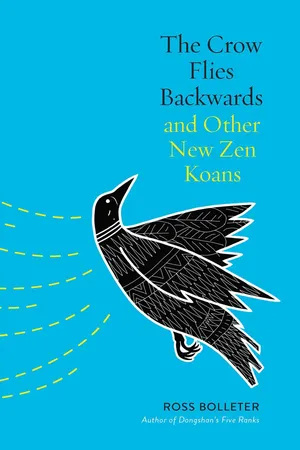
The Crow Flies Backwards and Other New Zen Koans
eBook - ePub

The Crow Flies Backwards and Other New Zen Koans

  1. 336 pages
  2. English
  3. ePUB (mobile friendly)
  4. Available on iOS & Android
eBook - ePub

The Crow Flies Backwards and Other New Zen Koans

About this book

Discover how the mysterious, powerful form of the koan—known for bringing about sudden enlightenment—can disrupt and illuminate your everyday understanding of life. Traditionally, Zen koans—the teaching stories of Zen—are drawn from the words and teachings of ancient masters and primarily address the concerns of (male) monastic practitioners. In The Crow Flies Backward, Ross Bolleter changes all at. The 108 modern koans offered within address sexuality and childbirth, family, parenthood, work, money and even the nature time itself. These koans are drawn from a variety of modern sources: Western philosophy, the Bible, contemporary and classic literature from Proust to Lewis Carroll and Mary Oliver and Anne Carson, as well as stories provided by author's encounters with his Zen students. Bolleter's commentaries provide guidance to the reader on how to engage with each koan and koans in general, and direct guidance to meditate with koans. An appendix offers rarely-seen intimate and in-depth accounts of the process of koan introspection, from four of the author's senior students.

Frequently asked questions

Yes, you can cancel anytime from the Subscription tab in your account settings on the Perlego website. Your subscription will stay active until the end of your current billing period. Learn how to cancel your subscription.
No, books cannot be downloaded as external files, such as PDFs, for use outside of Perlego. However, you can download books within the Perlego app for offline reading on mobile or tablet. Learn more here.
Perlego offers two plans: Essential and Complete
  • Essential is ideal for learners and professionals who enjoy exploring a wide range of subjects. Access the Essential Library with 800,000+ trusted titles and best-sellers across business, personal growth, and the humanities. Includes unlimited reading time and Standard Read Aloud voice.
  • Complete: Perfect for advanced learners and researchers needing full, unrestricted access. Unlock 1.4M+ books across hundreds of subjects, including academic and specialized titles. The Complete Plan also includes advanced features like Premium Read Aloud and Research Assistant.
Both plans are available with monthly, semester, or annual billing cycles.
We are an online textbook subscription service, where you can get access to an entire online library for less than the price of a single book per month. With over 1 million books across 1000+ topics, we’ve got you covered! Learn more here.
Look out for the read-aloud symbol on your next book to see if you can listen to it. The read-aloud tool reads text aloud for you, highlighting the text as it is being read. You can pause it, speed it up and slow it down. Learn more here.
Yes! You can use the Perlego app on both iOS or Android devices to read anytime, anywhere — even offline. Perfect for commutes or when you’re on the go.
Please note we cannot support devices running on iOS 13 and Android 7 or earlier. Learn more about using the app.
Yes, you can access The Crow Flies Backwards and Other New Zen Koans by Ross Bolleter in PDF and/or ePUB format, as well as other popular books in Theology & Religion & Buddhism. We have over one million books available in our catalogue for you to explore.

Information

PART I
Prelude
Introduction: The Nature of the Koan and How Koans Came to the West
IN A CERTAIN SENSE, koans — like poems or jokes — can’t be defined precisely. However, we can say broadly that a koan is a formulation that, when deeply explored in meditation, provides us with a means to awaken to who we truly are, as well as to express, deepen, and embody that awakening in our lives. Koans are protean; they can appear, for instance, as a verse, a folk story, a teacher’s words, or a dialogue between teacher and student. Here is a traditional koan in verse from unknown sources that intimates the mystery of the Way:
From a well that has never been dug,
water ripples in a spring that does not flow;
someone with no shadow or form is drawing the water.
Sometimes people encounter the Way in times of crisis, such as the death of a loved one or a life-threatening illness or through intense physical and emotional suffering. On such occasions, deep questions may surface: “Why do I suffer?” “Who am I without my loved one?” “Who am I in the face of my own mortality?” “What purpose does my life have?” Any such fundamental questions can be taken up as a koan — and our anguish spurs and gives us the tenacity to stay with the koan until it resolves.
It needs to be said at the outset that koan is not a mere synonym for “dilemma.” And yet when we sit in meditation with certain dilemmas of our lives, we can wear out the intellect in the cat’s cradle of opposing considerations and end by sitting with just our not knowing. If we can endure there, continuing our questioning, clarifications may arise unexpectedly out of nowhere.
Apart from koans that may arise from harrowing experiences and dilemmas, it is good to discover — as well as to create — koans from within the weave of our lives. For me, the following is such a koan, rich in possibilities concerning time and creative engagement with life, as well as the mystery of words:
When he was in his eighties, my father was knocked down by a delivery van. In hospital they put him in “treatment,” prior to admitting him as a patient. Although no one could find time to get him a bottle to piss in, four staff members came round with their clipboards during the three hours he waited there, to ask him his age. He generously gave each of them a fresh response — “twenty-one,” “ninety-eight,” “forty-seven,” and finally, “two hundred!”
Extending Chinese and Japanese Koan Traditions in the West
By advocating that we work with Western koans, I am in no way suggesting that we abandon the noble koan traditions that come down to us primarily from the Chan schools of China and the Zen schools of Japan. Such a legacy is a matter of wonder and is a tremendously efficacious tool for awakening and for integrating our awakening into our lives
So, rather than abandoning tradition, let us feel free to extend it. There are good reasons for this: the koan literature that we inherit comes to us almost entirely from patriarchal monastic traditions so that there are, understandably, lacunae especially regarding relationships, family, love, sex, childbirth, child rearing, work, and money. As lay Zen practitioners, we have an opportunity, even a responsibility, to develop koans that reflect these themes.
In The Crow Flies Backwards I also derive and create Western koans that focus on time and timelessness, along with the closely related theme of memory. These themes aren’t absent in Chinese and Japanese koan traditions, but they too can be extended.
Consider the opening of Kenneth Slessor’s great poem “Five Bells”:
Time that is moved by little fidget wheels
Is not my time, the flood that does not flow.
Between the double and the single bell
Of a ship’s hour, between a round of bells
From the dark warship riding there below,
I have lived many lives, and this one life
Of Joe, long dead, who lives between five bells.
Another koan with the theme of time and timelessness is William Blake’s “Eternity is in love with the productions of time” from his Marriage of Heaven and Hell. Both of these koans are explored later on.
Unlike the koans from our Zen monastic inheritance, koans from Western sources have no formal traditional responses, so both teacher and student must discover their own. This is an opportunity to be creative and to play. As a Zen teacher who is also an improvising musician and composer, I find joy in working with my students in this way, as well as creating koans in dialogue with them:
“Still wandering in your mind?” I asked a student.
“You bet.”
“What’s there?”
“Oh, gray sky, the sun on the salmon gums.”
How Koans Came West
The use of the koan as a teaching tool entered the West through the efforts of pioneering teachers such as Soyen Shaku (1860–1919), who taught Ida and Alexander Russell and their family at their home outside of San Francisco in 1905. (According to scholar Rick Fields, it seems that Ida Russell was the first person in the United States to undertake koan study.) Soyen Shaku’s student Nyogen Senzaki (1876–1958) was the first major Zen teacher to reside in the United States. He compiled his 101 Zen Stories in 1919 (the book saw a later iteration as Zen Flesh, Zen Bones) and used koans in his teaching in San Francisco at least from the 1920s onwards. Sokei-an Shigetsu Sasaki (1882–1945) was a Rinzai master who pioneered the Zen Way in New York in the 1930s. Sokei-an employed koans with his students, including Ruth Fuller Everett (1892–1967) who became his wife. As Ruth Fuller Sasaki, she made an inestimable contribution to the development of Zen in the West through her translations of such major Zen texts as The Record of Lin-chi, The Recorded Sayings of Layman P’ang, and Zen Dust: The History of the Koan and Koan Study in Rinzai (Lin-chi) Zen.
As noted above, koans that come down to us from Chinese sources may take a variety of forms — a verse, a teacher’s words, a dialogue between teacher and student, and so on. Similarly, for Western koans we will draw on verses, dialogues between teachers and students, lines from the Bible, literature both ancient and modern, and personal stories. There are also koans to be discovered within the weave of our lives, as well as in our contemporary culture. I explore these territories and encourage my students to do likewise.
I have endeavored to find or create Western koans that are appropriate for the student at various stages of the training path: for instance, the initial koans of emptiness which provide a vehicle for the student to awaken to their true and timeless nature; after that, koans which encourage the student to experience a return to the differentiated realm of color and form after their awakening experience. There are also koans that help the student to embody their awakening in the many and varied circumstances of their life, and others that elicit an awakening to the mystery of words. Finally, there are koans that assist the student to mature their awakening and ultimately assimilate it — and forget it — completely.
In terms of our deepest nature, we live at the intersection of sameness and difference. Indeed, we are that very intersection: vast yet utterly individual, with not a hairsbreadth between. It is my hope that The Crow Flies Backwards will provide a means to experience that matter and take it into our lives. Who, after all, is living this life?
What Does It Mean to Sit with a Koan?
1
KOANS WIDELY EMPLOYED to help us awaken to our true nature include Zhaozhou’s “Mu,” Bassui Zenji’s “Who is hearing that sound?” “Who am I?” and “What is it?” In this chapter I will employ the koan “Who am I?” as an exemplar and guide to working with your initial koan. I have chosen to do this because, regardless of our gender, our cultural background, or our life circumstances, we are all familiar with “Who am I?” as a fundamental question. It might be assumed that such familiarity runs the risk of entrapping the student in thoughts concerning a socially and personally constructed self and customary roles. However, the experience of students working on the koan “Who am I?” is that, in short order, it brings them face to face with the mystery that lies deeper than such matters.
Working with the Koan “Who Am I?”
In all the varying circumstances of your life, ask yourself and continue to ask yourself, “Who am I?”
Let your curiosity regarding this matter be boundless.
It is vital to engage with the koan “Who am I?” through regular daily seated meditation, through zazen. It’s also good to walk it into your life. Even the busiest days provide opportunities to return to the koan: while your computer is booting up, before answering your phone, or as you are walking between tasks. Robert Aitken called these opportunities “islands of practice.” Apart from their efficacy in terms of working with “Who am I?” these brief homecomings can be deeply refreshing and subtly shift the energy in difficult situations.
Great Faith, Great Doubt, and Great Determination
The qualities traditionally deemed necessary to awaken are great faith, great doubt, and great determination. The cross-legged posture of zazen is the perfect expression of this tripod, for your left knee on the mat, your backside on the cushion, and your right knee on the other side of the mat represent great faith, great doubt, and great determination without remainder!
Really, great faith means trusting that we are intrinsically awake and have been so from the beginning, while in the same breath striving to awaken for the first, dearest, freshest time. Koun Yamada (1907–1989) expressed it this way:
This great root of faith is not just a tepid faith. It is a thoroughgoing belief that will settle for nothing less than complete awakening, and is rooted firmly in the ground like a huge tree, immovable in the face of even the strongest gale.
Yamada also said, “I want to be a great tree shading all beings.” By this he meant that his realization, and his teaching that flowed from it, were not just for himself, but for the benefit of all beings, both sentient and nonsentient. This is the bodhisattva path where you enlighten yourself and others in the midst of the passions, in the midst of the suffering world. Bodhisattva means “enlightened being,” a being who is becoming enlightened and a being who enlightens others. Yamada was Robert Aitken’s principal teacher, and Aitken Roshi in turn was my first teacher. I am grateful for that great tree sheltering all beings that has made my own path possible.
The expression “great doubt” is puzzling for many people coming to Zen. In general, religions and spiritual paths don’t readily accept doubt, let alone encourage it, most especially concerning their own tenets. Great doubt surely includes the matter of accepting our own doubts: for instance our doubt as to whether we can come to awakening at all or whether, given the brevity of our life, we have time enough to come to awakening. Faced with such doubts, we include them, saying: “I am going ahead with my doubts.”
Doubt may also be associated with the withering away of our delusions and attachments. I remember a student who was working on the koan “Mu” telling me that his dreams were full of forests being destroyed and tumbling silently into the void. He would awaken terrified. I actually felt that what was happening for him was most promising and encouraged him to continue.
Doubt can also be associated with views such as: “I don’t deserve to awaken when there is so much suffering in the world.” To this I respond: “But your awakening is your birthright. You don’t have to deserve it any more than you have to deserve your life.”
Doubt fuels the Way. The deeper we go, the more our cherished ideas are brought into question. Notions like our identity and its substantiality, for example, begin to be less and less pressing.
In sesshin, the intensive meditation retreats of the Zen tradition, we get to test this. After a couple of days the notion of myself as a musician fades away at the edges of the moment. After sesshin, the musician role feels light, insubstantial, almost strange to take up again, and yet I do, in the spirit of play.
Deeper ...

Table of contents

  1. Cover Page
  2. Title Page
  3. Dedication
  4. Contents
  5. Preface
  6. Part I: Prelude
  7. Part II: Commentaries on Western Koans
  8. Part III: The Crow Flies Backwardsand Other Western Koans
  9. Appendix: Personal Accounts
  10. Mari Rhydwen: Working on“Snow in a Silver Bowl”
  11. Bob Joyner: My Experience of Koan Work
  12. Phillip McNamara: Working with“Who Is Hearing That Sound?”
  13. Bibliography
  14. Credits
  15. Index
  16. About the Author
  17. Copyright