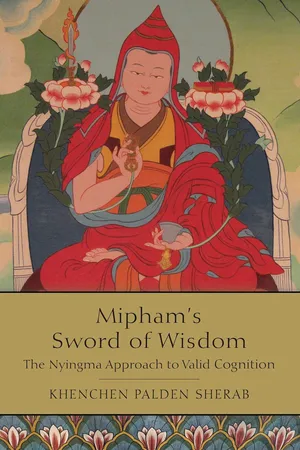
Mipham's Sword of Wisdom
eBook - ePub

Mipham's Sword of Wisdom

  1. 312 pages
  2. English
  3. ePUB (mobile friendly)
  4. Available on iOS & Android
eBook - ePub

Mipham's Sword of Wisdom

About this book

Presents the Nyingma-lineage understanding of valid cognition in Buddhism. Its core subject is the Buddhist view of the two truths—the relative truth of conventional appearances and the absolute truth of emptiness and buddha nature—and how the two truths are inseparable. The main questions posed are: How can we know the two truths and how can we be certain that our knowledge is accurate? "The great scholar and advanced spiritual master Jamgon Mipham's Sword of Wisdom is a classic work that explicates valid cognition. I am happy to see it now available in English with commentary and scholarly appendices that will be very helpful for serious students in understanding this profound and important text."— His Holiness the Sakya Trichen Mipham's Sword of Wisdom explores the Nyingma-lineage understanding of valid cognition in Vajrayana Buddhism. This translation, a clear and concise primer on higher realization through valid cognition in Buddhist philosophy, presents these ideas in English for the very first time and includes the sutra presentation of the two truths and the tantra teachings of the two truths as the purity and equality of all phenomena. When you've finished Mipham's Sword of Wisdom, you'll have

  • rich insights into Nyingma teachings on valid cognition,
  • a profound new understanding of the two truths and their inseparability,
  • a solid foundation in valid cognition through direct perception and reasoning according to the traditional Indian treatises of Dharmakirti and Dignaga,
  • and much more.

Frequently asked questions

Yes, you can cancel anytime from the Subscription tab in your account settings on the Perlego website. Your subscription will stay active until the end of your current billing period. Learn how to cancel your subscription.
At the moment all of our mobile-responsive ePub books are available to download via the app. Most of our PDFs are also available to download and we're working on making the final remaining ones downloadable now. Learn more here.
Perlego offers two plans: Essential and Complete
  • Essential is ideal for learners and professionals who enjoy exploring a wide range of subjects. Access the Essential Library with 800,000+ trusted titles and best-sellers across business, personal growth, and the humanities. Includes unlimited reading time and Standard Read Aloud voice.
  • Complete: Perfect for advanced learners and researchers needing full, unrestricted access. Unlock 1.4M+ books across hundreds of subjects, including academic and specialized titles. The Complete Plan also includes advanced features like Premium Read Aloud and Research Assistant.
Both plans are available with monthly, semester, or annual billing cycles.
We are an online textbook subscription service, where you can get access to an entire online library for less than the price of a single book per month. With over 1 million books across 1000+ topics, we’ve got you covered! Learn more here.
Look out for the read-aloud symbol on your next book to see if you can listen to it. The read-aloud tool reads text aloud for you, highlighting the text as it is being read. You can pause it, speed it up and slow it down. Learn more here.
Yes! You can use the Perlego app on both iOS or Android devices to read anytime, anywhere — even offline. Perfect for commutes or when you’re on the go.
Please note we cannot support devices running on iOS 13 and Android 7 or earlier. Learn more about using the app.
Yes, you can access Mipham's Sword of Wisdom by Khenchen Palden Sherab in PDF and/or ePUB format, as well as other popular books in Theology & Religion & Eastern Philosophy. We have over one million books available in our catalogue for you to explore.
1

Prelude
PRELIMINARY VERSES OF HOMAGE

Images
THE HOMAGE TO MAÑJUŚRĪ AND PADMASAMBHAVA IN UNION
Namo śrī vajra padma tīkṣṇaye
Homage to the glorious and sharp vajra lotus!
THE HOMAGE TO ŚĀKYAMUNI BUDDHA1
With the chariot of the winds of the two accumulations,2 you led the four divisions3 of the troops of the ten powers4 to victory in battle over the gods of desire.5
With the sharp fangs and claws6 of the four fearlessnesses,7 you swallowed all at once the elephant8 brains of antagonistic proponents of eternalism and nihilism.
By abiding on the snow mountains9 of knowing the nature and entire extent of phenomena, you destroyed the darkness of the two obscurations10 through the two yogic disciplines.11
In the center of a thousand-spoke wheel, among humans you are exalted like a lion. You are called Siddhārtha, since you have accomplished all aims. Please bring forth auspiciousness!12
THE HOMAGE TO PADMASAMBHAVA13
Shining with a thousand luminous marks of deathlessness,14
you sprang forth from a lotus blossom in the center of a lake.15
Nangsi Zilnön,16 nirmanakāya who outshines all apparent existence,
please be the crown jewel that beautifies my head until I am fully enlightened.
THE HOMAGE TO MAÑJUŚRĪ17
On the tip of the anthers of a thousand-petal lotus of devotion,18
Lord of Dharma, I continue to reverently pay homage to you.
Mawé Sengé, ever-youthful Lion of Speech,19
please bestow the light of intelligence on all beings everywhere.20
THE HOMAGE TO SARASVATĪ21
With a hundred thousand melodious words of the noble Dharma,
you beautify a garden of lotuses in full bloom — the throats of all the buddhas.
Sarasvatī, graceful swan glowing with the luster of moonlight,
playfully cruise at this time through the lake of my mind.
THE HOMAGE TO THE VIDYĀDHARAS OF THE THREE LINEAGES22
With one gulp of discernment, you retained in the belly of your intelligence a hundred thousand streams of the definitive and secret three sections23 of the tantras,
which you disgorged, like the learned one Agastya,24 as excellent explanations having the eight qualities.25
I praise you hundreds of times, genuine masters of awareness of the past.26
THE HOMAGE TO LONGCHENPA27
The teachings of the Buddha are like the Realm of the Thirty-Three Gods,28 where many nonsectarian and learned authors assemble, like the vassal kings paying homage to Indra.29
In their center, like Indra, you sit majestically on the supreme yāna of Dzokchen, which is like Sasung, the royal elephant,30 and from there you survey all phenomena with your thousand shining eyes.31
Openly brandishing your thousand-pronged vajra32 of explanation, debate, and composition, you are crowned with the jewels of many scriptures.33
Supremely learned lord Longchenpa, as renowned as Indra, never before has there been someone like you. Please victoriously crown the top of my head.
THE HOMAGE TO JAMGÖN MIPHAM RINPOCHÉ34
Your arrogant and vicious opponents, like a thousand elephants,
are overpowered, even without study or contemplation,
by your laughing roar of reasoning, O Lion of Speech.35
Mipham Choklé Namgyal, may you be victorious.
THE HOMAGE TO THE ROOT TEACHER36
With the sharp vajra weapon of scripture and reasoning
you overpower your opponents, who resemble arrogant, jealous gods.
Gracious teacher who kindly helps me see the excellent, genuine path,
like the king of the gods, may you be ever victorious.
These verses of homage are offered like the welcoming gesture of strewing fresh, white lotus petals. It is as the Root Mañjuśrī Tantra states:
The letter A, the great nature itself,
holds the teachings of the teacher in the highest esteem.
THE QUALITIES OF JAMGÖN MIPHAM
Before going further, I want to discuss Mipham Rinpoché, the author of the root text, who was predicted in several terma scriptures. First, there is a prediction of him in a terma discovered by Drodul Sang-ngak Lingpa:37
The emanation of Nupchen38 named Mipham
will come forth as an especially powerful lord of mind terma.
Another prediction of Mipham Rinpoché comes from the terma discovered by Terchen Traktung Dudjom Trolö Tsal:39
Mipham Gyatso will turn back the flood of invading armies,
conquer the tenet systems of mistaken views,
and make the Vajrayāna teachings shine brilliantly, like the sun.
There are other predictions of Mipham Rinpoché, particularly in the vajra predictions of the King of the Sages, Buddha Śākyamuni himself, as well as the vajra predictions of Orgyen Padmakara, the Second Buddha of our time.40 They greatly praise Mipham as the very embodiment of the wisdom of all the buddhas, or in other words, as Jetsun Mañjuśrī, the Lion of Speech, appearing in the form of a spiritual friend.
Being a master of the eight great treasures of confidence41 and the four right discriminations,42 Mipham Rinpoché wrote outstanding commentaries on the countless entrances to the common and uncommon scriptures, particularly the profound and vast intentions of the sūtras and tantras, which had been perfectly expounded by the Bu...

Table of contents

  1. Cover Page
  2. Title Page
  3. More praise for Mipham’s Sword of Wisdom
  4. Contents
  5. Translator’s Introduction
  6. The Sword of Wisdom That Ascertains Reality by Jamgön Mipham
  7. The Radiant Light of the Sun and Moon by Khenchen Palden Sherab
  8. 1. Prelude: Preliminary Verses of Homage
  9. 2. The Validity of the Teachings and the Teacher
  10. 3. The Two Truths
  11. 4. An Explanation of Causality through Interdependent Appearances
  12. 5. Overview of the Four Reasonings and the Reasonings of Causal Efficacy and Dependency
  13. 6. The Six Causes, Five Effects, and Four Conditions
  14. 7. The Reasoning of the Nature
  15. 8. Valid Cognition
  16. 9. Direct Perception
  17. 10. The Reasoning of a Valid Proof: Inference Based on Evidence
  18. 11. Correct Signs and False Signs
  19. 12. The Ways Inference Is Presented
  20. 13. Conventional and Ultimate Valid Cognition
  21. 14. The Four Reliances
  22. 15. The Definitive Meaning: The Eight Intentions
  23. 16. The Definitive Meaning in the Vajrayāna
  24. 17. Rely on Wisdom to Reach the Eight Great Treasures
  25. 18. Conclusion
  26. Appendix A. Jamgön Mipham’s Annotated Verses: The Sword of Wisdom That Ascertains Reality
  27. Appendix B. Outline of Jamgön Mipham’s Verses
  28. Appendix C. Outline of Khenchen Palden Sherab’s Commentary
  29. Notes
  30. Glossary of Sanskrit and Tibetan Terms
  31. Bibliography
  32. Sources Cited in the Commentary
  33. Index
  34. About the Author
  35. What to Read Next from Wisdom Publications
  36. About Wisdom Publications
  37. Copyright