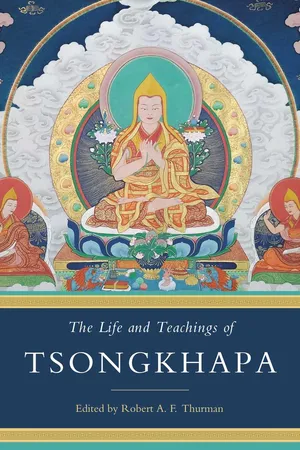
The Life and Teachings of Tsongkhapa
eBook - ePub

The Life and Teachings of Tsongkhapa

  1. 296 pages
  2. English
  3. ePUB (mobile friendly)
  4. Available on iOS & Android
eBook - ePub

The Life and Teachings of Tsongkhapa

About this book

A must-read for students of Tibetan Buddhism, The Life and Teachings of Tsongkhapa provides a thorough exploration of the great teacher's wisdom. In The Life and Teachings of Tsongkhapa, you'll discover Tsongkhapa's teachings on

  • transcendental aspects of sutra, tantra, and insight meditation,
  • mystic conversations with great bodhisattvas,
  • deeply spiritual songs in praise of Manjushri and Maitreya,
  • and much more.


The anthology concludes with a number of intensely moving songs in praise of Tsongkhapa and his immeasurable contribution to Tibetan Buddhism by such realized and remarkable Tibetan Buddhists as the Seventh Dalai Lama, the Eighth Karmapa, Dulnagpa Palden, and Khedrup Je. This edition has been substantially corrected by Robert Thurman and contains a new introduction and a bibliography of all the works referenced in the text.

Frequently asked questions

Yes, you can cancel anytime from the Subscription tab in your account settings on the Perlego website. Your subscription will stay active until the end of your current billing period. Learn how to cancel your subscription.
At the moment all of our mobile-responsive ePub books are available to download via the app. Most of our PDFs are also available to download and we're working on making the final remaining ones downloadable now. Learn more here.
Perlego offers two plans: Essential and Complete
  • Essential is ideal for learners and professionals who enjoy exploring a wide range of subjects. Access the Essential Library with 800,000+ trusted titles and best-sellers across business, personal growth, and the humanities. Includes unlimited reading time and Standard Read Aloud voice.
  • Complete: Perfect for advanced learners and researchers needing full, unrestricted access. Unlock 1.4M+ books across hundreds of subjects, including academic and specialized titles. The Complete Plan also includes advanced features like Premium Read Aloud and Research Assistant.
Both plans are available with monthly, semester, or annual billing cycles.
We are an online textbook subscription service, where you can get access to an entire online library for less than the price of a single book per month. With over 1 million books across 1000+ topics, we’ve got you covered! Learn more here.
Look out for the read-aloud symbol on your next book to see if you can listen to it. The read-aloud tool reads text aloud for you, highlighting the text as it is being read. You can pause it, speed it up and slow it down. Learn more here.
Yes! You can use the Perlego app on both iOS or Android devices to read anytime, anywhere — even offline. Perfect for commutes or when you’re on the go.
Please note we cannot support devices running on iOS 13 and Android 7 or earlier. Learn more about using the app.
Yes, you can access The Life and Teachings of Tsongkhapa by Robert A.F. Thurman in PDF and/or ePUB format, as well as other popular books in Philosophy & Eastern Philosophy. We have over one million books available in our catalogue for you to explore.

Information

PART 1
LIFE, LIBERATION, AND ACCOMPLISHMENTS
The first chapter in this part, “A Short Biography,” was taught by Geshé Ngawang Dhargé in Dharamsālā at the Library of Tibetan Works & Archives, translated in the main by Khamlung Tulku. Its major source is Khedrup Jé’s Haven of Faith, the standard short biography that is usually printed at the beginning of Tsongkhapa’s Collected Works. I have a complete draft translation of this work, which will be forthcoming sometime soon. It is included here essentially to give the reader an idea of the many-sided marvel of the life of this great scholar, saint, and teacher-adept.
The second chapter is included to show, in Tsongkhapa’s own words, the extreme breadth and depth of his education and experience, as well as his own sense of gratitude to Mañjuśhrī, his final guru. I translated this myself.
The third chapter balances the picture of his vast learning with a sketch of the richness of his mystic experiences, the catalog of his visions sounding like an iconographic encyclopedia.
1A Short Biography
Image
The great Nyingma teacher Lhodrak Khenchen Namkha Gyaltsen once asked the Bodhisattva Vajrapāṇī to describe the qualities of Lama Jé Tsongkhapa; but since these were innumerable, Vajrapāṇī was unable to do so. To hear the complete biography of the Lord Tsongkhapa would take at least a year. This brief exposition has been compiled merely as an introduction for English-speaking readers.
Tsongkhapa, popularly known as Jé Rinpoche, was born in 1357, the year of the bird, in the Tsong Kha region of Amdo Province, in eastern Tibet. His father, who was bold but unassuming, energetic yet taciturn and reserved, was constantly engaged in thoughts of the Teaching and recited the Expression of the Names of Mañjuśhrī each day. His mother, a guileless and very kind woman, was always chanting the six-syllable mantra of Avalokiteśhvara — oṃ mani padme hūṃ. They had six sons, Tsongkhapa being the fourth.
During the time of Buddha Śhākyamuni, Tsongkhapa, in a previous incarnation, was a young boy who offered the Buddha a clear, crystal rosary and received a conch shell in return. The Buddha then called his disciple Ānanda to him and prophesied that the boy would be born in Tibet, would found a great monastery between the areas of Dri and Den, and would present a crown to the statue of the Buddha in Lhasa and be instrumental in the flourishing of the Dharma in Tibet. The Buddha gave the young boy the future name of Sumati Kīrti, or, in Tibetan, Losang Drakpa.
All this occurred exactly as the Buddha had prophesied. The conch shell that the Buddha had given the boy was unearthed during the building of Ganden monastery and, until 1959, could still be seen in Drepung, the largest monastery in Tibet. The crown still rests on the head of the Buddha statue in Lhasa.
Over a thousand years after the passing of Śhākyamuni Buddha, further prophesies relating to Jé Rinpoche were given by the lotus-born guru Padmasambhava. He predicted that a fully ordained Buddhist monk named Losang Drakpa would appear in the east near the land of China. He said that this monk would be regarded as being an emanation of a bodhisattva of the greatest renown and would attain the complete enjoyment body of a buddha.
During the year of the monkey, which preceded his birth, his parents had unusual dreams. His father dreamed of a monk who came to him from the Five-Peaked Mountain (Wu-tai-shan) in China, a place particularly associated with Mañjuśhrī. This monk required shelter for nine months, which, in the dream, his father gave by accommodating him in their shrine room for that length of time.
His mother dreamed that she and one thousand other women were in a flower garden, to which a boy dressed in white and carrying a vessel came from the east while a girl dressed in red and holding peacock feathers in her right hand and a large mirror in her left came from the west. The boy went to each of the women in turn and asked the girl if the woman would be suitable. The girl repeatedly rejected them until the boy pointed to Tsongkhapa’s mother, whom she indicated as the perfect choice. The boy and girl then purified Tsongkhapa’s mother by bathing her, and when she awoke the next day she felt very light.
In the first month of the year of the bird, Jé Rinpoche’s parents again had striking dreams. His mother saw monks coming with many different ritual objects, saying that they were going to invoke the statue of Avalokiteśhvara. When the statue appeared, it was as big as a mountain, yet as it approached her it diminished in size, finally entering her body through her crown aperture.
Tsongkhapa’s father dreamed of Vajrapāṇī, who, from his own pure realm, threw down a vajra, which landed on his wife.
Just before giving birth, his mother dreamed of many monks arriving with offerings. When she inquired about their purpose they replied that they had come to pay their respects and gain an audience. Simultaneously, the boy in white from her previous dream appeared and pointed to her womb. With key in hand he entered it and opened a box, from which came the golden statue of Avalokiteśhvara. This statue was stained, and a girl in red appeared and cleaned it with a peacock feather. This dream symbolized that Tsongkhapa would be an emanation of Avalokiteśhvara as well as of Mañjuśhrī. The same morning, Tsongkhapa was born without causing any suffering to his mother. At the time of his birth an auspicious star appeared in the sky. These portents were ample evidence of the birth of someone remarkable. In this respect Jé Rinpoche’s birth resembled that of the Buddha.
Prior to these events, Tsongkhapa’s future great teacher, Chöjé Döndrup Rinchen, had been in Lhasa and had learned that upon his return to Amdo, he would find a disciple who was an emanation of Mañjuśhrī. After Tsongkhapa’s birth, he sent his chief disciple to the parents with a protection knot, some relic pills, and a letter of greeting.
At the age of three, Tsongkhapa took layman’s vows from the Fourth Karmapa Lama Rölpai Dorjé and received the name Kunga Nyingpo.
When Tsongkhapa’s parents invited Chöjé Döndrup Rinchen to their home, the lama brought horses, sheep, and a huge number of gifts, which he gave to Tsongkhapa’s father. When the lama requested the father to part with his son, the father was delighted at the prospect of his child being with such a great teacher and allowed him to leave with the lama.
Before taking the novice vows, Tsongkhapa received many tantric initiations and teachings, including the Heruka empowerment, and was given the secret name of Dönyo Dorjé. When he was seven, he fulfilled his yearning to take the novice vows, receiving them from his teacher. It is here that he was given the name of Losang Drakpa, which, forty years later, was to become the most talked about and controversial nom de plume in central Tibet.
Tsongkhapa attached greater importance to guarding his vows than he did his eyes or his own life. He had entered the mandalas of Heruka, Hevajra, Yamāntaka, and other deities before receiving ordination, and was even performing self-initiation meditations on Heruka when he was only seven. Before self-initiation is allowed, a major retreat of the specific deity must be completed.
His eminent teacher took care of him until he went to central Tibet at the age of sixteen. Before the statue of Śhākyamuni Buddha in the Lhasa Cathedral, he offered prayers to enable his completion of all the stages of sutra and tantra in order to mature and lead other trainees to enlightenment.
Chöjé Döndrup Rinchen proffered advice in poetical form to the effect that Tsongkhapa should first study and master the Ornament of Realizations (Abhisamayālaṃkāra) and then approach the other four great treatises. The lama further suggested Tsongkhapa’s lifelong choice of meditational deities to whom he should make offerings and with whom he should feel perpetually inseparable. The following deities were to be cultivated accordingly: Yamāntaka for the continuation of his practice, Vajrapāṇī for freedom from interruptions, Mañjuśhrī for increase in wisdom and discriminating awareness, Amitāyus for long life, and the three Dharma protectors — Vaiśhravaṇa, the six-armed Mahākāla, and Dharmarāja — for protection and for the availability of prerequisites while practicing.
On his departure, his master came with him as far as Tsongkha Kang, from where Tsongkhapa went on alone, walking backward with his hands folded at his heart and reciting the Hymn of the Names of Mañjuśhrī. When he reached the line “Those who do not return to cyclic existence never come back,” he had tears in his eyes, for he realized that he would never return to Amdo.
Traveling with Denma Rinchen Pal, in autumn of the year of the bull (1373), Tsongkhapa arrived at Drikung, a five-day journey from Lhasa, where he met the head lama of the Drikung Kagyü monastery, Chennga Chökyi Gyalpo by name. This great lama was his first teacher after...

Table of contents

  1. Cover Page
  2. Title Page
  3. Contents
  4. Preface: by Gyatso Tsering
  5. Introduction: by Robert A. F. Thurman
  6. Part 1. Life, Liberation, and Accomplishments
  7. Part 2. Stages of the Path to Enlightenment
  8. Part 3. Middle Way Critical Philosophy: Insight Meditation
  9. Part 4. Praises, Prayers, and a Mystic Conversation
  10. Part 5. Praises and an Invocation
  11. Notes
  12. Bibliography
  13. Index
  14. About the Author
  15. Copyright