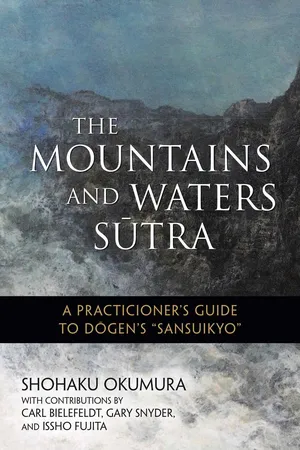
The Mountains and Waters Sutra
eBook - ePub

The Mountains and Waters Sutra

A Practitioner's Guide to Dogen's "Sansuikyo"

  1. 328 pages
  2. English
  3. ePUB (mobile friendly)
  4. Available on iOS & Android
eBook - ePub

The Mountains and Waters Sutra

A Practitioner's Guide to Dogen's "Sansuikyo"

About this book

An indispensable map of a classic Zen text. "Mountains and waters are the expression of old buddhas." So begins "Sansuikyo, " or "Mountains and Waters Sutra, " a masterpiece of poetry and insight from Eihei Dogen, the thirteenth-century founder of the Soto school of Zen. Shohaku Okumura—renowned for his translations of and magisterial teachings on Dogen—guides the reader through the rich layers of metaphor and meaning in "Sansuikyo, " which is often thought to be the most beautiful essay in Dogen's monumental Shobogenzo. His wise and friendly voice shows us the questions Dogen poses and helps us realize what the answers could be. What does it mean for mountains to walk? How are mountains an expression of Buddha's truth, and how can we learn to hear the deep teachings of river waters? Throughout this luminous volume, we learn how we can live in harmony with nature in respect and gratitude—and awaken to our true nature.
Frequently asked questions

Yes, you can cancel anytime from the Subscription tab in your account settings on the Perlego website. Your subscription will stay active until the end of your current billing period. Learn how to cancel your subscription.
At the moment all of our mobile-responsive ePub books are available to download via the app. Most of our PDFs are also available to download and we're working on making the final remaining ones downloadable now. Learn more here.
Perlego offers two plans: Essential and Complete
  • Essential is ideal for learners and professionals who enjoy exploring a wide range of subjects. Access the Essential Library with 800,000+ trusted titles and best-sellers across business, personal growth, and the humanities. Includes unlimited reading time and Standard Read Aloud voice.
  • Complete: Perfect for advanced learners and researchers needing full, unrestricted access. Unlock 1.4M+ books across hundreds of subjects, including academic and specialized titles. The Complete Plan also includes advanced features like Premium Read Aloud and Research Assistant.
Both plans are available with monthly, semester, or annual billing cycles.
We are an online textbook subscription service, where you can get access to an entire online library for less than the price of a single book per month. With over 1 million books across 1000+ topics, we’ve got you covered! Learn more here.
Look out for the read-aloud symbol on your next book to see if you can listen to it. The read-aloud tool reads text aloud for you, highlighting the text as it is being read. You can pause it, speed it up and slow it down. Learn more here.
Yes! You can use the Perlego app on both iOS or Android devices to read anytime, anywhere — even offline. Perfect for commutes or when you’re on the go.
Please note we cannot support devices running on iOS 13 and Android 7 or earlier. Learn more about using the app.
Yes, you can access The Mountains and Waters Sutra by Shohaku Okumura, Shodo Spring in PDF and/or ePUB format, as well as other popular books in Theology & Religion & Eastern Philosophy. We have over one million books available in our catalogue for you to explore.
APPENDIX 1. CIRCUMAMBULATING THE MOUNTAINS AND WATERS
I FIRST ENTERED into the Mountains and Waters at Tassajara thirty years ago, when I was young and foolish. After that, I wandered off, into the halls of academe, getting gradually old and foolish. And now it seems I’ve circled back, to start all over again. Odd how my life somehow got bound up with this old book by Dōgen.
I set out to translate the book in 1971, when I was a student at Berkeley and studying Zen with Shunryū Suzuki in San Francisco. At the time, I was looking to try out my new knowledge of Japanese on Dōgen, and Suzuki suggested that I take a look at the “Mountains and Waters Sūtra.” A look convinced me it was much too hard for me, but Suzuki said I should do it anyway and offered to help. I had one short, sweet summer at Tassajara, sitting in the sycamore shade with my books and meeting with the man to go over the text. Then, the man was gone, and I was off to classrooms in Tōkyō. I figured that was more or less the end of it.
However, a few years ago, one of my students at Stanford, Mark Gonnerman, got an idea for a seminar on Gary Snyder’s long poem Mountains and Rivers Without End. When Gary came down from the Sierras to read for us, he talked about how that old Tassajara translation had worked its way into his work on the book. Sure enough, if you follow Gary’s trail through the book, you can see Dōgen’s mountains walking across the landscape of the poems. So Mark asked me to rework my translation and give a talk on the sūtra for his seminar. And there I was, a lifetime later, back where I started — but with many more books and no man to help.
Meanwhile, around the same time, the Sōtōshū Shūmuchō had the idea of starting up the Sōtō Zen Text Project to translate the entire Shōbōgenzō, and somehow I got involved, even though I still couldn’t understand what Dōgen was talking about. I used to think that I shouldn’t try to translate the Shōbōgenzō till I understood Dōgen, but recently I’ve come to realize that I can’t wait for that anymore and should just do it anyway, as Suzuki said. I figure that he must have understood what Dōgen was getting at and, if he had just lived a little longer, could have used even a poor translation of the “Mountains and Waters Sūtra” to explain it to people. I figure others probably understand and may be able to use whatever I can do now to explain it to people. Anyway, with a book like the Shōbōgenzō, you can’t have too many translations.
There are already several translations of the Shōbōgenzō, and more are coming out now all the time. Some of them seem pretty poor, but some are really good. I don’t think my own translations will be better than the good ones, but I want to try something a little different from most of what I’ve seen so far. Of course, there are lots of ways to translate, each with its own virtues and vices. When the translator doesn’t understand what the author is talking about, probably the safest approach is to keep as close as possible to the author’s language. Every translator has to cook her text, but the trick in this approach is to try for no more than medium rare, so the reader can still taste some of the raw juices of the original words.
The chief virtue here, at least when all goes well, is that the translation will have less of the translator’s own ideas. The chief vice is that the translation will be hard to read, with a foreign feel, full of odd diction and unusual syntax. Sometimes, this minimalist approach may catch more of the author’s style; other times it can distort the style, making what may originally have been smooth and flowing for the native reader into something twisted and clunky. Sometimes, it can make a passage seem more difficult or more exotic than it really is, turning what was fairly easy and idiomatic into something strange and fraught with unintended mystery; but it can also preserve some of the original strangeness and keep open mysteries that are inherent in the text.
Every translation is a bunch of trade-offs, every translator is a negotiator between author and audience. But when the negotiations get tough, as they often do with Dōgen, I guess I’d rather let the reader wrestle with the difficulties of his medieval Japanese diction and syntax than make her read my own ideas in easy English paraphrase. Dōgen loved his language, and he was a master of it. He had his own ways of saying things, strange, powerful ways, notoriously demanding of the reader. The language of his Shōbōgenzō has been boggling minds in Japan for almost eight hundred years now, and it seems only fair to let it boggle us for a while. Anyway, in another hundred years or so, today’s elegant English translations will probably look just as cramped and quaint as the clunky ones that stick closer to the text.
The point of avoiding easy paraphrase and sticking close to the language of the text is not just to keep the translation as difficult for the reader as the original but to make it easier for the reader to get behind the translation to the original difficulties. And for this, I want to have as many notes as possible. Not just the usual notes on Buddhist technical terms and Zen masters’ names but all sorts of notes on interesting words and ambiguous phrases, on ordinary idioms and obscure allusions, on puns and word plays. Notes that warn when the translation doesn’t really get it or is just a guess; notes that give other options than the one I end up choosing. I want notes that say things like “The antecedent of the pronoun here isn’t clear, but Menzan’s commentary says it’s X.”
One of the things I like best about the Shūmuchō translation project is that it allows me to indulge this footnote fetish. Publishers, even academic presses, don’t like a lot of notes; they make a book too bulky and expensive. But right from the start of the Sōtō Zen Text Project, we decided that, in addition to publishing our work as a book, we’d have an electronic version of our translations that includes all our notes on the texts. Most people probably won’t care about them, but at least they’ll be there for anyone who really wants to get into the Shōbōgenzō. Maybe teachers can use them sometimes to prepare lectures; maybe people can use them to make better translations.
It’s one of the great luxuries of academic life that one can while away half a day tracking down a single strange word in old books. Of course, this way of doing things means you go pretty slowly. At this point, I guess our project has about one-fourth of the Shōbōgenzō in draft form, but it will still be several years before we can go to press. Meanwhile, we wanted to start making some of our work available, in order to see how people like it and get suggestions on what we might do better. We’re happy that the Education Center have offered us space in Dharma Eye to run a series of our translations. As you might guess, I’m especially happy that we’re starting off the series with my old friend, the “Mountains and Waters Sūtra.”
The translations we put in Dharma Eye can’t include all our notes. But as we publish our work in Dharma Eye, we’ll be putting it on the internet, together with our annotation. The Stanford Center for Buddhist Studies has kindly let us use a corner of their server to put up a Sōtō Zen Text Project website, where you can find the translations, as well as news of the project and a handy email form for sending us messages. Please come and visit us.
Prof. Carl Bielefeldt
Stanford University
Carl Bielefeldt is an American scholar specializing in East Asian studies, editor of the Sōtō Zen Text Project, and in 1971 was the first translator of Sansuikyō into English. This essay first appeared in Dharma Eye, no. 9, October 2001.
APPENDIX 2. MOUNTAINS HIDDEN IN MOUNTAINS: DŌGEN ZENJI AND THE MIND OF ECOLOGY
PROLOGUE: SERVING SENTIENT BEINGS
In what manner should one accommodate and serve sentient beings? To do so, one should think: “Throughout the realm-of-dharmas and the realm-of-space, in the ocean-like cosmos in the ten directions, there are infinite kinds of sentient beings; some are born of eggs, some are born of the womb, of wetness, or of metamorphosis; . . . some live by earth, some by water, fire, wind, space, trees, or flowers. . . . O countless are their kinds and infinite are their forms, shapes, bodies, faces, life-spans, races, names, dispositions, views, knowledge, desires, inclinations, manners, costumes, and diets. They abide in numerous kinds of dwellings: in towns, villages, cities, and palaces. They comprise the devas, the nagas, the heavenly musicians, the tree nymphs . . . humans, nonhumans, beings without feet, beings with two, four, or many feet; some are with form, some are without form, some with or without thoughts, or neither with nor without thoughts. To all these infinite kinds of beings, I will render my service and accommodate them in whatever way is beneficial to them.”
Why should we cherish all sentient beings?
Because sentient beings are the roots of the tree-of-awakening.
The Bodhisattvas and the buddhas are the flowers and fruits.
Compassion is the water for the roots.
— Hua-yen Sūtra
I. OPENING THE MOUNTAIN
I grew up on a farm in the eastern Pacific, western North America, in the Puget Sound area of Washington State. I worked as a kid caring for the family milk cows and entering the forest, and as I grew older I explored the vast Cascade range. I become an avid backpacker, mountain climber, and amateur naturalist. I also witnessed excessive exploitation of the forests and began to do environmental politics while still in high school.
Puget Sound in the 1930s was about like Yayoi, Japan: some parts developed but much wild land left. Today it is 90 percent logged. As I studied history and literature, both occidental and oriental, I learned that Hinduism and Buddhism shared the ethical precept of ahimsā, nonharming, and that this was meant to embrace not just human beings but all living beings. This definitely tilted me toward Asia. This proclivity was reinforced by seeing East Asian landscape paintings, by reading Chinese and Japanese poetry in translation, and by the Daoist writings of Lao-tzu and Chuang-tzu. I discovered Indian mythology and cosmology and yoga practice. I went on to read up on early Indian Buddhism, Mahayana sūtras, and Zen. When I arrived at Zen I finally saw the connections between the insights of Mahāyāna sūtras, Daoist thought, sumi painting, poetry, Indian yoga, and zazen practice.
It was a few more years before I discovered Dōgen. By that time I was living in Kyōto studying at Daitoku-ji with the sōdō-rōshi,124 Oda Sessō. I was introduced to Dōgen by the elderly Morimoto-Rōshi of Nagaoka Zenjuku, with whom I occasionally visited, and who once admiringly said: “Dōgen! You should look at Dōgen. He gives Zen away, he tells everything! Dōgen is like a clam. He opens his mouth and you can see down to the bottom of his stomach. Read the Shōbōgenzō.” There was not much Dōgen in translation then. I found an early translation of the Zuimonki in Kyōto. Back in the States I ran into Dr. Carl Bielefeldt’s translation of “Sansuikyō” when it was still part of his M.A. draft. (Someone at Page Street, I think, smuggled it to me.)
Once I had read the “Sansuikyō” and gotten a little sense of Dōgen’s approach to both practice and the phenomenal world of nature, I knew I was dealing with something far richer than just an East-Asian nature sensibility, far more than “love of nature” with its limited and chosen range of subjects, but with a great mind that played across all the realms. As a person who had worked outdoors for the Forest Service and logging companies, and as one who had lived for months in remote mountaintop fire-lookout cabins, I also took mountains and rivers pretty literally. They were the wildest and most exciting features of the landscape, waiting to be traveled on foot or by canoe.
You cannot see the landscape with accuracy and clarity if you just drive across it in a train or car. The only way a landscape can be known is by walking across it, day after day. I realized that Dōgen knew his mountains and rivers not only from zazen but from his own walking — starting with his hike up Mount Hiei when he was nine or ten. Like everyone in those days, he was doubtless walking hundreds of miles, up hill and down, in both Japan and China, for most of his life.
II. BILLIONS OF BEINGS SEE THE MORNING STAR, AND THEY ALL BECOME BUDDHAS
There have been many Dōgens brought forward in this century: the strict monk, the big-spirited teacher, the philosopher, the aristocrat, and the poet. And maybe I should suggest the peripatetic, the walker, the hiker. These facets of the great teacher are called forth of course by different constituencies, groups with different views, who “construct” Dōgen to fit their needs. No blame for this; it happens constantly everywhere.
Now it becomes possible for contemporary environmentalists, of wide and compassionate view, also to think of Dōgen as a kind of ecologist. An ecologist, not just a Buddhist priest who had a deep sensibility for nature, but a proto-ecologist, a thinker who had remarkable insight deep into the way that wild nature works. At the risk of saying what’s already known, I’ll say a few words about ecology as a scientific discipline.
Ecology is originally based on biology. It now incorporates methods and information from physics, mathematics, and even engineering. The English word was created in the nineteenth century from the Greek root oikos, which means “household,” ...

Table of contents

  1. Cover Page
  2. Title Page
  3. Contents
  4. Foreword · Issho Fujita
  5. Editor’s Preface · Shodo Spring
  6. Introduction
  7. The Text
  8. The Commentary
  9. Appendix 1. Circumambulating the Mountains and Waters · Carl Bielfeldt
  10. Appendix 2. Mountains Hidden in Mountains: Dōgen Zenji and the Mind of Ecology · Gary Snyder
  11. Appendix 3. The Meaning of the Title Shōbōgenzō
  12. Appendix 4. Furong Daokai
  13. Notes
  14. Glossary of Names
  15. Glossary of Terms and Texts
  16. Bibliography
  17. Index
  18. About the Author
  19. Copyright