
- 296 pages
- English
- ePUB (mobile friendly)
- Available on iOS & Android
eBook - ePub
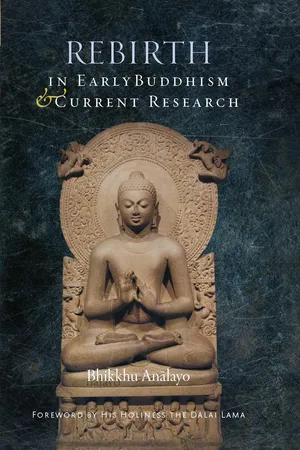
Rebirth in Early Buddhism and Current Research
About this book
Join a rigorous scholar and Buddhist monk on a brisk tour of rebirth from ancient doctrine to contemporary debates.
German Buddhist monk and university professor Bhikkhu Analayo had not given much attention to the topic of rebirth before some friends asked him to explore the treatment of the issue in early Buddhist texts. This succinct volume presents his findings, approaching the topic from four directions. The first chapter examines the doctrine of rebirth as it is presented in the earliest Buddhist sources and the way it relates to core doctrinal principles. The second chapter reviews debates about rebirth throughout Buddhist history and up to modern times, noting the role of confirmation bias in evaluation of evidence. Chapter 3 reviews the merits of current research on rebirth, including near-death experience, past-life regression, and children who recall previous lives. The chapter concludes with an examination of xenoglossy, the ability to speak languages one has not learned previously, and chapter 4 examines the particular case of Dhammaruwan, a Sri Lankan boy who chants Pali texts that he does not appear to have learned in his present life. Rebirth in Early Buddhism and Current Research brings together the many strands of the debate on rebirth in one place, making it both comprehensive and compact. It is not a polemic but an interrogation of the evidence, and it leaves readers to come to their own conclusions.
Frequently asked questions
Yes, you can cancel anytime from the Subscription tab in your account settings on the Perlego website. Your subscription will stay active until the end of your current billing period. Learn how to cancel your subscription.
At the moment all of our mobile-responsive ePub books are available to download via the app. Most of our PDFs are also available to download and we're working on making the final remaining ones downloadable now. Learn more here.
Perlego offers two plans: Essential and Complete
- Essential is ideal for learners and professionals who enjoy exploring a wide range of subjects. Access the Essential Library with 800,000+ trusted titles and best-sellers across business, personal growth, and the humanities. Includes unlimited reading time and Standard Read Aloud voice.
- Complete: Perfect for advanced learners and researchers needing full, unrestricted access. Unlock 1.4M+ books across hundreds of subjects, including academic and specialized titles. The Complete Plan also includes advanced features like Premium Read Aloud and Research Assistant.
We are an online textbook subscription service, where you can get access to an entire online library for less than the price of a single book per month. With over 1 million books across 1000+ topics, weāve got you covered! Learn more here.
Look out for the read-aloud symbol on your next book to see if you can listen to it. The read-aloud tool reads text aloud for you, highlighting the text as it is being read. You can pause it, speed it up and slow it down. Learn more here.
Yes! You can use the Perlego app on both iOS or Android devices to read anytime, anywhere ā even offline. Perfect for commutes or when youāre on the go.
Please note we cannot support devices running on iOS 13 and Android 7 or earlier. Learn more about using the app.
Yes, you can access Rebirth in Early Buddhism and Current Research by Bhikkhu Analayo in PDF and/or ePUB format, as well as other popular books in Theology & Religion & Buddhism. We have over one million books available in our catalogue for you to explore.
Information
Transcriptions
INTRODUCTION
IN WHAT FOLLOWS I present transcripts of the PÄli chants by Dhammaruwan selected for study in this book, arranged in sequence according to their placing in the PÄli canon. Words in the transcripts that differ from any of the main editions consulted are underlined; an underlined ellipsis marks a place where one or more of the editions has additional material. In the footnotes to these underlined occurrences I first refer to the recordings, combining an abbreviation for the text with the count of minutes and seconds of the approximate time when this particular phrase occurs in the recording.452 This is followed by the variants in the four PÄli editions consulted (Be: Burmese, Ce: Ceylonese, Ee: Pali Text Society, and Se: Siamese), from which I only note those that make a clearly audible difference.453 The same goes for the annotation in these editions, from which I only record variants mentioned in the editionās notes if these correspond to the reading in question. The footnotes appended to the titles of the texts give information about the location of the discourse in the Pali Text Society edition and the parts of the discourse covered by the recording.454
DN 15 MahÄnidÄna-sutta455
evaį¹ me sutaį¹. ekaį¹ samayaį¹ bhagavÄ kurÅ«su viharati kammÄsadhammaį¹ nÄma kurÅ«naį¹ nigamo.
atha kho ÄyasmÄ Änando yena bhagavÄ tenā upasaį¹
kami. upasaį¹
kamitvÄ bhagavantaį¹ abhivÄdetvÄ ekamantaį¹ nisÄ«di. ekamantaį¹ nisinno kho ÄyasmÄ Änando bhagavantaį¹ etad avoca:
acchariyaį¹ bhante abbhutaį¹ bhante yÄva gambhÄ«ro cÄyaį¹ bhante paį¹iccasamuppÄdo gambhÄ«rÄvabhÄso ca, atha ca pana me uttÄnakuttÄnako viya khÄyatÄ« ti.
mÄ hā evaį¹ Änanda avaca, mÄ hā evaį¹ Änanda avaca. gambhÄ«ro cÄyaį¹, Änanda,456 paį¹iccasamuppÄdo gambhÄ«rÄvabhÄso ca. etassa Änanda dhammassa ananubodhÄ appaį¹ivedhÄ evam ayaį¹ pajÄ tantÄkulakajÄtÄ guį¹agaį¹į¹hikajÄtÄ457 muƱjapabbajabhÅ«tÄ apÄyaį¹ duggatiį¹ vinipÄtaį¹ saį¹sÄraį¹ nÄtivattati.
atthi idappaccayÄ jarÄmaraį¹an ti iti puį¹į¹hena satÄ Änanda atthiā ssa458 vacanÄ«yaį¹. kim paccayÄ jarÄmaraį¹an ti iti ce vadeyya, jÄtipaccayÄ jarÄmaraį¹an ti iccā assa vacanÄ«yaį¹.
atthi idappaccayÄ jÄtÄ« ti iti puį¹į¹hena satÄ Änanda atthi āssa459 vacanÄ«yaį¹. kim paccayÄ jÄtÄ« ti iti ce vadeyya, bhavapaccayÄ jÄtÄ« ti iccā assa vacanÄ«yaį¹.
atthi idappaccayÄ bhavo ti iti puį¹į¹hena satÄ Änanda atthi āssa460 vacanÄ«yaį¹. kim paccayÄ bhavo ti iti ce vadeyya, upÄdÄnapaccayÄ bhavo ti iccā assa vacanÄ«yaį¹.
atthi idappaccayÄ upÄdÄnan ti iti puį¹į¹hena satÄ Änanda atthi āssa461 vacanÄ«yaį¹. kim paccayÄ upÄdÄnan ti iti ce vadeyya, taį¹hÄpaccayÄ upÄdÄnan ti iccā assa vacanÄ«yaį¹.
atthi idappaccayÄ taį¹hÄ ti iti puį¹į¹hena satÄ Änanda atthi āssa462 vacanÄ«yaį¹. kim paccayÄ taį¹hÄ ti iti ce vadeyya, vedanÄpaccayÄ taį¹hÄ ti iccā assa vacanÄ«yaį¹.
atthi idappaccayÄ vedanÄ ti iti puį¹į¹hena satÄ Änanda atthi āssa463 vacanÄ«yaį¹. kim paccayÄ vedanÄ ti iti ce vadeyya, phassapaccayÄ vedanÄ ti iccā assa vacanÄ«yaį¹.
atthi idappaccayÄ phasso ti iti puį¹į¹hena satÄ Änanda atthi āssa464 vacanÄ«yaį¹. kim paccayÄ phasso ti iti ce vadeyya, nÄmarÅ«papaccayÄ phasso ti iccā assa vacanÄ«yaį¹.
atthi idappaccayÄ nÄmarÅ«pan ti iti puį¹į¹hena satÄ Änanda atthi āssa465 vacanÄ«yaį¹. kim paccayÄ nÄmarÅ«pan ti iti ce vadeyya, viƱƱÄį¹apaccayÄ nÄmarÅ«pan ti iccā assa vacanÄ«yaį¹.
atthi idappaccayÄ viƱƱÄį¹an ti iti puį¹į¹hen...
Table of contents
- Cover Page
- Title Page
- Contents
- Foreword by His Holiness the Dalai Lama
- Foreword by Bhante Gunaratana
- Acknowledgments
- Abbreviations
- Introduction
- I. The Early Buddhist Doctrine of Rebirth
- II. Debates on Rebirth
- III. Evidence Considered Supportive of Rebirth
- IV. Case Study in PÄli Xenoglossy
- Conclusion
- Transcriptions
- References
- Index
- About the Author
- Copyright