Science and Philosophy in the Indian Buddhist Classics, Vol. 1
eBook - ePub

Science and Philosophy in the Indian Buddhist Classics, Vol. 1

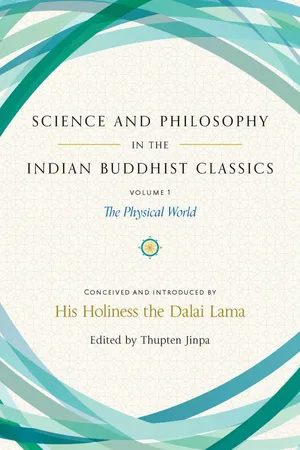
The Physical World

  1. 521 pages
  2. English
  3. ePUB (mobile friendly)
  4. Available on iOS & Android
eBook - ePub

Science and Philosophy in the Indian Buddhist Classics, Vol. 1

The Physical World

About this book

Explore the nature of our material world in a unique sourcebook, conceived by the Dalai Lama, collecting the scientific observations found in classical Buddhist treatises. 

Under the visionary supervision of His Holiness the Dalai Lama, Science and Philosophy in the Indian Buddhist Classics brings together classical Buddhist explorations of the nature of our material world and the human mind and puts them into context for the modern reader. It is the Dalai Lama’s view that the explorations by the great masters of northern India in the first millennium CE still have much that is of interest today, whether we are Buddhist or not.

Volume 1, The Physical World, explores the nature of our material world—from the macroscopic to the microscopic. It begins with an overview of the many frameworks, such as the so-called five aggregates, that Buddhist thinkers have used to examine the nature and scope of reality. Topics include sources of knowledge, the scope of reason, the nature and constituents of the material world, theories of the atom, the nature of time, the formation of the universe, and the evolution of life, including a detailed explanation of the early Buddhist theories on fetal development. The volume even contains a brief presentation on early theories about the structure and function of the brain and the role of microorganisms inside the human body. The book weaves together passages from the works of great Buddhist thinkers such as Asanga, Vasubandhu, Nagarjuna, Dignaga, and Dharmakirti. Each of the major topics is introduced by Thupten Jinpa, the Dalai Lama’s principal English-language translator and founder of the Institute of Tibetan Classics.
Frequently asked questions

Yes, you can cancel anytime from the Subscription tab in your account settings on the Perlego website. Your subscription will stay active until the end of your current billing period. Learn how to cancel your subscription.
No, books cannot be downloaded as external files, such as PDFs, for use outside of Perlego. However, you can download books within the Perlego app for offline reading on mobile or tablet. Learn more here.
Perlego offers two plans: Essential and Complete
  • Essential is ideal for learners and professionals who enjoy exploring a wide range of subjects. Access the Essential Library with 800,000+ trusted titles and best-sellers across business, personal growth, and the humanities. Includes unlimited reading time and Standard Read Aloud voice.
  • Complete: Perfect for advanced learners and researchers needing full, unrestricted access. Unlock 1.4M+ books across hundreds of subjects, including academic and specialized titles. The Complete Plan also includes advanced features like Premium Read Aloud and Research Assistant.
Both plans are available with monthly, semester, or annual billing cycles.
We are an online textbook subscription service, where you can get access to an entire online library for less than the price of a single book per month. With over 1 million books across 1000+ topics, we’ve got you covered! Learn more here.
Look out for the read-aloud symbol on your next book to see if you can listen to it. The read-aloud tool reads text aloud for you, highlighting the text as it is being read. You can pause it, speed it up and slow it down. Learn more here.
Yes! You can use the Perlego app on both iOS or Android devices to read anytime, anywhere — even offline. Perfect for commutes or when you’re on the go.
Please note we cannot support devices running on iOS 13 and Android 7 or earlier. Learn more about using the app.
Yes, you can access Science and Philosophy in the Indian Buddhist Classics, Vol. 1 by Thupten Jinpa, Ian Coghlan in PDF and/or ePUB format, as well as other popular books in Theology & Religion & Buddhism. We have over one million books available in our catalogue for you to explore.

Information

Part 1
Image
OVERVIEW AND METHODOLOGY
1
Image
Systems of Classification
WHEN ANCIENT INDIAN Buddhist texts present the topic of reality, they rely on numerous systems of classification. For example, in the Attainment of Knowledge (JƱānaprasthāna), which belongs to the Seven Treatises of Abhidharma,28 as well as its commentary the Great Treatise on Differentiation (Mahāvibhāṣāśāstra), three groupings are used to classify all phenomena: (1) aggregates, (2) elements, and (3) bases. First, all conditioned phenomena are systematically presented in the five aggregates (skandha): the aggregates of form, feeling, discernment, formation, and consciousness. When external and internal phenomena are classified by means of object, sense faculty, and consciousness, phenomena are presented in terms of the eighteen elements and the twelve bases. The eighteen elements (dhātu) consist of six objective elements — form, sound, smell, taste, tactility, and mental objects; [140] six sense-faculty elements that support consciousness — the eye sense faculty, ear sense faculty, nose sense faculty, tongue sense faculty, body sense faculty, and mental sense faculty; and six subjective elements that are supported consciousnesses — eye consciousness, ear consciousness, nose consciousness, tongue consciousness, body consciousness, and mental consciousness. When the term base (āyatana) is applied as part of this classification system, all phenomena are categorized in twelve bases: the six objects comprising the sense base of form, sound, smell, taste, tactility, and the base of mental objects; and the six sense faculties comprising the eye sense base, ear sense base, nose sense base, tongue sense base, body sense base, and mental sense base. In these classification systems, unconditioned phenomena are included in the mental-object element from the list of eighteen elements and the mental-object base29 in the enumeration of the twelve bases.
Alternatively, in Vaibhāṣika works such as Vasubandhu’s Treasury of Knowledge (Abhidharmakośa), the following framework of five basic categories of reality is presented: (1) evident material form, (2) primary minds, (3) concomitant mental factors, (4) nonassociated formative factors, and (5) unconditioned phenomena.
According to this classification all external and internal physical phenomena — the five sense objects such as material form and so forth and the five sense faculties such as the eyes — are included in the basic category of evident material form. The phenomena that constitute the inner world of consciousness are subsumed in the two categories of primary minds and concomitant mental factors. Those conditioned phenomena that belong to neither the class of material form nor consciousness — such as the three attributes of conditioned phenomena, namely, (1) arising, (2) enduring, and (3) disintegrating, as well as the three times of past, present, and future, and so forth — encompass the basic category of nonassociated formative factors. Finally, those phenomena that are not produced by causes and conditions constitute the basic category of unconditioned phenomena. In this way, all knowable objects are systematically classified in terms of the five basic categories of reality. [141]
In Indian Buddhist texts on epistemology, however, the presentation of reality is framed in terms of the following three topics: (1) the objects of knowledge, (2) the mind that knows, and (3) the way the mind engages objects. In contrast, in the texts of the Mind Only school, reality is presented in terms of the theory of the three natures: (1) dependent nature, (2) perfected nature, and (3) imputed nature.30 In the texts of the Middle Way (Madhyamaka) school, phenomena are presented in terms of (1) the basis, which comprises the two truths,31 (2) the path encompassing both method and wisdom,32 and (3) the result, namely, the truth body and the form body of a buddha.33 In the texts of tantra the presentation is arranged in terms of (1) the ground, that is, the nature of reality, (2) the stages for proceeding on the path, and (3) how the result is actualized. Thus, in brief, different formats were employed in classical Indian texts to systematically present the nature of reality.
In this two-volume compendium, we have organized our presentation on reality in terms of five major themes:
1.The presentation of knowable objects
2.The presentation of the cognizing mind
3.How the mind engages its objects
4.The means by which the mind ascertains objects
5.The presentation of the person, the agent who ascertains objects
One might ask, ā€œSince there are a vast number of Indian Buddhist treatises, what are the principal sources for this compendium?ā€ Here the presentation of physical phenomena in general, the primary elements and derivative form in particular, and the subtle and coarse particles that comprise material entities are based [142] by and large on the textual tradition of Abhidharma. We take as our sources: (1) the texts of the upper Abhidharma system, such as Asaį¹…ga’s Compendium of Abhidharma (Abhidharmasamuccaya) and its associated commentaries, (2) the Seven Treatises of Abhidharma as well as the Great Treatise on Differentiation, and (3) the treatises that expound these works, such as Vasubandhu’s Treasury of Knowledge as well as its associated writings belonging to the lower Abhidharma system.34 At times we have also consulted Bhāvaviveka’s Blaze of Reasoning (Tarkajvālā) and its commentarial tradition. In the specific section where the question of whether indivisible particles exist or not is analyzed, we have principally selected the logical arguments negating the existence of partless entities presented by NagārjÅ«na, Āryadeva, CandrakÄ«rti, and so on. We have also drawn from Vasubandhu’s Twenty Verses (Viį¹ƒÅ›atikā). As for the formation and destruction of external world systems and their inhabitants, and the progressive development of the fetus in the womb and so on, by and large we have relied on Nanda’s SÅ«tra on Entering the Womb, the texts of the upper and lower Abhidharma systems, the corpus of the Kālacakra tantra, and traditional medical texts. Information concerning the channels, winds, and drops of the subtle body is derived from the texts of highest yoga tantra as well as works on medical science. The presentation on the brain too is based on traditional medical texts. [143]
Regarding the presentation on the subjective mind, we have drawn primarily on Asaį¹…ga’s Five Treatises on the Grounds as well as Yogācāra texts associated with these works, Vasubandhu’s Treasury of Knowledge and its Autocommentary, and in particular the texts of the Buddhist epistemological tradition, such as the works of Dignāga and DharmakÄ«rti, as well as their subsequent commentators. The presentation on mental factors is compiled from the texts of the upper and lower Abhidharma systems. With regard to the levels of subtlety of mind, in terms of the notion of ā€œcoarseā€ and ā€œsubtleā€ minds contingent on (the subtlety of the mental states of) higher and lower realms of existence, we principally rely on the texts of the upper and lower Abhidharma systems as well as works pertaining to the Yogācāra school. As for the levels of subtlety of mind, the stages of dissolution of wind and mind, and the stages of death and so on as described in the highest yoga tantra system, we have drawn principally from the textual corpus of Guhyasamāja tantra as well as the cycle of texts belonging to the Kālacakra system.
On the way in which the mind engages its objects, we have taken the texts of the Buddhist epistemological tradition as our principal source while also drawing on the Yogācāra texts of Asaį¹…ga and his followers. With respect to the means by which the mind engages its object, in terms of the application of formal reasoning, we have based our presentation on the Buddhist sÅ«tras, Asaį¹…ga’s Śrāvaka Grounds (ŚrāvakabhÅ«mi), and so on, as well as Buddhist epistemological writings. On the essential points pertaining to the methods of training the mind, we have relied mainly on the following works: the Unraveling the Intention SÅ«tra (Saṃdhinirmocana-sÅ«tra), the texts of the upper and lower Abhidharma systems, and works belonging to the Yogācāra school. In particular, we have utilized these specific texts: Śāntideva’s [144] Engaging in the Bodhisattva’s Deeds (Bodhicāryāvatara) as well as his Compendium of Training (Śikṣāsamuccaya), DharmakÄ«rti’s Exposition of Valid Cognition (Pramāṇavārttika), and Kamalaśīla’s Stages of Meditation (Bhāvanākrama). Finally, on the presentation of the person, the one who ascertains objects, we have drawn from treatises such as those of the Middle Way school.
2
Image
Methods of Inquiry
CRITICAL ANALYSIS AND THE ā€œFOUR RELIANCESā€
QUESTION: When early Indian Buddhist thinkers in general and those of Nālandā University35 in particular established their presentations on reality through various approaches, such as in terms of the five aggregates, the elements, and the sense bases, did they do so on the basis of a literal acceptance of what is found in the scriptures, or did they develop their presentations based primarily on logical reasoning?
Response: In general, according to Buddhism, the way one should engage in the analysis of reality was stated in a sūtra by the Buddha himself: [145]
Monks and scholars, just as you test gold
by burning, cutting, and polishing it,
so too well examine my speech.
Do not accept it merely out of respect.36
Thus the Buddha advised his followers that when they examine the meaning of the scriptures, they should rigorously analyze the relevant topic just as a skilled goldsmith tests gold by burning, cutting, and polishing it. And only when one has gained confidence in its words should one have a conviction about a scriptural statement. It is inappropriate to have a conviction about something without critical analysis, simply because it has been stated by one’s teacher. So this sÅ«tra statement demonstrates that when analyzing the nature of reality, it is evidence derived from reasoning that is primary, not scripture.
In Buddhist texts in general and those of the Nālandā thinkers in particular, when a specific issue is analyzed, greater importance is accorded to direct experience compared with logical reasoning and scripture. Moreover, if one were to take scripture to be the sole authority when inquiring into the nature of reality, [146] that scripture too would require validation by another scripture. This second scripture, in turn, would need the support of another scripture, and so on, resulting in an infinite regress. Thus these words of the Buddha demonstrate that validation of scripture must ultimately rest on stainless reasoning, and such flawless logic must be grounded, in turn, in valid experience. Such an approach is commended by the Buddha.
Furthermore, if we were to investigate the treatises composed by eminent Nālandā thinkers, we find that readers should approach such works on the basis of critical inquiry pertaining to the subject matter of the text, not through faith and conviction from the beginning. When positive doubt (that is, doubt tending to the fact)37 has arisen, this is the stage when one engages the subject matter of the treatise. These thinkers also say that if the subject is presented in terms of the five elements of exposition, it helps to make the contents of the text easily perceivable to the reader’s mind. The five elements of exposition are:
1.Any treatise should have a purpose for its composition.
2.There should be a summary presentation of the main body of the treatise so that the essential points of the subject matter of the text may easily appear to the mind of the reader.
3.Then there should be a word meaning that constitute...

Table of contents

  1. Cover Page
  2. Title Page
  3. Contents
  4. Preface
  5. Introduction by His Holiness the Dalai Lama
  6. Part 1. Overview and Methodology
  7. Part 2. Knowable Objects
  8. Part 3. Subtle Particles
  9. Part 4. Time
  10. Part 5. The Cosmos and Its Inhabitants
  11. Part 6. Fetal Development and the Channels, Winds, and Drops
  12. Appendix: The Eighteen Topics of Chapa Chƶkyi SengƩ
  13. Notes
  14. Glossary
  15. Bibliography
  16. Index
  17. About the Authors
  18. Copyright