The Crystal Mirror of Philosophical Systems
eBook - ePub

The Crystal Mirror of Philosophical Systems

A Tibetan Study of Asian Religious Thought

  1. 696 pages
  2. English
  3. ePUB (mobile friendly)
  4. Available on iOS & Android
eBook - ePub

The Crystal Mirror of Philosophical Systems

A Tibetan Study of Asian Religious Thought

About this book

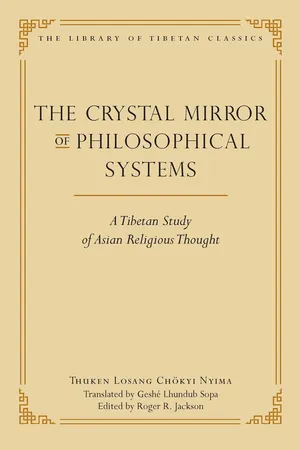
The Crystal Mirror of Philosophical Systems, by Thuken Losang Chokyi Nyima (1737-1802), is arguably the widest-ranging account of religious philosophies ever written in pre-modern Tibet. Like most Tibetan texts on philosophical systems, this work covers the major schools of India, both Buddhist and non-Buddhist, but then goes on to discuss in detail the entire range of Tibetan traditions as well, with separate chapters on the Nyingma, Kadam, Kagyu, Shije, Sakya, Jonang, Geluk, and Bon schools. Not resting there, Thuken goes on to describe the major traditions of China--Confucian, Daoist, and the multiple varieties of Buddhist--as well as those of Mongolia, Khotan, and even Shambhala. The Crystal Mirror of Philosophical Systems is unusual, too, in its concern not just to describe and analyze doctrines, but to trace the historical development of the various traditions. The Crystal Mirror of Philosophical Systems is an eloquent and erudite presentation exploring the religious history and philosophical systems of an array of Asian Cultures--and offering evidence that the serious and sympathetic study of the history of religions has not been a monopoly of Western scholarship.
Frequently asked questions

Yes, you can cancel anytime from the Subscription tab in your account settings on the Perlego website. Your subscription will stay active until the end of your current billing period. Learn how to cancel your subscription.
At the moment all of our mobile-responsive ePub books are available to download via the app. Most of our PDFs are also available to download and we're working on making the final remaining ones downloadable now. Learn more here.
Perlego offers two plans: Essential and Complete
  • Essential is ideal for learners and professionals who enjoy exploring a wide range of subjects. Access the Essential Library with 800,000+ trusted titles and best-sellers across business, personal growth, and the humanities. Includes unlimited reading time and Standard Read Aloud voice.
  • Complete: Perfect for advanced learners and researchers needing full, unrestricted access. Unlock 1.4M+ books across hundreds of subjects, including academic and specialized titles. The Complete Plan also includes advanced features like Premium Read Aloud and Research Assistant.
Both plans are available with monthly, semester, or annual billing cycles.
We are an online textbook subscription service, where you can get access to an entire online library for less than the price of a single book per month. With over 1 million books across 1000+ topics, we’ve got you covered! Learn more here.
Look out for the read-aloud symbol on your next book to see if you can listen to it. The read-aloud tool reads text aloud for you, highlighting the text as it is being read. You can pause it, speed it up and slow it down. Learn more here.
Yes! You can use the Perlego app on both iOS or Android devices to read anytime, anywhere — even offline. Perfect for commutes or when you’re on the go.
Please note we cannot support devices running on iOS 13 and Android 7 or earlier. Learn more about using the app.
Yes, you can access The Crystal Mirror of Philosophical Systems by Thuken Losang Chokyi Nyima, Roger R. Jackson, Lhundub Sopa in PDF and/or ePUB format, as well as other popular books in Theology & Religion & Buddhism. We have over one million books available in our catalogue for you to explore.

Information

1. Preface
[3] An Expression of Worship and Promise to Compose
I prostrate to the mighty Muni,63 the lord of philosophical systems,
Who saw everything in the untold billions of philosophical systems,
Refuted the positions of ill-spoken philosophical systems,
And gave teachings on the principles of pure philosophical systems.
I prostrate respectfully to the Unconquerable and to Mañjughoṣa,64
Who possessed the entire secret treasury of the Conqueror’s speech
And ordained the banquet of profound and extensive Dharma
With various emanations in countless fields.
May victory come to the two eyes of the world known as Nāgārjuna and Asaį¹…ga, who,
Distinguishing well between definitive and provisional scriptures, illuminated the great chariot-paths of Madhyamaka and Cittamātra
Exactly as prophesied by the Conqueror himself when he said, ā€œThere will rise a conjunct sun and moon
Who will open well, respectively, the hundred-petaled lotus and night-lily gardens of the two ways.ā€65
I bow respectfully to the ornaments that beautify Jambudvīpa:66
Āryadeva, Aśvaghoį¹£a, Bhāvaviveka, Buddhapālita,
Candrakīrti, Śāntideva, Vasubandhu, Haribhadra,
Sthiramati, Dignāga, DharmakÄ«rti, Guṇaprabha, and Śākyaprabhā.
I make prostrations as well to the assembly of mighty yogins who,
Drunk on the beer of bliss and emptiness, join with their great secret songs
In the banquet of fortunate supreme adepts
In the palace of the supreme vehicle, highest yoga tantra.
I bow down, remembering the kindness of the translators, pandits, and Dharma kings,
Who, with the strength of the green horse of their arousal of the awakening mind,
Drew the great light of the sun of the holy Dharma to this land,
Which, though surrounded by snow mountains, was covered with the darkness of confusion.67
I bow to all the supreme beings who, appearing different yet sharing a single nature,
Spread in this Land of Snows the ways of many different philosophical systems,
Which, though differently elucidated, come down to a single ultimate intention,
Like rivers and streams descending separately but mingling in a single ocean. [4]
I bow from my heart to the great lord Dīpaṃkara, who lovingly and unstintingly bestowed on his Tibetan disciples
The mighty king of teachings on the awakening mind, brought from SuvarṇadvÄ«pa after many hardships.
And I bow as well to the second conqueror and his spiritual sons;68 he took as his own the complete teaching of the Muni, and through his excellent explanations
And the marvel of a life lived purely, he opened the way of the Gandenpa,69 the greatest way of all.
I prostrate to the upholders of the Ganden teaching,
Who set atop the victory banner of explanation and practice
The wish-granting jewel of the unstained tradition of the protector70
And sent down the inexhaustible rain of all that is virtuous, good,71 and desirable.
I exalt at my crown Amitābha and Lokeśvara,
The mighty conquerors, father and son,72
Who, performing in saffron robes, cause the unremitting increase
Of the highest essence of the teaching of the Muni until samsara ends.
Until enlightenment, may there remain at the center of my heart the incomparably kind three-aspected gurus,73
Who, empowered by love for beings as if they were their own children, open the door to the inexhaustible Dharma treasury of the secret mind,
The mentors who freely bestow the essence of the wealth of excellent explanation, and in particular
The actualization of all buddhas, Rƶlpai DorjƩ, and those named Maitripāda and Ratna.74
Thus, with words of praise
And with flowers held in the folded hands of faith,
I have worshipped the great lord of the teaching,
The Muni, along with his spiritual sons and their students.
Many, under the sway of anger, have deprecated
The Dharmas and persons of other systems
Without even knowing how to properly distinguish among
The various philosophical systems in this land.
Many, under the sway of the four negative tendencies,
Failing to ascertain any reason
For the special distinctiveness of their own philosophical system,
And driven only by confusion and desire, still hold their system as supreme.
In order to set them in conscientiousness,
I will briefly discuss here
The sources and standpoints of the philosophical systems
That arose in the Holy Land75 of India and in Tibet and China.
If any there are with honest eyes,
Free of the cataracts of partiality,
They should view the many wondrous forms that appear
In this white crystal mirror of excellent explanation. [5]
A General Explanation of the Project
Now, countless are the ways in which logicians have conceived and established philosophical systems amid the world systems as measureless as space, and likewise the very pure philosophical systems that arose from the awakening mind and deeds of the Muni, the Buddha, the Blessed One76 are beyond number, so who could discuss the countless ways in which they arose? Here, I will discuss just briefly how different philosophical systems arose in particular lands in Jambudvīpa and the unique standpoints of each system.
This text, then, is fivefold: I. The history of philosophical systems in the Holy Land of India; II. Their history in Tibet, the Land of Snows; III. Their history in the land of Great China; IV. Their history in some other places; and V. The conclusion, which explains the outcome. Part I is twofold: A. The history of the non-Buddhist extremists and B. The history of the Buddhists.77 Section A is threefold: 1. The story of how the extremists arose; 2. A brief explanation of their standpoints; and 3. The purpose of explaining those.
2. Indian Schools78
I. The History of Philosophical Systems in the Holy Land of India79
A. The history of the non-Buddhist extremists80
1. The story of how the extremists arose
FOR A LONG TIME after this world had come into being, humans here in JambudvÄ«pa enjoyed uncultivated crops, but then lazy people began hoarding food, so farming became necessary. Then greedy people took what had not been given to them, and because of the discord that resulted, it became necessary to appoint a leader who could pass judgment. The first [6] leader was called King Saṃmāta (ā€œHonored by Manyā€).81
Seeing the king punish some evildoers at that time saddened certain beings, who then went to solitary places in the forest and remained there; thus arose the brahmans. Some of these hermits reduced their desires and achieved satisfaction; sitting alone, they isolated mind and body and so attained tranquil abiding. When they then gained supernormal and magical powers, they were called ā€œseers.ā€82 Of those, many who had attained supernormal powers and trained in logic analyzed their own mi...

Table of contents

  1. Cover Page
  2. Title Page
  3. Message from the Dalai Lama
  4. Special Acknowledgments
  5. Publisher’s Acknowledgments
  6. Contents
  7. General Editor’s Preface
  8. Translator’s Preface
  9. Editor’s Introduction
  10. Map of Tibet
  11. Technical Note
  12. The Crystal Mirror: An Excellent Explanation Showing the Sources and Assertions of All Philosophical Systems
  13. 1. Preface
  14. 2. Indian Schools
  15. 3. Introduction to Tibetan Buddhism
  16. 4. The Nyingma Tradition
  17. 5. The Kadam Tradition
  18. 6. The Kagyü Tradition
  19. 7. The ShijƩ Tradition
  20. 8. The Sakya Tradition
  21. 9. The Jonang and Minor Traditions
  22. 10. The Geluk Tradition 1: Tsongkhapa
  23. 11. The Geluk Tradition 2: Tsongkhapa’s Successors
  24. 12. The Geluk Tradition 3: The Distinctiveness of Geluk
  25. 13. The Bƶn Tradition
  26. 14. Chinese Traditions 1: Non-Buddhist
  27. 15. Chinese Traditions 2: Buddhist
  28. 16. Central Asian Traditions
  29. 17. Conclusion
  30. Appendix: Detailed Outline of Thuken’s Text
  31. Notes
  32. Glossary
  33. Glossary of Enumerations
  34. Bibliography
  35. Index
  36. About the Contribuors
  37. The Institute of Tibetan Classics
  38. The Library of Tibetan Classics
  39. Become a Benefactor of the Library of Tibetan Classics
  40. About Wisdom Publications
  41. A Note About Dust Jackets
  42. Copyright