- 224 pages
- English
- ePUB (mobile friendly)
- Available on iOS & Android
eBook - ePub
About this book
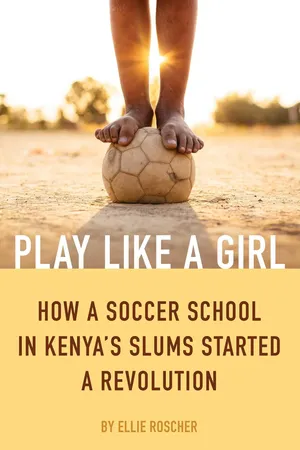
Growing up and living in Kibera, Kenya, Abdul Kassim was well aware of the disproportionate number of challenges faced by women due to the extreme gender inequalities that persist in the slums. After being raised by his aunts, mother, and grandmother and having a daughter himself, he felt that he needed to make a difference.
In 2002, Abdul started a soccer team for girls called Girls Soccer in Kibera (GSK), with the hope of fostering a supportive community and providing emotional and mental support for the young women in the town. The soccer program was a success, but the looming dangers of slum life persisted, and the young women continued to fall victim to the worst kinds of human atrocities. Indeed, it was the unyielding injustice of these conditions that led Abdul to the conclusion that soccer alone was not enough to create the necessary systemic change.
In 2006, after much work, the Kibera Girls Soccer Academy (KGSA) was established with their first class of 11 girls and 2 volunteer teachers. Today, KGSA is composed of 20 full-time staff, provides a host of artistic and athletic programs for more than 130 students annually, and continues to expand. By providing academics inside and outside of the classroom along with artistic and athletic opportunities, KGSA inspires the young women of Kibera to become advocates for change within their own communities and for Kenya as a whole.
Play Like a Girl tells the KGSA story through Abdul’s voice and vision and the stories of key staff and students. It is written by Ellie Roscher who spent 2 summers doing research at KGSA and several years writing this book.
Frequently asked questions
Yes, you can cancel anytime from the Subscription tab in your account settings on the Perlego website. Your subscription will stay active until the end of your current billing period. Learn how to cancel your subscription.
No, books cannot be downloaded as external files, such as PDFs, for use outside of Perlego. However, you can download books within the Perlego app for offline reading on mobile or tablet. Learn more here.
Perlego offers two plans: Essential and Complete
- Essential is ideal for learners and professionals who enjoy exploring a wide range of subjects. Access the Essential Library with 800,000+ trusted titles and best-sellers across business, personal growth, and the humanities. Includes unlimited reading time and Standard Read Aloud voice.
- Complete: Perfect for advanced learners and researchers needing full, unrestricted access. Unlock 1.4M+ books across hundreds of subjects, including academic and specialized titles. The Complete Plan also includes advanced features like Premium Read Aloud and Research Assistant.
We are an online textbook subscription service, where you can get access to an entire online library for less than the price of a single book per month. With over 1 million books across 1000+ topics, weâve got you covered! Learn more here.
Look out for the read-aloud symbol on your next book to see if you can listen to it. The read-aloud tool reads text aloud for you, highlighting the text as it is being read. You can pause it, speed it up and slow it down. Learn more here.
Yes! You can use the Perlego app on both iOS or Android devices to read anytime, anywhere â even offline. Perfect for commutes or when youâre on the go.
Please note we cannot support devices running on iOS 13 and Android 7 or earlier. Learn more about using the app.
Yes, you can access Play Like a Girl by Ellie Roscher in PDF and/or ePUB format, as well as other popular books in Social Sciences & Education Biographies. We have over one million books available in our catalogue for you to explore.
Information
THRIVING GIRLS CHANGE THE WORLD
2011
A person is a person through other people.
âDESMOND TUTU
A KGSA soccer game one Sunday was supposed to start at ten. Teka showed up an hour late after church. With him was a man with a plastic bag with two beat-up soccer balls. âNeither team brought a ball to the game. So I had to go borrow balls from this guy. He thought I was going to steal them, so he came with me as collateral.â
The game started when the soccer balls arrived. None of this fazed anyone. Spectators sat on the dry grass under trees on the sidelines by Kibera Girls Soccer. The goals didnât have nets, and the grass wasnât marked.
Kibera Girls scored within the first thirty seconds. They were very athletic and well trained, passing and ball-handling easily around their opponents. These young women were exhilarating to watch. They controlled the ball and pace of the game. They were fearless and precise.
Toward the middle of the second half, Coach Byrones made three substitutions. As the girls were running off the field, they started taking off their jerseys. They handed the shirts to the girls waiting to go in. The team had only eleven jerseys, just enough for the girls playing. One girl even took off her cleats and handed them over to her replacement, who was waiting in socks to join the game.
By the end of the game, the initial number of spectators had almost doubled, most of them men. After the struggle the girls went through to gain respect as athletes, it was exciting that men were supporting girlsâ soccer. The girls were changing Kibera one game at a time. After a few short years, it no longer seemed strange that girls were playing soccer or that men were coming to watch them win. The coaches were men. The official was a man. Where were the other women? Where were these playersâ friends? They were making food and washing clothes, caring for small children and going to church, praying for a break in life. KGSA would not feel that its work was done until women are also the coaches, officials, and spectators on the sidelines.
The score remained 1-0, and for Coach Byrones, a win was not enough. âWe should have scored more goals,â Coach Byrones said. âThe girls relaxed as soon as they scored.â
At the end of the game, Teka gave the man back his two soccer balls and gave Coach Byrones money for the girlsâ lunch. Providing lunch was the only way to guarantee that the team ate.
The conversations that took place at KGSA often centered on the importance of free education, of delaying pregnancy and early marriage, of eliminating child prostitution and eradicating poverty. But the school also carved out time and space for these girls to run and kick, to be in their bodies as powerful athletes, to be free. The girls spent a Sunday afternoon playing soccer in the warm sunârunning, sweating, yelling, laughing, and playing. In Kibera, that is nothing short of revolutionary.
In Kibera and all over the world, something ugly happens to girls in adolescent years, for which sports is a healthy corrective. Girls think being feminine means being cute and catty. They show up timid and lazy. Then they learn the dignity of hard work, sweat, and putting the team above the win. They set goals and work incrementally to achieve them in a space where boys are not allowed. They develop a work ethic and an identity that will be a part of them for the rest of their lives. They finally see that muscles are beautiful, and that family is, in fact, the only win there is. They realize, âI kick serious ass. If I can do this, I can do anything.â
When talking about a big soccer win, the KGSA players involuntarily sat up straighter, talked louder, got excited, and lost themselves in the memory of the moment. The soccer field was, for them, a battleground where they were fighting for their freedom. The field was a tangible space where girls could use their bodies to struggle against the oppression and break through it to find another way of being. The players used soccer as a metaphor, an allegory, for their struggles off the field. Every loss, every practice, had something to teach about life. Soccer helped them believe they were strong, equal, and powerful and that their liberation started in their own bodies. They were, indeed, agents in their own transformation.
A successful soccer team went out and founded a successful school; in hindsight, it made perfect sense that a school made up of soccer teammates and headed by its coach turned into a family. Even years later, when only a fraction of the students played soccer competitively, the school felt like one big, healthy team working toward victory. The school was more than soccer, but soccer was an undeniable key to its success.
The head soccer coach Byrones embodied and promoted the strategic crossover between KGSA the school and KGSA the soccer team. He could have just shown up at the field for games, but instead he spent a lot of time at the school. He came in during the late morning in jeans and a track jacket, checked his email in the library, arranged logistics for food and transportation, and talked to the girls during their breaks. He understood that he was not just coaching soccer. Byrones wanted to know how his players were doing at school and at home. Improving their game was most important as a tool for improving their lives.
Byrones first saw Girls Soccer in Kibera play way back in 2004 before the school existed. He knew right away that something special was going on.
âThey were pretty young, they looked very ambitious, they had the desire to play. You canât coach that, that desire. They just had it. I could see it in their eyes.â
Salim, Abdulâs former partner, brought Byrones into the fold to teach.
Abdul remembered, âThe girls were behind in Byronesâs class. He was being lazy. When I approached him about being behind in the syllabus, he lied to me. So I fired him.â
Byronesâs fiancĂ©e had left him. He lost weight. He kept coming around, clearly missing KGSA. Byrones apologized. Abdul was protective of the classroom, but invited him to be part of the soccer staff. Bryones was a great player in his own right, but not yet a great coach. He took courses, developed curriculum, and was running the program by 2011.
Byrones used the Socratic method when coaching. He didnât yell, but rather asked questions. ââWhat do you think you should have done there? When do you think you should have executed a shot?â Then they give the right answer. âSo why didnât you?â So often they say, âI didnât believe in myself, I wasnât sure it would go in.ââ
He loved seeing potential in girls that they didnât see themselves.
âAt times a player will tell me, âI think Iâm comfortable playing defense.â But in their strengths and abilities, I see a striker. I tell her she is a striker, and she looks at me like Iâm crazy. Then I keep on pushing and after a game or two it works, and she thinks, âAh, I am the best striker in the world!ââ
KGSA was playing in the semifinal in a tournament in Nairobi. The agreement was that the organizers of the tournament would pay for transportation for KGSA. The night before the game, the money hadnât come through. Byrones called in the morning, but by that time, he knew they would not get to the field in time and they would lose by default.
The organizers decided, âNo, this is a semifinal match, and there is no way we are awarding a bye.â
They sent a bus, and the girls had to change en route. Byrones knew they would get to the field cold, tight, and rushed. He was right. Their opponents scored within the first twenty minutes. KGSA was being outplayed.
At half time, Byrones said, âLadies, weâve come a long way to just be beaten. We are humble from Kibera, yes, but that doesnât make us timid. Everybody is thinking, âYou cannot do it, because you are from Kibera.â But we can get back into this game. They had their half. They scored their goal. And now we are warm. Itâs our turn. Letâs win this game.â
Within five minutes of the second half, KGSA got a free kick outside the penalty area. Rose arched the ball into the net. The noisy crowd went quiet.
Byrones imagined everybody thinking, âAh, so the girls from Kibera can play.â
He was thinking, âYes, shut up and watch my girls play.â
KGSA controlled the play and the clock the second half, keeping the ball on the opponentâs side. When they got another free kick, Byrones made Rose take it again just in case people thought her first shot was lucky.
âShe took it and, yes, a second goal. That goal got us a lot of publicity. Everybody wanted to talk to this Rose from Kibera. There were clubs that had buses and great facilities and pay their players allowances. We donât have money, but we won. I have orphans and kids from single parents on my team. I am an orphan too. I tell my girls, âPeople should not look at your face and tell that youâre an orphan. Donât feel sorry for yourself, be intimidated, or withdraw. Stick out your neck and say, yes, I am an orphan, but I am here to play.ââ
KGSA offered free lunch to the players. Most players didnât have three square meals a day. Byrones wished he could offer more, like nice facilities or a stipend.
The KGSA team was not like high school teams in the United States. Most of the players on the team also went to KGSA for school, though it was not a requirement. KGSA had ten and under, twelve and under, fourteen and under, sixteen and under, eighteen and under, and seniors teams. The players on the junior teams were encouraged to go to KGSA for secondary, but they were not coerced. On the eighteen and under team, which was most like a secondary school team, there were twenty-two players. Twelve of the twenty-two went to KGSA. Additionally, graduates and former students who didnât graduate could keep playing. Some of Byronesâs main players were the breadwinners for their families. He realized the sacrifices they were making to continue to play.
Byrones encouraged girls to play no matter what their age or ability. He could see how soccer helped these girls and young women demand that men treat them with respect. âItâs not about competition; itâs about how soccer makes them fit into society. Itâs not about winning the league, but learning self-discipline and life skills. Soccer is a strength that will keep them independent and safe.â
For the players who did go to KGSA, he made home visits to see their living situations and encourage their studies.
âThe visits get them to understand that we care about more than just soccer. Education is a pillar. They will get derailed and lose their way without it. We need to create bridges to employment. Soccer for ladies is not very commercial. It will be hard for them to play for money. They need to know I am watching, and I am concerned. Players are always a reflection of the coach. If I donât have disciplined players, if they are unruly and uncouth, that points to the coach. I want it to be our philosophy in the whole program: humble, disciplined, educated.â
When players decided to leave, he encouraged them to stay in the program as mentors.
âWe want all female coaches, officials, and players to take over and champion the program. They can carry the philosophy to the next level. These are the women who will take my job from me, and that is how it should be. Our little girls should have female coaches they can look up to and hope to be like someday.â
Byrones knew how to make soccer about so much more than soccer. The program, backed by his philosophy, benefited each player in her own right. Once you were on the team, you were family. So many of the players needed that sense of belonging. Take, for example, the story of two sisters and teammates, Josephine and Maureen. Josephine may be one of those girls who will take over the soccer program from Byrones someday. She was mature, a natural mentor to younger girls, and she understood the game. Even in her uniform skirt, Josephine looked like an athlete. She wore her hair in tight braids and had defined calf muscles under her uniform socks. She was quiet and serious, very serious. Even when she smiled, her eyes never lost focus. She was focused about school and soccer. There was a kindness, a deep gentleness in her spirit. But it was as if she could see the next goal in a space somewhere between you and her, and she never took her eye off that spot. She nodded calmly. She knew sheâd get there.
Josephine was raised in the Rift Valley with her younger adopted sister, Maureen. Their mother divorced their father and left them to move to Nairobi. Josephine and Maureen were very close to their father, who raised them well. They went through primary school in the Rift Valley Province, which is where they fell in love with soccer. Their school valued sports and required them to play on a daily basis.
While Josephine and Maureen were still in primary school, their father died. Their mother came to the funeral, and Josephine asked her to take them with her to Nairobi.
âI knew it would be hard to get to know her a second time. She left us when we were very little, but with her in Kibera, we were happy and felt loved. I finished my primary school and went to a secondary school.â
Josephineâs mother also got sick and had to stop working. Her brothers made enough to feed the girls, but Josephine dropped out of secondary school and took care of her mother. She didnât improve. The family decided to take her back to her rural home in hopes that the fresh air outside the slum would help her. They left Maureen alone in Kibera to guard the house and keep going to school as a first-year student at KGSA. They talked to the neighbors and asked them to keep a good eye on Maureen. Josephine got on a bus with her brothers and her mother, praying that her mother would recover.
âShe died on our way to the rural village,â Josephine said. âI watched her die. First my father, then my mother. We arrived at the village with a corpse. It was as if she wanted to die in her village.â
They sent word back to Maureen in Kibera. Teka, Byrones, and a few of the girls accompanied Maureen to the funeral. Josephine couldnât believe that the KGSA community came so far to offer support.
âThat gave us strength. After the funeral, my parentsâ family wanted to separate us and take each one of us to different houses. We refused and said that we would be fine in Kibera.â
Maureen wanted to stay at KGSA. âI loved how passionate the girls at KGSA were about school. When the teachers came to class, the atmosphere changed from jokes to seriousness. I loved the way the students answered questions and how the teachers involved the students in discussions.â
Josephine and Maureenâs brothers continued to support them with living expenses. KGSA offered to pay their rent and food so that Maureen and Josephine could keep on studying.
âByrones showed unwavering support when we were grieving for my mother,â Josephine said. âHe told me I could come to KGSA too, and I agreed without any hesitation. Maybe it was going to be the family I had always wanted. My first day was very exciting because the school felt warm. The girls had smiles that never faded. After class, the coach told me to go to trainings and games. I was so excited because I was going to play on the same team as my sister. The soccer team is like a family.â
Maureen, unlike most girls as talented at soccer as she was, didnât know if she wanted to be a soccer player when she graduated. She wanted to be an artist because she said she felt at home when she drew. âI want to know how to invest my money, and I donât want soccer managers to manipulate me. If I get an education, then I will get money and not need men who will use me. I am a very talented girl, and I plan to use my knowledge for the good of the community.â
One day, Abdul called Rose and asked, âWhere are you?â
âIâm plaiting hair, and I canât leave.â
âYou have to come to selection right now. Youâll make it.â
They were making selections for the 2011 Homeless World Cup, which is a four-on-four small-arena soccer tournament. Itâs a quick game. Kenya had never sent a womenâs team before. The 2011 tournament was held in Paris. Rose didnât go to tryouts right away, because she didnât think she had a shot. She was the thirtieth woman on the field, and they selected only eight women.
The training was rigorous in more ways than one. It was a trek from Kibera, requiring Rose to wake up early and take multiple buses with no fare provided. There was no lunch offered as at KGSA practice. It was a huge time and financial risk, with no payoff if she was one of the twenty-two ladies cut. Abdul pushed her to keep going.
âDonât give up. Youâre supposed to do it.â
âI donât see it. I donât know. The coaches are harsh. When I do my best, they donât encourage me. The way is long and expensive. Iâm getting out.â
She dropped out after two weeks of tryouts, but the man in charge called Abdul, saying that he wanted her back on the field.
âYou used to dream of getting on an airplane when you were little, Rose,â Abdul pleaded. âThis is it. This is your shot.â
After a few more days of training, they had thinned the field from thirty to nine. Then they discovered that one of the women was not, in fact, poor. By checking her Facebook page, they found out she had been outside of the country twice. She was cut, and Rose was going to Paris to represent Kenya in the 2011 Homeless World Cup.
Commando made the team too. After growing up together, going to KGSA together, and playing on the same field for years, Rose and Commando were roommates in Paris. They supported each other throughout the adventure, proud that two of the eight team members were representing Kibera and KGSA.
Rose had never been on an airplane before. She held a hand to her heart as she looked out the window, not believing how high up they were. She didnât want to sleep on the long flight, because she didnât want to miss anything. She loved that she could watch any movie she wanted on the screen in front of her.
When she got to the grounds of the tournament, the rumor was that Brazil and Mexico were the teams to beat. The Kenyan ladies were intimidated, but they told each other: âThey have two legs. We have two legs. Letâs go and play.â
Kenya did not play in the firs...
Table of contents
- Cover
- Title Page
- Copyright Page
- Dedication
- Table of Contents
- Authorâs Note
- Introduction
- Lighting Slowly: Pre-2006
- Free School Isnât Free: 2006
- Educating the Girl Child: 2007
- The Problems of the Urban Poor Are Everyoneâs Problems: 2008
- Creating Something New: 2009
- Accessing the Light: 2010
- Thriving Girls Change the World: 2011
- The Song She Sang to Me: 2012
- Burning Brighter: 2013
- Epilogue: 2014â2016
- Resources
- Acknowledgments