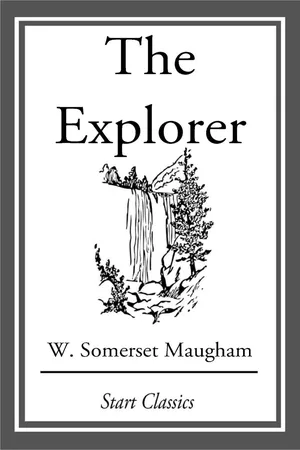
The Explorer
eBook - ePub

The Explorer

  1. 197 pages
  2. English
  3. ePUB (mobile friendly)
  4. Available on iOS & Android
eBook - ePub

The Explorer

About this book

A daring, brilliant and dramatic novel -- a new revelation of Maugham's genius. A tangle of African adventures, a false tale, doubt and the final reconciliation of the lovers make up this pleasant story.
Frequently asked questions

Yes, you can cancel anytime from the Subscription tab in your account settings on the Perlego website. Your subscription will stay active until the end of your current billing period. Learn how to cancel your subscription.
No, books cannot be downloaded as external files, such as PDFs, for use outside of Perlego. However, you can download books within the Perlego app for offline reading on mobile or tablet. Learn more here.
Perlego offers two plans: Essential and Complete
  • Essential is ideal for learners and professionals who enjoy exploring a wide range of subjects. Access the Essential Library with 800,000+ trusted titles and best-sellers across business, personal growth, and the humanities. Includes unlimited reading time and Standard Read Aloud voice.
  • Complete: Perfect for advanced learners and researchers needing full, unrestricted access. Unlock 1.4M+ books across hundreds of subjects, including academic and specialized titles. The Complete Plan also includes advanced features like Premium Read Aloud and Research Assistant.
Both plans are available with monthly, semester, or annual billing cycles.
We are an online textbook subscription service, where you can get access to an entire online library for less than the price of a single book per month. With over 1 million books across 1000+ topics, we’ve got you covered! Learn more here.
Look out for the read-aloud symbol on your next book to see if you can listen to it. The read-aloud tool reads text aloud for you, highlighting the text as it is being read. You can pause it, speed it up and slow it down. Learn more here.
Yes! You can use the Perlego app on both iOS or Android devices to read anytime, anywhere — even offline. Perfect for commutes or when you’re on the go.
Please note we cannot support devices running on iOS 13 and Android 7 or earlier. Learn more about using the app.
Yes, you can access The Explorer by W. Somerset Maugham in PDF and/or ePUB format, as well as other popular books in Literature & Classics. We have over one million books available in our catalogue for you to explore.

Information

Year
2015
eBook ISBN
9781633554382

II

While Lucy wandered by the seashore, occupied with painful memories, her old friend Dick, too lazy to walk with her, sat in the drawing-room of Court Leys, talking to his hostess.
Mrs. Crowley was an American woman, who had married an Englishman, and on being left a widow, had continued to live in England. She was a person who thoroughly enjoyed life; and indeed there was every reason that she should do so, since she was young, pretty, and rich; she had a quick mind and an alert tongue. She was of diminutive size, so small that Dick Lomas, by no means a tall man, felt quite large by the side of her. Her figure was exquisite, and she had the smallest hands in the world. Her features were so good, regular and well-formed, her complexion so perfect, her agile grace so enchanting, that she did not seem a real person at all. She was too delicate for the hurly-burly of life, and it seemed improbable that she could be made of the ordinary clay from which human beings are manufactured. She had the artificial grace of those dainty, exquisite ladies in the Embarquement pour Cithère of the charming Watteau; and you felt that she was fit to saunter on that sunny strand, habited in satin of delicate colours, with a witty, decadent cavalier by her side. It was preposterous to talk to her of serious things, and nothing but an airy badinage seemed possible in her company.
Mrs. Crowley had asked Lucy and Dick Lomas to stay with her in the house she had just taken for a term of years. She had spent a week by herself to arrange things to her liking, and insisted that Dick should admire all she had done. After a walk round the park he vowed that he was exhausted and must rest till tea-time.
'Now tell me what made you take it. It's so far from anywhere.'
'I met the owner in Rome last winter. It belongs to a Mrs. Craddock, and when I told her I was looking out for a house, she suggested that I should come and see this.'
'Why doesn't she live in it herself?'
'Oh, I don't know. It appears that she was passionately devoted to her husband, and he broke his neck in the hunting-field, so she couldn't bear to live here any more.'
Mrs. Crowley looked round the drawing-room with satisfaction. At first it had borne the cheerless look of a house uninhabited, but she had quickly made it pleasant with flowers, photographs, and silver ornaments. The Sheraton furniture and the chintzes suited the style of her beauty. She felt that she looked in place in that comfortable room, and was conscious that her frock fitted her and the circumstances perfectly. Dick's eye wandered to the books that were scattered here and there.
'And have you put out these portentous works in order to improve your mind, or with the laudable desire of impressing me with the serious turn of your intellect?'
'You don't think I'm such a perfect fool as to try and impress an entirely flippant person like yourself?'
On the table at his elbow were a copy of the Revue des Deux Mondes and one of the Fortnightly Review. He took up two books, and saw that one was the Fröhliche Wissenschaft of Nietzsche, who was then beginning to be read in England by the fashionable world and was on the eve of being discovered by men of letters, while the other was a volume of Mrs. Crowley's compatriot, William James.
'American women amaze me,' said Dick, as he put them down. 'They buy their linen at Doucet's and read Herbert Spencer with avidity. And what's more, they seem to like him. An Englishwoman can seldom read a serious book without feeling a prig, and as soon as she feels a prig she leaves off her corsets.'
'I feel vaguely that you're paying me a compliment,' returned Mrs. Crowley, 'but it's so elusive that I can't quite catch it.'
'The best compliments are those that flutter about your head like butterflies around a flower.'
'I much prefer to fix them down on a board with a pin through their insides and a narrow strip of paper to hold down each wing.'
It was October, but the autumn, late that year, had scarcely coloured the leaves, and the day was warm. Mrs. Crowley, however, was a chilly being, and a fire burned in the grate. She put another log on it and watched the merry crackle of the flames.
'It was very good of you to ask Lucy down here,' said Dick, suddenly.
'I don't know why. I like her so much. And I felt sure she would fit the place. She looks a little like a Gainsborough portrait, doesn't she? And I like to see her in this Georgian house.'
'She's not had much of a time since they sold the family place. It was a great grief to her.'
'I feel such a pig to have here the things I bought at the sale.'
When the contents of Hamlyn's Purlieu were sent to Christy's, Mrs. Crowley, recently widowed and without a home, had bought one or two pictures and some old chairs. She had brought these down to Court Leys, and was much tormented at the thought of causing Lucy a new grief.
'Perhaps she didn't recognise them,' said Dick.
'Don't be so idiotic. Of course she recognised them. I saw her eyes fall on the Reynolds the very moment she came into the room.'
'I'm sure she would rather you had them than any stranger.'
'She's said nothing about them. You know, I'm very fond of her, and I admire her extremely, but she would be easier to get on with if she were less reserved. I never shall get into this English way of bottling up my feelings and sitting on them.'
'It sounds a less comfortable way of reposing oneself than sitting in an armchair.'
'I would offer to give Lucy back all the things I bought, only I'm sure she'd snub me.'
'She doesn't mean to be unkind, but she's had a very hard life, and it's had its effect on her character. I don't think anyone knows what she's gone through during these ten years. She's borne the responsibilities of her whole family since she was fifteen, and if the crash didn't come sooner, it was owing to her. She's never been a girl, poor thing; she was a child, and then suddenly she was a woman.'
'But has she never had any lovers?'
'I fancy that she's rather a difficult person to make love to. It would be a bold young man who whispered sweet nothings into her ear; they'd sound so very foolish.'
'At all events there's Bobbie Boulger. I'm sure he's asked her to marry him scores of times.'
Sir Robert Boulger had succeeded his father, the manufacturer, as second baronet; and had promptly placed his wealth and his personal advantages at Lucy's feet. His devotion to her was well known to his friends. They had all listened to the protestations of undying passion, which Lucy, with gentle humour, put smilingly aside. Lady Kelsey, his aunt and Lucy's, had done all she could to bring the pair together; and it was evident that from every point of view a marriage between them was desirable. He was not unattractive in appearance, his fortune was considerable, and his manners were good. He was a good-natured, pleasant fellow, with no great strength of character perhaps, but Lucy had enough of that for two; and with her to steady him, he had enough brains to make some figure in the world.
'I've never seen Mr. Allerton,' remarked Mrs. Crowley, presently. 'He must be a horrid man.'
'On the contrary, he's the most charming creature I ever met, and I don't believe there's a man in London who can borrow a hundred pounds of you with a greater air of doing you a service. If you met him you'd fall in love with him before you'd got well into your favourite conversation on bimetallism.'
'I've never discussed bimetallism in my life,' protested Mrs. Crowley.
'All women do.'
'What?'
'Fall in love with him. He knows exactly what to talk to them about, and he has the most persuasive voice you ever heard. I believe Lady Kelsey has been in love with him for five and twenty years. It's lucky they've not yet passed the deceased wife's sister's bill, or he would have married her and run through her money as he did his first wife's. He's still very good-looking, and there's such a transparent honesty about him that I promise you he's irresistible.'
'And what has happened to him since the catastrophe?'
'Well, the position of an undischarged bankrupt is never particularly easy, though I've known men who've cavorted about in motors and given dinners at the Carlton when they were in that state, and seemed perfectly at peace with the world in general. But with Fred Allerton the proceedings before the Official Receiver seem to have broken down the last remnants of his self-respect. He was glad to get rid of his children, and Lady Kelsey was only too happy to provide for them. Heaven only knows how he's lived during the last two years. He's still occupied with a variety of crack-brained schemes, and he's been to me more than once for money to finance them with.'
'I hope you weren't such a fool as to give it.'
'I wasn't. I flatter myself that I combined frankness with good-nature in the right proportion, and in the end he was always satisfied with the nimble fiver. But I'm afraid things are going harder with him. He has lost his old alert gaiety, and he's a little down at heel in character as well as in person. There's a furtive look about him, as though he were ready for undertakings that were not quite above board, and there's a shiftiness in his eye which makes his company a little disagreeable.'
'You don't think he'd do anything dishonest?' asked Mrs. Crowley quickly.
'Oh, no. I don't believe he has the nerve to sail closer to the wind than the law allows, and really, at bottom, notwithstanding all I know of him, I think he's an honest man. It's only behind his back that I have any doubts about him; when he's there face to face with me I succumb to his charm. I can believe nothing to his discredit.'
At that moment they saw Lucy walking towards them. Dick Lomas got up and stood at the window. Mrs. Crowley, motionless, watched her from her chair. They were both silent. A smile of sympathy played on Mrs. Crowley's lips, and her heart went out to the girl who had undergone so much. A vague memory came back to her, and for a moment she was puzzled; but then she hit upon the idea that had hovered about her mind, and she remembered distinctly the admirable picture by John Furse at Millbank, which is called Diana of the Uplands. It had pleased her always, not only because of its beauty and the fine power of the painter, but because it seemed to her as it were a synthesis of the English spirit. Her nationality gave her an interest in the observation of this, and her wide, systematic reading the power to compare and analyse. This portrait of a young woman holding two hounds in leash, the wind of the northern moor on which she stands, blowing her skirts and outlining her lithe figure, seemed to Mrs. Crowley admirably to follow in the tradition of the eighteenth century. And as Reynolds and Gainsborough, with their elegant ladies in powdered hair and high-waisted gowns, standing in leafy, woodland scenes, had given a picture of England in the age of Reason, well-bred and beautiful, artificial and a little airless, so had Furse in this represented the England of to-day. It was an England that valued cleanliness above all things, of the body and of the spirit, an England that loved the open air and feared not the wildness of nature nor the violence of the elements. And Mrs. Crowley had lived long enough in the land of her fathers to know that this was a true England, simple and honest; narrow perhaps, and prejudiced, but strong, brave, and of great ideals. The girl who stood on that upland, looking so candidly out of her blue eyes, was a true descendant of the ladies that Sir Joshua painted, but she had a bath every morning, loved her dogs, and wore a short, serviceable skirt. With an inward smile, Mrs. Crowley acknowledged that she was probably bored by Emerson and ignorant of English literature; but for the moment she was willing to pardon these failings in her admiration for the character and all it typified.
Lucy came in, and Mrs. Crowley gave her a nod of welcome. She was fond of her fantasies and would not easily interrupt them. She noted that Lucy had just that frank look of Diana of the Uplands, and the delicate, sensitive face, refined with the good-breeding of centuries, but strengthened by an athletic life. Her skin was very clear. It had gained a peculiar freshness by exposure to all manner of weather. Her bright, fair hair was a little disarranged after her walk, and she went to the glass to set it right. Mrs. Crowley observed with delight the straightness of her nose and the delicate curve of her lips. She was tall and strong, but her figure was very slight; and there was a charming litheness about her which suggested the good horse-woman.
But what struck Mrs. Crowley most was that only the keenest observer could have told that she had endured more than other women of her age. A stranger would have delighted in her frank smile and the kindly sympathy of her eyes; and it was only if you knew the troubles she had suffered that you saw how much more womanly she was than girlish. There was a self-possession about her which came from the responsibilities she had borne so long, and an unusual reserve, unconsciously masked by a great charm of manner, which only intimate friends discerned, but which even to them was impenetrable. Mrs. Crowley, with her American impulsiveness, had tried in all kindliness to get through the barrier, but she had never succeeded. All Lucy's struggles, her heart-burnings and griefs, her sudden despairs and eager hopes, her tempestuous angers, took place in the bottom of her heart. She would have been as dismayed at the thought of others seeing them as she would have been at the thought of being discovered unclothed. Shyness and pride combined to make her hide her innermost feelings so that no one should venture to offer sympathy or commiseration.
'Do ring the bell for tea,' said Mrs. Crowley to Lucy, as she turned away from the glass. 'I can't get Mr. Lomas to amuse me till he's had some stimulating refreshment.'
'I hope you like the tea I sent you,' said Dick.
'Very much. Though I'm inclined to look upon it as a slight that you should send me down only just enough to last over your visit.'
'I always herald my arrival in a country house by a little present of tea,' said Dick. 'The fact is it's the only good tea in the world. I sent my father to China for seven years to find it, and I'm sure you will agree that my father has not lived an ill-spent life.'
The tea was brought and duly drunk. Mrs. Crowley asked Lucy how her brother was. He had been at Oxford for the last two years.
'I had a letter from him yesterday,' the girl answered. 'I think he's getting on very well. I hope he'll take his degree next year.'
A happy brightness came into her eyes as she talked of him. She apologised, blushing, for her eagerness.
'You know, I've looked after George ever since he was ten, and I feel like a mother to him. It's only with the greatest difficulty I can prevent myself from telling you how he got through the measles, and how well he bore vaccination.'
Lucy was very proud of her brother. She found a constant satisfaction in his good looks, and she loved the openness of his smile. She had striven with all her might to keep away from him the troubles that oppressed her, and had determined that nothing, if she could help it, should disturb his radiant satisfaction with the world. She knew that he was apt to lean on her, but though she chid herself sometimes for fostering the tendency, she could not really prevent the intense pleasure it gave her. He was young yet, and would soon enough grow into manly ways; it could not matter if now he depended upon her for everything. She rejoiced in the ardent affection which he gave her; and the implicit trust he placed in her, the complete reliance on her judgment, filled her with a proud humility. It made her feel stronger and better capable of affronting the difficulties of life. And Lucy, living much in the future, was pleased to see how beloved George was of all his friends. Everyone seemed willing to help him, and this seemed of good omen for the career which she had mapped out for him.
The recollection of him came to Lucy now as she had last seen him. They had been spending part of the summer with Lady Kelsey at her house on the Thames. George was going to Scotland to stay with friends, and Lucy, bound elsewhere, was leaving earlier in the afternoon. He came to see her off. She was touched, in her own sorrow at leaving him, by his obvious emotion. The tears were in his eyes as he kissed her on the platform. She saw him waving to her as the train sped towards London, slender and handsome, looking more boyish than ever in his whites; and she felt a thrill of gratitude because, with all her sorr...

Table of contents

  1. Cover
  2. Title Page
  3. Copyright Page
  4. I
  5. II
  6. III
  7. IV
  8. V
  9. VI
  10. VII
  11. VIII
  12. IX
  13. X
  14. XI
  15. XII
  16. XIII
  17. XIV
  18. XV
  19. XVI
  20. XVII
  21. XVIII
  22. XIX
  23. XX
  24. XXI