Contrary to much perceived wisdom, the Sahara is a rich and varied tapestry of diverse environments that sustain an array of ecosystems. Throughout its history, the Sahara has been a stage for human evolution, with human habitation, movement and lifeways shaped by a dynamic environment of successive phases of relative humidity and aridity driven by wider global climatic changes. The nature of human utilization of the landscape has undergone many changes, from the ephemeral and ill-defined lithic scatters of the Early Holocene to the dense and complex funerary landscapes of Late Holocene Pastoral period. Generally speaking, the living have left very little trace of their existence while funerary monuments endure, stamping the landscape with a cultural timelessness that marks certain regions of the desert as “special”.
During the last ten years, the Western Sahara Project has undertaken large scale archaeological and environmental research that has begun to address the gaps in our knowledge of the archaeology and palaeoenvironments of Western Sahara, and to develop narratives of prehistoric cultural adaptation and change from the end of the Pleistocene to the Late Holocene and place it within its wider Saharan context.
A detailed discussion of past environmental change and a presentation of results from the environmental component of the extensive survey work are provided. A typology of built stone features– monuments and funerary architecture is presented together with the results of the archaeological component of the extensive survey work, focusing on stone features, but also including discussion of ceramics and rock art and the analysis of lithic assemblages. Chapters focusing on intensive survey work in key study areas consider the landscape contexts of monuments and the results of excavation of burial cairns and artefact scatters.
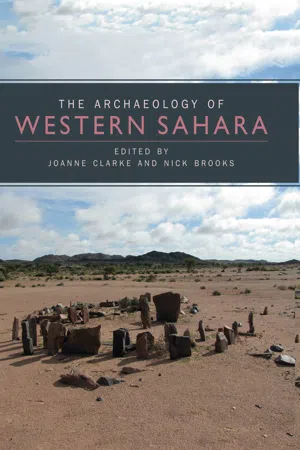
eBook - ePub
The Archaeology of Western Sahara
A Synthesis of Fieldwork, 2002 to 2009
- 328 pages
- English
- ePUB (mobile friendly)
- Available on iOS & Android
eBook - ePub
The Archaeology of Western Sahara
A Synthesis of Fieldwork, 2002 to 2009
About this book
Information
Subtopic
Art GeneralIndex
HistoryChapter 1
The Archaeology of Western Sahara in Context
Joanne Clarke and Nick Brooks
Introduction
Throughout its history, the Sahara has been a stage for human evolution and cultural development, with human habitation, movement and life ways shaped by a dynamic environment of successive phases of relative humidity and aridity driven by wider global climatic changes. Recently, a large body of archaeological and environmental data has been generated by work carried out in the central and eastern Sahara, which has enabled researchers to construct a range of individual Saharan narratives involving linked environmental and cultural changes (Cremaschi and di Lernia 1998; di Lernia 1999a; di Lernia and Manzi 2002; Kröpelin 2007; Kuper and Kröpelin 2006; Lézine et al. 2011; Mattingly et al. 2003, 2007, 2010, 2013). While much is now known about the prehistory of the central and eastern Sahara, and to a lesser extent the Atlantic Sahara (Vernet 1998, 2007a, 2007b), less is known about the western region of the Sahara, inland of the Atlantic coast (but see, Amara and Yass 2010; Rodrigue 2011; Vernet 2014).
Between 2002 and 2008 the Western Sahara Project undertook archaeological and environmental research in the territory of Western Sahara, in the areas under the control of the indigenous Sahrawi Government (Fig. 1.1). This research is beginning to address gaps in our knowledge and understanding of the environmental and cultural evolution of the western regions of the Sahara Desert.
The choice of Western Sahara is a region of great archaeological and palaeoenvironmental interest because of its environmental conditions and the history of archaeological investigation in the region. As in the rest of the Sahara, evidence of past human occupation in Western Sahara is plentiful. Surface scatters of pottery and worked stone are abundant, prehistoric rock paintings and engravings are numerous, and built stone structures including prehistoric funerary monuments are present in great numbers. However, due to its history of conflict, detailed archaeological and palaeoenvironmental research in Western Sahara has been extremely limited. With the exception of studies of rock art, almost nothing has been published in the international research literature. While a number of studies dating from the colonial and post-colonial periods have been published in Spanish and the languages of the Spanish regions (Almagro Basch 1945–1946, 1946; Sáenz de Buruaga 2008) the archaeological map of Western Sahara remains literally and figuratively almost blank as far as the wider international archaeological research community is concerned, particularly away from the Atlantic Coast (Brooks et al. 2009; Vernet 2014).
Conflict and remoteness mean not only that the archaeological record of Western Sahara is poorly known, but also that it is relatively undisturbed, particularly in the less accessible areas in the east in which the Western Sahara Project operates. Built stone features in these areas are startling in their richness and diversity, but few studies have been undertaken with some notable exceptions (e.g. Balbin Behrmann 1975; Milburn 1996a, 2005; Pellicer and Acosta 1991; Sáenz de Buruaga 2008). It is clear that these regions were either relatively well populated at certain times in the past, or at least that they were frequently visited and used as places for the burial of the dead, and perhaps also for associated mortuary rituals.
The role of climate change in mediating the occupation and exploitation of Saharan landscapes over time has been demonstrated by numerous studies (Cremaschi and Zerboni 2009; di Lernia 2002, 2006; Jousse 2004; Kuper and Kröpelin 2006; Nicoll 2004; Sereno et al. 2008). As in other Saharan regions, climate change would have affected the prehistoric populations of Western Sahara via its impact on local environments. For example, a shift from humid to arid conditions during the Middle Holocene (Brooks 2006, 2010; deMenocal et al. 2000a, 2000b) may have meant that regions that were initially habitable subsequently became unviable for permanent human occupation. Moreover, the extent to which parts of the desert were (or were not) viable for human occupation may have fluctuated even within generally humid periods, given the evidence for short, abrupt episodes of aridity punctuating these longer humid trends (Cremaschi 2002; Cremaschi and di Lernia 1999). Environmental trajectories of such a nature may have contributed to the creation of social links and territorial boundaries that were reinforced during arid phases by burying the dead in places that had been inhabited in the past but that had become largely uninhabitable due to aridity (Brass 2007; di Lernia 2006).

Fig. 1.1. Location and key features of Western Sahara, including major drainage systems, key locations, and the wall or ‘Berm’ that separates the areas controlled by Morocco (north and west of the Berm) from those controlled by the indigenous Sahrawi (Polisario) government (south and east of the Berm).
Western Sahara may be viewed as a marginal environment, and such environments have long been considered by archaeologists to be sensitive barometers of cultural adaptation and change. In this context, marginal environments are those in which small changes in climate can have significant impacts on the viability of existing subsistence and livelihoods necessitating adaptation that might be visible in the archaeological record. A desert is not a priori a marginal environment, because the economic strategies of those who inhabit it will not necessarily be significantly affected by small changes in climate. For example, a change in already-low rainfall in a region that cannot sustain rain-fed agriculture or wild grasses may be insignificant to those who practice oasis agriculture based on groundwater. However, on the fringes of the desert, where rain-fed agriculture is practiced in times of relative humidity, even a small change can lead to a region no longer being viable as a place to live and may result in a significant displacement of people during periods of drought. This scenario constitutes what we would call a marginal environment. Changes in temperature can have similar effects, for example when they result in tolerance thresholds being crossed (e.g. for particular plant and animal species). When rainfall is adequate a marginal environment may support a wide variety of plant and animal species. However, a few consecutive years of drought may have profound impacts on a landscape with no standing bodies of water or deep aquifers. Western Sahara, and particularly the areas studied by the Western Sahara Project, represents precisely this kind of environment.
Aims and approach of this volume
This book presents the results of initial archaeological and environmental exploration in the ‘Free Zone’ of Western Sahara. It begins to address the gaps in our knowledge of the archaeology and palaeoenvironments of the region, and also develops narratives of prehistoric cultural adaptation and change from the end of the Pleistocene to the Late Holocene. The diversity and quality of the archaeological record in Western Sahara means that it is not sufficient simply to present in a descriptive manner archaeological and environmental data acquired by reconnaissance work. Such an approach would not do justice to the depth of cultural meaning preserved in the landscapes of the region. Instead, our work is presented within its wider Saharan context, drawing on evidence and insights from a variety of archaeological and environmental studies undertaken in other regions of the Sahara (di Lernia 2002, 2013a; Huysecom et al. 2001; Mattingly et al. 2003, 2007, 2013, 2018), and set in current theoretical perspectives on the phenomenology of landscapes. Continuing the tradition of other Saharan studies, this volume also considers the way in which human adaptation and cultural change plays out in marginal environments.
A key theme of this book is the changing nature of human utilisation of the landscape, from the ephemeral and ill-defined pottery and lithic scatters of the Early and early Middle Holocene, to the dense and complex funerary landscapes of the Middle and Late Holocene. Perhaps the most striking feature of this period of human occupation in Western Sahara is the contrast between the ways in which people impacted the desert. Generally speaking, the living left very little trace of their existence on the desert and only the occasional hearth, stone emplacement or artefact scatter attests to their presence. The exception is the extraordinary rock art that characterises the Sahara more generally. Yet, the features that they erected for burying their dead and for their funerary rituals are both monumental and enduring, stamping the landscape with a cultural timelessness that marks certain regions of the desert as ‘special’. In essence, some parts of the desert have been ‘shaped’ by a continuous blending of the natural topography with built features that reference both the desert landscape and each other, and are themselves extended and enhanced by the desert topography. In so doing, the monument builders created cultural landscapes, which in their construction have become embodied with social meaning. Thomas (2013, 317) describes prehistoric European monuments as ‘mnemonic devices … engendering memory … a landscape of language’. He argues that small monuments can trigger memories just as effectively as large ones, but there is a temptation to distinguish between truly monumental monuments and minor architectural features as different in both scale and significance. There is no doubt that the funerary landscapes of Western Sahara embodied memory and identity in the fashion described by Thomas and these ideas will be explored later in the book.
The archaeology of Western Sahara lends itself well to a phenomenological approach as espoused by Thomas and others. Throughout the book we draw upon recent studies in landscape phenomenology from contexts in Europe and farther afield (Bradley 2007; Tilley 2004; Thomas 2013). Yet, our research aims to expand upon these approaches by contextualising the ways in which the prehistoric inhabitants of the desert experienced both the tangible elements of their environment and the intangible elements. By including environmental studies we have been able to address the relationship people had with the environment, with the desert landscape in which they built monuments, and with time as a changing dimension in which they created memories and changing identities. At the heart of landscape phenomenology is its holistic approach to the dynamic relationship between environment, place and people. But it is not just about the way in which people impacted landscapes; it is also about the way in which landscapes impacted people.
Geopolitical context
Western Sahara is located in northwestern Africa, at the westernmost extremity of the Sahara Desert, between the Atlantic Ocean to the west, Morocco to the north, Algeria to the east, and Mauritania to the east and south. Formerly Spanish Sahara, Western Sahara is designated by the United Nations Special Committee on Decolonisation as a non-self-governing territory, one of 17 such territories in which the decolonisation process has not yet been completed. Following the withdrawal of the Spanish colonial authorities in 1975–1976, Morocco and Mauritania fought a military conflict with the indigenous Sahrawi independence movement, the Frente Popular para la Liberación de Saguía el Hamra y Río de Oro or Polisario Front, named after the administrative districts of the former Spanish Sahara. Mauritania withdrew from the conflict in 1979, after which the territory was contested between Morocco and the Polisario. In 1991 the United Nations brokered a ceasefire between these two parties pending a referendum on self-determination for the territory, and installed a peacekeeping force tasked with facilitating the referendum and monitoring the ceasefire. This peacekeeping force, the United Nations Mission for the Referendum in Western Sahara (known by its French acronym, MINURSO) remains in Western Sahara today, and the referendum has been postponed repeatedly. Prospects for a political solution to the conflict currently appear remote.
By the time of the ceasefire in 1991, the Moroccan Armed Forces had constructed a series of defensive works to secure the territory under their control: ‘In six sweeping movements, the Moroccans created a “spider’s web of earthworks”, measuring approximately 4000km in length, across more than seventy five percent of the territory of Western Sahara’ (Garfi 2014, 42). Today, the legacy of this programme of ‘enclosure’ is the ‘wall’ or ‘Berm’, which extends for some 2400km through Western Sahara, making excursions into Mauritanian territory where the border between Western Sahara and Mauritania switches from an east–west to a north–south orientation, and along the southernmost east–west border between Western Sahara and Mauritania (Fig. 1.1). The Berm effectively partitions Western Sahara into a Moroccan-controlled zone and a Polisario-controlled zone. Under the terms of the UN ceasefire and Military Agreement #1, there is parity between these zones with respect to permitted activity of the two parties to the conflict. A ‘buffer strip’ is defined under the terms of ceasefire, extending 5km from the Berm into the Polisario-controlled zone. The excursion of the Berm into Mauritania where the border changes direction means that the Polisario-controlled zone is divided into a ‘Northern Sector’ and a ‘Southern Sector’, which are non-contiguous. The areas in the Polisario-controlled zone are often referred to locally as the ‘Liberated Territories’ or the Free Zone. We use the latter term as shorthand for the parts of Western Sahara under Polisario control.
Today, the majority of the indigenous Sahrawi inhabitants of Western Sahara live in refugee camps around the town of Tindouf in neighbouring Algeria. A 2008 report by Human Rights Watch (HRW) estimated the population of the camps at 125,000, although it is likely that this figure is based on the 125,000 rations distributed to the ‘most vulnerable’ people in the camps (a subset of the population, albeit a large one) every month by the World Food Programme (http://www.wfp.org/countries/algeria). Fiddian-Qasmiyeh (2009) cites a figure of 155,000 for the population of the Sahrawi refugee camps. The United Nations High Commission for Refugees (UNHCR) has used a figure of 90,000 ‘most vulnerable refugees’ since 2012 or earlier.1 The Danish Refugee Council cites a figure of ‘up to 165,000’, based on Algerian government data.2 A smaller number of Sahrawi continue to live in the Moroccan-controlled areas of Western Sahara, along with an increasing number of Moroccan settlers. Sahrawi from the camps around Tindouf sometimes reside temporarily in the Free Zone when rainfall results in good pasture for the herds of camels, sheep and goats that are kept there by some families. An unknown but small number of Sahrawi live in the Free Zone permanently, but a lack of resources and infrastructure means the capacity of the Free Zone to support settlement is currently extremely limited.
The refugee camps near Tindouf also house the government of the Sahrawi Arab Democratic Republic (SADR), declared by the Polisario on 27 February 1976. The SADR is a member state of the African Union, and has been recognised by a total of some 80 foreign governments, although the diplomatic landscape has been highly dynamic in this context, and the SADR is currently recognised by around 50 governments.
The Western Sahara Project: history, context and aims
The Western Sahara Project was initiated by Margaret Raffin and Nick Brooks, following a visit by the former to the Sahrawi refugee camps and the Free Zone of Western Sahara, during which the potential for archaeological work was discussed with the Sahrawi Minister of Culture. This discussion resulted in an invitation from the Ministry of Culture to Margaret Raffin to establish a UK-led project whose purpose would be to conduct archaeological research in the Free Zone. Since 2005, the Project has been co-directed by Nick Brooks and Joanne Clarke, of the University of East Anglia (UEA).
The invitation from the Sahrawi Ministry of Culture to undertake archaeological research in the Free Zone specified that this research should have a particular focus on funerary monuments. The Sahrawi people are Muslims and had, until the conflict, not really identified with the people buried in the prehistoric necropoli, but this perception has changed. Even while we were working in Western Sahara we saw the relationship between the past (as represented by the funerary monuments) and the present (as represented by the local people) strengthen and consolidate. Hodder (2003) emphasises the importance of archaeology as giving a voice to local people. The Sahrawi Ministry of Culture is acutely aware of the importance of heritage for building a sustainable society. In the fragile conditions in which they live (in refugee camps where connection with the past can be all too easily lost). The SADR see their cultural heritage as important to affirming their cultural rights to Western Sahara, while publishing in English ensures wide dissemination to the outside world. Hodder (2003, 56) says that monumentality [in particular] is often central to the construction of social memory as it gives materiality to what is often intangible. Thus, our work serves not just to reveal the prehistory of the region, but also to strengthen the links between the SADR and the cultural heritage of a landscape from which the population it represents has been largely forcibly removed. Until our work, the funerary landscapes of the Free Zone had received relatively litt...
Table of contents
- Cover
- Title
- Copyright
- Contents
- Acknowledgements
- List of Figures
- List of Tables
- List of Plates
- Chapter 1: The Archaeology of Western Sahara in Context - Joanne Clarke and Nick Brooks
- Chapter 2: The Environmental Survey - Sue J. McLaren, Nick Brooks, Helena White, Marijke van der Veen, Tony Gouldwell and Maria Guagnin
- Chapter 3: Typology of Stone Features - Nick Brooks, Salvatore Garfi and Yves Gauthier
- Chapter 4: The Extensive Survey - Nick Brooks, Joanne Clarke, Yves Gauthier and Maria Guagnin
- Chapter 5: Intensive Survey - Salvatore Garfi and Joanne Clarke
- Chapter 6: The Excavations - Joanne Clarke, Vicky Winton and Alexander Wasse
- Chapter 7: The Chipped Stone - Anne Pirie
- Chapter 8: Western Sahara in Local and Regional Context - Joanne Clarke and Nick Brooks
- Bibliography
- Plate section
Trusted by 375,005 students
Access to over 1.5 million titles for a fair monthly price.
Study more efficiently using our study tools.
Frequently asked questions
Yes, you can cancel anytime from the Subscription tab in your account settings on the Perlego website. Your subscription will stay active until the end of your current billing period. Learn how to cancel your subscription
No, books cannot be downloaded as external files, such as PDFs, for use outside of Perlego. However, you can download books within the Perlego app for offline reading on mobile or tablet. Learn how to download books offline
Perlego offers two plans: Essential and Complete
- Essential is ideal for learners and professionals who enjoy exploring a wide range of subjects. Access the Essential Library with 800,000+ trusted titles and best-sellers across business, personal growth, and the humanities. Includes unlimited reading time and Standard Read Aloud voice.
- Complete: Perfect for advanced learners and researchers needing full, unrestricted access. Unlock 1.5M+ books across hundreds of subjects, including academic and specialized titles. The Complete Plan also includes advanced features like Premium Read Aloud and Research Assistant.
We are an online textbook subscription service, where you can get access to an entire online library for less than the price of a single book per month. With over 1.5 million books across 990+ topics, we’ve got you covered! Learn about our mission
Look out for the read-aloud symbol on your next book to see if you can listen to it. The read-aloud tool reads text aloud for you, highlighting the text as it is being read. You can pause it, speed it up and slow it down. Learn more about Read Aloud
Yes! You can use the Perlego app on both iOS and Android devices to read anytime, anywhere — even offline. Perfect for commutes or when you’re on the go.
Please note we cannot support devices running on iOS 13 and Android 7 or earlier. Learn more about using the app
Please note we cannot support devices running on iOS 13 and Android 7 or earlier. Learn more about using the app
Yes, you can access The Archaeology of Western Sahara by Joanne Clarke, Nick Brooks, Joanne Clarke,Nick Brooks, Jo Clarke, Nick Brooks in PDF and/or ePUB format, as well as other popular books in History & Art General. We have over 1.5 million books available in our catalogue for you to explore.