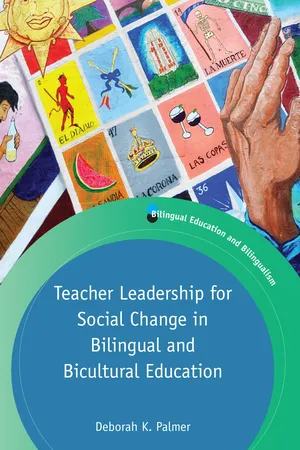
Leadership takes on a tone of urgency when we are struggling for justice. At the same time, the right to lead – the agency to embrace a leadership identity – can also feel more distant when we are marginalized by the dominant society. For bilingual education teachers working with immigrant communities, the development of critical consciousness, pride in the cultural and linguistic resources of the bilingual community, the vocabulary to name and face marginalization, and a strong professional network are fundamental to their development of professional identities as leaders and advocates. Based on the experiences of 53 Spanish-English bilingual teachers in Central Texas, this book aims to explore, define, and understand bilingual teacher leadership. It merges the themes of leadership, teacher preparation and bilingual education and is essential reading for bilingual or ESL teachers, teacher educators and researchers serving an increasingly transnational/translingual student body.
eBook - ePub
Teacher Leadership for Social Change in Bilingual and Bicultural Education
- English
- ePUB (mobile friendly)
- Available on iOS & Android
eBook - ePub
Teacher Leadership for Social Change in Bilingual and Bicultural Education
About this book
Information
1 Why Bilingual Teacher Leadership?
‘Are you sitting down?’ asked Alba. ‘Are you?’ I replied. When I picked up the phone in July 2007 to learn from my colleague Dr Alba Ortiz that the US Department of Education had funded our grant proposal for the Proyecto Maestría Collaborative for Teacher Leadership in Bilingual/ESL Education (Palmer & Ortiz, 2007), I was in fact sitting down: in a friend’s living room. I had just shared my own exciting news, that I was expecting my second child the following January. To be honest, at that moment, I had very little conception of all that might be involved in running a 1.4 million dollar federal service grant. I knew only that I would have the opportunity to recruit and bring to the University of Texas (UT) more cohorts of fantastic bilingual teachers like the group I had had the privilege of teaching during my first year as a professor. Proyecto Maestría had started as a pilot program funded by the Austin Independent School District (AISD), and I had filled my classes in 2005–2006 with 12 experienced bilingual education teachers seeking master’s degrees, fully funded by their employer. Dr George Blanco, associate professor emeritus, had recruited and admitted them just before he retired in 2005 in order to pursue a collaborative opportunity with AISD.
When I sat down to write a proposal for a US Department of Education Title III National Professional Development Project in March 2007, I was already missing that cohort of students. I had in my mind’s eye the astounding growth I’d watched them experience – men and women with established careers as bilingual educators in elementary schools throughout the district, many of whom also had families and busy lives outside their jobs. They had spoken up in class to express their amazement at the way in which Gloria Anzaldúa or Gramscii or Paolo Freire was putting words to their own experiences as teachers, as bilingual individuals and for most of them as Latinx1 in America. These 12 teachers in Austin, Texas, some of whom had been alternatively certified and had therefore never experienced a college course treating the subject of their profession, taught me – a native of Massachusetts having spent 12 years as a teacher and graduate student in California – what Spanish and Spanglish and bilingualism meant to Tejanos, what most concerned bilingual education teachers in Central Texas and how resilient and powerful full-time professional teachers could be when inspired by an opportunity to come together to learn and to transform their workplaces. I also had a fully articulated draft of the grant proposal, written by the experienced Dr Blanco, which had almost been funded three years previously.
I did modify George’s draft, specifically adding ideas to respond to the experiences of the teachers in the pilot-year cohort and including my own aspirations for teacher-research and transformation, but for the most part, I let Dr Blanco’s words guide my proposal. The executive director of the Department of English Language Learners (ELLs) in AISD contributed a letter of support, as did the Texas Education Agency, both attesting to the increasing numbers of students carrying the label ‘English Language Learner’ and the high need in the region for professional development to support ‘Increased quantity and improved quality’ for bilingual and English as a second language (ESL) educators.
Institutionally, I had the crucial support of a long-established partnership with our local school district, a well-respected master’s degree program in Bilingual Education, Dr Alba Ortiz and her staff in UT’s Office of Bilingual Education and several key senior colleagues in my department to support the project.
This book is partially about the program we ran; I will describe Proyecto Maestría and share details about the kinds of experiences teachers had during their time at UT. However, primarily the program provided a context, a laboratory, a productive platform, from which to explore what it meant for bilingual education teachers to become leaders. I have come to understand bilingual teacher leadership as intricately tied to cultural and linguistic identities and praxis, and building broad networks of professional allies. Teacher leadership in general terms is teachers embracing roles beyond the confines of their classrooms, but for bilingual teachers this necessarily implies embracing identities as advocates on behalf of their bilingual students and families within the frequently marginalizing structures of public schooling. Bilingual teachers need particular kinds of support to embrace leadership, and they experience leadership in particular kinds of ways. With the ongoing insights of the Proyecto Maestría teachers, I have developed a more complex, nuanced and layered understanding of leadership identities as bilingual teachers take them up. The primary purpose of this book is to explore definitions of bilingual teacher leadership as manifested in this space, with these teachers, in the hopes that it might serve others to better understand what is necessary, and what is possible.
Sociohistorical and Demographic Context: Language Ecology of Central Texas
Our project attempted to directly address what was and continues to be a tremendous need in our local community in Central Texas: professional development to prepare experienced bilingual teachers with leadership skills, and to support a broader base of general education teachers to develop the skills and dispositions necessary to work effectively with the large and increasing population of bilingual and emergent bilingual (EB) students. The stated primary goal of the grant was twofold: to improve the quality and to increase the quantity of qualified bilingual and ESL teachers in the Austin, Texas region, where there is a large and growing number of students entering public schools as speakers of languages other than English – primarily Spanish.
Texas, with over 980,000 students in public schools who are identified as ‘English Language Learners’ (ELLs)2 – approximately 18.5% of the total student population – and many more who speak an additional language beyond English, is one of the most linguistically and culturally diverse states in the United States (Division of Research and Analysis, Office of Academics, 2016). It has long been a border-crossing state; Texans are proud to assert that ‘six flags’ have hung over the region during the time since the first arrival of European colonists from Spain in the 1500s, including a 10-year period from 1836 to 1845 when Texas stood as its own young nation, flying the flag of the Texas Republic. Texas joined the United States in 1845. Then in 1848 the Treaty of Guadalupe Hidalgo moved the US/Mexico border south to the Rio Grande, known in Mexico as the Rio Bravo, ceding all of Texas plus all or parts of what is now Arizona, California, Nevada, New Mexico, Utah, Wyoming and Colorado.
Bilingualism and bilingual education have had a ‘strange career’ in Texas (Blanton, 2005). The territory that is now known as Texas has always been a linguistically diverse space – first with Native American languages, then with the violent colonizing dominance of Spanish, followed by multiple waves of European and Asian immigrant languages, including German, French, Polish, Czech, English, Vietnamese, Arabic and Chinese (Kloss, 1998). As political control shifted back and forth across the state, so did loyalties to various languages, and schooling options along with them. For an extended period of time prior to the early 1900s (when nativist hysteria related to World War I led to a push for English-only), schooling was available in different regions of Texas in German, Spanish, Polish, Dutch and Czech – sometimes bilingually with English, sometimes not (Blanton, 2005). Spanish-medium schools in particular were widespread and popular. Called ‘escuelitas’ [little schools], many were private, non-sectarian schools created by Mexican Americans unhappy with exclusionary and racist practices in public schools (Blanton, 2005; San Miguel & Donato, 2010). It is also interesting to note that public schools prior to World War I supported bilingual education in Spanish; as historian Carlos Kevin Blanton (2005: 29) noted: ‘Those schools choosing to educate Spanish speakers in an English-Only manner paid the price of losing Tejano patronage’.
As the Progressive Movement gained traction in Texas, merging and centralizing school districts and developing larger-scale education projects that would reach all children, and simultaneously during US participation in two World Wars, xenophobic anti-bilingual, English-only ideologies prevailed (Blanton, 2005; Delgado Bernal, 2000; Schmid, 2000). For nearly 50 years, from 1918 until the late 1960s, state law in Texas mandated a rigid and violent English-only policy of instruction for all children, particularly for young Spanish-speaking children. The results were devastating in terms of educational outcomes; for example, 81% of children in Laredo in the late 1920s were classified as ‘overage’ (i.e. having been retained at least one year), with other districts along the US/Mexico border reporting similar high rates of educational failure (Blanton, 2005). Many older adults, some of them still practicing bilingual educators or their parents, remember attending school in the English-only era; they remember paying money, or suffering humiliating punishments, for the crime of speaking their language in a classroom or on the playground. Many associate their language and culture with shame, as something that should be hidden in the home. Because of their own experiences in school, many Tejanx parents chose to raise their children monolingually in English.
Bilingual education returned to Texas alongside the Chicano Civil Rights Movement in the 1960s. The laws that eventually mandated bilingual programming, however, drew on deficit discourses of remediation and compensatory education, the result of a political compromise in order to move the legislation through (Flores, 2016; Grinberg & Saavedra, 2000; Wiese & Garcia, 1998). The most prominent of these laws was the 1968 Bilingual Education Act (BEA) – Title VII of the federal Elementary and Secondary Education Act, negotiated into President Lyndon B. Johnson’s signature education bill by Texas Senator Ralph Yarborough (Blanton, 2005; Crawford, 2004). The BEA provided grant-based funding for innovative programs to support bilingual education for ‘limited English proficient’ children. Around the same time, a combination of court cases and legislation established that children with limited English had a right to ‘accommodation’ to ensure they understood the education they were being offered. This led Texas, in 1981, to mandate transitional bilingual education programs in districts and at elementary-grade levels with 20 or more students from the same language group requiring it (Blanton, 2005; Texas Education Code, 1995).
Yet, with the powerful negative history around Spanish in the region, even today many current and aspiring bilingual teachers lack academic confidence in the language, as most have never had the opportunity for formal study beyond second grade (Ek et al., 2013; Guerrero & Guerrero, 2017). Many parents lack the desire or understanding to support their children to develop bilingualism, and many school systems maintain early-exit transitional bilingual programming with the primary goal (albeit less directly stated in this day and age) to support ‘linguistically disadvantaged’ children to acquire English quickly without losing ground in their academic subjects. This legacy of subtractive schooling and transitional ideologies toward Latinx and Spanish-speaking students has been difficult to overcome (Palmer, 2011; Valenzuela, 1999).
In very recent years, there has been some movement toward additive dual language programming for Texas schoolchildren. Dual language programs are bilingual programs that have the stated goal of developing children’s ‘bilingualism, biliteracy and biculturalism’, and maintain substantial instruction in the non-English language for at least the duration of elementary school, preferably longer (Gomez et al., 2005; Palmer et al., 2015b). A rapidly increasing number of schools and districts in Texas are adopting dual language programs to replace their transitional bilingual education programs (Wilson, 2011). These dual language programs are most certainly not without their issues (Cervantes-Soon et al., 2017). In particular, ideological resistance has been strong, given the troubled history of bilingualism in the state (Fitzsimmons-Doolan et al., 2015; Palmer, 2011), and accountability systems that ultimately emphasize English achievement have impeded the implementation of strong, additive bilingual programs (Palmer et al., 2015a; Palmer & Snodgrass-Rangel, 2011). However, discourses do appear to be shifting, and additive bilingualism is becoming attractive to many in the state.
This is a pivotal moment in the history of bilingual education in Texas, and bilingual teachers are key players in these shifting policy contexts. It is a timely opportunity to invest in educator leadership in the area of bilingual/ESL education.
Getting (Re)Started
In the fall of 2007, I reached out to our cohort of pilot-year graduates to help me run some recruitment meetings for our new grant program. I listened as one graduate from the pilot cohort, a man on his way to becoming a principal, described to prospective participants the feeling of having ‘new words’ in his mouth like ‘hegemony’ and ‘heteroglossia’. I heard two women from the cohort talk about being inspired to return to graduate school for a PhD, when they had ‘never imagined’ they would be able to actually enter a graduate program at an institution like UT Austin.
In late February and throughout March, with my infant son in tow, I hired a program coordinator and administrative assistant and coordinated our admissions process. By April 1, we had selected our first grant-supported cohort of nine teachers, all of whom happened to be Latina women. When I had the privilege of calling them on the telephone to inform them of their admission to Proyecto Maestría, I remember smiling broadly at their whoops of joy.
In all, the Proyecto Maestría grant provided full scholarships to 53 participants in five cohorts, who entered UT Austin in June for five consecutive years from 2008 to 2012. Each cohort spent approximately 15 months earning their master’s degrees. While they attended UT and in the months and years that followed, most of the participants found ways to express a sense of transformation. Graduate school seemed to offer them an opportunity to explore empowering new identities.
Partway through the first cohort’s tenure, I decided to explore participants’ routes to embracing professional leadership identities (Palmer et al., 2014b). I began to collect data about their experiences. I also began archiving students’ reflections during their participation in my fall and spring semester master’s degree classes: ‘Teaching in the Elementary Classroom: Bilingual Education’ and ‘Teacher Leadership for Bilingual/ESL’. I held onto their final projects and written class work. I began recording interviews with participants after they completed the program, and holding voluntary reunion ‘study group’ meetings for participants about a range of topics. A few program graduates became involved in research projects with me, my colleagues or one of the doctoral students in our program. I particularly sought to learn about what ‘teacher leadership’ can mean in a bilingual education context, and what becoming a le...
Table of contents
- Cover-Page
- Half-Title
- series
- Title
- Copyright
- Dedication
- Contents
- Acknowledgements
- 1 Why Bilingual Teacher Leadership?
- 2 Literature Review: Defining Bilingual Teacher Leadership (with Kimberly Strong)
- 3 Developing Teacher Agency and Identity in Bilingual/Bicultural Educational Contexts: Critical Pedagogies for Hope and Transformation
- 4 The Proyecto Maestría Program and the Teachers
- 5 Bilingual Teacher Leaders are Reflexive Practitioners
- 6 Bilingual Teacher Leaders are Cultural/Linguistic Brokers
- 7 Bilingual Teacher Leaders are Collaborators
- 8 Conclusion: Bilingual Teacher Leaders are Advocates and Change Agents
- Appendix A Program of Work: Bilingual/Bicultural Education MA/MEd Degrees, 2009–2013
- Appendix B Syllabus, EDC 385G Teacher Leadership for Bilingual/ESL: Mentoring, Coaching and Professional Development
- References
- Index
Trusted by 375,005 students
Access to over 1.5 million titles for a fair monthly price.
Study more efficiently using our study tools.
Frequently asked questions
Yes, you can cancel anytime from the Subscription tab in your account settings on the Perlego website. Your subscription will stay active until the end of your current billing period. Learn how to cancel your subscription
No, books cannot be downloaded as external files, such as PDFs, for use outside of Perlego. However, you can download books within the Perlego app for offline reading on mobile or tablet. Learn how to download books offline
Perlego offers two plans: Essential and Complete
- Essential is ideal for learners and professionals who enjoy exploring a wide range of subjects. Access the Essential Library with 800,000+ trusted titles and best-sellers across business, personal growth, and the humanities. Includes unlimited reading time and Standard Read Aloud voice.
- Complete: Perfect for advanced learners and researchers needing full, unrestricted access. Unlock 1.5M+ books across hundreds of subjects, including academic and specialized titles. The Complete Plan also includes advanced features like Premium Read Aloud and Research Assistant.
We are an online textbook subscription service, where you can get access to an entire online library for less than the price of a single book per month. With over 1.5 million books across 990+ topics, we’ve got you covered! Learn about our mission
Look out for the read-aloud symbol on your next book to see if you can listen to it. The read-aloud tool reads text aloud for you, highlighting the text as it is being read. You can pause it, speed it up and slow it down. Learn more about Read Aloud
Yes! You can use the Perlego app on both iOS and Android devices to read anytime, anywhere — even offline. Perfect for commutes or when you’re on the go.
Please note we cannot support devices running on iOS 13 and Android 7 or earlier. Learn more about using the app
Please note we cannot support devices running on iOS 13 and Android 7 or earlier. Learn more about using the app
Yes, you can access Teacher Leadership for Social Change in Bilingual and Bicultural Education by Deborah Palmer,Deborah K. Palmer in PDF and/or ePUB format, as well as other popular books in Languages & Linguistics & Education General. We have over 1.5 million books available in our catalogue for you to explore.