eBook - ePub
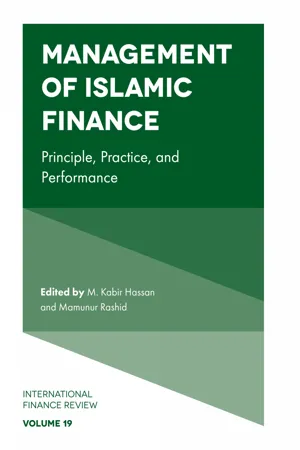
Management of Islamic Finance
Principle, Practice, and Performance
- 276 pages
- English
- ePUB (mobile friendly)
- Available on iOS & Android
eBook - ePub
Management of Islamic Finance
Principle, Practice, and Performance
About this book
Islamic finance has emerged as an alternative to century-old conventional financial instruments to cater to cater to the needs of Muslims as well as non-Muslims. The industry has seen significant growth over the last two decades and has been facing omnidirectional challenges with respect to regulation, competition, and compatibility. These challenges have presented worthy debate on the principles, practices, and performance in Islamic finance globally. In this issue, we have presented issues relevant to the most recent debate on the performance, practices, and principles of the Islamic finance industry as a whole, covering eleven distinct issues. Authors have contributed to the existing body of knowledge on risk management in Islamic banks, diversification in Islamic equity markets, performance and acceptance of Islamic microcredit and Islamic banking services, long-term corporate finance using sukuk, and the social development agenda via the development of financial intuitions, SME financing, and financial inclusion. Selected topics cover the principles in relevant areas, focus on recent practices, and highlight performance on certain influential areas. The issue is aimed at academicians, researchers, and policymakers who are working in the Islamic finance industry and who would like to explore more.
Information
CHAPTER 1
INVESTIGATING INTERNATIONAL PORTFOLIO DIVERSIFICATION OPPORTUNITIES FOR THE ASIAN ISLAMIC STOCK MARKET INVESTORS
ABSTRACT
The purpose of this chapter is to analyze the possible portfolio diversification opportunities between Asian Islamic market and other regions’ Islamic markets; namely USA, Europe, and BRIC. This study makes the initial attempt to fill in the gaps of previous studies by focusing on the proxies of global Islamic markets to identify the correlations among those selected markets by employing the recent econometric methodologies such as multivariate generalized autoregressive conditional heteroscedastic–dynamic conditional correlations (MGARCH–DCC), maximum overlap discrete wavelet transform (MODWT), and the continuous wavelet transform (CWT). By utilizing the MGARCH-DCC, this chapter tries to identify the strength of the time-varying correlation among the markets. However, to see the time-scale-dependent nature of these mentioned correlations, the authors utilized CWT. For robustness, the authors have applied MODWT methodology as well. The findings tend to indicate that the Asian investors have better portfolio diversification opportunities with the US markets, followed by the European markets. BRIC markets do not offer any portfolio diversification benefits, which may be explained partly by the fact that the Asian markets cover partially the same countries of BRIC markets, namely India and China. Considering the time horizon dimension, the results narrow down the portfolio diversification opportunities only to the short-term investment horizons. The very short-run investors (up to eight days only) can benefit through portfolio diversification, especially in the US and European markets. The above-mentioned results have policy implications for the Asian Islamic investors (e.g., Portfolio Management and Strategic Investment Management).
Keywords: Multivariate generalized autoregressive conditional heteroscedastic–dynamic conditional correlations; maximal overlap discrete wavelet transform; continuous wavelet transform; contagion; volatility spillover; Shari’ah indices
1. INTRODUCTION
The economic integration of international stock markets has become especially relevant over the last two decades. The substantial development of technology and the increased flow of capital between countries are the main factors for this globalization process. Thus, understanding the linkages between different financial markets is of great importance for portfolio managers and financial institutions. Volatility, as measured by the standard deviation or variance of returns, is often used as a crude measure of the total risk of financial assets (Brooks, 2002). Hence, when referring to international equity markets integration, researchers not only investigate the return causality linkages, but also measure volatility spillover effects. Information about volatility spillover effects is very useful for the application of value at risk and hedging strategies.
Recently, with the role of the emerging markets becoming more important, economists not only focus on developed countries, for example, United States, the United Kingdom, and Japan, but also pay great attention to the emerging markets. For example, in the equity markets, the extent of the linkages of the emerging stock market exchanges with developed stock market exchanges has important implications for both the developing and the developed countries’ investors. If the emerging market stock exchange is only weakly integrated with the developed market, it has the implication that there would be portfolio diversification possibilities for developed countries’ investors through including the emerging market stocks in their portfolio as this diversification should reduce risk, and vice versa. On the contrary, if the emerging stock markets were fully integrated with the developed stock markets, there would not be any portfolio diversification benefit for either developed and/or emerging countries’ investors.
Several researches such as Kumar and Mukhopadhyay (2002) and Wong, Agarwal, and Du (2005) support the notion that there is a correlation between the various markets globally. Furthermore, Yang (2005) inspected the international stock exchange correlations between Japan and the Asian Four Tigers (Hong Kong, Singapore, South Korea, and Taiwan) and found that stock exchange correlations vary widely over time and volatilities seem to be contagious across the markets. The importance of these studies was also confirmed by Levy and Sarnat (1970), in which they have shown how the correlations between developed and developing countries provide a paramount risk-reduction benefit.
More recently, the focus of the studies of these topics shifted to the contagion effect of financial crisis. For example, Lucia and Bernadette’s (2010) analysis show the evidence that the global financial crisis in 2007–2009 has been affecting differently the world economic regions. In the same year, Charles, Pop, and Darne (2011) discovered that during the crisis, both Islamic and conventional indices were affected to the same degree by variance changes. However, in terms of portfolio diversification, Achsani, Effendi, and Abidin (2007), in general, find that the interdependence of the Islamic stock markets tends to be asymmetric across a wide geographical area. While there are strong correlations between the Islamic stock indices of Indonesia and Malaysia, the US and Canada, and Japan and Asia Pacific, this is not exactly the case across the region.
In Grubel’s fundamental work in 1968, the idea of international portfolio diversification resulting in lower portfolio risks is still broadly acknowledged and accepted in the literature. International stock market relations are very important to international investors and fund managers to identify a set of international stocks that form best-diversified portfolios with the lowest possible risks (Dacjman, Festic, & Kavkler, 2012). The substance of lower risks from international diversification is significantly reliant upon low correlations across cross-border markets (Grubel & Fadner, 1971). Therefore, an increase in co-movements between asset returns of international stock market can subsequently reduce the advantage of international diversified investment portfolios (Ling & Dhesi, 2010). It has been further accepted in the literature that correlations among markets are raising through time due to changes in interdependence across markets (Engle, 2002). Likewise, market returns are not only time-varying, but may also be reliant on time scales highlighting the importance of investment horizons (Gencay et al., 2001).
Over the past decade, the global financial markets have observed the fast-growing “Islamic Financial Sector.” According to DeLorenzo (2000), the Islamic financial system is founded around the fundamentals of Shari’ah (Islamic Law) that requires profits from investment to be earned in an ethical and socially responsible way following the teachings of Islam. Equities traded under Shari’ah indices run through a screening procedure to guarantee they are free from the prohibited elements as commanded by Shari’ah. The common screening elements comprise riba (interest rates), gharar (uncertain outcomes), maysir (gambling), prohibited commodities (liquor, pork, etc.), and fulfillment of contractual requ...
Table of contents
- Cover
- Title
- Chapter 1 Investigating International Portfolio Diversification Opportunities for the Asian Islamic Stock Market Investors
- Chapter 2 Islamic Banks’ Resilience to Systemic Risks: Myth or Reality-Evidence from Bangladesh
- Chapter 3 Satisfaction with Islamic Microcredit Institutions: A Borrower-Centric Approach
- Chapter 4 Religious Preference and Financial Inclusion: The Case for Islamic Finance
- Chapter 5 Post-Default Sukuk Restructuring: An Appraisal of Shari’ah Issues
- Chapter 6 Relevance of Development Financial Institutions in the Presence of Islamic Financial Institutions
- Chapter 7 Corporation’s Threshold for Debt: Implications for Policy Reforms toward Equity-Biased Corporate Tax System
- Chapter 8 “Reverse Mudarabah” An Alternative of Classical Mudarabah for Financing Small Businesses
- Chapter 9 Participating Mortgages: An Alternative to Housing Finance
- Chapter 10 Determinants of Customers’ Engagement with Islamic Banking
- Chapter 11 Political Islam, Democracy, and Islamic Finance Development
- Index
Trusted by 375,005 students
Access to over 1.5 million titles for a fair monthly price.
Study more efficiently using our study tools.
Frequently asked questions
Yes, you can cancel anytime from the Subscription tab in your account settings on the Perlego website. Your subscription will stay active until the end of your current billing period. Learn how to cancel your subscription
No, books cannot be downloaded as external files, such as PDFs, for use outside of Perlego. However, you can download books within the Perlego app for offline reading on mobile or tablet. Learn how to download books offline
Perlego offers two plans: Essential and Complete
- Essential is ideal for learners and professionals who enjoy exploring a wide range of subjects. Access the Essential Library with 800,000+ trusted titles and best-sellers across business, personal growth, and the humanities. Includes unlimited reading time and Standard Read Aloud voice.
- Complete: Perfect for advanced learners and researchers needing full, unrestricted access. Unlock 1.5M+ books across hundreds of subjects, including academic and specialized titles. The Complete Plan also includes advanced features like Premium Read Aloud and Research Assistant.
We are an online textbook subscription service, where you can get access to an entire online library for less than the price of a single book per month. With over 1.5 million books across 990+ topics, we’ve got you covered! Learn about our mission
Look out for the read-aloud symbol on your next book to see if you can listen to it. The read-aloud tool reads text aloud for you, highlighting the text as it is being read. You can pause it, speed it up and slow it down. Learn more about Read Aloud
Yes! You can use the Perlego app on both iOS and Android devices to read anytime, anywhere — even offline. Perfect for commutes or when you’re on the go.
Please note we cannot support devices running on iOS 13 and Android 7 or earlier. Learn more about using the app
Please note we cannot support devices running on iOS 13 and Android 7 or earlier. Learn more about using the app
Yes, you can access Management of Islamic Finance by M. Kabir Hassan, Mamunur Rashid, M. Kabir Hassan,Mamunur Rashid in PDF and/or ePUB format, as well as other popular books in Business & Finanza. We have over 1.5 million books available in our catalogue for you to explore.