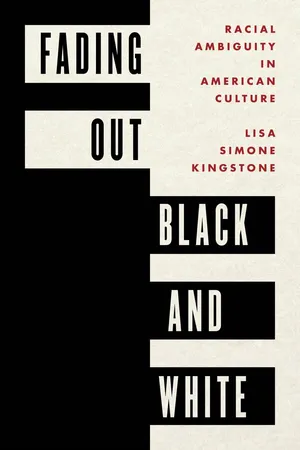
What happens to a country that was built on race when the boundaries of black and white have started to fade? Not only is the literal face of America changing where white will no longer be the majority, but the belief in the firmness of these categories and the boundaries that have been drawn is also disintegrating.
In a nuanced reading of culture in a post Obama America, this book asks what will become of the racial categories of black and white in an increasingly multi-ethnic, racially ambiguous, and culturally fluid country. Through readings of sites of cultural friction such as the media frenzy around 'transracial' Rachel Dolezal, the new popularity of racially ambiguous dolls, and the confusion over Obama's race, Fading Out Black and White explores the contemporary construction of race.
This insightful, provocative glimpse at identity formation in the US reviews the new frontier of race and looks back at the archaism of the one-drop rule that is unique to America.
- 224 pages
- English
- ePUB (mobile friendly)
- Available on iOS & Android
eBook - ePub
About this book
Information
21Chapter 1
Tracing Race
A Tour of the Racial Binary
Before looking at our cultural case studies, it is useful to give an overhaul of binary thinking in order to understand the changes that are taking place today. Understanding how these myths were built, sustained, policed, and defied is the story of American identity. Today’s removal of Confederate statues and Confederate flags is part of our changing of the narrative. A hero is now taken as a villain; a flag becomes understood as a racial slur. I look here at the movements and philosophies that built and reinforced the binary.
The black/white binary in the United States is an edifice built over five hundred years and won’t be dismantled easily. The idea that there are biologically different human “races” that we can label by physical type and also connect to superior and inferior traits such as intelligence, morality, physical prowess, and work ethic is an idea that was crucial to the building of American identity. Sometimes called biological essentialism, the conversion of a vast array of people from the continent of Africa with rich and distinct tribal cultures were reduced to one thing: an object called a N*gger. This distortion of a human with a distinct language, identity, and culture to a piece of cargo is made clear in figure 1.1 of a diagram of the Brookes slave ship.
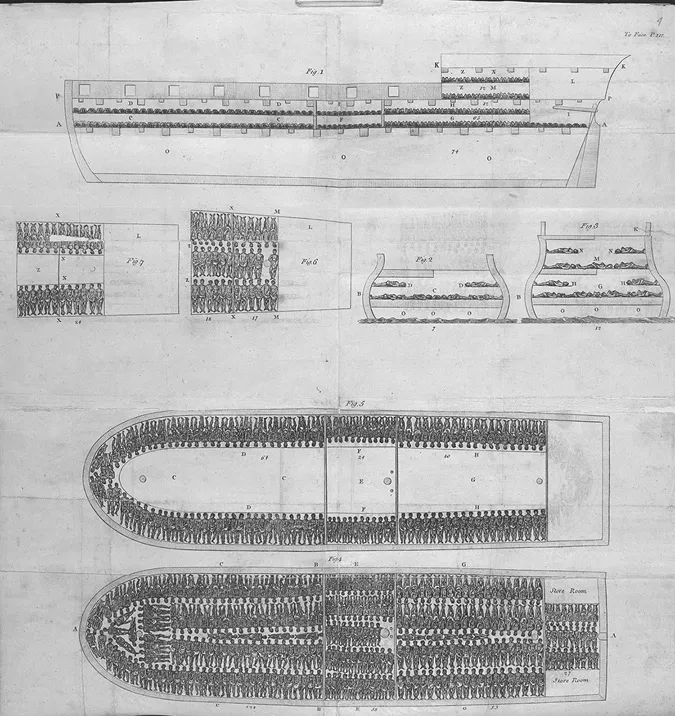
Figure 1.1 “Diagram of the Brookes Slave Ship” (1788), which depicts the ship loaded to its full capacity of 454 people. The diagram is a practical guide on how to efficiently store cargo.
Source: The British Library Board (shelfmark: 522.f.23, page 112). Published in 1787 by James Phillips, George Yard, Lombard Street, London (http://www.bl.uk/learning/citizenship/campaign/myh/photographs/gallery2/image2/brookesship.html).
Here the cold practicality of storing live humans (who all look identical to each other and are pictured with no distinguishing characteristics) is seen in a similar way to canned goods, stored for maximum profit. In fact, at first glance, you don’t realize they are people; they are simply property to be exchanged. Once this creation of the black sprung out of the slave ship, it needed defending through propaganda, stories, songs, biblical proof, and pseudoscience.
In the early days of the founding, the notion of blackness and whiteness was deeply entrenched by the aftermath of Bacon’s Rebellion in 1676, in which enslaved Africans, Native Americans, and white indentured servants 22bonded together to protest the current governor of the colony; their uniting successfully into a political force left the English nervous about the potential of this new group. If these dispossessed groups formed an alliance, they would seize control—after all, many of them had reason to be dissatisfied with their status and were hostile toward the elites. A divide and conquer strategy was created and made into law with the Virginia slave codes of 1705. 23Before that, people were referred to by their country of origin, their free or slave status, or by their Christian or “heathen” status. Theodore Allen in his The Invention of the White Race argues that the “white race” category was invented as a means of social control.1 From that point on, white indentured servants were encouraged to identify with the elites as fellow white people and not with blacks or Native Americans. Blackness became equated with slavery, contamination, and inferiority; and whiteness with freedom, privilege, and superiority. These codes forbid blacks and slaves from bearing arms, congregating in large numbers, exacted harsh punishments if they assaulted Christians or attempted escape, and black servants were made slaves for life. Later came antimiscegenation laws, forbidding blacks from marrying or having sex with whites. Blackness became a kind of contamination and the one-drop rule assured whites that they would always be separate even from those who were ambiguous phenotypically. Even in states where this was not translated into law, the belief that the mixing of races was unnatural became widespread. Any African ancestry made you black, so free men from Africa were suddenly pulled into the vortex of that chasm of blackness too. The rule of hypodescent ensured that any child born to a white parent and a black parent was automatically black—useful for slave owners to increase their property. The child always followed the condition of the mother, so this legislation was key for keeping the number of enslaved robust.
Although western art had shown the nobility and prestige of African people as evidenced in the five-volume collection The Image of the Black in Western Art2 (which includes sculpture, paintings, drawings of the vast array of black figures since the time of the pharaohs), these images were not seen by most of the inhabitants of the early colonies. Instead, the new drawings of black people were to entrench the belief that they were animal like and identical in character or more precisely in their lack of character.3 Figure 1.2 shows Nott’s “scientific” drawing of skull shape, which attempted to connect blacks to monkeys, a trope about blackness that is still very much alive today.
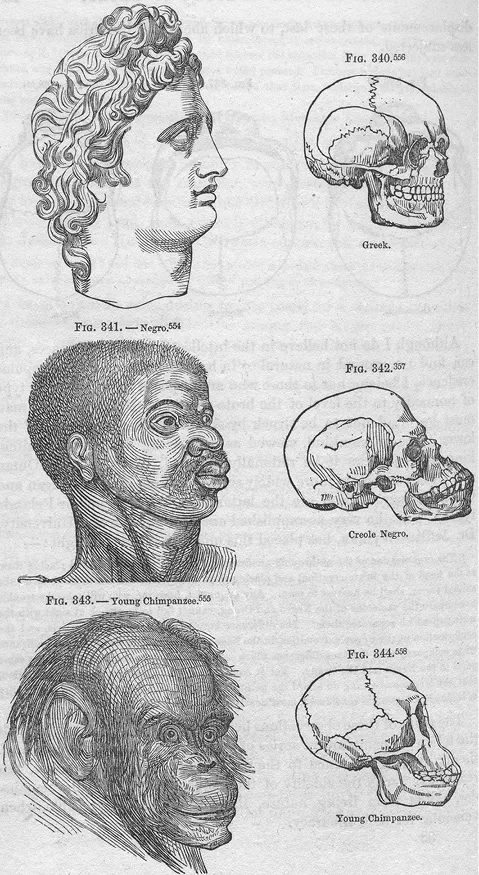
Figure 1.2 Indigenous Races of the Earth, 1857. This drawing attempted to connect black people to chimpanzees by comparing skull shape.
Source: The British Library (shelfmark: General Reference Collection 10007.k.4). Book: “Types of Mankind,” page 458, published in 1854 by Philadelphia: Lippincott, G...
Table of contents
- Contents
- List of Figures
- Acknowledgments
- Preface
- Introduction
- 1 Tracing Race: A Tour of the Racial Binary
- 2 The Trial of Rachel Dolezal: The First Transracial
- 3 Obama as Racial Rorschach: The First Blank President
- 4 Casting Color: Black Barbie and the Black Doll as Racial Barometer
- 5 Really Black: Black-ish and the Black Sitcom as Racial Barometer
- 6 Talking About Race: Black, White, and Mixed-Race Focus Groups
- Coda
- Appendix 1: Demographic Information Form
- Appendix 2: Flyer for Focus Groups
- Bibliography
- Index
- About the Author
Trusted by 375,005 students
Access to over 1.5 million titles for a fair monthly price.
Study more efficiently using our study tools.
Frequently asked questions
Yes, you can cancel anytime from the Subscription tab in your account settings on the Perlego website. Your subscription will stay active until the end of your current billing period. Learn how to cancel your subscription
No, books cannot be downloaded as external files, such as PDFs, for use outside of Perlego. However, you can download books within the Perlego app for offline reading on mobile or tablet. Learn how to download books offline
Perlego offers two plans: Essential and Complete
- Essential is ideal for learners and professionals who enjoy exploring a wide range of subjects. Access the Essential Library with 800,000+ trusted titles and best-sellers across business, personal growth, and the humanities. Includes unlimited reading time and Standard Read Aloud voice.
- Complete: Perfect for advanced learners and researchers needing full, unrestricted access. Unlock 1.5M+ books across hundreds of subjects, including academic and specialized titles. The Complete Plan also includes advanced features like Premium Read Aloud and Research Assistant.
We are an online textbook subscription service, where you can get access to an entire online library for less than the price of a single book per month. With over 1.5 million books across 990+ topics, we’ve got you covered! Learn about our mission
Look out for the read-aloud symbol on your next book to see if you can listen to it. The read-aloud tool reads text aloud for you, highlighting the text as it is being read. You can pause it, speed it up and slow it down. Learn more about Read Aloud
Yes! You can use the Perlego app on both iOS and Android devices to read anytime, anywhere — even offline. Perfect for commutes or when you’re on the go.
Please note we cannot support devices running on iOS 13 and Android 7 or earlier. Learn more about using the app
Please note we cannot support devices running on iOS 13 and Android 7 or earlier. Learn more about using the app
Yes, you can access Fading Out Black and White by Lisa Simone Kingstone in PDF and/or ePUB format, as well as other popular books in Social Sciences & Black Studies. We have over 1.5 million books available in our catalogue for you to explore.