- 504 pages
- English
- ePUB (mobile friendly)
- Available on iOS & Android
eBook - ePub
About this book
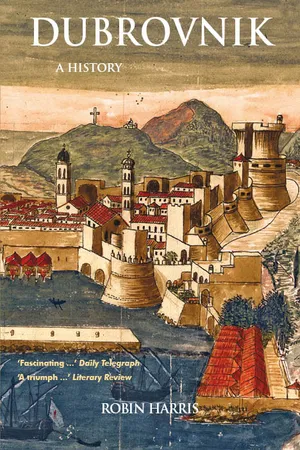
Since emerging as a settlement in the seventh century, Dubrovnik has faced Venetian aggressors, Ottoman plotters, a terrible earthquake in 1667 and, finally, the will of Napoleon. In 1991-92 the city survived the besieging Yugoslav army, which heavily damaged but did not destroy its cultural heritage. This book is a comprehensive history of Dubrovnik's progress over twelve centuries of European development, encompassing arts, architecture, social and economic changes, politics and the trauma of war.
Information
Topic
HistoireSubtopic
Histoire de l'Europe de l'EstONE
Ragusan Roots and Riddles: The Origins of Ragusa/Dubrovnik
Natural Advantages
The precise circumstances of Ragusa/Dubrovnik’s foundation will, it seems safe to predict, continue to be the subject of almost disproportionate scholarly debate involving not just distinguished historians but eminent archeologists and linguists. The subject has always had a burning importance, not least for the inhabitants of Dubrovnik itself who, over the centuries and uninhibited by excessive scruple, devised a number of reassuring myths to reinforce their ancient but tiny city-state’s legitimacy.
Why, though, might the first inhabitants have chosen to settle in Dubrovnik? After all, the whole Dalmatian coastal stretch enjoys the benefits of a typical Mediterranean climate, conducive to the cultivation of olives, vines and citrus fruit. There are long months of productive fishing, though mariners have always feared the destructive violence of the cold northeast wind – the bura. Unlike the western (Italian) coast of the Adriatic, the eastern (Dalmatian) is endowed with sheltered bays and harbours, while the mountains, though they make access inland more difficult, offer valuable navigation points. Unlike the people of the hinterland, those who live along the Dalmatian coastal strip have always enjoyed easy communications with each other’s settlements and manageable ones with the rest of the Mediterranean world. Whereas inland the rugged mountains and thick forests marked off one rural community from another and induced a certain isolationism and backwardness that would come to be synonymous with the term ‘Balkan’, the Dalmatian communities were more open and sophisticated. They were also richer. And from this point of view the mountains, which hindered access to the less civilised hinterland, had an added benefit: they constituted a useful barrier against at least casual raiders from the interior, lured by the prospect of easy pickings along the more developed coast.
Dubrovnik, however, had particular natural and other advantages which marked it out from the rest of coastal Dalmatia. Most important from the very beginning must have been its harbour. This faced southeast, and so escaped the unwelcome force of the bura. But the harbour was also sheltered in large measure from the southeast wind (known locally as šilok) by the island of Lokrum, which acted too as a kind of breakwater against the incoming swell. Similarly, while the southwest wind (or lebić) often sent waves thundering against the western part of the town, the cliffs and, later, walls of Dubrovnik afforded good protection for ships riding in the harbour. In Greek, Roman and early medieval times – before the invention of rudders and primitive compasses – ships travelled whenever possible during spring and summer and, unless in the direst emergency, during the hours of daylight. Along the eastern Adriatic coast in these seasons the prevailing wind was the northwesterly maestral which would usually blow quite steadily from mid-morning till sunset. For ships using sail and oars to make their way up the coast, for example from the Greek settlement of Budva to that on Korčula, Dubrovnik would have served as an ideal, secure haven – all the more so since in ancient times it was usual to pull ships ashore, and Dubrovnik’s harbour had (in those days) to the west a sandy bank against which to do so. A further benefit was that in these early times there were sources of drinkable water to the east of the harbour: many centuries later, as the sea level rose and the land sank, the water in these wells became brackish and other water had, particularly in summer, to be brought by ships from the springs of Mlini some four nautical miles down the coast.1
Dubrovnik had other benefits as well. It is the only one of the Dalmatian towns that looks straight out onto the Adriatic. This enabled those within to gain early warning of approaching danger.2 Moreover, while Dubrovnik’s harbour offered by far the best protection, there were also more or less satisfactory alternatives for ships unable to reach it by nightfall or because of adverse conditions. Thus for ships seeking shelter along the coast there were the possibilities offered by the bay of Župa, the bay of Zaton and the Channel of Koločep, which lies between the ‘Elaphite Islands’, as the older Pliny termed them (that is Šipan, Lopud and Koločep), and the shore. There was also, at a pinch, the nearby inlet of Rijeka Dubrovačka, though it was unpleasantly open to both bura and maestral.
The mouth of the Neretva river, further up the coast, provided another haven. But above all, it was from the earliest times – when travel by boat was so much swifter and easier than travel overland – the easiest access point to the interior and had indeed been the site of the flourishing Roman trading centre of Narona (Vid, near modern Metković). Not surprisingly, once Dubrovnik began to develop as a trading centre, the Neretva estuary quickly fell under Ragusan influence.3
Situated towards the southeastern end of the Adriatic, with prevailing winds and currents operating in its favour, Dubrovnik must from the earliest times have enjoyed a modest coastal trade with its Dalmatian neighbours. But once the size of its ships and the experience of its mariners grew, it was also well-situated to exploit the valuable East-West link with Italy – Ancona (which became for many Ragusans a home from home, and where a Ragusan colony flourished up until the nineteenth century) and the grain-rich lands of Apulia.4 Looking further ahead, however, it was Dubrovnik’s development of the Balkan trade which, in association with its commercial fleet, would be the basis of the Republic’s economic success: so the fact of the town’s proximity to ancient roads into the hinterland, via Župa and Konavle to the southeast and Slano to the northwest, should also be mentioned when listing Dubrovnik’s natural advantages. These were the routes by which the Ragusans would exploit the mineral wealth of Serbia and Bosnia. And later it would be by way of the dubrovački drum – the famous Dubrovnik Road – that the Ragusans would establish their fraught but fruitful relationship with the Ottoman Empire.
But this, of course, is to anticipate by many centuries. What sort of people were the inhabitants of Dalmatia from among whom, in uncertain combinations, under obscure circumstances and with a contentious chronology, the little settlement at Ragusa would emerge?
Ragusan Prehistory – Epidaurum
The Eastern Adriatic was already populated at the start of Neolithic times, and the near surrounds of Dubrovnik – and perhaps the cliff site of Ragusa itself – were inhabited in the Bronze and Iron Ages.5 But the precise movements or even identity of the peoples who populated Dalmatia in these early times are extremely obscure. The Illyrians are regarded as the oldest historically established people in the region, but who they really were – and what ultimately happened to them – is less clear.6 One tribe called the ‘Histri’ occupied what is modern Istria, to which they gave their name. A second tribe called the ‘Liburni’, who may or may not have been ethnically Illyrian, lived along the Croatian littoral as far as the River Krka. A third tribe, the ‘Delmati’, who gave their name to Dalmatia, inhabited the Dalmatian coast as far as the River Cetina and inland to the territories (in what is modern Bosnia) of Livanjsko Polje, Duvanjsko Polje and Glamočko Polje.7
The Celts appeared in the Balkans in the fourth century BC and lived with or integrated among the Illyrian population they found. But the earlier (fifth/sixth century) Greek colonisation of much of the eastern Adriatic left a more abiding impression. Under the leadership and protection of the city of Syracuse, there grew up the Dorian colony of Issa on the island of Vis, which itself spawned other Greek towns on the neighbouring islands and coastal region.
Interestingly, in view of so much subsequent myth-making down the centuries, and in spite of its sharing a name with a famous classical Greek city, it is clear that Dalmatian Epidaurum – later known as Ragusa Vecchia (‘Old Ragusa’), the modern Cavtat situated some miles down the coast from modern Dubrovnik – was not a Greek settlement.8 In fact, Epidaurum does not even figure in accounts of those Roman-Illyrian Wars which convulsed the region beginning in 230–229, continuing in 220–219 and 167 BC and only coming to a bloody close with a Roman victory in 9 AD.9 From then on, Dalmatia was subject to strong social, cultural and political influence from Rome, which would have decisive consequences for its future. In particular, the new rulers settled colonists and built up towns as centres for them. Epidaurum was one of these centres.
The place is first mentioned in 47 BC, when Pompey’s legate, Marcus Octavius, attacked it because it was held by a garrison loyal to Caesar. Epidaurum was besieged by land and sea but got word to Caesar, who sent an army to relieve it. Marcus Octavius’s fleet and army, however, withdrew before the relief force arrived.10 Epidaurum was described as a ‘colony’ by Pliny the Elder (who died in 79), but when it formally became one is unknown. Probably, it received that designation at the same time as Narona and Salona (modern Solin, a suburb of Split) under Augustus.11 The name ‘Epidaurum’ deserves some explanation, because the – false – assumption that it was Greek had such a strong bearing on the myths subsequently attached to it and to Dubrovnik.12 It seems, in fact, to be a Latinised Illyrian expression, perhaps meaning ‘behind the forest’. The place was probably first established as an Illyrian fishing village, or perhaps as a fortified place useful for pirates, and then was seized and developed by the resourceful Romans for their own purposes.
In any case, it quickly became an important stop on the Roman road which stretched north to Narona, Salona, Jadera (Zadar), Senia (Senj), Tergeste (Trieste) and finally Rome itself. To the south the road led to Resinium (Risan), Butua (Budva), Ulcinium (Ulcinj) and through modern Albania to Solun (Thessalonika). The link with Narona, which flourished mightily at this time, was particularly important.13 Of Epidaurum’s buildings and monuments hardly anything survives: a few inscriptions are the most important remaining evidence o...
Table of contents
- Cover
- Title
- Copyright
- Contents
- List of Illustrations
- Acknowledgments
- A Note on Names
- A Note on Pronunciation
- A Note on Citations
- Preface
- 1. Ragusan Roots and Riddles: The Origins of Ragusa/Dubrovnik
- 2. Distant Friends and Hostile Neighbours: Dubrovnik Under Byzantine Protection (c. 800–1205)
- 3. The Serenissima’s Subjects: Dubrovnik Under Venetian Rule (1205–1358)
- 4. A Kind of Independence: Dubrovnik’s Autonomous Development Under Hungarian Suzerainty (1358–c. 1433)
- 5. Eastern Approaches: Dubrovnik Within the Ottoman Empire (c. 1396–1526)
- 6. War, Diplomacy and Chaos: Dubrovnik Between the Habsburgs, Venice and the Porte (1526–1667)
- 7. Governing Passion: The Institutions of Government and the Challenges They Faced (c. 1272–1667)
- 8. Merchant Venturing: Economic Development (c. 1272–1667)
- 9. Ragusan Society: Dubrovnik’s Social Structure and Mores (c. 1300–c. 1667)
- 10. Religious Life: Ecclesiastical Organization and Spirituality in Dubrovnik (c. 1190–1808)
- 11. Cultural Life: Literature, Scholarship, Painting and Music (c. 1358–c. 1667)
- 12. The Construction of Dubrovnik: Settlement and Urban Planning, Fortification and Defence, Public and Private Building in the Ragusan Republic (c. 1272–1667)
- 13. Death and Resurrection: The Great Earthquake and its Aftermath (1667–1669)
- 14. Sunset Years: Political, Economic, Social and Cultural Life (1669–1792)
- 15. The Fall of the Ragusan Republic: The Background to and Circumstances of the Abolition of the Republic in 1808
- Postscript: Ragusan Shadows: Episodes from the Later History of Dubrovnik
- Appendix 1: A Note on Dubrovnik’s ‘Independence’
- Appendix 2: A Note on Money, Weights and Measures
- Chronology
- Notes
- Bibliography
- Sources for Illustrations
- Index
Trusted by 375,005 students
Access to over 1.5 million titles for a fair monthly price.
Study more efficiently using our study tools.
Frequently asked questions
Yes, you can cancel anytime from the Subscription tab in your account settings on the Perlego website. Your subscription will stay active until the end of your current billing period. Learn how to cancel your subscription
No, books cannot be downloaded as external files, such as PDFs, for use outside of Perlego. However, you can download books within the Perlego app for offline reading on mobile or tablet. Learn how to download books offline
Perlego offers two plans: Essential and Complete
- Essential is ideal for learners and professionals who enjoy exploring a wide range of subjects. Access the Essential Library with 800,000+ trusted titles and best-sellers across business, personal growth, and the humanities. Includes unlimited reading time and Standard Read Aloud voice.
- Complete: Perfect for advanced learners and researchers needing full, unrestricted access. Unlock 1.5M+ books across hundreds of subjects, including academic and specialized titles. The Complete Plan also includes advanced features like Premium Read Aloud and Research Assistant.
We are an online textbook subscription service, where you can get access to an entire online library for less than the price of a single book per month. With over 1.5 million books across 990+ topics, we’ve got you covered! Learn about our mission
Look out for the read-aloud symbol on your next book to see if you can listen to it. The read-aloud tool reads text aloud for you, highlighting the text as it is being read. You can pause it, speed it up and slow it down. Learn more about Read Aloud
Yes! You can use the Perlego app on both iOS and Android devices to read anytime, anywhere — even offline. Perfect for commutes or when you’re on the go.
Please note we cannot support devices running on iOS 13 and Android 7 or earlier. Learn more about using the app
Please note we cannot support devices running on iOS 13 and Android 7 or earlier. Learn more about using the app
Yes, you can access Dubrovnik by Robin Harris in PDF and/or ePUB format, as well as other popular books in Histoire & Histoire de l'Europe de l'Est. We have over 1.5 million books available in our catalogue for you to explore.