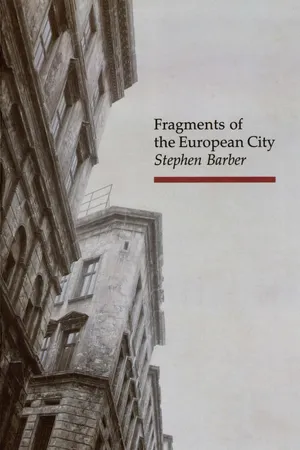
This book explores the visual transformation of the contemporary European city, focusing on the most emblematic and visibly wounded of all European cities – Berlin.
Taking as its subject the ‘intricately assembled, relentlessly disassembling metropolitan screen’, it charts the virulent implosions of culture, the distortions and violence that give city-living its fractured and hallucinatory quality.
Provocatively written as a series of inter-locking poetic fragments, the text evokes the formation of metropolitan ‘identity’ as it ricochets between the physical surface of the city and the vulnerable but manipulating consciousness of city dwellers.
Barber has discovered a powerful new vocabulary – a vocabulary charged with the visual and sonic impact of the cinema. Like the city, the text pulsates, creatively chaotic, raw and exhilarating.
- English
- ePUB (mobile friendly)
- Available on iOS & Android
eBook - ePub
Fragments of the European City
About this book
Information
1
The European city is a hallucination made flesh and concrete, criss-crossed by marks of negation: graffiti, bullet-holes, neon. The city is an immense arena of eroded and exploded signs – signs that mediate the city to the individual, and that individual to the city. For all their pockets of stasis and stagnation, the European cities have taken on a momentum of transformation in the final decade of the twentieth century, and that transformation demands constant, obsessional exploration. The eyes of the cities’ inhabitants are in a process of visual suffusion, compacting a multiplicity of gestures and movements into the act of seeing the city. The process of experiencing the European city is one of corrosion, in which the screens of the city are torn away, revealing layers and nodes of history and memory that lie shattered by the trajectories of the twentieth century. Just as it moves forward, blindly but sensationally, the European city is moving backward in time, colliding abrasively with extreme moments of conflict: the collections of murder, annihilation, violence that make the twentieth century vivid and tangible in all its horror. From this mesh of space and time, which itself transmits the history and experience of the European city, the imageries of television and cinema are ejected into the city: television constantly, droning with the noise of the city, and cinema intermittently, performing its dense projection of vision into the eyes of its spectators. The inhabitant of the European city is a participant entangled utterly in the visible, susceptible to an infinity of aural and visual acts that encompass the tortuous, the exquisite and a vast array of the banal: the banal supports the city and gives it life. Assembling a city is the most gratuitously social act imaginable, conglomerating human lives into a mass of friction. To build a city is to subjugate the imagination to the obliterating power of the everyday. The cities trail limbs of suburbia that are the exposed and wounded sites of all the random residue generated by the glory of the European metropolis: racism, poverty, drug abuse, prostitution, desperation. The detritus abjected by the city and the strangeness exuded by the city are interacting elements of the same arrangement, of the same visual sensation. The city projects itself with a force which is exhausting, that in visual terms exacts surrender and acceptance of the city’s appearance. The cities have a self: cities exist to be travelled in, worked in, passed through by the colossal ephemera of human lives. The cities represent themselves, accumulating a mass of vital imageries from the fluid matter of memory, nostalgia, evocation, and suturing that index of scars into the projection of the contemporary moment, the present and presence of the city in its immediacy and urgency. The survival of the figures that inhabit the European city hinges on a questioning of – a penetration of – the hallucination that is a city.
2
The cities of Europe metamorphose rapidly. Each component is dispensable and may be restructured at will at any moment: the arrangement of the city is constantly cut, impacted, expanded. The flux between the city and its inhabitants is a site of ferocious visual tension, with imageries generated that collapse and reformulate the perception of the city, its languages, its societies, its nationalities, its cultures. The cities have never possessed unity, and now the multiplicity of voices passing between the transforming city and the transforming individual creates an utter fragmentation. This aggravated sense of dissolution in upheaval is a source of anxiety, an upending of visual identity: but it also incites the exhilaration that is integral to a moment of reconstitution from zero, to a new way of working a sensation into the matter of the city. All voices must be interrogated in the European city – all media voices, sources, imageries and, yet again, ‘the voice of the father’. After the Second World War, after the riots of the late 1960s, the voice of the father, with its power to unleash mass psychosis and mass uniformity, was rejected. In the radio voice of Hitler, the children of Germany and Austria had been made to recognize a father whose words were the very origin of their identity. That voice was corporeal in its penetration into the self. With the disgrace and death of that infallible father, every word transmitted by the media in the name of the father became a source of suspicion and refusal, always seeping back, always attempting to supplant. Every father that speaks, from Berlin to Belgrade, has a voice that the city’s inhabitants must set aside in order to breathe. The refusal of the voice of the father is in the great tradition of the European cities, where the imposing image of the historical past is that of the historical void, and where memory is a set of blackouts, shocks and violences, interspersed with points of stasis. To refuse the voice of the father implies isolation, punishment, which the city answers severely in a visual arrangement of tenement blocks, suburban high-rise encampments, colonies on the edge of the city. However essential the act of refusal may be as an assertion of presence of the void of the city, it never prevents the reassertion of the voice of the father. The city resounds with a tinnitus of the aural media that is reinforced by every image that tracks and illuminates the inhabitants’ daily round. The contemporary is endlessly at maximum volume and at maximum ocular speed and colour, unstoppable in its broken rhythms and cacophonies. The silence of the city can exist only when its inhabitant becomes stranded in the historical gaps of the city, where its past wounds intersect with the future, but where the present is empty, vacuumed of sound. In the last instance, no authentic father exists in the European cities, and the source of the voices is only the axis of a mass of divergent representations, that spurts imageries and languages in every direction. The European city compulsively invites its inhabitants to refuse the voice of their fathers; but however extreme or intricate that refusal may be, the city will always survive by inventing a new set of voices around another axis of sound and vision. The voices of the city and the voices of its figures are in a dialogue of the deaf, a dialogue in forked tongues – but together they produce the raw material that is the language of the city, into which its imageries can be assembled. The voices are at maximum potential after their extremity has brought down a conflagration, a choking of the vocal tract and the end of the city, as in 1945 Berlin: then the city is speechless and stricken, infinitely open to all languages.
3
A journey into the suburbs: the tramways grind through the arrangement of housing blocks where, from every balcony, eyes stare down. The longer the journey, the greater the sense of dilution – a diffusion of human experience into a blank tone of impermanent concrete, supermarkets, television screens. Even the graffiti that blast from the heart of the city has been submerged here, leaking away from declaration and obliteration into a description of affection and taunting: pyrotechnics over blood. The battles of territory, race, neo-fascism that marked every wall and tram-shelter of the eastern Berlin suburb of Marzahn have now been screened by new colours in the gang warfare of the lost city: a set of vivid but blank screens placed over the virulence and anguish which once pitted those walls like the constellations of shrapnel on the old grey tenement facades of the city. In these outer suburbs, these annexes of extremity, the sensation of an act of chance is overwhelming. Nothing could be more bizarre than the vast accumulation of human bodies and low-grade building materials on the edge of the city: a spontaneous concoction, born of intoxication and obsession on the part of its constructors. The light around these blocks is dense, almost tangible, punctuated only by the insignia of supermarkets, the incessant namings of shopping chains. If this European suburb were exchanged, by chance, with the blocks around a city in Albania, the operation would not leave a scar; the languages of the supermarkets could be reinvented with new numerals, designs, desires; and the tramways could ingest another population into the city. Around the concrete suburbs of Marseilles, the violent light compacts the lethal explosions of fury and indignation, so that banality is brilliant; in Marzahn, the light petrifies an already comatose situation, though anger exists in a parallel dosage, equally volatile and narcotic. The transplantation of anger from the city suburbs into the heart of the European city is a process of insinuation – the infiltration of languages and imageries moves in a great intersecting gesture from the metropolis to suburbia and back, so that European suburbia mirrors, frozenly, that which is intensely present within the European city, giving the city its burning core of banality.
4
At every step, something vital is missing in the European city. Trajectories from one location to another are interrupted by a process which is designed to clot the city into nodes of financial efficiency. But in the European city, such a bogus coagulation will not hold, and the city pours out its riotous haemophiliac pulse, irregularly but unstoppably. The trajectory taken through the city is guided by that city’s voids, by what is not there. The city is constructed by its gaps. Now that the wars of the twentieth century have lost the carapace of their original authenticity, their existence persists and visualizes itself only in fragments – but fragments of intense power that impact raw past upon the present moment. Immense human gatherings upon the European city, such as the Soviet Army’s final movement from Kostrzyn through to Berlin, are blank gestures in contemporary Europe, when set against the slightest thread of material damage or decay which is present in the fabric of the contemporary city: the evidence of loss is the crucial matter of the metropolis. The voids of the European city hold it together, haunting the city’s inhabitants with a nostalgia for destruction that is also a lust for survival. New buildings must be discarded instinctually as inept apparitions, visual evidence of malicious will – since to build rearranges the complex network of the objects which are not there, and which sustain human balance by the permanence of their invisibility. Every European city has a twin that died at birth. The plan to obliterate the surviving ruined elements of Berlin in 1945, after the war, and to construct a new city some distance away, is the anchoring memory of the contemporary city: the void city with its void population is constantly resuscitated by the damaged fragments that carry its imagery and its memory. The entirety of Europe now comprises an eminently missing city which will not conglomerate, which eludes its identity, which will not adhere to its own history. In the heart of its catastrophe, wrapped in the skin of its nostalgia for obliteration, Europe resides, in fragments.
5
The former Stasi (secret police) headquarters in Berlin-Lichtenberg has had its identity cracked and humiliated. Some of it is a supermarket, some of it commercial offices. The city was based around a network of gazes that had their axis in this building, and now that that axis has been crushed out of existence, the gazes swing wildly, in an undetermined helter-skelter of acts of looking. The contact between each human being in the city of East Berlin was determined by their proximity and by the terror which that proximity occasioned. Contact was based on the presence of omniscience, across scales and networks of tedium and banality. When the act of looking was made closely enough, it revealed a flaw; if that visual flaw could be welded to an oral declaration, then a representation of betrayal could be constructed. Every momentary movement of expulsion, abjection, refusal in the city had its source in the collection and assemblage, on a massive scale, of gazes. The carapace on the private life of the city’s inhabitants became a surface to be flayed with gazes, and the more abrasive the gaze became, the less distance could be maintained between the inhabitant and the raw city. The arena of looking was built on such velocities of vision and sound that no compromise was too absurd to make – the entire configuration of looking and denunciation created its own bizarre identity, so brittle that it exploded in an instant. And one arena of vision has been replaced by another, in which the gaze has no object or source – nothing can be pinned down according to any system of recognition, or of guilt. The gaze is void, occupied bogusly by the imageries of the former Federal Republic; also occupied by television and advertising imageries, which possess alien multiplicity. The levels of differentiation in the act of looking, so complex and intricate in the time of the Stasi, like a pointillism of vision, are now attenuated. Eyes trained to see and skin the appearances of human behaviour in the city now have to move in every direction, simply to catch the textures of what is authentic, what reinforces, what endangers, in the detail of everyday life. So vision freewheels, ‘Catherine-wheels’ even, into visions of racism based on appropriated schemes of colour and of income – a spilling of the talent of such eyes, schooled as they are with advanced mechanisms of gazing. Everything, every inhabitant of the city, is seen at once, with a simultaneity which blurs into existence extreme amalgams of concrete, petroleum, air and flesh.
6
The extinguishing of memory is a tough, rapid process in the impermeable European city. At the end of 1993, I visit the Soviet Army’s ‘Museum of the Unconditional Surrender of Fascist Germany in the Great Patriotic War, 1941–45’ in Berlin-Karlshorst. My visit evokes in me the sensation of an impregnable substance which, I feel, has disintegrated only by accident. The desolation is tangible, a sheer and unmotivated falling-away of power from an immense altitude. The Soviet Army’s vast battle for Berlin left its layering of bones, fragments, ashes, bullet-holes in the body of the city, cemented by the volatile stuff of memory. The excavation and discarding of that layer is a gratuitous process, the utter lack of weight of which mirrors, oppositionally, the immensity of killing, of fear, of political and military domination. The eyes of the viewer see that the...
Table of contents
- Front Cover
- Half Title
- Title Page
- Copyright
- Contents
- 1
- 2
- 3
- 4
- 5
- 6
- 7
- 8
- 9
- 10
- 11
- 12
- 13
- 14
- 15
- 16
- 17
- 18
- 19
- 20
- 21
- 22
- 23
- 24
- 25
- 26
- 27
- 28
- 29
- 30
- 31
- 32
- 33
- 34
- 35
- 36
- 37
- 38
- 39
- 40
- 41
- 42
- 43
- 44
- 45
- 46
- 47
- 48
- 49
- 50
Trusted by 375,005 students
Access to over 1.5 million titles for a fair monthly price.
Study more efficiently using our study tools.
Frequently asked questions
Yes, you can cancel anytime from the Subscription tab in your account settings on the Perlego website. Your subscription will stay active until the end of your current billing period. Learn how to cancel your subscription
No, books cannot be downloaded as external files, such as PDFs, for use outside of Perlego. However, you can download books within the Perlego app for offline reading on mobile or tablet. Learn how to download books offline
We are an online textbook subscription service, where you can get access to an entire online library for less than the price of a single book per month. With over 1.5 million books across 990+ topics, we’ve got you covered! Learn about our mission
Look out for the read-aloud symbol on your next book to see if you can listen to it. The read-aloud tool reads text aloud for you, highlighting the text as it is being read. You can pause it, speed it up and slow it down. Learn more about Read Aloud
Yes! You can use the Perlego app on both iOS and Android devices to read anytime, anywhere — even offline. Perfect for commutes or when you’re on the go.
Please note we cannot support devices running on iOS 13 and Android 7 or earlier. Learn more about using the app
Please note we cannot support devices running on iOS 13 and Android 7 or earlier. Learn more about using the app
Yes, you can access Fragments of the European City by Stephen Barber in PDF and/or ePUB format, as well as other popular books in Literature & Literary Collections. We have over 1.5 million books available in our catalogue for you to explore.