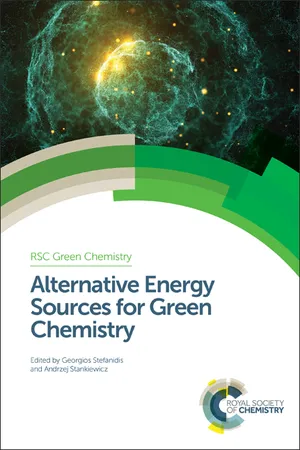
The use of alternative energy forms and transfer mechanisms is one of the key approaches of process intensification. In recent years, significant amounts of research have been carried out in developing chemical processing technologies enhanced by plasma, electric and magnetic fields, electromagnetic and ultra-sound waves and high gravity fields. Discussing the broad impact of alternative energy transfer technologies on reactions, separations and materials synthesis, this book reports on recent breakthrough results in various application areas. It provides a comprehensive overview of the current developments in the field. The book enables industrialists, academics and postgraduates in alternative-energy based processing to see the potential of alternative energies for green chemistry and sustainability of chemical manufacturing.
- 429 pages
- English
- PDF
- Available on iOS & Android
eBook - PDF
Alternative Energy Sources for Green Chemistry
About this book
Information
Table of contents
- Cover
- Alternative Energy Sources for Green Chemistry
- Preface
- Contents
- Chapter 1 - Microwave-Assisted Green Organic Synthesis
- Chapter 2 - Microwave-Assisted Plant Extraction Processes
- Chapter 3 - Low-Temperature Microwave Pyrolysis and Large Scale Microwave Applications
- Chapter 4 - Microwave Reactor Concepts: From Resonant Cavities to Traveling Fields
- Chapter 5 - Greener Processing Routes for Reactions and Separations Based on Use of Ultrasound and Hydrodynamic Cavitation
- Chapter 6 - Magnetically Assisted Separations in Chemical Industry and Biotechnology: Basic Principles and Applications
- Chapter 7 - Prospects of Magnetic Nanoparticles for Magnetic Field-Assisted Mixing of Fluids with Relevance to Chemical Engineering
- Chapter 8 - Photocatalysis: Past Achievements and Future Trends
- Chapter 9 - Photocatalytic Reactors in Environmental Applications
- Chapter 10 - Plasma-Assisted Nitrogen Fixation Reactions
- Chapter 11 - Higee Technologies and Their Applications to Green Intensified Processing
- Chapter 12 - High-Gravity Operation in Vortex Chambers for the Generation of High-Efficiency Fluidized Beds
- Subject Index
Trusted by 375,005 students
Access to over 1.5 million titles for a fair monthly price.
Study more efficiently using our study tools.
Frequently asked questions
Yes, you can cancel anytime from the Subscription tab in your account settings on the Perlego website. Your subscription will stay active until the end of your current billing period. Learn how to cancel your subscription
No, books cannot be downloaded as external files, such as PDFs, for use outside of Perlego. However, you can download books within the Perlego app for offline reading on mobile or tablet. Learn how to download books offline
Perlego offers two plans: Essential and Complete
- Essential is ideal for learners and professionals who enjoy exploring a wide range of subjects. Access the Essential Library with 800,000+ trusted titles and best-sellers across business, personal growth, and the humanities. Includes unlimited reading time and Standard Read Aloud voice.
- Complete: Perfect for advanced learners and researchers needing full, unrestricted access. Unlock 1.5M+ books across hundreds of subjects, including academic and specialized titles. The Complete Plan also includes advanced features like Premium Read Aloud and Research Assistant.
We are an online textbook subscription service, where you can get access to an entire online library for less than the price of a single book per month. With over 1.5 million books across 990+ topics, we’ve got you covered! Learn about our mission
Look out for the read-aloud symbol on your next book to see if you can listen to it. The read-aloud tool reads text aloud for you, highlighting the text as it is being read. You can pause it, speed it up and slow it down. Learn more about Read Aloud
Yes! You can use the Perlego app on both iOS and Android devices to read anytime, anywhere — even offline. Perfect for commutes or when you’re on the go.
Please note we cannot support devices running on iOS 13 and Android 7 or earlier. Learn more about using the app
Please note we cannot support devices running on iOS 13 and Android 7 or earlier. Learn more about using the app
Yes, you can access Alternative Energy Sources for Green Chemistry by Georgios Stefanidis, Andrzej Stankiewicz in PDF and/or ePUB format, as well as other popular books in Technology & Engineering & Industrial & Technical Chemistry. We have over 1.5 million books available in our catalogue for you to explore.