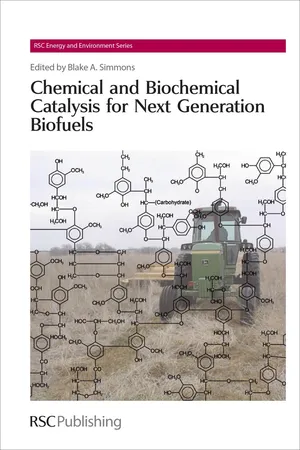
The development of renewable and sustainable lignocellulosic biofuels is currently receiving worldwide attention and investment. Despite decades of research, there remain significant challenges to be overcome before these biofuels can be produced in large volumes at competitive prices. One obstacle is the lack of efficient and affordable catalytic systems to dissolve and hydrolyze polysaccharides into sugars. These sugars are then fed to microrganisms and fermented into biofuels. The price of these catalysts, be they biological, thermochemical, or chemical in nature, represent one of the largest costs in the conversion process. There are a number of catalytic schemes, each with their own advantages and disadvantages, available. This book presents a general yet substantial review of the most promising processes and the spectrum of biomass pretreatment, enzymes, chemical catalysts, and hybrid approaches of hydrolyzing biomass into fermentable sugars. It is the only currently available book that compares the biochemical, chemical, and thermochemical conversion processes to biofuel production.
- 194 pages
- English
- ePUB (mobile friendly)
- Available on iOS & Android
eBook - ePub
Chemical and Biochemical Catalysis for Next Generation Biofuels
About this book
Information
CHAPTER 1
Introduction
Joint BioEnergy Institute, Physical Biosciences Division, Lawrence Berkeley National Laboratory, Emeryville, CA; Biofuels and Biomaterials Science and Technology, Sandia National Laboratories, Livermore, CA
The development of advanced biofuels, defined here as those that are derived from non-food sources, capable of displacing a significant amount of petroleum within the global transportation sector has quickly become a topic of significant interest. The primary drivers for this effort are found in two areas: (1) concerns over energy security related to finite sources of fossil fuels, and (2) the environmental risks associated with unabated carbon emissions that are linked to global warming. While there are significant efforts underway in the fields of renewable energy for electricity production (e.g. wind, solar and geothermal), more than half of the current energy consumption of the planet is currently met with the consumption of liquid fuels, with over 20% of current global carbon emissions in 2008 generated by the transportation sector alone (Figure 1.1). The significant price fluctuations observed in the petroleum ($32-147/barrel) and natural gas ($4-13/1000ft3) markets over the past few years have had dramatic effects in all aspects of commerce, and increase concerns over resource availability and supply stability.

Figure 1.1 Distribution of global carbon emissions as a function of energy sector. (Adapted from IEA Report: CO2 Emissions from Fuel Combustion-Highlights, 2010, pg. 9.)
Recent estimates by the International Energy Agency (IEA) calculate that global demand for transport will increase by 45% by 2030, placing even further strains on a system that has reached the upper limit in terms of production and further increase carbon emissions.1 These results underscore the need for the realization and rapid commercialization of scalable and cost-effective means of generating low-carbon fuels to meet the growing global energy demand in a sustainable fashion.
To meet this challenge, the US federal government, several state governments, and numerous governments worldwide are strongly committed to displacing fossil fuels with renewable, low carbon fuels produced from biomass. For instance, the US federal government has set a target of displacing 36 billion gallons of current US petroleum consumption within the transportation sector by 2022 under the Renewable Fuel Standard (RFS2) legislation. With a production cap of 15 billion gallons per year placed on corn ethanol, this leaves a gap of 21 billion gallons per year that must be met by other sources and conversion technologies. With total fossil fuel consumption within this sector currently running at levels of ∼200 billion gallons per year in the United States, this requires the development of a significant commercial infrastructure capable of producing approximately this level of non-starch biofuels per year over a very short timeframe. The European Union, China, Australia and New Zealand have also established targets for biofuel production.
The development of these advanced biofuels is not without controversy, and the recent furor over the “food vs. fuel” debate2 has highlighted the need for the development of sustainability metrics within the context of global food and energy supplies. The annual global primary production of biomass, or lignocellulose, is equivalent to the 4500 EJ of solar energy captured each year.3 It is estimated that a sustainable bioenergy supply of 270 EJ can meet ∼50% of the world’s total primary energy demand. In terms of total biomass availability, this amount of bioenergy can be achieved by only using ∼6% of the annual global primary production of biomass. As with all terrestrial systems of production, the ultimate potential for bioenergy depends to great extent on the land available for production. Currently, the amount of land devoted to growing energy crops for biomass fuels is calculated to represent only 0.19% of the world’s total land area and only 0.5–1.7% of global agricultural land.4 If we establish an upper limit of the total global bioenergy production potential in 2050 of 1135 EJ, out of a total global energy demand of 1041 EJ (source: EIA, 2011), it is theoretically possible that the total global energy demand can be met on a renewable basis without affecting the global production of food crops.5
There exist multiple pathways that have been hypothesized as effective means of converting biomass into biofuels, biopower, and co-products. These include biochemical, chemical, thermochemical, and hybrid conversion routes that follow multiple pathways for the production of fuels and chemicals (Figure 1.2). All of the technologies to date have advantages and disadvantages that must be taken into consideration, and all of them are currently deployed at some scale throughout the world. More importantly, the logistics of the local environment in which a proposed biorefinery/biopower conversion unit is built must be considered when identifying the most appropriate conversion technology, or combination of routes, for that region. Water availability, biomass availability, advanced land management practices, fertilizer demand, harvesting, storage, and distribution systems are all critical aspects in the successful operation of any sustainable biorefinery lifecycle that must be considered at a systems level.

Figure 1.2 Schematic depiction of potential biomass conversion pathways.
In addition to the sustainability criterion, cost is another major factor that must be addressed before advanced biofuels can reach significant levels of production. The cost estimates for these advanced biofuels varies significantly within the scientific and commercial literature. A recent report by the National Academy of Sciences estimated that cellulosic ethanol produced by biochemical conversion is equivalent to $115/bbl of gasoline and that biomass-to-liquid biofuels produced by thermochemical conversion are equivalent to $140/bbl.6 These estimates are predicted future prices and are highly dependent on assumptions of feedstock cost, conversion efficiency, and type of fuel produced, and as such there remain significant opportunities around biomass conversion technologies that could significantly reduce the cost of production.
One of the most significant obstacles today is the lack of affordable catalytic systems that can efficiently convert the biomass into desired intermediates (e.g. sugar) and/or products (e.g. fuels). The price of these catalysts, be they biological, thermochemical, or chemical in nature, represent one of the largest costs in the conversion process. For example, in the biochemical conversion route, it has been calculated that the cost of deconstructing the biomass (biomass→sugars) is second only to the cost of the feedstock, and represents the single biggest opportunity for cost savings within the biorefinery context. Similar cost pressures exist for the thermochemical conversion route, where catalysts must be able to tolerate complex heterogeneous feeds while maintaining high selectivity and high yields at low cost. There are a number of catalytic schemes, each with their own advantages and disadvantages, currently under development. This book presents a general yet substantial review from subject matter experts of the most promising processes within the spectrum of biomass pretreatment, enzymes, chemical catalysts, thermochemistry and hybrid approaches of converting biomass into intermediates and fuels, and is aimed to inform the reader on a wide range of topics.
References
1. IEA, CO2 Emissions from Fuel Combustion - Highlights, 2010, 130 pp.
2. A. O. Converse Renewable energy in the United States: is there enough land? Applied Biochemistry and Biotechnology, 2007, 137–140, 11–624.
3. R. H. Sims, Bioenergy Options for a Cleaner Environment: In Developed and Developing Countries, 2004, Elsevier Ltd., Oxford, UK, 184 pp.
4. M. Hoogwijk, A. Faaij, R. Van den Broek, G. Berndes, D. Gielen and W. Turkenburg Exploration of the ranges of the global potential of biomass for energy, Biomass and Bioenergy, 2003, 25(2), 119–133.
5. E. M.W. Smeets, A. P. C. Faaij, I. M. Lewandowski and W. C. Turkenburg, A bottom-up assessment and review of global bio-energy potentials to 2050, Progress in Energy and Combustion Science, 2007, 33(1), 56–106.
6. National Academy of Sciences, Overview and Summary of America’s Energy Future: Technology and Transformation, 2010, 58 pp.
CHAPTER 2
Biomass Availability and Sustainability for Biofuels
Feedstocks Division, Joint BioEnergy Institute, Physical Biosciences Division, Lawrence Berkeley National Laboratory, Berkeley, CA
2.1 Introduction
On earth, only 29.2% of the surface is land (149 million km2) and the rest is covered ocean. From this 29.2%, only 59.5% is considered as biologically productive land (88.6 million km2) which corresponds to forests (39.3 million km2) or agricultural areas (49.3 million km2). Biologically productive land corresponds to land that supports human demands for food, fiber, and timber for infrastructure and energy (FAO definition). The other 40.5% of lands, considered as non-productive lands, have a very low or no primary productivity since they are covered by ice, water, or constructions, or they are located under extreme climate conditions (cold, dry, or arid). The productive lands are divided into several biomes, primarily classified according to the vegetation types and productivity,1 which are dictated by the climate and human accessibility. In order to define which lands can be transformed as bioenergy lands (biofuel lands), an evaluation of most of the primary lands has to be conducted and will be presented in this section.
2.2 General Land Types
2.2.1 Forest Lands
Forests cover approximately 39.3 million km2 and are divided into three main types: boreal, tropical, and temperate ( Table 2.1). Boreal forests represent 13 million km2, 33% of the total forest, and correspond to forest growing in cold areas (yearly average temperature +5 to –5°C) and a short growing season with an aboveground biomass accumulation of 2.3 t/ha/year.2 They are mainly found in the northern part of the northern hemisphere and in some mountains at high altitudes. Coniferous trees are the dominant species, also called ‘evergreen’.
Table 2.1 Summary of submerged-lands.
| Area | Productivity (t DM/ha/y) | ||||
| (M km2) | % | % | |||
| Forest lands | boreal | 13 | 33 | 2.3 | |
| tropical | 9.8 | 25 | 9.5 | ||
| temperate | 16.5 | 42 | 14 | ||
| 39.3 | 26.4 | ||||
| Agricultural lands | very suitable | 13.5 | 27 | 18–22 | |
| suitable | 15.1 | 31 | 13–17 | ||
| moderately suitable | 7.9 | 16 | 10–12 | ||
| marginally suitable | 5.4 | 11 | 4–7 | ||
| non-suitable | 7.4 | 15 | <2 | ||
| 49.3 | 33.1 | ||||
| “Non-biologically” productive lands | Desert | 31.5 | 52 | 1.5 | |
| Tundra | 5.6 | 9 | 0.8 | ||
| Rest (urban area, rivers, glacier…) | 23.3 | 39 | |||
| 60.4 | 40.5 | ||||
| Submerged lands | 149 | ||||
(Data extracted from: http://faostat.fao.org with 2008 as reference year, Terrestrial Global Productivity2, and several other resources.5,6,10)
The temperate forests cover 9.8 million km2, 25% of total forest,2 and are found in a more moderate climate and in both hemispheres. The diversity of tree species is much larger than the boreal forest and varies significantly between both hemispheres. The dominant species eucalyptus, Nothofagus, Araucaria, and Podocarpus are predominant in the southern hemisphere and pine, sequoia, oak, maple, and birch are preferentially in the northern hemisphere. The temperate forests cover a smaller surface than the boreal or tropical forests. They are mainly found on low quality soils (sandy, rocky, etc.), on poorly accessible areas or in isolated areas, which correspond to lands that are usually classified as non-suitable for farming. This is explained by a large deforestation during the past centuries ...
Table of contents
- Cover image
- Title page
- Copyright
- Preface
- Contents
- Chapter 1 Introduction
- Chapter 2 Biomass Availability and Sustainability for Biofuels
- Chapter 3 Surface Science Studies Relevant for Metal-catalyzed Biorefining Reactions
- Chapter 4 Dilute Acid and Hydrothermal Pretreatment of Cellulosic Biomass
- Chapter 5 A Short Review on Ammonia-based Lignocellulosic Biomass Pretreatment
- Chapter 6 Cellulases and Hemicellulases for Biomass Degradation: An Introduction
- Chapter 7 Advances in Gasification for Biofuel Production
- Chapter 8 Bioinspired Catalysts for Biofuels: Challenges and Future Directions
- Subject Index
Trusted by 375,005 students
Access to over 1.5 million titles for a fair monthly price.
Study more efficiently using our study tools.
Frequently asked questions
Yes, you can cancel anytime from the Subscription tab in your account settings on the Perlego website. Your subscription will stay active until the end of your current billing period. Learn how to cancel your subscription
No, books cannot be downloaded as external files, such as PDFs, for use outside of Perlego. However, you can download books within the Perlego app for offline reading on mobile or tablet. Learn how to download books offline
Perlego offers two plans: Essential and Complete
- Essential is ideal for learners and professionals who enjoy exploring a wide range of subjects. Access the Essential Library with 800,000+ trusted titles and best-sellers across business, personal growth, and the humanities. Includes unlimited reading time and Standard Read Aloud voice.
- Complete: Perfect for advanced learners and researchers needing full, unrestricted access. Unlock 1.5M+ books across hundreds of subjects, including academic and specialized titles. The Complete Plan also includes advanced features like Premium Read Aloud and Research Assistant.
We are an online textbook subscription service, where you can get access to an entire online library for less than the price of a single book per month. With over 1.5 million books across 990+ topics, we’ve got you covered! Learn about our mission
Look out for the read-aloud symbol on your next book to see if you can listen to it. The read-aloud tool reads text aloud for you, highlighting the text as it is being read. You can pause it, speed it up and slow it down. Learn more about Read Aloud
Yes! You can use the Perlego app on both iOS and Android devices to read anytime, anywhere — even offline. Perfect for commutes or when you’re on the go.
Please note we cannot support devices running on iOS 13 and Android 7 or earlier. Learn more about using the app
Please note we cannot support devices running on iOS 13 and Android 7 or earlier. Learn more about using the app
Yes, you can access Chemical and Biochemical Catalysis for Next Generation Biofuels by Blake A Simmons in PDF and/or ePUB format, as well as other popular books in Physical Sciences & Environmental Science. We have over 1.5 million books available in our catalogue for you to explore.