There have been remarkable advances towards discovering agents that exhibit selectivity and sequence-specificity for DNA, as well as understanding the interactions that underlie its propensity to bind molecules. This progress has important applications in many areas of biotechnology and medicine, notably in cancer treatment as well as in future gene targeting therapies.
The editor and contributing authors are leaders in their fields and provide useful perspectives from diverse and interdisciplinary backgrounds on the current status of this broad area. The role played by chemistry is a unifying theme. Early chapters cover methodologies to evaluate DNA-interactive agents and then the book provides examples of DNA-interactive molecules and technologies in development as therapeutic agents. DNA-binding metal complexes, peptide and polyamide–DNA interactions, and gene targeting tools are some of the most compelling topics treated in depth.
This book will be a valuable resource for postgraduate students and researchers in chemical biology, biochemistry, structural biology and medicinal fields. It will also be of interest to supramolecular chemists and biophysicists.
- 414 pages
- English
- ePUB (mobile friendly)
- Available on iOS & Android
eBook - ePub
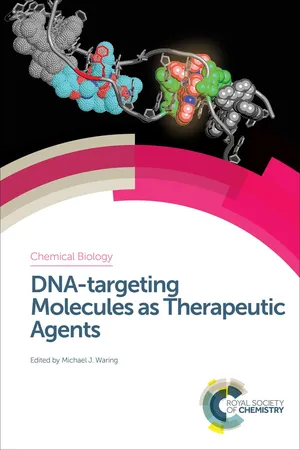
DNA-targeting Molecules as Therapeutic Agents
About this book
Information
Chapter 1
DNA Recognition by Parallel Triplex Formation
a Biological Sciences, Life Sciences Building 85, University of Southampton, Highfield, Southampton SO17 1BJ, UK;
b Chemistry Research Laboratory, Department of Chemistry, University of Oxford, Oxford OX1 3TA, UK;
1.1 Why Triplexes?
Triplex-forming oligonucleotides (TFOs) bind in the duplex major groove by forming hydrogen bonds with exposed groups on the Watson–Crick (W–C) base pairs, generating a triple-helical structure (e.g., Figure 1.1). The unique base–base recognition properties of these molecules can be exploited as a means to target duplex sequences present or embedded within natural or synthetic DNA.1,2 Unlike most DNA-recognition agents, such as polyamides, TFOs are capable of targeting extended sequences, with a relatively low propensity to bind to non-target sites. In this way TFOs have been exploited as gene-targeting agents for modulating gene expression,3,4 as a means to detect and/or isolate plasmid and genomic DNA for molecular biology or diagnostics,5,6 and as a tool to introduce functionality into DNA nanostructures engineered for bionanotechnology or synthetic biology.7 Despite this, the applications of TFOs that contain natural nucleotides are often restricted by their low binding affinity and slow association kinetics at neutral pH, as well as a requirement for oligopurine–oligopyrimidine duplex target sequences. To overcome these limitations a variety of base, sugar and phosphate modifications have been developed to allow triplex formation at mixed-sequence targets with high affinity at neutral pH. This chapter will review the developments and current state-of-the-art of nucleotide modifications used to improve the triplex-forming properties of oligonucleotides.
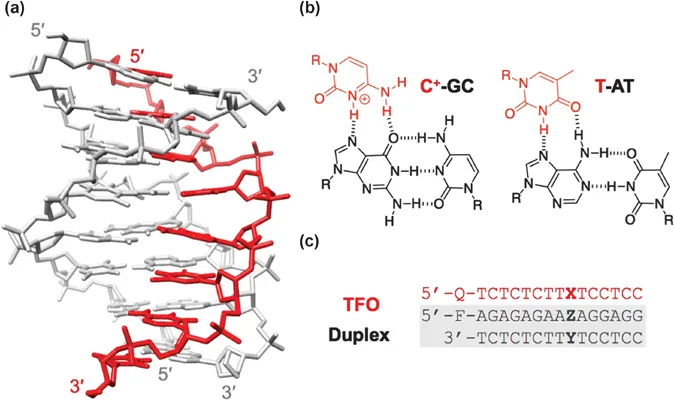
Figure 1.1 Triplex-directed DNA recognition. (a) Structure of a parallel DNA triplex (PDB code: 1D3X); (b) Chemical structures of C+–GC and T–AT base triplets (R is deoxyribose); (c) Triplex sequence used to characterise the triplex-forming properties of an oligonucleotide containing a single nucleotide analogue (at position X) against each of the four base pairs (at position ZY) by fluorescence melting using molecular beacons (F is a fluorophore: Q is a quencher). In each case the third strand is shown in red and the duplex in black.
1.1.1 Triplets and Triplex Motifs
Triplexes were first observed experimentally over 60 years ago by Rich and co-workers after mixing the polyribonucleotides poly-U and poly-A in a 2 : 1 ratio.8 Additional studies demonstrated that poly-C and poly-G could generate a similar structure under low-pH conditions,9 and since then a variety of DNA and RNA triplexes have been identified.10–13 The binding of an oligonucleotide within the major groove is asymmetric and can occur in either a parallel or antiparallel orientation relative to the oligopurine-containing strand of the target duplex. Pyrimidine-rich oligonucleotides bind in a parallel orientation under slightly acidic conditions (pH<6.0), with T and protonated C forming Hoogsteen hydrogen bonds with AT and GC base pairs, generating the base triplets T–AT and C+–GC, respectively (Figure 1.1b).1,2 (In this chapter the notation X–ZY refers to a triplet, in which the third strand base X interacts with the duplex base pair ZY, forming hydrogen bonds to base Z.) In contrast, purine-rich oligonucleotides bind in an antiparallel orientation, with A and G forming reverse-Hoogsteen hydrogen bonds with AT and GC base pairs respectively, generating A–AT and G–GC triplets.14,15
In theory, both triplex motifs could be usefully exploited for the recognition of unique duplex sequences but the greater stability of the parallel motif has meant it has been more widely adopted. Parallel triplexes are intrinsically more stable than their antiparallel counterparts because T–AT and C+–GC triplets are structurally isomorphic; that is, if the C-1′ atoms of their W–C base pairs are superimposed, the positions of the C-1′ atoms of the third strand are almost identical.16 This minimises backbone distortions of both the third strand and duplex between adjacent triplets. In contrast, antiparallel triplets are not isomorphic and lead to structural distortions at the junctions between consecutive triplets. The use of the antiparallel motif is also hampered by the tendency of purine-containing oligonucleotides to self-associate into structures such as G-quadruplexes and GA-duplexes, which compete with triplex formation and reduce the effective TFO concentration. It should also be noted that both G–GC and T–AT triplets can be generated in both binding motifs, and GT-containing oligonucleotides can therefore be designed to bind in either orientation. However, the non-isomorphic nature of these two triplets means that the most stable orientation is dependent on the number of GpT and TpG steps.17 This chapter will therefore focus on triplexes generated through the parallel binding motif using pyrimidine-rich oligonucleotides.
1.1.2 Base, Sugar and/or Phosphate Modifications
We and others have characterised a variety of novel base, sugar and phosphate modifications designed to improve the triplex-forming properties of oligonucleotides and a wealth of data has been generated on the affinity, kinetics and selectivity of triplexes containing these modifications. However, it is often hard to compare the effectiveness of a given modification between studies, since its properties will depend on its positioning within the third strand, the sequence context, length of third strand and/or duplex, as well as the pH and other solution conditions, such as the presence of divalent cations. Most experiments have involved the characterisation of a single substitution within a third strand by examining its interaction with duplexes containing each of the four base pairs at the same position. In this way an X–ZY triplet is generated, where X is the analogue under study and ZY is either an AT, TA, GC or CG base pair in turn (e.g., Figure 1.1c). Often the modification is compared with the most effective natural nucleotide at the same position, i.e., with T, C+, G or T opposite an AT, GC, TA or CG base pair respectively. The formation of G–TA and T–CG triplets for recognising pyrimidine–purine base pairs will be discussed in Section 1.4.2.
The simplest and most common means for characterising triplex stability is by ultraviolet melting, in which the triplex thermal stability is determined from the temperature-dependent change in absorbance at 260 nm, ge...
Table of contents
- Cover
- Title
- Copyright
- Contents
- Chapter 1 DNA Recognition by Parallel Triplex Formation
- Chapter 2 Interfacial Inhibitors
- Chapter 3 Slow DNA Binding
- Chapter 4 Thermal Denaturation of Drug–DNA Complexes1
- Chapter 5 Computer Simulations of Drug–DNA Interactions: A Personal Journey
- Chapter 6 Binding of Small Molecules to Trinucleotide DNA Repeats Associated with Neurodegenerative Diseases
- Chapter 7 Parsing the Enthalpy–Entropy Compensation Phenomenon of General DNA–Ligand Interactions by a ‘Gradient Determinant’ Approach
- Chapter 8 Structural Studies of DNA-binding Metal Complexes of Therapeutic Importance
- Chapter 9 Therapeutic Potential of DNA Gene Targeting using Peptide Nucleic Acid (PNA)
- Chapter 10 Sequence-selective Interactions of Actinomycin D with DNA: Discovery of a Thermodynamic Switch
- Chapter 11 Molecular Modelling Approaches for Assessing Quadruplex–Small Molecule Interactions
- Chapter 12 Molecular Recognition of DNA by Py–Im Polyamides: From Discovery to Oncology
- Chapter 13 Synthetic Peptides for DNA Recognition Inspired by Transcription Factors
- Chapter 14 Targeting DNA Mismatches with Coordination Complexes
- Chapter 15 CRISPR Highlights and Transition of Cas9 into a Genome Editing Tool
- Subject Index
Trusted by 375,005 students
Access to over 1.5 million titles for a fair monthly price.
Study more efficiently using our study tools.
Frequently asked questions
Yes, you can cancel anytime from the Subscription tab in your account settings on the Perlego website. Your subscription will stay active until the end of your current billing period. Learn how to cancel your subscription
No, books cannot be downloaded as external files, such as PDFs, for use outside of Perlego. However, you can download books within the Perlego app for offline reading on mobile or tablet. Learn how to download books offline
Perlego offers two plans: Essential and Complete
- Essential is ideal for learners and professionals who enjoy exploring a wide range of subjects. Access the Essential Library with 800,000+ trusted titles and best-sellers across business, personal growth, and the humanities. Includes unlimited reading time and Standard Read Aloud voice.
- Complete: Perfect for advanced learners and researchers needing full, unrestricted access. Unlock 1.5M+ books across hundreds of subjects, including academic and specialized titles. The Complete Plan also includes advanced features like Premium Read Aloud and Research Assistant.
We are an online textbook subscription service, where you can get access to an entire online library for less than the price of a single book per month. With over 1.5 million books across 990+ topics, we’ve got you covered! Learn about our mission
Look out for the read-aloud symbol on your next book to see if you can listen to it. The read-aloud tool reads text aloud for you, highlighting the text as it is being read. You can pause it, speed it up and slow it down. Learn more about Read Aloud
Yes! You can use the Perlego app on both iOS and Android devices to read anytime, anywhere — even offline. Perfect for commutes or when you’re on the go.
Please note we cannot support devices running on iOS 13 and Android 7 or earlier. Learn more about using the app
Please note we cannot support devices running on iOS 13 and Android 7 or earlier. Learn more about using the app
Yes, you can access DNA-targeting Molecules as Therapeutic Agents by Michael J Waring in PDF and/or ePUB format, as well as other popular books in Biological Sciences & Biochemistry. We have over 1.5 million books available in our catalogue for you to explore.