Have you ever wondered how plants attract certain insects, or how insects communicate with each other? This book explains the natural chemical compounds that determine the fascinating interactions between plants and insects providing a gentle and absorbing introduction to organic chemistry that is highly relevant to everyday life and to the natural world.
Specific organic compounds and intriguing chemistry determine whether insects are keen on feeding on plants or avoid certain plants altogether. Some insects have learned to use plant compounds as their own defences, and some plants use digestive processes to use insects as nutritional supplements. Plant-insect interactions are vital for our food supply, for pollination of orchards or detrimentally in insect infestations of crops, as well as in applications like silk production.
By the author of the popular book, The Chemistry of Plants: Perfumes, Pigments, and Poisons, this book benefits from Margareta Séquin's vast experience leading field trips and seminars to botanical gardens and nature reserves, and teaching chemistry to beginners.
Organic chemistry is often seen as a challenging, sometimes abstract field. This book makes chemistry exciting and accessible for readers interested in a deeper understanding of the natural world. The book is organized according to the increasing complexity of compounds introduced, and so it also serves as a useful teaching aid for undergraduate chemistry or biology courses, and as a supplementary text for students in plant sciences, ecology, and entomology, and in horticultural programs.
- 186 pages
- English
- ePUB (mobile friendly)
- Available on iOS & Android
eBook - ePub
About this book
Trusted by 375,005 students
Access to over 1.5 million titles for a fair monthly price.
Study more efficiently using our study tools.
Information
Topic
NaturwissenschaftenSubtopic
ÖkologiePart 1: The Plant Perspective
2 Plants Attracting Insects
2.1 Introduction
Survival and successful reproduction are essential for the continuation of life for all living things. As for plants, reproduction greatly depends on insect pollination. In about two thirds of all the species of flowering plants, known as the angiosperms, insects pollinate the flowers by moving pollen from the male anthers of one flower to the female stigma of another flower of the same species. (Figure 2.1 shows a schematic drawing of the basic parts of a flower.) Pollination induces fertilization of the plant, followed by seed production, and thus promotes reproduction of the species. Organic compounds produced by the plants have major roles in advertising to potential pollinators and attracting them. Many plants feature colors in their flowers that are visible and appealing to insect pollinators (Figure 2.2(a) and (b)). In addition, flowers emit attractive scents when ready for pollination. Many flowers also offer sweet nectars and ample pollen as food, to further entice insects to visit.
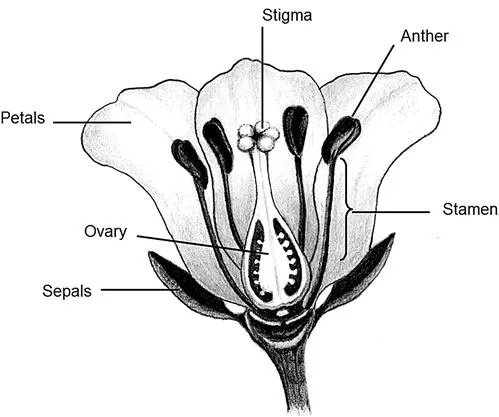
Figure 2.1 Schematic drawing of the flower parts of a flowering plant. (Drawing by Eveline Larrucea.)
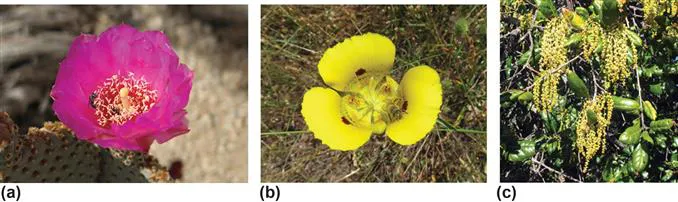
Figure 2.2 Insect-pollination versus wind-pollination. (a) Colorful flowers with plenty of pollen, like the blossoms of a beavertail cactus (Opuntia basilaris), attract pollinating insects. (b) Brightly-colored flower petals, with nectar guides and floral nectar, attract beetle pollinators in a yellow mariposa tulip (Calochortus luteus). (c) Wind-pollinated plants, like live oaks (Quercus sp.), have inflorescences with inconspicuous colors and produce large amounts of pollen.
Fossil finds of plants and insects have shown that towards the end of the early Cretaceous era, between 130 and 90 million years ago, a rapid evolution of plants and insects occurred. Diversification of plants, with fast-increasing numbers of plant species, took off when insects started to evolve during that time period. It is generally assumed that it was the diversification of nectar- and pollen-collecting insects that greatly drove the evolution of plants.1
Compared to pollination by insects, pollination by wind is the more ancient form in evolutionary terms. Examples of wind-pollinated plants are pines (Pinus spp.), oaks (Quercus spp., Figure 2.2(c)), and all the grasses (Poaceae). Wind-pollinated plants tend to have drab floral parts and no nectar. This type of pollination obviously requires wind and also masses of pollen which is randomly dispersed into the surrounding space. Insect pollination, on the other hand, requires smaller quantities of pollen for successful fertilization. Insects seek out plants that have the proper attractive features in the form of enticing colors and smells, aside from inviting floral shapes, and tend to be quite faithful to the particular plant species they visit. Efficient mixing of plant genes takes place as insects transport male genetic information contained in pollen to the female floral parts of another flower of the same species. Self-pollination in insect-pollinated flowers is uncommon. In contrast to dispersal of pollen by wind, pollination by insects can successfully occur in scattered and isolated plant populations, as can be found in tropical forests. Specific floral scents and attractive pigments direct insects to isolated plants of the same species at considerable distances, and pollinating insects can detect and visit the matching plants.
2.2 Plant Volatiles That Attract Pollinating Insects
Plants produce large numbers of volatile compounds, i.e. compounds that easily evaporate into the air. More than 1700 different volatile organic compounds, sometimes abbreviated as VOCs, have been identified in flowers alone.2 We notice these volatiles if they have distinct odors to us, pleasant or unpleasant, especially on a warm day. (Note that the characterizations of the nature of the smells are necessarily from a human point-of-view.) Scents emitted by flowers alert potential pollinators. Because plants are mostly rooted in one place, the volatiles are a means of long-distance communication with other organisms, like insects. Compared to visual cues from flowers such as colors, odorous volatiles are randomly sent into the surrounding space and thus have low directionality. Concentrations of the scents emitted by flowers are affected by wind conditions and can be disturbed by smoke, as from forest fires, and other pollutants.3 The scents, together with appropriate floral colors and shapes of the flowers, are inviting to select pollinators.
Some flowers attract a broad range of pollinators, whereas others only appeal to a few types of insects. Sweet scents, like the strong fragrance of the damask rose (Rosa damascena) (Figure 2.3(a)), are generally attractive to butterflies, bees, and bumble bees. Moths are lured by heavy, aromatic smells of flowers that tend to open later in the day, like the blossoms of white jasmine (Jasminum sp.) (Figure 2.3(b)). Maroon-colored or brown inflorescences often produce smells of decaying fish or of carrion, and are attractive to flies or small gnats. Floral smells are emitted during specific times of a plant’s growth phase, such as during the opening of flowers. Some plants even enhance the evaporation of attractive compounds, heating up during the flowering phase by increasing metabolic rates. This phenomenon is especially common in plants of the Arum family. A famous example is the Sumatran corpse plant (Amorphophallus titanum, Figure 2.3(c)) whose giant inflorescence can heat up by more than 10 °C, sending out volatiles with a rotten-meat smell that attracts fly pollinators.4
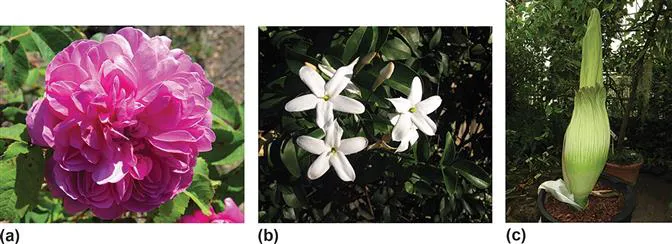
Figure 2.3 Fragrant and foul-smelling flowers. (a) Damask rose (Rosa damascena) is a highly fragrant, sweet-smelling rose. (b) Heavy-scented jasmine flowers (Jasminum sp.) release their fragrance late in the day, attracting moths. (c) A large inflorescence of the corpse plant (Amorphophallus titanum), about two meters tall, is ready to open and to release foul-smelling volatiles that attract flies.
We shall encounter volatile compounds again in a later chapter, but there the volatiles are emitted not from flowers but from plant parts like leaves and needles. Under these circumstances, the volatiles can act as deterrents towards insects and other animals, keeping the browsers from feeding on the plants and thus supporting the plants’ survival.
2.3 Compositions of Plant Scents
Plant scents are mixtures of sometimes more than a hundred different volatile organic compounds. These compounds are generally oily liquids at ambient temperatures. This property gave them the general name essential oils, ‘essential’ here meaning the characteristic or essence of a scent. The composition of a plant scent is influenced by the type of plant, its age, its growth phase, and the time of day, as well as the local climate and the soil conditions. These factors also determine the concentrations, i.e. the percentages, of compounds found in a particular fragrance.
If we want to determine the components of a floral scent, the most commonly used method is gas chromatography (GC) combined with mass spectrometry (MS). Gas chromatography is a highly sensitive analytical method that is used to separate mixtures of volatile compounds, requiring only fractions of a microliter (i.e. 10−6 liters) for analysis. It is therefore a most valuable method to separate and examine mixtures of volatiles for which only very small quantities are available. This certainly applies to essential oils in floral fragrances of which often only trace amounts are present.5
In order to study the components of a fragrance by GC, we first need to collect a sample of the scent mixture. A frequently-used, gentle method is head-space analysis. Figure 2.4 shows a head-space analysis set-up for collecting volatiles emitted by the fragrant flowers of a ylang ylang shrub (Cananga odorata). A glass bell jar is placed over the fragrant flowers and connected with a probe containing a material that can absorb volatile oils. The floral volatiles are pulled with a pump into the probe. This method is non-destructive to the plant parts. The collected oils are eluted, i.e. rinsed, from the probe with appropriate solvents and can then be further separated and analyzed by gas chromatography (Figure 2.5). If combined with mass spectrometry (MS), the identity of the single compounds in a mixture can be determined by GC-MS. Figure 2.5(a) shows a schematic picture of a gas chromatograph. Figure 2.5(b) displays an example of a gas chromatogram of a sample of a mixture of volatile oils, as in a floral scent, with each line in the chromatogram representing a different compound.6
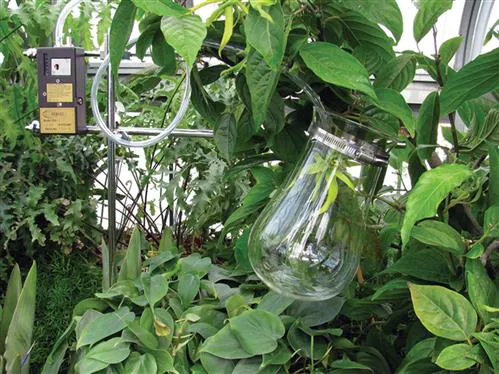
Figure 2.4 Head space analysis set-up to collect volatiles emitted by the fragrant flowers of an ylang shrub (Cananga odorata), Longwood Gardens, Pennsylvania. (Photo Courtesy Longwood Gardens.)
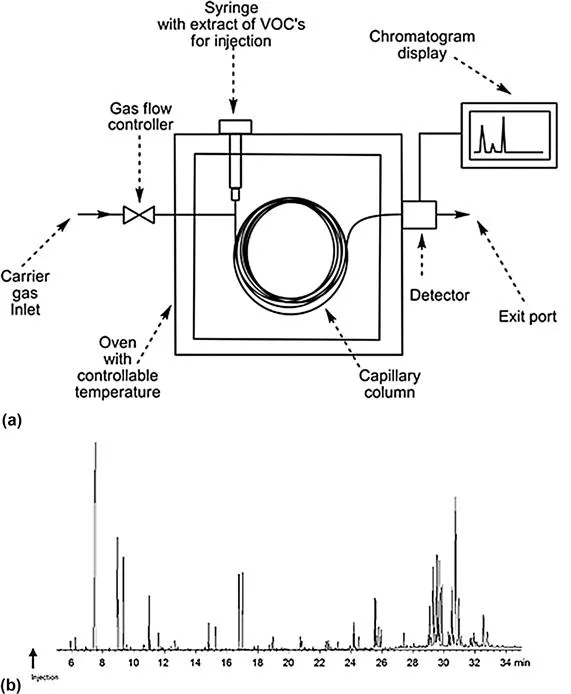
Figure 2.5 Analysis of a mixture of volatile compounds, as in a floral scent, by gas chromatography. (a) Schematic drawing of a gas chromatograph. (b) A sample gas chromatogram of a mixture of volatile oils. (Gas chromatogram by Phenomenex, Inc.)
In a related method, used to evaluate the odor contributions of the compounds in a volatile mixture, a ‘sniffing port’ is attached to the exit port of the gas chromatograph. Each compound can then be smelled as it is being separated and can be further evaluated for its individual odor quality. Humans have no odor perception of some compounds in the volatile mixtures of plant scents, but these may well be recognized by animals like insects. (After all, plants did not evolve floral scents to attract humans.) The sensitivity towards different volatiles can be very different among insects, and a higher percentage of a volatile compound in the mixture does not necessarily mean that it is more easily perceived. On the other hand, volatiles present in trace amounts can be crucial scent comp...
Table of contents
- Cover
- Title
- Copyright
- Contents
- Introduction
- Part 1: The Plant Perspective
- Part 2: The Insect Perspective
- Part 3: Plants and Insects: The Human Perspective
- Epilogue
- Glossary
- Subject Index
Frequently asked questions
Yes, you can cancel anytime from the Subscription tab in your account settings on the Perlego website. Your subscription will stay active until the end of your current billing period. Learn how to cancel your subscription
No, books cannot be downloaded as external files, such as PDFs, for use outside of Perlego. However, you can download books within the Perlego app for offline reading on mobile or tablet. Learn how to download books offline
Perlego offers two plans: Essential and Complete
- Essential is ideal for learners and professionals who enjoy exploring a wide range of subjects. Access the Essential Library with 800,000+ trusted titles and best-sellers across business, personal growth, and the humanities. Includes unlimited reading time and Standard Read Aloud voice.
- Complete: Perfect for advanced learners and researchers needing full, unrestricted access. Unlock 1.5M+ books across hundreds of subjects, including academic and specialized titles. The Complete Plan also includes advanced features like Premium Read Aloud and Research Assistant.
We are an online textbook subscription service, where you can get access to an entire online library for less than the price of a single book per month. With over 1.5 million books across 990+ topics, we’ve got you covered! Learn about our mission
Look out for the read-aloud symbol on your next book to see if you can listen to it. The read-aloud tool reads text aloud for you, highlighting the text as it is being read. You can pause it, speed it up and slow it down. Learn more about Read Aloud
Yes! You can use the Perlego app on both iOS and Android devices to read anytime, anywhere — even offline. Perfect for commutes or when you’re on the go.
Please note we cannot support devices running on iOS 13 and Android 7 or earlier. Learn more about using the app
Please note we cannot support devices running on iOS 13 and Android 7 or earlier. Learn more about using the app
Yes, you can access The Chemistry of Plants and Insects by Margareta Séquin in PDF and/or ePUB format, as well as other popular books in Naturwissenschaften & Ökologie. We have over 1.5 million books available in our catalogue for you to explore.