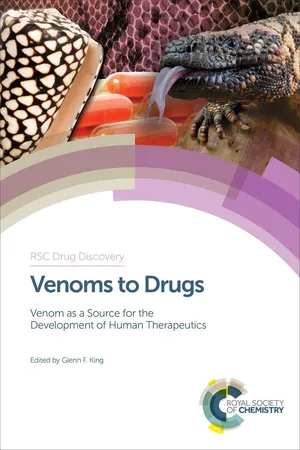
The pharmaceutical industry has become increasingly interested in biologics from animal venoms as a potential source for therapeutic agents in recent years, with a particularly emphasis on peptides. To date six drugs derived from venom peptides or proteins have been approved by the FDA, with nine further agents currently being investigated in clinical trials. In addition to these drugs in approved or advanced stages of development, many more peptides and proteins are being studied in varying stages of preclinical development. This unique book provides an up to date and comprehensive account of the potential of peptides and proteins from animal venoms as possible therapeutics. Topics covered include chemistry and structural biology of animal venoms, proteomic and transcriptomic approaches to drug discovery, bioassays, high-throughput screens and target identification, and reptile, scorpion, spider and cone snail venoms as a platform for drug development. Case studies are used to illustrate methods and successes and highlight issues surrounding administration and other important lessons that have been learnt from the development of approved therapeutics based on venoms. The first text to focus on this fascinating area and bridging an important gap, this book provides the reader with essential and current knowledge on this fast-developing area. Venoms to Drugs will find wide readership with researchers working in academia and industry working in all medicinal and pharmaceutical areas.
eBook - ePub
Venoms to Drugs
Venom as a Source for the Development of Human Therapeutics
- 320 pages
- English
- ePUB (mobile friendly)
- Available on iOS & Android
eBook - ePub
Venoms to Drugs
Venom as a Source for the Development of Human Therapeutics
About this book
Information
CHAPTER 1
Seeing the Woods for the Trees: Understanding Venom Evolution as a Guide for Biodiscovery
1.1 The Fundamental Problems
The majority of commercial drugs being used today in both developed and developing countries are based on natural products.1 Most of these products are based upon plants, but research into animal venoms holds great potential for the discovery of novel medicinally useful natural products.2,3 Knowledge of the evolutionary origins of venom proteins/peptides and the forces shaping the biodiversity seen today is crucial for efficient biodiscovery. In addition, efficient utilisation of venom toxins in drug design and development cannot be achieved without recognition of the true biochemical, ecological, morphological, and pharmacological diversity of venoms and associated venom systems. A major limitation of the use of venom proteins thus far has been the very narrow taxonomical range studied. Entire groups of venomous animals remain virtually ignored. Those that have been examined have apparently been selected due to their medical significance or ease of collection, rather than as a result of their ecological or evolutionary uniqueness.
Venom is defined as “a secretion, produced in a specialised gland in one animal and delivered to a target animal through the infliction of a wound (regardless of how tiny it may be), which contains molecules that disrupt normal physiological or biochemical processes in the victim so as to facilitate feeding or defence by the producing animal”.4 This definition encompasses creatures normally considered venomous (e.g., scorpions, snakes, and spiders) as well as animals that have not been traditionally recognised as such (e.g., leeches, ticks, and vampire bats). Acknowledgement of the evolutionary analogy of the recruitment and use of toxins in all these animals increases the number of known independent occasions in which venom has evolved independently. In addition, this acknowledgement improves our understanding of the factors underlying the evolution of venoms and their associated proteins while also drawing attention to the vast pool of unstudied toxins. Venom has been a key innovation in the evolutionary history of an incredibly diverse range of animals. Even using the traditional definition of venom, venom systems are believed to have evolved independently on at least 20 occasions in extant lineages (Figure 1.1). Intriguing fossil evidence has also led to speculation about the possibility of extinct venomous lineages represented by the theropod dinosaur Sinornithosaurus5 and the extinct pantolestid mammal Bisonalveus browni.5 If lineages such as ticks, leeches, vampire bats, etc. are rightfully recognised as venomous, the number of independent evolutionary events in which venom has arisen increases to over 30.

Figure 1.1 Schematic tree of venomous life in the animal kingdom. Coloured branches indicate lineages that include members with venom systems. Phylogeny based on the tree of life presented in Pennisi.145 Note that a number of animal lineages have been pruned from the tree. Adapted from ref. 34.
The evolutionary selection pressure upon defensive venoms (e.g., those of fish and bees) is largely directed at the development of streamlined venom that has the primary action of immediate, intense localised pain.6–8 In contrast, predatory venoms are shaped by a classic co-evolutionary arms race, where evolving venom resistance in prey and the evolution of novel venom composition exerts reciprocal selective pressures on one another in a situation that conforms to the Red Queen hypothesis of Van Valen.9 Powerful purifying selection pressures acting on predatory venoms for millions of years have resulted in highly complex modern venom arsenals that consist of potent compounds with exquisite target specificity. Variation in venom composition is not only observed between different lineages, but also between the closely related species within a clade.10 Intraclade differences in venom composition often arise as a result of the evolution of prey-specific toxins in species with specialised diets.11–13 Significant variation in venom profile has even been demonstrated within individual species with widespread geographical distributions.14,15 Venom can also vary intraspecifically as the result of numerous other factors, including sibling differences16 and ontogenic changes in prey preference17 or behaviour. In Sydney funnel-web spiders (Atrax robustus), juvenile male spiders and female spiders of all ages have similar insecticidal predatory venoms, whilst sexually mature males (who stop feeding and leave the burrows in search of females) have a vertebrate-specific defensive venom.18 It is this adaptive complexity and innovation that makes predatory venoms ideal candidates for the discovery of therapeutic lead compounds.
The majority of venom components have evolved to target physiological systems reachable by the bloodstream. In particular, the neurological and haemostatic systems have been convergently targeted via a myriad of innovative pathways (Figure 1.2).4 A consistent feature of venom proteins is a stable molecular scaffold of cross-linked cysteines19 (see Chapter 2 for further details of disulfide-rich toxin scaffolds); this characteristic appears to facilitate modification of non-structural residues, which in turn facilitates protein neo-/sub-functionalisation. A remarkable degree of convergence exists not only in terms of toxin molecular scaffolding, but also in target specificity and bioactivity.4 The superimposition of sequences from functionally convergent toxins reveals tremendously useful information regarding structure–function r...
Table of contents
- Cover image
- Title page
- Copyright
- Preface
- Contents
- Chapter 1 Seeing the Woods for the Trees: Understanding Venom Evolution as a Guide for Biodiscovery
- Chapter 2 The Structural Universe of Disulfide-Rich Venom Peptides
- Chapter 3 Venoms-Based Drug Discovery: Proteomic and Transcriptomic Approaches
- Chapter 4 Venoms-Based Drug Discovery: Bioassays, Electrophysiology, High-Throughput Screens and Target Identification
- Chapter 5 Reptile Venoms as a Platform for Drug Development
- Chapter 6 The Molecular Diversity of Conoidean Venom Peptides and their Targets: From Basic Research to Therapeutic Applications
- Chapter 7 Scorpion Venoms as a Platform for Drug Development
- Chapter 8 Therapeutic Applications of Spider-Venom Peptides
- Chapter 9 Case Study 1: Development of the Analgesic Drugs Prialt® and Xen2174 from Cone Snail Venoms
- Chapter 10 Case Study 2: Transforming a Toxin into a Therapeutic: the Sea Anemone Potassium Channel Blocker ShK Toxin for Treatment of Autoimmune Diseases
- Chapter 11 Engineering Venom Peptides to Improve Their Stability and Bioavailability
- Chapter 12 Manufacturing of Venom-Derived Therapeutic Peptides
- Subject Index
Trusted by 375,005 students
Access to over 1.5 million titles for a fair monthly price.
Study more efficiently using our study tools.
Frequently asked questions
Yes, you can cancel anytime from the Subscription tab in your account settings on the Perlego website. Your subscription will stay active until the end of your current billing period. Learn how to cancel your subscription
No, books cannot be downloaded as external files, such as PDFs, for use outside of Perlego. However, you can download books within the Perlego app for offline reading on mobile or tablet. Learn how to download books offline
We are an online textbook subscription service, where you can get access to an entire online library for less than the price of a single book per month. With over 1.5 million books across 990+ topics, we’ve got you covered! Learn about our mission
Look out for the read-aloud symbol on your next book to see if you can listen to it. The read-aloud tool reads text aloud for you, highlighting the text as it is being read. You can pause it, speed it up and slow it down. Learn more about Read Aloud
Yes! You can use the Perlego app on both iOS and Android devices to read anytime, anywhere — even offline. Perfect for commutes or when you’re on the go.
Please note we cannot support devices running on iOS 13 and Android 7 or earlier. Learn more about using the app
Please note we cannot support devices running on iOS 13 and Android 7 or earlier. Learn more about using the app
Yes, you can access Venoms to Drugs by Glenn F. King, Glenn F King in PDF and/or ePUB format, as well as other popular books in Biological Sciences & Biochemistry. We have over 1.5 million books available in our catalogue for you to explore.