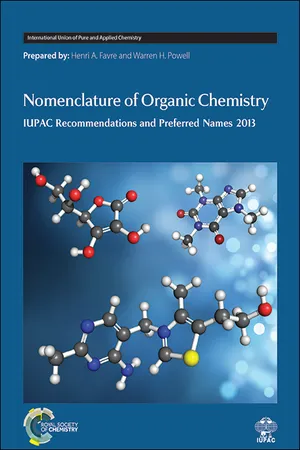
Chemical nomenclature is used to identify a chemical species by means of written or spoken words and enables a common language for communication amongst chemists. Nomenclature for chemical compounds additionally contains an explicit or implied relationship to the structure of the compound, in order that the reader or listener can deduce the structure from the name. This purpose requires a system of principles and rules, the application of which gives rise to a systematic nomenclature. Of course, a wide range of traditional names, semisystematic or trivial, are also in use for a core group of common compounds. Detailing the latest rules and international practice, this new volume can be considered a guide to the essential organic chemical nomenclature, commonly described as the "Blue Book". An invaluable source of information for organic chemists everywhere and the definitive guide for scientists working in academia or industry, for scientific publishers of books, journals and databases, and for organisations requiring internationally approved nomenclature in a legal or regulatory environment.
eBook - PDF
Nomenclature of Organic Chemistry
IUPAC Recommendations and Preferred Names 2013
- 1,613 pages
- English
- PDF
- Available on iOS & Android
eBook - PDF
Nomenclature of Organic Chemistry
IUPAC Recommendations and Preferred Names 2013
About this book
Information
Publisher
Royal Society of ChemistryYear
2013Print ISBN
9780854041824
9780854041824
Edition
1eBook ISBN
9781849733069
Table of contents
- Nomenclature of Organic Chemistry
- Contents
- PREFACE
- ACKNOWLEDGEMENTS
- CHANGES FROM THE 1979 EDITION, THE 1993 GUIDE, AND OFFICIAL PUBLICATIONS FROM 1993 THROUGH 2002 INCLUDED IN THE 2013 EDITION OF IUPAC NOMENCLATURE OF ORGANIC CHEMISTRY
- GLOSSARY
- CHAPTER P-1 GENERAL PRINCIPLES, RULES, AND CONVENTIONS
- CHAPTER P-2 PARENT HYDRIDES
- CHAPTER P-3 CHARACTERISTIC (FUNCTIONAL) AND SUBSTITUENT GROUPS
- CHAPTER P-4 RULES FOR NAME CONSTRUCTION
- CHAPTER P-5 SELECTING PREFERRED IUPAC NAMES AND CONSTRUCTING NAMES OF ORGANIC COMPOUNDS
- CHAPTER P-6 APPLICATIONS TO SPECIFIC CLASSES OF COMPOUNDS
- CHAPTER P-7 RADICALS, IONS, AND RELATED SPECIES
- CHAPTER P-8 ISOTOPICALLY MODIFIED COMPOUNDS
- CHAPTER 9 SPECIFICATION OF CONFIGURATION AND CONFORMATION
- CHAPTER 10 PARENT STRUCTURES FOR NATURAL PRODUCTS AND RELATED COMPOUNDS
- REFERENCES
- APPENDIX 1 Seniority list of elements and ‘a’ terms used in skeletal replacement (‘a’) nomenclature, in decreasing order of seniority
- APPENDIX 2 Detachable prefixes used in substitutive nomenclature
- APPENDIX 3 Structures for alkaloids, steroids, terpenoids and Similar compounds given in Table 10.1, P-101.2.7, Chapter 10
- SUBJECT INDEX
Trusted by 375,005 students
Access to over 1.5 million titles for a fair monthly price.
Study more efficiently using our study tools.
Frequently asked questions
Yes, you can cancel anytime from the Subscription tab in your account settings on the Perlego website. Your subscription will stay active until the end of your current billing period. Learn how to cancel your subscription
No, books cannot be downloaded as external files, such as PDFs, for use outside of Perlego. However, you can download books within the Perlego app for offline reading on mobile or tablet. Learn how to download books offline
Perlego offers two plans: Essential and Complete
- Essential is ideal for learners and professionals who enjoy exploring a wide range of subjects. Access the Essential Library with 800,000+ trusted titles and best-sellers across business, personal growth, and the humanities. Includes unlimited reading time and Standard Read Aloud voice.
- Complete: Perfect for advanced learners and researchers needing full, unrestricted access. Unlock 1.5M+ books across hundreds of subjects, including academic and specialized titles. The Complete Plan also includes advanced features like Premium Read Aloud and Research Assistant.
We are an online textbook subscription service, where you can get access to an entire online library for less than the price of a single book per month. With over 1.5 million books across 990+ topics, we’ve got you covered! Learn about our mission
Look out for the read-aloud symbol on your next book to see if you can listen to it. The read-aloud tool reads text aloud for you, highlighting the text as it is being read. You can pause it, speed it up and slow it down. Learn more about Read Aloud
Yes! You can use the Perlego app on both iOS and Android devices to read anytime, anywhere — even offline. Perfect for commutes or when you’re on the go.
Please note we cannot support devices running on iOS 13 and Android 7 or earlier. Learn more about using the app
Please note we cannot support devices running on iOS 13 and Android 7 or earlier. Learn more about using the app
Yes, you can access Nomenclature of Organic Chemistry by Henri A Favre,Warren H Powell in PDF and/or ePUB format, as well as other popular books in Physical Sciences & Chemistry. We have over 1.5 million books available in our catalogue for you to explore.