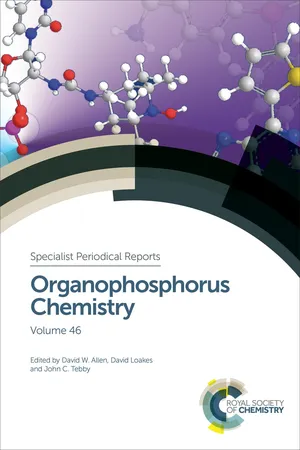
Coverage in this annual review of the literature presents a comprehensive and critical survey of the vast field of study involving organophosphorus compounds, from phosphines and phosphonium salts through to phosphorus acids, nucleotides, ylides and phosphazenes. The Editors have added to the usual content with a timely chapter on the recent developments in green synthetic approaches in organophosphorus chemistry to reflect current interests in the area.
eBook - ePub
Organophosphorus Chemistry
Volume 46
- 431 pages
- English
- ePUB (mobile friendly)
- Available on iOS & Android
eBook - ePub
Organophosphorus Chemistry
Volume 46
About this book
Information
Quinquevalent phosphorus acids
DOI: 10.1039/9781788010689-00213
a Polish Academy of Sciences, Centre of Molecular and Macromolecular Studies, Sienkiewicza 112, 90-363 Łódź, Poland.
E-mail: [email protected][email protected]
E-mail: [email protected][email protected]
b Jan Długosz University in Częstochowa, Armii Krajowej 13/15, 42-200 Częstochowa, Poland
1 Introduction
This chapter covers scientific contributions in quinquevalent organophosphorus chemistry published in the literature in 2015. The review is not comprehensive but shows some of the significant achievements in this area contained in leading journals. The chapter describes compounds possessing three P–O bonds (phosphates), two P–O and one P–C bonds (phosphonates) as well as one P–O and two P–C bonds (phosphinates) in addition to the phosphoryl group P=O. Each of the main sections has been divided in the same way, covering synthesis, reactions and biological aspects of phosphoric, phosphonic and phosphinic acids and their derivatives. As in previous years, an additional subsection devoted to miscellaneous applications, other than biological ones, have been added in two sections devoted to phosphates and phosphonates.
In some cases, syntheses and reactions have been carried out simultaneously on two groups of compounds (e.g. phosphonates and phospinates), however they are referred to only once in one subsection. The interest in chemistry of phosphoric and phosphonic acids and their derivatives has maintained in the review period while the interest in the area of phosphinic acids and their derivatives has decreased this year.
On the same level, as in the previous year papers on the use of chiral phosphoric acids has remained the same. This subsection was introduced in 2009, however, due to limited space, the achievements in this area are mentioned but not discussed in detail in this year. Chiral phosphoric acids as catalysts found applications in various organic reactions involving as examples: Mannich-type addition of azlactones with aldimines, Michael addition of unactivated α-substituted ketones, enantioselective Diels–Alder reaction of α-substituted acroleins with 1,2-dihydropyridines, asymmetric carbozincation of pentafulvenes, asymmetric hydrohydroxyalkylation of butadiene, imine hydrogenation with Knçlker's iron complex, allylboration-Heck reaction of 2-bromobenzaldehydes with allylboronic acid pinacol ester, [4+2] hetero-Diels–Alder reaction of ortho-quinone methides and unactivated alkenes, cyclisation reactions of β,γ-unsaturated α-ketoesters, arylamines and acetylacetone, dearomatising redox cross coupling aryl hydrazines and ketones, asymmetric β-hydrogen transfer reduction of α-trifluoromethyl ketones, conversion of an indenyl cyclobutanol to spirocyclic indene and many others.
Other aspects, like total syntheses of biologically active compounds utilising phosphates, have been reported during the review period, including the total syntheses of (+)-leustroducsin B and (−)-enigmazole A, an asymmetric total synthesis of the (3R,16Z,20E,23R)-(−)-eushearilide via Wittig/aldol/macrolactonisation reaction sequence, a synthesis of a phosphonooxymethyl prodrug of the antitumor agent triptolide, prepared from a natural product, a highly stereoselective total syntheses of cephalosporolide E and cephalosporolide F, which was transformed into the cephalosporolide E via a stereocontrolled spiroketal isomerisation, promoted by diphenylphosphate acid.
The total syntheses of biologically active compounds utilising phosphonates as reagents have also been intensly developed as in previous years and included for instance: a total synthesis of topsentolide A1 and its stereoisomers, a cytotoxic oxylipin against human solid tumor cell lines, a total synthesis of the natural products (−)-cedarmycins A and B utilising synthesis of α-alkylidene-γ-butyro...
Table of contents
- Cover
- Title
- Copyright
- Contents
- Preface
- Phosphines and related C–P bonded compounds
- Tervalent phosphorus acid derivatives
- Phosphine chalcogenides
- Phosphonium salts and P-ylides
- Nucleotides and nucleic acids: mononucleotides
- Quinquevalent phosphorus acids
- Pentacoordinated and hexacoordinated compounds
- Phosphazenes
- Green synthetic approaches in organophosphorus chemistry: recent developments
Trusted by 375,005 students
Access to over 1.5 million titles for a fair monthly price.
Study more efficiently using our study tools.
Frequently asked questions
Yes, you can cancel anytime from the Subscription tab in your account settings on the Perlego website. Your subscription will stay active until the end of your current billing period. Learn how to cancel your subscription
No, books cannot be downloaded as external files, such as PDFs, for use outside of Perlego. However, you can download books within the Perlego app for offline reading on mobile or tablet. Learn how to download books offline
Perlego offers two plans: Essential and Complete
- Essential is ideal for learners and professionals who enjoy exploring a wide range of subjects. Access the Essential Library with 800,000+ trusted titles and best-sellers across business, personal growth, and the humanities. Includes unlimited reading time and Standard Read Aloud voice.
- Complete: Perfect for advanced learners and researchers needing full, unrestricted access. Unlock 1.5M+ books across hundreds of subjects, including academic and specialized titles. The Complete Plan also includes advanced features like Premium Read Aloud and Research Assistant.
We are an online textbook subscription service, where you can get access to an entire online library for less than the price of a single book per month. With over 1.5 million books across 990+ topics, we’ve got you covered! Learn about our mission
Look out for the read-aloud symbol on your next book to see if you can listen to it. The read-aloud tool reads text aloud for you, highlighting the text as it is being read. You can pause it, speed it up and slow it down. Learn more about Read Aloud
Yes! You can use the Perlego app on both iOS and Android devices to read anytime, anywhere — even offline. Perfect for commutes or when you’re on the go.
Please note we cannot support devices running on iOS 13 and Android 7 or earlier. Learn more about using the app
Please note we cannot support devices running on iOS 13 and Android 7 or earlier. Learn more about using the app
Yes, you can access Organophosphorus Chemistry by David W Allen, David Loakes, John C Tebby, David W Allen,David Loakes,John C Tebby in PDF and/or ePUB format, as well as other popular books in Physical Sciences & Organic Chemistry. We have over 1.5 million books available in our catalogue for you to explore.