Like cereal, pulse processing is one of the oldest and most important of all food processing, which encompasses a diverse range of products. Pulses are widely grown throughout the world and their dietary and economic importance is globally appreciated and well recognized. Although cereal processing has several dedicated text books, no dedicated text on pulse processing is currently available for food science and technology graduates. This book aims to address this oversight, starting with a chapter highlighting the importance of pulses, their production and consumption trends. The coverage in subsequent chapters provides details on the physical and chemical characteristics of pulses, starches, proteins and minor constituents in them and then how they are processed and used. Cooking quality, analysis and the value of the food products will all be examined with the final chapter reviewing the regulatory and legislative requirements for pulses. This book will serve as a comprehensive text book for undergraduate and postgraduate students, educators, industry personnel involved with grain processing and to some extent researchers providing an up-to-date insight into pulse science, processing and technology.
- 310 pages
- English
- ePUB (mobile friendly)
- Available on iOS & Android
eBook - ePub
Pulse Chemistry and Technology
About this book
Information
Publisher
Royal Society of ChemistryYear
2015Print ISBN
9781849733311
9781849733311
Edition
1eBook ISBN
9781782625674
CHAPTER 1
Introduction
1.1. IMPORTANCE OF PULSES
The word “pulse” is derived from the Greek word “poltos”, which means porridge. Pulses are important crops, serving as an important source of nutrition for billions of people around the world. Pulses encompass those species of plants that belong to the Fabaceae (Leguminoseae) family and are consumed by human beings or domestic animals, commonly in the form of dry matter seeds, i.e. as grain legumes. A few oil-bearing seeds such as groundnut (Arachis hypogaea) and soybean (Glycine max) are also categorised as legume crops. However, these are grown primarily for processing into edible oil. Grain pulses are important foodstuffs in tropical and subtropical countries, where they are second in importance to cereals as a source of protein (20–25% protein by weight). Pulse grains are an excellent source of protein, carbohydrates, dietary fibre, vitamins, minerals and phytochemicals. Much of the world’s population relies on pulses as staple food, particularly in combination with cereals. Cereals, being deficient in lysine, are commonly consumed along with pulses, thus completing the dietary protein intake.
Pulses are the edible seeds of leguminous plants, which have the ability to fix atmospheric nitrogen via root nodules. Most of the economically important legumes belong to the subfamily Papilionoideae (Faboideae), which has about 700 genera and 18 000 species. although not all species are consumed by humans. The legumes used by humans are commonly called food legumes or grain legumes or pulses. A classification of pulses is given in Figure 1.1.
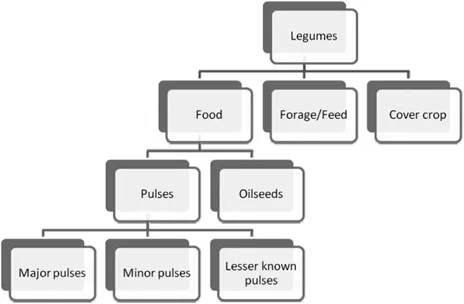
Figure 1.1 Classification of pulses
Pulses are defined by the Food and Agricultural Organization (FAO) of the United Nations as annual leguminous crops yielding from one to twelve grains or seeds of variable size, shape and colour within a pod. The terms “legumes” and “pulses” are used interchangeably because all pulses are considered legumes (although not all legumes are considered pulses). The term “pulse”, as used by the FAO, is reserved for crops harvested solely for use as dry grains. This term therefore excludes green beans and green peas, which are considered as vegetable crops. The crops which are mainly grown for oil extraction (oilseeds like soybeans and peanuts), and those which are used exclusively for sowing (clovers, alfalfa) are also excluded from the term pulses. FAO recognises 11 primary pulses: (1) dry beans; (2) dry broad beans; (3) dry peas; (4) chickpea; (5) dry cowpea; (6) pigeon pea; (7) lentil; (8) bambara groundnut; (9) vetch; (10) lupins and (11) minor pulses. Some of the commonly grown and consumed pulses are show in Figure 1.2.
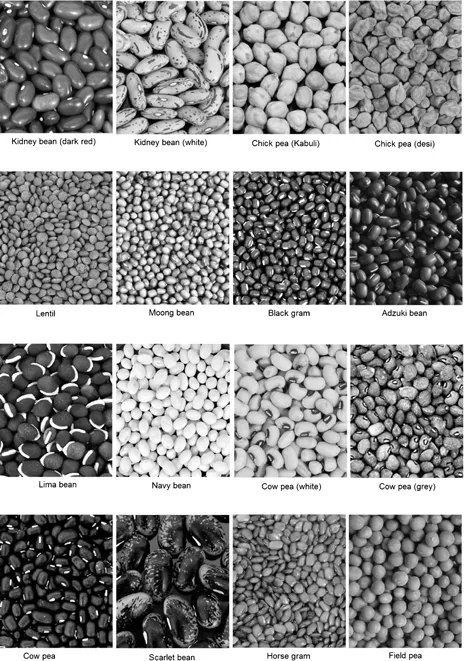
Figure 1.2 Commonly grown and consumed pulses around the world
1.2. TRENDS IN PULSE PRODUCTION AND CONSUMPTION
1.2.1. Pulse Production
Pulse crops have a relatively small share in the total agricultural area and production when compared to cereals. Pulse production data for major pulse producing countries from 2000 to 2009 is presented in Table 1.1.
Table 1.1 Production of important pulses during 2000–2009a (metric tonnes)
| Pulses | Country | 2009 | 2008 | 2004 | 2000 |
| Lentils | Canada | 1 510 200 | 1 043 200 | 915 800 | 914 100 |
| India | 950 000 | 810 000 | 1 037 800 | 1 078 900 | |
| Nepal | 147 725 | 161 147 | 158 671 | 137 343 | |
| USA | 265 760 | 108 545 | 189 692 | 137 393 | |
| Ethiopia | 123 777* | 94 103 | 55 113 | 59 000 | |
| China | 120 000* | 150 000* | 144 000* | 116 000 | |
| Chickpea | India | 7 060 000 | 5 748 600 | 5 717 500 | 5 118 100 |
| Australia | 445 000 | 442 543 | 135 215 | 162 000 | |
| Turkey | 562 564 | 518 026 | 620 000 | 548 000 | |
| Pakistan | 740 500 | 474 600 | 611 100 | 564 500 | |
| Myanmar | 398 000 | 347 900 | 224 300 | 84 279 | |
| Ethiopia | 312 080* | 286 820 | 162 858 | 164 627 | |
| Peas, dried | Canada | 3 379 400 | 3 571 300 | 3 097 200 | 2 864 300 |
| China | 960 000* | 1 100 000* | 1 060 000 | 102 000* | |
| Russia, Federation | 1 348 890 | 1 256 830 | 1 242 500 | 815 230 | |
| India | 754 459Im | 749 981Im | 725 200Im | 814 800 | |
| USA | 777 320 | 556 560 | 517 957 | 157 578 | |
| France | 546 846 | 451 416 | 1 680 780 | 1 936 500 | |
| Pigeon peas | India | 2 270 000 | 3 075 900 | 2 346 400 | 2 694 000 |
| Myanmar | 765 000 | 719 000 | 477 000 | 182 000 | |
| Malawi | 206 021Im | 149 873 | 93 084 | 99 261 | |
| Uganada | 91 000 | 90 000 | 84 000 | 78 000 | |
| Kenya | 46 474 | 84 168 | 105 571 | 65 604 | |
| United Republic of Tanzania | 37 610Im | 47 649Im | 47 128Im | 47 869 | |
| Dry beans | Brazil | 3 486 760 | 3 461 190 | 2 967 010 | 3 038 240 |
| India | 2 440 000 | 3 010 000 | 2 883 900 | 2 847 000 | |
| Myanmar | 3 000 000f | 3 2... |
Table of contents
- Cover
- Title
- Copyright
- Preface
- Contents
- Chapter 1 Introduction
- Chapter 2 Pulse Grain Structure
- Chapter 3 Major Constituents of Pulses
- Chapter 4 Minor Constituents of Pulses
- Chapter 5 Pulse Proteins
- Chapter 6 Protein Isolates and Concentrates
- Chapter 7 Pulse Starch
- Chapter 8 Properties of Pulses
- Chapter 9 Post-Harvest Handling
- Chapter 10 Drying of Pulses
- Chapter 11 Storage of Pulses
- Chapter 12 Processing of Pulses
- Chapter 13 Pulse Products and Utilisation
- Chapter 14 Pulse Grain Quality Criteria
- Subject Index
Trusted by 375,005 students
Access to over 1.5 million titles for a fair monthly price.
Study more efficiently using our study tools.
Frequently asked questions
Yes, you can cancel anytime from the Subscription tab in your account settings on the Perlego website. Your subscription will stay active until the end of your current billing period. Learn how to cancel your subscription
No, books cannot be downloaded as external files, such as PDFs, for use outside of Perlego. However, you can download books within the Perlego app for offline reading on mobile or tablet. Learn how to download books offline
We are an online textbook subscription service, where you can get access to an entire online library for less than the price of a single book per month. With over 1.5 million books across 990+ topics, we’ve got you covered! Learn about our mission
Look out for the read-aloud symbol on your next book to see if you can listen to it. The read-aloud tool reads text aloud for you, highlighting the text as it is being read. You can pause it, speed it up and slow it down. Learn more about Read Aloud
Yes! You can use the Perlego app on both iOS and Android devices to read anytime, anywhere — even offline. Perfect for commutes or when you’re on the go.
Please note we cannot support devices running on iOS 13 and Android 7 or earlier. Learn more about using the app
Please note we cannot support devices running on iOS 13 and Android 7 or earlier. Learn more about using the app
Yes, you can access Pulse Chemistry and Technology by Brijesh Tiwari,Narpinder Singh in PDF and/or ePUB format, as well as other popular books in Technology & Engineering & Agronomy. We have over 1.5 million books available in our catalogue for you to explore.