Hydrogels in Cell-Based Therapies
eBook - ePub

Hydrogels in Cell-Based Therapies

  1. 238 pages
  2. English
  3. ePUB (mobile friendly)
  4. Available on iOS & Android
eBook - ePub

Hydrogels in Cell-Based Therapies

About this book

Hydrogels are attractive materials for uses in regenerative medicine due to their biocompatibility and high water absorbance and retention properties. Applications are emerging in stem cell niches, biopolymers and synthetic polymers for tissue scaffolding, wound healing and hydrogels for cellular diagnostics and delivery.

Hydrogels in Cell-Based Therapies looks at the use of different polymers and other bionanomaterials to fabricate different hydrogel systems and their biomedical applications including enzyme responsive hydrogels and biomaterials, thermally responsive hydrogels, collagen gels and alginates.

With complementary expertise in cell biology and soft materials, the Editors provide a comprehensive overview of recent updates in this highly topical field. This highly interdisciplinary subject will appeal to researchers in cell biology, biochemistry, biomaterials and polymer science and those interested in hydrogel applications.
Frequently asked questions

Yes, you can cancel anytime from the Subscription tab in your account settings on the Perlego website. Your subscription will stay active until the end of your current billing period. Learn how to cancel your subscription.
No, books cannot be downloaded as external files, such as PDFs, for use outside of Perlego. However, you can download books within the Perlego app for offline reading on mobile or tablet. Learn more here.
Perlego offers two plans: Essential and Complete
  • Essential is ideal for learners and professionals who enjoy exploring a wide range of subjects. Access the Essential Library with 800,000+ trusted titles and best-sellers across business, personal growth, and the humanities. Includes unlimited reading time and Standard Read Aloud voice.
  • Complete: Perfect for advanced learners and researchers needing full, unrestricted access. Unlock 1.4M+ books across hundreds of subjects, including academic and specialized titles. The Complete Plan also includes advanced features like Premium Read Aloud and Research Assistant.
Both plans are available with monthly, semester, or annual billing cycles.
We are an online textbook subscription service, where you can get access to an entire online library for less than the price of a single book per month. With over 1 million books across 1000+ topics, we’ve got you covered! Learn more here.
Look out for the read-aloud symbol on your next book to see if you can listen to it. The read-aloud tool reads text aloud for you, highlighting the text as it is being read. You can pause it, speed it up and slow it down. Learn more here.
Yes! You can use the Perlego app on both iOS or Android devices to read anytime, anywhere — even offline. Perfect for commutes or when you’re on the go.
Please note we cannot support devices running on iOS 13 and Android 7 or earlier. Learn more about using the app.
Yes, you can access Hydrogels in Cell-Based Therapies by Che J Connon, Ian W Hamley in PDF and/or ePUB format, as well as other popular books in Technology & Engineering & Biotechnology in Medicine. We have over one million books available in our catalogue for you to explore.
CHAPTER 1
Soluble Molecule Transport Within Synthetic Hydrogels in Comparison to the Native Extracellular Matrix
MATTHEW PARLATOa AND WILLIAM MURPHY*a,b,c
aDepartment of Biomedical Engineering, University of Wisconsin Madison, Wisconsin Institutes for Medical Research, 1111 Highland Avenue, Madison, WI 53705, USA;
bMaterials Science Program, University of Wisconsin Madison, Wisconsin Institutes for Medical Research, 1111 Highland Avenue, Madison, WI 53705, USA;
cDepartment of Orthopedics and Rehabilitation, University of Wisconsin Madison, Wisconsin Institutes for Medical Research, 1111 Highland Avenue, Madison, WI 53705, USA
*E-mail: [email protected]

1.1 Introduction

Soluble factor signalling and gradient formation are of known biological importance and direct processes such as stem cell differentiation,1,2 cellular migration,3–6 limb bud development,7–9 and neural tube development.7 Soluble transport within the in vivo environment is complex, involving spatiotemporal interactions and molecular recognition between soluble molecules and extracellular matrix (ECM) components.2–16 Because of such complexity, what is known and what can be studied about soluble transport in vivo is limited. Therefore, the use of well-defined in vitro experimental platforms is an attractive option. Because of the similarity of hydrogels to the native ECM, synthetic hydrogels can serve as model systems for the study of soluble transport and gradient formation within the ECM.17–19 Synthetic hydrogels are also useful because of their biocompatibility and adaptability for use with a variety of chemistries.17,19–26
The hydrated polymer chains of synthetic hydrogels slow solute movement just as the macromolecules within the ECM do, thus assisting in the formation of concentration gradients.27 Furthermore, drug delivery technologies have been incorporated into synthetic hydrogels that serve as well-defined soluble factor sources and sinks within the hydrogel.28–31 Other experimental approaches seek to incorporate the ability of the native ECM to specifically bind and release soluble molecules into synthetic hydrogels by the incorporation of proteoglycans21,26,32–34 or peptides that have high binding affinities for specific soluble molecules.31,35–37 Many methods also exist that exert temporal control over transport within synthetic hydrogels by allowing the hydrogel to degrade over time, be remodelled by cell-secreted enzymes, or respond to external cues such as temperature or pH.20,24,30,38–47
There are many articles and reviews that discuss the first principles of transport within the native ECM and synthetic hydrogels separately;27,29,48–52 however, the purpose of this chapter is to compare and contrast the two. We endeavour to address some of the critical questions that arise during development of synthetic hydrogels to mimic natural signalling gradients in the ECM, such as: (1) how does transport and gradient formation of soluble molecules within synthetic hydrogels compare to that within the native ECM? (2) What aspects of signalling within the native ECM have been mimicked within synthetic hydrogels and what aspects remain to be explored? and (3) what are the potential consequences of these differences, and how can the synthetic hydrogels be made to more closely mimic the signalling of the native ECM? This chapter is divided into five sections based on the following parameters that influence molecular transport in natural or synthetic ECMs: steady-state diffusion, soluble factor generation and consumption, matrix interactions, temporal dependencies, and convection. Each of these sections is divided into two subsections. The first subsection discusses the topic with regard to the native ECM and the second with regard to synthetic hydrogels. Finally, the chapter concludes with a short discussion of the future directions for synthetic hydrogels that seek to recapitulate various aspects of signalling in the native ECM.

1.2 Steady-State Diffusion

1.2.1 Steady-State Diffusion Within the Native ECM

Soluble factor gradients within the ECM are generated through a variety of mechanisms, but to begin the discussion, a simple case with defined ‘source’ and ‘sink’ regions is discussed. In the simplest scenario, defined source and sink regions occur due to one group of cells producing large amounts of soluble molecules while another nearby group does not produce these molecules and instead consumes them. The goal of this section is to understand the basic mechanisms by which soluble factor gradients may form within the native ECM. Additionally, we examine what fundamental properties of both the soluble factor and the native ECM affect this gradient formation.
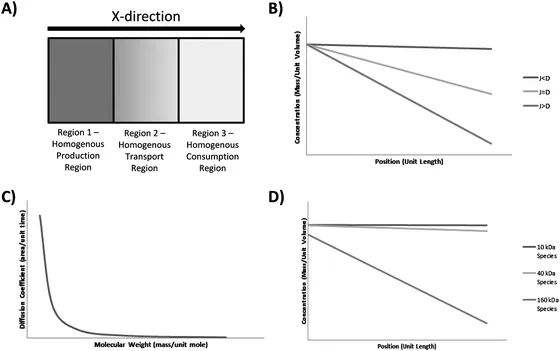
Within this section, all sources and sinks are assumed to exist at a single point in space to facilitate mathematical descriptions. Therefore, they are referred to as ‘point-sources’ and ‘point-sinks’. They are also assumed to produce or consume molecules instantaneously and without limits. Due to these properties, they are referred to as ‘perfect sources and sinks’. Furthermore, we assume that the ECM in which the molecules are diffusing is homogeneous and that all parameters are constant with time (i.e. steady state). Notably, biological scenarios do not feature perfect, point-sources and point-sinks, but this is a useful and widely utilized starting point in discussions of transport in the native ECM.12,15,53 A diagram of this problem is shown in Figure 1.1a. A summary of these assumptions is as follows:
(1) All regions are homogeneous.
(2) The source region is a perfect, point source.
(3) The sink region is a perfect, point sink.
(4) All parameters are constant with time (‘steady state’).
images
Figure 1.1 (A) Diagram of proposed problem involving a perfect source, perfect sink, and a homogeneous transport region. Arrow indicates the positive x-direction. (B) Analysis of solute mass flux over diffusion coefficient ratio (J over D ratio) for the transport problem diagrammed in (A). When J is far less than D, concentration is nearly constant with respect to x. Conversely, when J is far greater than D, the concentration decreases quickly with respect to x. (C) Diffusion coefficient versus molecular weight as proposed by the Brinkman equation for diffusion within the native ECM. A steep, non-linear drop-off of the diffusion coefficient with respect to increasing molecular weight is observed. (D) Changes in the concentration gradient based solely on changes to the diffusion coefficient calculated by the Brinkman equation shown in (C). A fourfold increase in molecular weight only slightly changes the concentration gradient; however, a 16-fold increase in the molecular weight brings about a drastic...

Table of contents

  1. Cover image
  2. Title page
  3. Copyright
  4. Contents
  5. Chapter 1 Soluble Molecule Transport Within Synthetic Hydrogels in Comparison to the Native Extracellular Matrix
  6. Chapter 2 Biocompatibility of Hydrogelators Based on Small Peptide Derivatives
  7. Chapter 3 Recombinant Protein Hydrogels for Cell Injection and Transplantation
  8. Chapter 4 The Instructive Role of Biomaterials in Cell-Based Therapy and Tissue Engineering
  9. Chapter 5 Microencapsulation of Probiotic Bacteria into Alginate Hydrogels
  10. Chapter 6 Enzyme-Responsive Hydrogels for Biomedical Applications
  11. Chapter 7 Alginate Hydrogels for the 3D Culture and Therapeutic Delivery of Cells
  12. Chapter 8 Mechanical Characterization of Hydrogels and its Implications for Cellular Activities
  13. Chapter 9 Extracellular Matrix-Like Hydrogels for Applications in Regenerative Medicine
  14. Subject Index