![]()
CHAPTER 1
Science and Art—My Two Passions
RICHARD R. ERNST
Laboratorium für Physikalische Chemie, ETH Zürich, Switzerland Email:
[email protected]What a magnificent life spending most of my time and effort on beloved passions! My two major loves are indeed SCIENCE and ART. It is even better when two interests match, complement, and overlap each other in a harmonious fashion. Naturally, other fascinations have also brought excitement and thrills into my past 80 years. But nuclear magnetic resonance spectroscopy (NMR), a prominent member of analytical chemistry, on the one hand, and Tibetan painting art, a fascinating visual feast, on the other, have provided the best conceivable life ever.
I did not wilfully select science and art as my passions. It all happened by chance,1 by encounters that were arranged by whatever is governing destiny. I love the term “chance” without having to enact a beneficial originator, acting behind the scenes. I know that without my personal contributions, destiny could not have achieved its goals. However, the indispensable personal contributions were also inspired by circumstances, and it is not justified to derive personal meritoriousness from the lucky outcome.
1.1 MY PATHWAY INTO SCIENCE
I was born into a family that already manifested the technical and artistic genes which determined the course of my life.1 My father was teaching architecture at the local technical high school (Technikum Winterthur) and on the other hand, regularly playing the cello in chamber music groups. The city of Winterthur also provided the same kind of two-sided inspiration with the heavy machine factories of Sulzer and Rieter, on the one hand, and the magnificent European art collections of Oskar Reinhart, on the other.2,3 The availability of resources provided the indispensable link between art and industry in “my” city. It was clear that I could never assemble a comparable personal art collection, with my lacking financial basis.
There was still another artistic motivation: the radiance of the superb symphony orchestra of Winterthur, sponsored by Oskar Reinhart’s brother Werner who lived on the same road as my parents.4–6 Music became my nurturing element during the early period of my life. In fact, I felt a strong desire to become a musical composer and I dreamed of sitting with closed eyes in the concert hall listening to “my” music being played by the Winterthur orchestra. I learned to play the cello, following the tradition set by my father, although I would have preferred to master the piano, which is handier for a would-be composer.
My scientific drive originated from the desire to explore the surroundings. In the attic of our old house, built in 1898 by my grandfather, I discovered a wooden box full of chemicals, the last remainders of an uncle who died in 1923. They inspired my first chemical adventures in the basement of our house, leading to explosions and other surprising effects. Fortunately, our house and I survived, nurturing my decision to study chemistry at ETH Zurich. The undergraduate studies were disappointing because pure phenomenology prevailed in organic, inorganic, and technical chemistry. Thus, I went into physical chemistry, hoping to find a better basis for comprehending my observations. In particular, spectroscopy became my preferred tool of exploration. My thesis advisor, Prof. Hs. H. Günthard, suggested that I acquaint myself with nuclear magnetic resonance (NMR), an upcoming analytical method that was “worth investing a lifetime”. It was not clear to me from the beginning that NMR could provide the keys for opening the treasure chest of nature: NMR was exceedingly slow and insensitive. But I helped myself by shaping and polishing the keys until they indeed allowed fascinating glimpses behind the scenes of nature. Under the guidance of Hans Primas, I helped to complete the construction of a 25 MHz NMR spectrometer, based on a 6k Gauss permanent magnet.7,8
In 1964, I was in the midst of my first professional employment at Varian Associates, Palo Alto, California, when it became clear to my American boss Weston A. Anderson and to me that a multiple channel NMR concept might lead to the urgently needed sensitivity improvement. Simultaneous data acquisition by pulse excitation proved to be the magic trick that enabled high-sensitivity Fourier-transform NMR.9–12 NMR became a fantastic tool for exploring materials and objects of nature of all kinds—except for bulky objects of art. They just did not fit into the narrow gap of the magnets used for polarizing the atomic nuclei, or into our standard 5 mm sample tubes.
1.2 MY ADVENTURES IN TIBETAN PAINTING ART
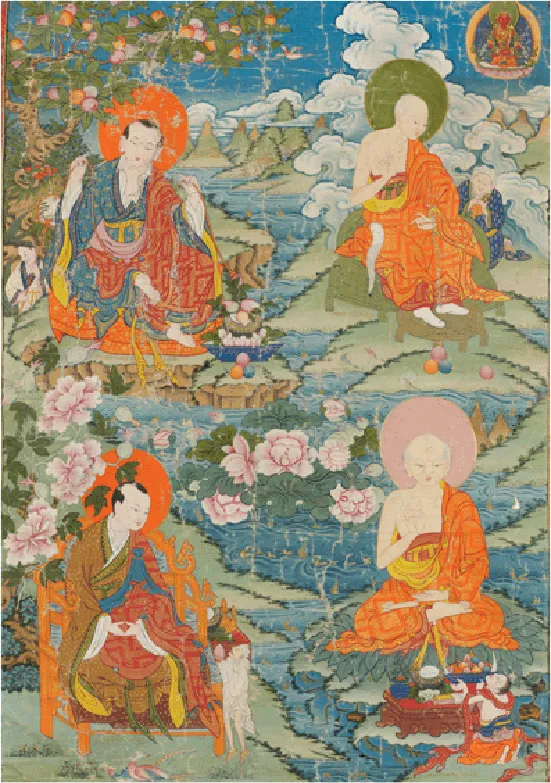
My early NMR experience did not provide an easy link to art to justify a contribution to the book “Science and Arts” that lies on your desk. I had to be patient to become accidentally exposed also to Tibetan painting art,13–17 my dormant second passion. In 1968, I returned with my family from California to Switzerland, and we took a detour via Asia. In the market in Kathmandu, Nepal, I stumbled unexpectedly across a Tibetan painting. I was struck by its fantastic colourfulness, and I bought it (Figure 1.1). At the beginning, I had no clues to comprehend its spiritual meaning. My science background was not particularly helpful in understanding its secret messages. Only much later did I learn about Buddhism and the role of the 16 Arhats, four of which are shown on “our” first thangka. But the fascination for this kind of art from a “different world” caught me; and step by step, I became a collector of Tibetan scroll paintings.
Figure 1.1 The thangka ET1 shows four of the 16 Arhats, disciples of Buddha. The painting was originally part of a series of seven thangkas with Buddha Sakyamuni on the central painting. The thangka shown is, according to a Tibetan inscription on the back, “no. 2 on the right”. The four Arhats are identified in fine golden script, starting on the upper left, with Kanakavatsa (in Tibetan: Gser behu), followed clockwise by Vajraputra (Rdo rje mohi bu), Bhadra (Bzang po), and by Kanaka-Bharadvaja (Bha ra dhva dza gser can). They are sitting, escorted by followers, in a Chinese-inspired idyllic landscape with a river and animals. On the top left, we find Buddha Amitayus, representing longevity. The painting follows a style typical for the 18th–19th centuries in Central and Eastern Tibet.
It took a while to localize the commercial channels by which some Tibetan items came to the West and to Switzerland. My professional life, back in Switzerland, was at the beginning neither productive nor pleasant. A serious nervous breakdown in 1969, caused by private and professional inadequacies, kept me from scientific endeavours for several months. I was forced to spend a convalescence stage near the beautiful city of Lugano and had the leisure to browse through some curio shops in this tourist’s place. By another pure chance, I discovered in a Cuckoo-clock shop (!) two ancient thangkas and a gilded bronze figure, having just arrived from Tibet by Tibetan refugees or dealers. One of the two thangkas represents the conqueror of death, Yamantaka, a frightful dark-blue deity with nine heads and uncountable arms; eight heads possess an angry complexion, while the top head looks peaceful and belongs to the Bodhisattva Manjushri, the deity of wisdom. Our Yamantaka painting from 1590–1620 is reproduced in refs 18 and 19.18,19 Yamantaka struck me as a fitting metaphor for a scientist who needs the strength and endurance of the fierce deity and at the same time the benevolent wisdom of Manjushri to be successful.
The gilded bronze figure, bought on the same occasion, represents Avalokitesvara, the deity of compassion. A legend tells that he, a Bodhisattva, was once looking down onto the misery of people, and in pity, his head decomposed into eleven pieces that formed, after reassembly, his eleven heads. His top head represents the all-encompassing spirit of Amitabha, the Buddha of our world. Nine heads are peaceful, reflecting compassion, while the last head has the frightful complexion of Mahakala, a protector of Dharma, the Buddhist creed. The bronze figure of Avalokitesvara stems from the 18th century, possibly from Beijing, while the Yamantaka thangka was painted at the monastery of Ngor in Central Tibet, to be mentioned later. The date of the Yamantaka painting can be deduced from the lineage or the “family tree” of teachers, going back to Buddha Shakyamuni, shown at the borders of the painting. The individual teachers are identified by gold ink inscriptions. The last teacher must be contemporary with the painting itself. He lived around 1600. The second Tibetan painting, acquired in the same shop, is the central subject of the last part of this article (Figures 1.7–1.9). The unification of opposing aspects in thangka paintings and in bronze figures is quite typical for Buddhist art that attempts to establish harmonizing bridges between extremes to emphasize the need of peaceful coexistence on the “middle way”.20
1.3 SCIENTIFIC TOOLS FOR THE ANALYSIS OF ANCIENT PAINTINGS
Before describing in some detail four paintings from our rather extensive collection, let me introduce the scientific tools that I found useful for studies of scroll paintings.21
1.3.1 Age Determination of Paintings
The most reliable physical method for determining the age of thangkas is carbon-14 analysis.22–26 The age of the cotton canvas can be determined based on the fact that during the growth of the cotton fibres, radioactive 14C is incorporated into the fibres. The extent of the subsequent decay of radioactivity (with a half-life of 5730 years) allows one to estimate the age of the cotton. The 14C method has, however, several limitations:
- When the cotton fibres were already ancient when the painting was done, an erroneous age is determined.
- It is particularly difficult to date wooden objects, such as book covers, due to the fact that the piece of wood, used as an indicator of age, was growing over as many as several hundred years. The outer parts of a tree stem are younger than the central core.
- The production rate of radioactivity depends on the temporal sun activity that can vary significantly, leading to an irregular activity–time curve, sometimes even with several dates matching an observed radioactivity (see Figure 1.4). Especially for more recent dates, between 1650 and 2000, the correlation of radioactivity and time becomes so flat and irregular that any accurate dating is no longer possible.
1.3.2 Methods of Pigment Analysis
We demonstrate possibilities to identify pigments for getting a further insight into age and possibly provenience of paintings.27–30 We will deal with:
(i) Infrared reflectography and
(ii) Pigment analysis by Raman spectroscopy.
Further scientific approaches, which cannot be elaborated in the present context, are:
(iii) X-ray fluorescence31 and
(iv) Fourier infrared spectroscopy.32
The two techniques to be dealt with here are special due to the fact that they are true in situ techniques that require no sample preparation and are best suited for exploring precious historical artefacts where the taking of samples is undesirable. Both techniques are readily available in the tiny “home”-laboratory of the author with just 16 m2.
1.3.3 Infrared Reflectography
Infrared reflectography33 is a simple means for classifying the pigments into two classes: IRt pigments are transparent for infrared light, and IRnt pigments are non-transparent for infrared light. Prominent IRt pigments are: cinnabar (red), red lead (red), orpiment (yellow), realgar (orange), pararealgar (yellow), ultramarine blue or lazurite, Prussian blue, indigo (blue), and emerald green. Among th...