![]()
CHAPTER 1
The Traditional and Scientific Bases for Traditional Chinese Medicine: Communication Between Traditional Practitioners, Physicians and Scientists
JAMES D. ADAMS JR* AND ERIC J. LIEN
Department of Pharmacology and Pharmaceutical Sciences, School of Pharmacy, University of Southern California, Los Angeles, CA, 90089, USA
*E-mail:
[email protected]1.1 Introduction
The species Homo sapiens has existed for 200 000 years or so. Medicinal plants have been important to humans as indicated by plants in prehistoric burial sites, mummy wrappings and ancient legends. It is likely that during the entire period of human existence, plants have been used as medicines. This means there has been a tremendous natural selection, such that those who responded to plant medicines survived. Our genome has been altered by this natural selection. It has only been during the past 50 years or so that Science has tried to displace traditional medicine. However, even today, the majority of purified drugs used clinically are derived directly or indirectly from plants and other natural sources. It is critical to realize that the alteration of the human genome by the use of plant medicines makes humans more responsive to plant medicines today. We should continue to use plant medicines.
There is an old Chinese saying, “Thousands of prescriptions are easy to come by. A really good drug is hard to find.” This is still true today in spite of modern advances in biomedical technology. It is humbling to realize that while drugs can treat symptoms, only Mother Nature, the body, can cure and heal. Extension of life expectancy is accompanied by many lifestyle-related diseases such as diabetes, obesity, hypertension, cancer, drug addiction and degeneration of various organs and tissues. None of these diseases can be easily overcome by a quick fix with a miracle pill or surgical procedure. Fundamental changes are needed to reverse the downward spiral trend in healthcare effectiveness.
It is a sad fact that modern lifestyles cause the incidence of heart disease, diabetes, arthritis and cancer to increase every year, as shown by Centers for Disease Control statistics. In fact, heart disease, diabetes and arthritis are enabled by non-traditional medicine, since only the symptoms are treated, allowing patients to live with their disease. Efforts to cure these diseases are almost completely ineffective. Traditional Chinese medicine has much to teach in terms of preventing and curing these conditions.
1.2 The Basis of Traditional Chinese Medicine
There is a strong scientific basis for traditional Chinese medicine. However, the Science of traditional Chinese medicine is rarely discussed and needs to be more widely known. Currently, the scientific approach to traditional Chinese plant medicines is to purify them into single components. This is simply modern drug discovery in Chinese plants. However, traditional Chinese medicine usually uses complex mixtures of plant extracts, not single purified drugs. This is based on yin, yang and chi theories that are not widely understood by scientists.
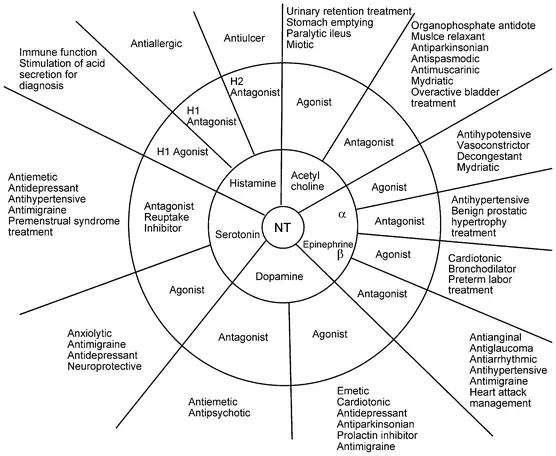
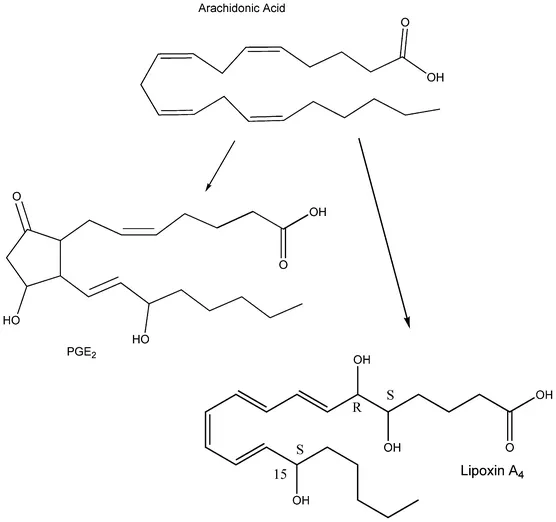
Yin is cold, wet and female. Yang is hot, dry and male. Yin and yang are constant influences in the body and must be kept in balance to prevent disease.1,2 Disease is treated by re-establishing the balance of yin and yang. Yin and yang are the balance of endogenous agonists and antagonists. This includes the balance between the sympathetic and parasympathetic nervous systems and also other systems (Figure 1.1). For instance, pain can be caused by prostaglandins, whereas pain relief can come from lipoxins.3,4 Prostaglandins interact with prostaglandin receptors such as DP, EP, FP and IP. Lipoxins interact with lipoxin receptors, such as ALXR. Both prostaglandins and lipoxins are endogenous compounds, are products of arachidonic acid and exist in a balance that controls pain (Figure 1.2). Pain is a necessary part of normal life, but should not be excessive. Pain relief can result from balancing prostaglandins and lipoxins.
Figure 1.1 Many therapeutic applications have be developed based on neurotransmitter (NT) agonists and antagonists. Each receptor has an agonist, NT, that is made locally, excreted when it is needed and cleared quickly. Each receptor also has an endogenous antagonist that is made locally, excreted when it is needed and cleared quickly. However, the endogenous antagonists for the NT shown are not known. Modified from Kuo et al.14
Figure 1.2 Arachidonic acid is the source of prostaglandin E2, which causes pain, and lipoxin A4, which relieves pain.
Chi is the life force, flows in the body in acupuncture channels and has several components. Chi derives from signaling processes in the body, such as phosphorylation/dephosphorylation, G protein signaling, cAMP production and degradation, calcium release and sequestration and others, and regulates bodily functions.5 For instance, anxiety is a learned response that alters the functions of several receptor signal transduction systems in the brain, serotonergic, GABAergic, noradrenergic, dopaminergic and others.6 Anxiety can greatly increase the risk of developing some diseases. It is necessary to unlearn anxiety in order to have a productive life. This involves a volitional act of restoring the balance or chi, of signal transduction systems. Chi also has a genetic component that is passed down from ancestors. Therefore, chi is controlled by genes. Chi controls yin and yang. Conversely, yin and yang influence chi. Chi can also be described as the Gibbs free energy (△G) available to do useful work according to the laws of thermodynamics.7
Yin, yang and chi constantly interact in the body to maintain health. Western medicine understands very well how to use drugs that are agonists and antagonists to modify signaling processes. However, Western medicine does not accept the use of complex plant extracts to perform these functions. Traditional Chinese medicine has learned experimentally over the centuries how to restore the chi, yin and yang of a patient to restore health with plant medicines.
1.3 Disease Causation
In traditional Chinese medicine, disease is caused by an imbalance in the body, usually caused by too much yin or too much yang.1,2 For instance, a cold may be caused by too much exposure to cold, wet wind. The cold is then counterbalanced by a fever that heats up the body. Yin in this case is an external influence. Yang, the fever, results from endogenous factors in the body. Hypertension may be caused by too much yang that results in more blood flow to cool the body. In this case, yang and yin are endogenous factors.
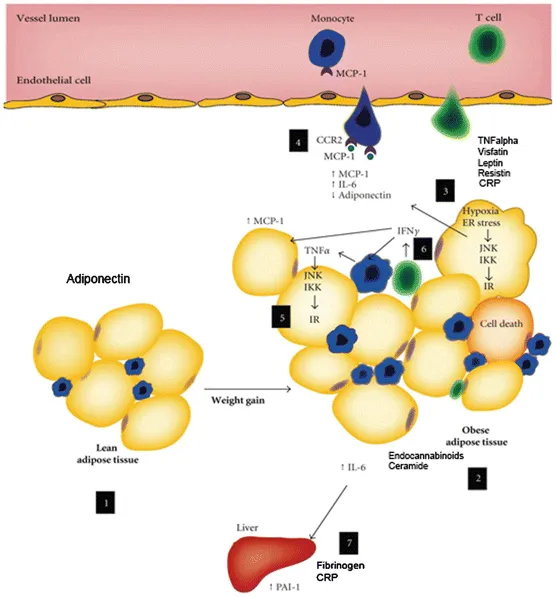
Science has only learned in the past few years that many diseases are caused by an imbalance in endogenous agonists and antagonists. For instance, arthritis, hypertension, atherosclerosis, diabetes and other conditions are caused by obesity that produces an abundance of toxic adipokines and toxic lipids in the body.5 These are endogenous agonists and antagonists that work at specific receptors to cause inflammation, increase blood pressure, damage blood vessels and the heart and cause insulin resistance (Figure 1.3). AIDS is caused by a virus-induced imbalance in T cells, which the body cannot correct. Infections are usually caused by external pathogens that infect the body, but are only able to infect because the body cannot mount an adequate immune response through endogenous leukocytes.
Figure 1.3 Adipokines produced by visceral fat. As visceral fat accumulates, adiponectin, an anti-inflammatory adipokine [1], decreases and many inflammatory adipokines increase [2], including tumor necrosis factor alpha (TNF-α), interleukin-6 (IL-6), visfatin, resistin, C-reactive protein (CRP), leptin and monocyte chemoattractant protein-1 (MCP-1). Toxic lipids are also produced excessively throughout the body as visceral fat accumulates, including ceramide and the endocannabinoids, anandamide and 2-arachidonylglycerol. Expanding adipocytes may become hypoxic and die through endoplasmic reticular stress (ER stress) that involves activation of inflammatory kinases, JNK and IKK [3]. Macrophages [4] and T cells [6] accumulate and secrete cytokines as visceral fat increases and activate inflammatory kinases in fat [5]. Macrophages express the MCP-1 receptor, chemokine C-C motif receptor 2 (CCR2). Adipokines in the plasma can increase liver production of inflammatory mediators and coagulation factors [7], including fibrinogen, CRP and plasminogen activator inhibitor-1 (PAI-1). Modified from Rocha and Folco.15
Cancer is caused by endogenous or external factors that damage DNA. Cancer is able to grow only because the body cannot kill the cancer cells with endogenous factors. Recent evidence has found that obesity increases cancer risk and mortality.8 Visceral fat releases adipokines, including IL-6, TNF and leptin, that increase the growth and malignancy of tumor-initiating stem cells.9 This leads to tumor growth, malignancy and mortality.
In non-traditional medicine, diseases are detected too late, after the disease has already progressed to an intolerable state. This is true of diabetes, arthritis, heart disease, cancer and most other diseases. The patient may benefit from an early disease prevention program that prevents diseases from progressing to an intolerable state. Patients can be taught to avoid toxic lifestyles that cause diseases.
1.4 Disease Prevention
One of the vital functions of traditional practitioners is to keep their patients healthy and working. They do this with strong programs in disease prevention. Most of us are born healthy and could remain healthy if we knew how. Disease prevention is the key to staying healthy. Traditional practitioners have learned over the centuries that people who keep themselves thin and strong stay healthy, people who stay away from alcohol stay healthy, people who stay away from abuse of some plant-derived medicines and smoking stay healthy and people who minimize stress in their lives stay healthy. Toxic lifestyles lead to disease.5 All people should be encouraged to perform 60–70 minutes’ of aerobic exercise daily for disease prevention and to encourage healing. Exercise increases the production of stem cells in every organ examined so far.
Today, keeping people alive is the priority in many non-traditional medical practices, not disease prevention. Even people with substantial multiple organ pathology from diabetes, heart disease, congestive heart failure, stroke and other conditions are kept alive with modern medicines. Many non-traditional medical practitioners ignore the traditional approach to disease prevention since it is easier simply to treat the patient with a drug that manages symptoms. Hypertension, high blood cholesterol, high blood sugar and other specific symptoms can be managed with drugs. This approach does not cure the underlying disease, but keeps the patient alive. These drugs are used for the rest of the patient’s life. The problem then becomes managing the toxicity of the drugs. Some statins used in hypercholesterolemia cause muscle toxicity and diabetes. Pioglitazone, used in diabetes, causes congestive heart failure and kidney cancer. Some calcium channel blockers, used in hypertension, can cause bradycardia. Most drugs used to control blood sugar in diabetes can cause hypoglycemia. Non-steroidal anti-inflammatory drugs (NSAIDs) used in arthritis cause ulcers, kidney damage, heart attacks and strokes. Acetaminophen causes liver damage, kidney damage, heart attacks and strokes.
1.5 The Traditional Approach to the Treatment of Disease
Science still has much to learn from traditional Chinese medicine.10,11 The traditional approach is pragmatic, experimental and based on what helps the patient get back to a productive life. For instance, a patient crippled by stroke may be treated for up to 6 months with plant preparations and physical therapy in order to decrease paralysis and get them back to work. Scientists frequently do not understand the mechanisms involved in traditional medicine and should continue searching.
Traditional Chinese medicine requires expertise to find the proper mixture of plant medicines to achieve balance in the body. This is a difficult experimental process in each patient. Each disease in each patient requires an individualized approach to achieve balance.
Meditation, tai chi, yoga, prayer and other calming influences are critical to disease treatment and prevention in the traditional approach. Chi increases because of these calming influences and can maintain the balance of yin and yang. These calming influences help treat anxiety that greatly magnifies the risk of developing some diseases and decreases the chance of recovering from many diseases.
1.6 Randomized, Placebo-Controlled Clinical Trials
Non-traditional medicine is currently based on randomized, double-blin...