This comprehensive book approaches sustainability from two directions, the reduction of pollution and the maintaining of existing resources, both of which are addressed in a thorough examination of the main chemical processes and their impact. Divided into five sections, each introduced by a leading expert in the field, the book takes the reader through the various types of chemical processes, demonstrating how we must find ways to lower the environmental cost (of both pollution and contributions to climate change) of producing chemicals. Each section consists of several chapters, presenting the latest facts and opinion on the methodologies being adopted by the chemical industry to provide a more sustainable future. A follow-up to Materials for a Sustainable Future (Royal Society of Chemistry 2012), this book will appeal to the same broad readership - industrialists and investors; policy makers in local and central governments; students, teachers, scientists and engineers working in the field; and finally editors, journalists and the general public who need information on the increasingly popular concepts of sustainable living.
eBook - ePub
Chemical Processes for a Sustainable Future
- 800 pages
- English
- ePUB (mobile friendly)
- Available on iOS & Android
eBook - ePub
Chemical Processes for a Sustainable Future
About this book
Information
CHAPTER 1
General Concepts in Sustainable Chemical Processes
DARRELL ALEC PATTERSON*a,b AND JANET L. SCOTT*a,c
a Centre for Sustainable Chemical Technologies, University of Bath, Claverton Down, Bath, UK; b Bath Process Intensification Laboratory, Department of Chemical Engineering, University of Bath, Claverton Down, Bath, UK; c Department of Chemistry, University of Bath, Claverton Down, Bath, UK
*Email: [email protected]; [email protected];
[email protected]
*Email: [email protected]; [email protected];
[email protected]
1.1 WHAT IS A SUSTAINABLE CHEMICAL PROCESS?
The topics contained in this book represent the nexus between chemical engineering and chemistry. Covering many sustainable process technologies available, whilst outlining the chemistry that underpins them, this book differs from others which often focus on a subset of the processes or the chemistry, or on a specialist topic (e.g. process intensification). Process design equations and process modelling, scale up, process and energy integration, and process control are often neglected. Therefore, we aim to provide the first comprehensive coverage of sustainable chemical processes, the one-stop-shop for the area. This book therefore focuses on the chemical technologies (unit operations) from both a chemical engineering and chemistry perspective. In this chapter we discuss the overarching principles and concepts addressed in the individual chapters.
The subject of this book is sustainable chemical processes. But what are these? For us, they are processes (i.e. a set of linked unit operations† that take in raw materials and energy, and ultimately convert these into chemicals, biochemicals, materials or products) in a resource efficient manner that allows preparation of the desired product with minimal production of waste. Sustainable chemical processes or clean technologies are those that help us meet the goals of sustainability and sustainable development in our process systems.
The essence of sustainability and sustainable development is to ensure that our use of the planet’s limited material, energy and ecological resources will be such that we sustain the current standard of living for the increasing human population so that future generations are able live life at the current, or even better, standard of living. The latter is particularly applicable to the large proportion of the global human population that do not yet have access to clean water, adequate food, life-saving medication and other essentials for a happy, healthy life. Thus, sustainability and sustainable development has been defined as:1
‘…development which meets the needs of current generations while not compromising the ability of future generations to meet their own needs …’.
It is always worth reminding oneself that this widely quoted definition of sustainability arose from a commission asked to formulate ‘a global agenda for change’ and to recall Gro Harlem Brundtland’s words from her foreword to the report:1
‘… the ‘environment’ is where we all live; and ‘development’ is what we all do in attempting to improve our lot within that abode. The two are inseparable.’
The commission called for development and this has been reiterated in numerous reports since, for example:2
‘… economic development, social development and environmental stewardship are interdependent and mutually reinforcing components of sustainable development which is the framework for our efforts to achieve a higher quality of life for all people.’
A simple way of determining if a process or technology meets the goals of sustainability and sustainable development is to probe whether or not it meets all three components of the triple bottom line (also sometimes called the Three Pillars of Sustainability): people (social bottom line); planet (environmental bottom line); and profit (economic bottom line). There are various measures of these, which include:3
- People (social bottom line): worker happiness, industrial safety, benefits based on payroll expense, promotion rate, ‘loss time accident frequency’, ‘expenditure on illness and accident prevention/payroll expense’, ‘number of complaints per unit value added’, etc.
- Planet (environmental bottom line): life cycle assessment (see Section 1.4); environmental impacts such as acidification, global warming, human health, ozone depletion, photochemical ozone, wastes – hazardous and non-hazardous, and ecological health; and resource usage such as energy use, material use, water use and land use.
- Profit (economic bottom line): capital and operating costs, wealth created, value added per unit value of sales, value added per direct employee, and R&D expenditure as a percentage of sales.
When all three components of the bottom line are met (i.e. at the overlap of the three lobes, Figure 1.1), we have sustainability. The social and economic components are less directly related to the chemistry and chemical engineering emphasis of this book and therefore will not be our main focus (but they will be touched on where relevant). We will concentrate on ensuring that our sustainable chemical technologies meet the environmental bottom line. A systematic method for process choice that facilitates the selection of different technologies to meet this aim is to use the waste management hierarchy combined with the principles of green chemistry and green engineering.
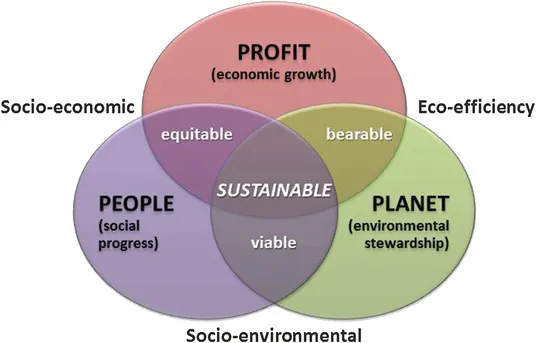
Figure 1.1 Sustainability is only achieved when all three aspects of the Triple Bottom Line are equally well satisfied.
1.2 THE PRINCIPLES OF GREEN CHEMISTRY AND GREEN ENGINEERING
1.2.1 The Twelve Principles of Green Chemistry
First set out by Paul Anastas and John Warner in their seminal work published in 1998,4 it is clear that these 12 principles were defined by chemists with synthesis in mind and, as with all sets of rules or guidelines, should always be implemented in combination with careful analysis and intelligent critical thought. Nonetheless, even in cases where the process developer might decide that a particular principle is not formulated in a manner that applies to their process, these provide an excellent checklist. For example, it is certainly not always best to conduct a synthetic chemical process at ambient temperature and pressure, as described in principle 6. There are a plethora of examples where an exothermic reaction is best conducted at elevated temperature, as the process is rapid and the evolved heat is used to maintain the reaction temperature (usually after an initial short heating stage to initiate reaction). If put in the context of energy efficiency, it is easy to determine what the optimum temperature should be: that at which the process proceeds at a reasonable rate and consumes the least energy (cooling costs energy too), while remaining safe.
For completeness, below we reproduce the 12 principles of green chemistry from Anastas and Warner,
THE TWELVE PRINCIPLES OF GREEN CHEMISTRY
- Prevention: It is better to prevent waste than to treat or clean up waste after it has been created.
- Atom Economy: Synthetic methods should be designed to maximize the incorporation of all materials used in the process into the final product.
- Less Hazardous Chemical Syntheses: Wherever practicable, synthetic methods should be designed to use and generate substances that possess little or no toxicity to human health and the environment.
- Designing Safer Chemicals: Chemical products should be designed to affect their desired function while minimizing their toxicity.
- Safer Solvents and Auxiliaries: The use of auxiliary substances (e.g., solvents, separation agents, etc.) should be made unnecessary wherever possible and innocuous when used.
- Design for Energy Efficiency: Energy requirements of chemical processes should be recognized for their environmental and economic impacts and should be minimized. If possible, synthetic methods should be conducted at ambient temperature and pressure.
- Use of Renewable Feedstocks: A raw material or feedstock should be renewable rather than depleting whenever technically and economically practicable.
- Reduce Derivatives: Unnecessary derivatization (use of blocking groups, protection/deprotection, temporary modification of physical/chemical processes) should be minimized or avoided if possible, because such steps require additional reagents and can generate waste.
- Catalysis: Catalytic reagents (as selective as possible) are superior to stoichiometric reagents.
- Design for Degradation: Chemical products should be designed so that at the end of their function they break down into innocuous degradation products and do not persist in the environment.
- Real-time Analysis for Pollution Prevention: Analytical methodologies need to be further developed to allow for real-time, in-process monitoring and control prior to the formation of hazardous substances.
- Inherently Safer Chemistry for Accident Prevention – Substances and the form of a substance used in a chemical process should be chosen to minimize the potential for chemical accidents, including releases, explosions, and fires.
Reproduced from: P. T. Anastas and J. C. Warner, Green Chemistry: Theory and Practice, Oxford University Press, New York, 1998, p. 30 with kind permission from Oxford University Press.4
1.2.2 The Twelve Principles of Green Engineering
In some cases the 12 principles of green chemistry are difficult to apply directly in engineering applications, in particular those that do not involve chemicals or reactions. Consequently a further set of 12 principles...
Table of contents
- Cover
- Title
- Copyright
- Contents
- About the Editors
- Introduction
- Chapter 1 General Concepts in Sustainable Chemical Processes
- Part A: Chemical Transformations
- Processes to Facilitate Chemical Transformations
- Examples of Chemical Transformations and Processes
- Part B: Biochemical Transformations and Reactors
- Extractions and Preparations
- Part C: Separations and Purifications
- Part D: Process Integration
- Subject Index
Trusted by 375,005 students
Access to over 1.5 million titles for a fair monthly price.
Study more efficiently using our study tools.
Frequently asked questions
Yes, you can cancel anytime from the Subscription tab in your account settings on the Perlego website. Your subscription will stay active until the end of your current billing period. Learn how to cancel your subscription
No, books cannot be downloaded as external files, such as PDFs, for use outside of Perlego. However, you can download books within the Perlego app for offline reading on mobile or tablet. Learn how to download books offline
Perlego offers two plans: Essential and Complete
- Essential is ideal for learners and professionals who enjoy exploring a wide range of subjects. Access the Essential Library with 800,000+ trusted titles and best-sellers across business, personal growth, and the humanities. Includes unlimited reading time and Standard Read Aloud voice.
- Complete: Perfect for advanced learners and researchers needing full, unrestricted access. Unlock 1.5M+ books across hundreds of subjects, including academic and specialized titles. The Complete Plan also includes advanced features like Premium Read Aloud and Research Assistant.
We are an online textbook subscription service, where you can get access to an entire online library for less than the price of a single book per month. With over 1.5 million books across 990+ topics, we’ve got you covered! Learn about our mission
Look out for the read-aloud symbol on your next book to see if you can listen to it. The read-aloud tool reads text aloud for you, highlighting the text as it is being read. You can pause it, speed it up and slow it down. Learn more about Read Aloud
Yes! You can use the Perlego app on both iOS and Android devices to read anytime, anywhere — even offline. Perfect for commutes or when you’re on the go.
Please note we cannot support devices running on iOS 13 and Android 7 or earlier. Learn more about using the app
Please note we cannot support devices running on iOS 13 and Android 7 or earlier. Learn more about using the app
Yes, you can access Chemical Processes for a Sustainable Future by Trevor Letcher, Janet Scott, Darrell Patterson, Trevor M Letcher,Janet Scott,Darrell Patterson in PDF and/or ePUB format, as well as other popular books in Physical Sciences & Industrial & Technical Chemistry. We have over 1.5 million books available in our catalogue for you to explore.