Atmospheric Chemistry provides readers with a basic knowledge of the chemistry of Earth's atmosphere, and an understanding of the role that chemical transformations play in this vital part of our environment. The composition of the 'natural' atmosphere (troposphere, stratosphere and mesosphere) is described in terms of the physical and chemical cycles that govern the behaviour of the major and the many minor species present, and of the atmospheric lifetimes of those species. An extension of these ideas leads to a discussion of the impacts of Man's activities on the atmosphere, and to an understanding of some of the most important environmental issues of our time. One thread of the book explains how living organisms alter the composition and pressures in the atmosphere, modify temperatures, and change the intensity and wavelength-distribution of light arriving from the Sun. Meanwhile, the living organisms on Earth have depended on these very same environmental conditions being satisfactory for the maintenance and evolution of life. There thus appear to be two-way interactions between life and the atmosphere. Man, just one species of living organism, has developed an unfortunate ability to interfere with the feedbacks that seem to have maintained the atmosphere to be supportive of surface life for more than 3.5 billion years. This book will help chemists to understand the background to the problems that arise from such interference. The structure of the book and the development of the subject deviate somewhat from those usually encountered. Important and recurring concepts are presented in outline first, before more detailed discussions of the atmospheric behaviour of specific chemical species. Examples of such themes are the sources and sinks of trace gases, and their budgets and lifetimes. That is, the emphasis is initially on the principles of the subject, with the finer points emerging at later points in the book, sometimes in several successive chapters. In this way, some of the core material gets repeated exposure, but in new ways and in new contexts. The book is written at a level that makes it accessible to undergraduate chemists, and in a manner that should make it interesting to them. However, the material presented forms a solid base for those who are extending their studies to a higher level, and it will also provide non-specialists with the background to an understanding of Man's several and varied threats to the atmosphere. Well-informed citizens can then better assess measures proposed to prevent or alleviate the potential damage, and policy makers more realistically formulate the necessary controls on a sound scientific foundation.
- 271 pages
- English
- ePUB (mobile friendly)
- Available on iOS & Android
eBook - ePub
Atmospheric Chemistry
About this book
Information
CHAPTER 1
Earth’s Atmosphere
1.1 CHEMISTRY IN THE ATMOSPHERE
Our atmosphere is an extraordinary mixture of gases and suspended particles, some inert and some highly reactive, some present in large quantities while others are found only in the minutest traces. New material is being added continuously to the atmosphere at the surface boundary, with materials trapped within the Earth, perhaps when the planet was formed, being liberated, sometimes slowly and gently, and sometimes violently in volcanic eruptions. So far, this description would also fit the atmospheres of our near neighbours Venus and Mars. But on Earth, the living organisms (the biota) make a quite dramatic contribution of their own to the supply of chemicals to the atmosphere. Humans are part of the biota, and are making an impact on the atmosphere out of all proportion to human life’s biological importance, as we shall see time and again in this book. The study of the chemistry of the ‘natural’ atmosphere is truly fascinating in its own right. But it is also clear that the chemist who has a good understanding of how this natural atmosphere works is one of the most likely candidates to make rational and informed suggestions about ways to offset Man’s depredations. Policy makers (and politicians) need chemists!
The mixture of gases and particles naturally contains many substances that can react with others that are present, and one of the primary tasks of the atmospheric chemist is to interpret the composition of atmosphere in terms of the pathways and rates of the reactions that occur. A knowledge, preferably obtained from experimental observations, of the possible mechanisms and of the chemical kinetics of the reactions thus lies at the core of this aspect of atmospheric chemistry. It is often helpful to imagine the atmosphere as a giant chemical reactor in which the chemical soup interacts to remove some components and to replace them with new species.
Of the biogenic gases, the most notable both in abundance and in properties is oxygen, O2, produced by photosynthesis. The existence of life allows oxygen to make up about one-fifth (21 per cent) of Earth’s atmosphere, while oxygen is almost absent from the atmospheres of Venus and Mars. However, many of the other gases released are reduced (CH4, H2S, (CH3)2S, for example), or at least only partially oxidized (CO and NO will serve as examples). Much of the chemical change in the lower part of the atmosphere thus consists of oxidation steps that lead ultimately to CO2, H2O, SO3, NO2 and N2O5 for the examples presented. We will look again at these products quite soon. For the moment, the significant feature to note is that the atmospheric conversion steps are driven, directly or indirectly, by solar ultraviolet radiation, so that the atmosphere is not just a reactor, but a photochemical reactor. To be sure, chemistry continues at night: charged particles from the Sun and lightning discharges provide energy for some reactions, while others can be promoted thermally near volcanoes. But by far the greatest proportion of the chemistry that we have outlined so far is ultimately dependent on photons emitted by the Sun.
This apparently simple picture of chemistry in the lower part of the atmosphere not surprisingly reveals considerable complexity when looked at more closely. It is at this point that the very close interactions between chemical, physical, biological and geological processes become evident. Chemical change is greatly influenced by temperature and pressure; not only the rates of reactions, but even the pathways open for reaction and thus the products formed may depend on these two factors. As a result, in the atmosphere altitude, latitude and longitude may all play a part in determining which processes occur, or at least compete successfully with alternative pathways. Pressures and temperatures in the atmosphere fairly obviously change with altitude, although the behaviour turns out to be far from obvious. It is here that we encounter the concept of different regions of the atmosphere, such as the troposphere, the stratosphere and the mesosphere, in which the classification is based on temperature structure. Figure 1.1 shows where the regions are located. Altitudes z are shown on the left-hand vertical scales, and temperatures T are plotted horizontally; the line shows how T varies with z. Atmospheric motions transport substances that live long enough to other heights and places. Reactions take place on the surfaces of suspended solids (aerosols) such as ice, soot and dusts, and within droplets (liquid H2O clouds, for example), as well as just within the gas phase, so that physics and meteorology are necessarily again involved in a detailed description of atmospheric chemistry. But chemical composition, and chemistry itself, may have an effect on temperatures, so there is a reverse interaction. Biology makes many of the chemicals released to the atmosphere, but life is sustained or shielded in one way or another by the atmosphere. Geology and geochemistry influence the chemical composition of the atmosphere, and in turn are influenced by it. It is worth noting, too, how the interactions often run in two directions: temperature affects chemistry, but chemistry influences temperatures. These so-called feedbacks thus need to be taken into account when attempting to understand atmospheric behaviour. Indeed, we do not get to a very deep understanding without considering the feedbacks between all the systems taken as a whole. It’s a complex and daunting task, but a fascinating and scientifically stimulating one that provides insights at all sorts of levels.
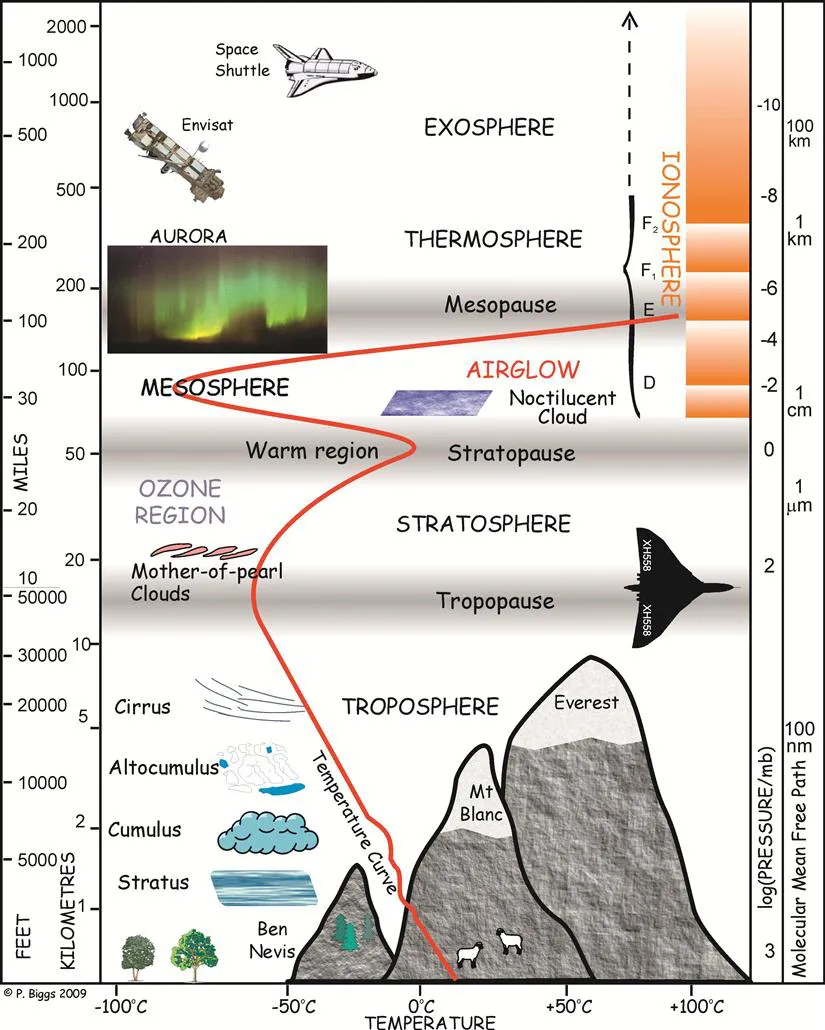
Figure 1.1 The temperature structure of the atmosphere. Temperatures show a complex dependence on altitude, decreasing with altitude at some heights but increasing at others. The turning points of the temperature gradient mark the boundaries between regions of the atmosphere. The diagram indicates the clouds and other features found at different altitudes. The right-hand ordinate scale shows both the pressure and the mean free path (λ) corresponding to the left-hand altitude scales. This version of the figure was constructed in 2009 by Dr P. Biggs, who kindly gave permission for its use here.
1.2 EARTH’S ATMOSPHERE IN PERSPECTIVE
Although we shall consider many more of the effects that life has had on Earth’s atmosphere later in the book, it is interesting to examine the pie charts in Figure 1.2, which indicate the actual compositions of the atmospheres of Venus, Earth and Mars. Comparison of the chart for Earth with the charts for Venus and Mars, the planets on either side of us, will show just how dramatically the existence of life on Earth has altered the composition of our atmosphere, particularly with respect to the proportion of carbon dioxide in the atmosphere.
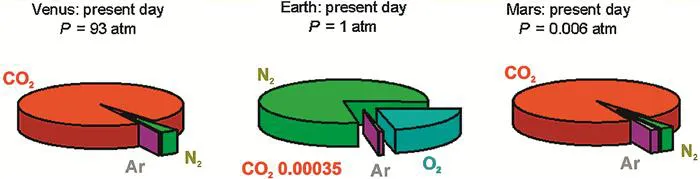
Figure 1.2 Abundances of gases in the atmospheres of Venus, Earth and Mars. The pie charts show the fractional abundances of the dominant gases, while those of other key components are shown in parentheses. Data for contemporary atmospheres are taken from R.P. Wayne, Chemistry of Atmospheres, 3rd edn, OUP, 2000, who cites the original references.
At this point, the unexpected nature of the Earth’s atmosphere becomes apparent. Since Earth lies in the solar system between Venus and Mars, Earth’s atmosphere might have been expected to consist primarily of the oxidized compound, carbon dioxide. But CO2 is only a minor (although very important) constituent. The presence of elemental oxygen as a major constituent is obviously one of the most significant features of our atmosphere and has some of the greatest impacts on its chemistry. Earth’s atmosphere appears to be a combustible mixture, since there is too much oxygen in the presence of too many gases that react with oxygen. Oxygen reacts with hydrogen to form water, with nitrogen to form nitrates, with methane to form carbon dioxide and water, and so on. Biological processes are dominant in the production of the oxidizable components of our atmosphere, and Earth’s atmosphere consequently maintains a steady-state disequilibrium composition. Furthermore, the entropy of the atmosphere is effectively reduced—the energy required for this reduction is supplied almost entirely by radiation from the Sun, which enables biology to produce both oxidizable components and, of course, oxygen.
As any high-altitude mountaineer will attest, most of this oxygen is found close to the surface of the Earth, and the atmosphere loses density very quickly as an ascent is made. Gaseous components in the atmosphere do not settle down on the planetary surface under the influence of gravitational attraction because the translational kinetic energy of the atoms or molecules competes with the forces of sedimentation. As a result of this competition, the density of gas falls with increasing altitude in the atmosphere. For the bulk liquids and solids of the oceans and land, the masses of the individual ‘particles’ are so great that this competition is completely ineffective, although if the material is finely divided enough it can remain in atmospheric suspension (an aerosol: see Section 1.3).
The total mass of Earth’s atmosphere is around 5×10¹⁸ kg. Half of this mass lies below an altitude of about 5.5 km and 99 per cent of that mass can be found below roughly 30 km, although several atmospheric species may still be found some 160 km or so above sea level, and ions of atomic and molecular hydrogen, nitrogen and oxygen can be found many hundreds of kilometres from the surface of the Earth. However, where the outer ‘boundary’ of the atmosphere actually occurs is extremely difficult to define; at an altitude of 100 km the pressure is only about one millionth of that at sea-level and the average distance between collisions of the atoms and molecules (the mean free path, λ), has reached 1 mm, several million times greater than the diameters of the colliding partners. At this altitude, chemical reactions are already rather slow because the reactants have such a low chance of colliding with each other. By the time we reach 160 km above the surface, the probability of collisions is very low indeed, and the mean free path is around 100 m.
Our high-altitude mountaineer will have also discovered that, like the density, the temperature decreases as we climb higher. In fact, it drops by about 6 K for every additional kilometre of altitude even for ...
Table of contents
- Cover
- Title
- Copyright
- Preface
- Contents
- Chapter 1 Earth’s Atmosphere
- Chapter 2 Physics of the Atmosphere
- Chapter 3 Sources and Sinks of Atmospheric Species
- Chapter 4 Observations and Models
- Chapter 5 Ozone
- Chapter 6 Cyclic Processes
- Chapter 7 Life and the Atmosphere
- Chapter 8 Chemistry in the Troposphere
- Chapter 9 The Stratosphere
- Chapter 10 Airglow, Aurora and Ions
- Chapter 11 Man’s Adverse Influences on the Atmosphere
- Further Reading
- Subject Index
Trusted by 375,005 students
Access to over 1.5 million titles for a fair monthly price.
Study more efficiently using our study tools.
Frequently asked questions
Yes, you can cancel anytime from the Subscription tab in your account settings on the Perlego website. Your subscription will stay active until the end of your current billing period. Learn how to cancel your subscription
No, books cannot be downloaded as external files, such as PDFs, for use outside of Perlego. However, you can download books within the Perlego app for offline reading on mobile or tablet. Learn how to download books offline
Perlego offers two plans: Essential and Complete
- Essential is ideal for learners and professionals who enjoy exploring a wide range of subjects. Access the Essential Library with 800,000+ trusted titles and best-sellers across business, personal growth, and the humanities. Includes unlimited reading time and Standard Read Aloud voice.
- Complete: Perfect for advanced learners and researchers needing full, unrestricted access. Unlock 1.5M+ books across hundreds of subjects, including academic and specialized titles. The Complete Plan also includes advanced features like Premium Read Aloud and Research Assistant.
We are an online textbook subscription service, where you can get access to an entire online library for less than the price of a single book per month. With over 1.5 million books across 990+ topics, we’ve got you covered! Learn about our mission
Look out for the read-aloud symbol on your next book to see if you can listen to it. The read-aloud tool reads text aloud for you, highlighting the text as it is being read. You can pause it, speed it up and slow it down. Learn more about Read Aloud
Yes! You can use the Perlego app on both iOS and Android devices to read anytime, anywhere — even offline. Perfect for commutes or when you’re on the go.
Please note we cannot support devices running on iOS 13 and Android 7 or earlier. Learn more about using the app
Please note we cannot support devices running on iOS 13 and Android 7 or earlier. Learn more about using the app
Yes, you can access Atmospheric Chemistry by Ann M Holloway,Richard P Wayne in PDF and/or ePUB format, as well as other popular books in Tecnología e ingeniería & Ciencia medioambiental. We have over 1.5 million books available in our catalogue for you to explore.