The genesis of the digital idea and why it transformed civilization
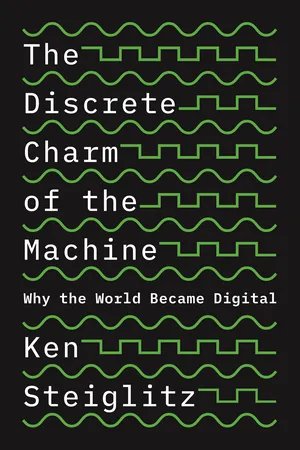
A few short decades ago, we were informed by the smooth signals of analog television and radio; we communicated using our analog telephones; and we even computed with analog computers. Today our world is digital, built with zeros and ones. Why did this revolution occur? The Discrete Charm of the Machine explains, in an engaging and accessible manner, the varied physical and logical reasons behind this radical transformation.
The spark of individual genius shines through this story of innovation: the stored program of Jacquard's loom; Charles Babbage's logical branching; Alan Turing's brilliant abstraction of the discrete machine; Harry Nyquist's foundation for digital signal processing; Claude Shannon's breakthrough insights into the meaning of information and bandwidth; and Richard Feynman's prescient proposals for nanotechnology and quantum computing. Ken Steiglitz follows the progression of these ideas in the building of our digital world, from the internet and artificial intelligence to the edge of the unknown. Are questions like the famous traveling salesman problem truly beyond the reach of ordinary digital computers? Can quantum computers transcend these barriers? Does a mysterious magical power reside in the analog mechanisms of the brain? Steiglitz concludes by confronting the moral and aesthetic questions raised by the development of artificial intelligence and autonomous robots.
The Discrete Charm of the Machine examines why our information technology, the lifeblood of our civilization, became digital, and challenges us to think about where its future trajectory may lead.
- 255 pages
- English
- PDF
- Available on iOS & Android
eBook - PDF
About this book
Information
Publisher
Princeton University PressYear
2019Print ISBN
9780691229027
9780691179438
eBook ISBN
9780691184173
Table of contents
- Cover Page
- Title Page
- Copyright Page
- Contents
- To the Reader
- Part I. A Century of Valves
- Part II. Sound and Pictures
- Part III. Computation
- Part IV. Today and Tomorrow
- Epilogue
- Notes
- Bibliography
- Index
Trusted by 375,005 students
Access to over 1.5 million titles for a fair monthly price.
Study more efficiently using our study tools.
Frequently asked questions
Yes, you can cancel anytime from the Subscription tab in your account settings on the Perlego website. Your subscription will stay active until the end of your current billing period. Learn how to cancel your subscription
No, books cannot be downloaded as external files, such as PDFs, for use outside of Perlego. However, you can download books within the Perlego app for offline reading on mobile or tablet. Learn how to download books offline
Perlego offers two plans: Essential and Complete
- Essential is ideal for learners and professionals who enjoy exploring a wide range of subjects. Access the Essential Library with 800,000+ trusted titles and best-sellers across business, personal growth, and the humanities. Includes unlimited reading time and Standard Read Aloud voice.
- Complete: Perfect for advanced learners and researchers needing full, unrestricted access. Unlock 1.5M+ books across hundreds of subjects, including academic and specialized titles. The Complete Plan also includes advanced features like Premium Read Aloud and Research Assistant.
We are an online textbook subscription service, where you can get access to an entire online library for less than the price of a single book per month. With over 1.5 million books across 990+ topics, we’ve got you covered! Learn about our mission
Look out for the read-aloud symbol on your next book to see if you can listen to it. The read-aloud tool reads text aloud for you, highlighting the text as it is being read. You can pause it, speed it up and slow it down. Learn more about Read Aloud
Yes! You can use the Perlego app on both iOS and Android devices to read anytime, anywhere — even offline. Perfect for commutes or when you’re on the go.
Please note we cannot support devices running on iOS 13 and Android 7 or earlier. Learn more about using the app
Please note we cannot support devices running on iOS 13 and Android 7 or earlier. Learn more about using the app
Yes, you can access The Discrete Charm of the Machine by Ken Steiglitz in PDF and/or ePUB format, as well as other popular books in Mathematics & Computer Science General. We have over 1.5 million books available in our catalogue for you to explore.