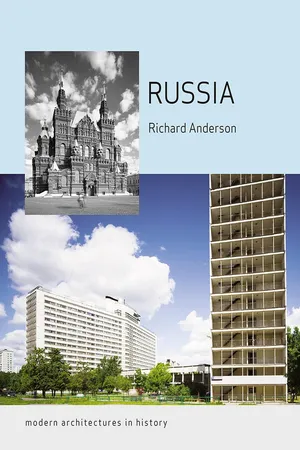
From one of the largest empires in world history to the dominant republic of the Soviet Union and ultimately to the Russian Federation as we know it today, this book offers a comprehensive account of Russia’s architectural production from the late nineteenth century to the present, explaining how architecture was both shaped by, and a material manifestation of, Russia’s rapid cultural, economic and social revolutions.
This book attends to the country’s complex relationship to global architectural culture, exploring Russia’s role as an epicentre of architectural creativity in the 1920s with the advent of Rationalism and Constructivism, and as a key protagonist in the Cold War. Challenging received interpretations of modern architecture in Russia, Richard Anderson shows how Russian architectural institutions departed from the course of modernism being developed in capitalist nations, and how it made a lasting yet little-known impact on territories extending from the Middle East to Central Asia and China.
Soviet Russia is at the core of this book. Anderson brings the relationship between architecture and socialism into focus through detailed case studies that situate buildings and concepts in the specific milieu of Soviet society, politics and ideology. Drawing on extensive research, Anderson provides a reappraisal of the architecture of the Stalin era and the final decades of the USSR. He accounts for the many ways in which Soviet conventions continue to shape Russian architecture today, but also acknowledges and explores the heterogeneous mix of attitudes and style among Russia’s architects. This book is essential reading for anyone who wants to understand the origins of the country’s contemporary architectural culture.
- English
- ePUB (mobile friendly)
- Available on iOS & Android
eBook - ePub
About this book
Information
Topic
ArquitecturaSubtopic
Arquitectura generalReferences
A note on transliteration and translation
In the references, a simplified version of the Library of Congress conventions for transliteration has been used. In the main text, diacritics for hard and soft signs have been omitted, and common Anglicized variants of names (Ulyanovsk, not Ul’ianovsk) have been adopted. Unless otherwise noted, all translations are my own.
Introduction
1 On Vertov’s film see Oksana Sarkisova, ‘Across One Sixth of the World: Dziga Vertov, Travel Cinema, and Soviet Patriotism’, October, CXXI (2007), pp. 19–40.
2 See William Craft Brumfield, ed., Reshaping Russian Architecture: Western Technology, Utopian Dreams (Cambridge, 1990); D. O. Shvidkovskii, Russian Architecture and the West (New Haven, 2007).
3 Recently, Russian authors have begun using the terms avangard (avant-garde) and konstruktivizm (Constructivism) as labels applicable to all the innovative work of the 1920s and early ’30s. In the interest of specificity, this usage is avoided here.
4 See, for example, A. V. Riabushin and A. Shukurova, ‘Tvorcheskie protivorechiia v noveishei arkhitekture Zapada’, Arkhitektura SSSR (October 1982), pp. 54–9.
5 Hergé, The Adventures of Tintin in the Land of the Soviets, trans. Leslie Lonsdale-Cooper and Michael Turner (New York, 2007), p. 78.
6 See in particular Jean-Louis Cohen’s The Future of Architecture Since 1889 (London, 2012), which incorporates Russian and Soviet contributions throughout the twentieth century.
7 See, for example, Alessandro De Magistris, URSS, anni ’30–’50: Paesaggi dell’utopia staliniana, exh. cat., Accademia Albertina delle Belle Arti, Turin (Milan, 1997); Danilo Udovički-Selb, ‘Between Modernism and Socialist Realism: Soviet Architectural Culture under Stalin’s Revolution from Above, 1928–1938’, Journal of the Society of Architectural Historians, LXVIII/4 (2009), pp. 466–95.
chapter one: National Forms, Rational Techniques
1 A.I.U. Polunov, Russia in the Nineteenth Century: Autocracy, Reform and Social Change, 1814–1914 (Armonk, NY, 2005).
2 F. M. Dostoevskii, ‘Dnevnik pisatelia’, in Polnoe sobranie sochinenii v tridtsati tomakh (Leningrad, 1980), vol. XXI, p. 107.
3 L. Dal’, ‘Istoricheskoe issledovanie russkogo zodchestva’, Zodchii, I/2 (1872), p. 3.
4 Apollinarii Krasovskii, Grazhdanskaia arkhitektura: Chasti zdaniia (St Petersburg, 1851), p. 29.
5 See V. V. Eval’d, Konstruktivnye osobennosti Amerikanskikh zdanii i estestvennye kamni, primeniaemye v sooruzheniiakh v soedinennykh shtatakh (St Petersburg, 1895).
6 Cited in Soiuz arkhitektorov SSSR, Sto let obshchestvennykh arkhitekturnykh organizatsii v SSSR, 1867–1967: Istoricheskaia spravka (Moscow, 1967), pp. 9–10.
7 R. A. Gedike, ‘Rech’ predsedatelia I-go otdela’, in Trudy I s’’ezda russkikh zodchikh v Sankt-Peterburge: 1892 god (St Petersburg, 1894), p. 2.
8 M. D. Bykovskii, O neosnovatel’nosti mneniia, chto arkhitektura grecheskaia, ili grekorimskaia, mozhet byt’ vseobshcheiu i chto krasota arkhitektury osnovyvaetsia na piati izvestnykh chinopolozheniiakh (Moscow, 1834), p. 4.
9 V. G. Lisovskii, Leontii Benua i peterburgskaia shkola khudozhnikov-arkhitektorov (St Petersburg, 2006), p. 37.
10 Cited in T. A. Slavina, Konstantin Ton (Leningrad, 1989), p. 91.
11 Cited in Lisovskii, Leontii Benua, p. 42.
12 Dostoevskii, ‘Dnevnik pisatelia’, p. 106.
13 See Ivan Zabelin, Opyty izucheniia russkikh drevnostei i istorii (Moscow, 1872). On Zabelin see Ivan Zabelin, V. B. Muraveva and Elena Tonchu, Cherty moskovskoi samobytnosti (Moscow, 2007).
14 Cited in T. A. Slavina, Issledovateli russkogo zodchestva: russkaia istoriko-arkhitekturnaia nauka XVIII–nachala XX veka (Leningrad, 1983), p. 83.
15 On these exhibitions see E. I. Kirichenko, ‘K voprosu o poreformennykh vystavkakh Rossii kak vyrazhenii istoricheskogo svoeobraziia arkhitektury vtoroi poloviny XIX v.’, in Khudozhestvennye protsessy v russkoi kul’ture vtoroi poloviny XIX veka, ed. G. Iu. Sternin (Moscow, 1984), pp. 83–136...
Table of contents
- Front Cover
- Half Title
- Russia: Modern architectures in history
- Title Page
- Copyright
- Contents
- Introduction
- one National Forms, Rational Techniques, 1861–95
- two Style, Innovation and Tradition, 1896–1916
- three Laboratories of Soviet Architecture, 1917–23
- four Socialist Construction, 1924–31
- five Architecture and Stalin’s Revolution, 1932–41
- six World War, Cold War, 1941–53
- seven Architecture without Excess, 1954–68
- eight Architecture in Developed Socialism, 1969–82
- nine From Perestroika to ‘Capitalist Realism’, 1983 to the Present
- References
- Select Bibliography
- Acknowledgements
- Photo Acknowledgements
- Index
Trusted by 375,005 students
Access to over 1.5 million titles for a fair monthly price.
Study more efficiently using our study tools.
Frequently asked questions
Yes, you can cancel anytime from the Subscription tab in your account settings on the Perlego website. Your subscription will stay active until the end of your current billing period. Learn how to cancel your subscription
No, books cannot be downloaded as external files, such as PDFs, for use outside of Perlego. However, you can download books within the Perlego app for offline reading on mobile or tablet. Learn how to download books offline
We are an online textbook subscription service, where you can get access to an entire online library for less than the price of a single book per month. With over 1.5 million books across 990+ topics, we’ve got you covered! Learn about our mission
Look out for the read-aloud symbol on your next book to see if you can listen to it. The read-aloud tool reads text aloud for you, highlighting the text as it is being read. You can pause it, speed it up and slow it down. Learn more about Read Aloud
Yes! You can use the Perlego app on both iOS and Android devices to read anytime, anywhere — even offline. Perfect for commutes or when you’re on the go.
Please note we cannot support devices running on iOS 13 and Android 7 or earlier. Learn more about using the app
Please note we cannot support devices running on iOS 13 and Android 7 or earlier. Learn more about using the app
Yes, you can access Russia by Richard Anderson in PDF and/or ePUB format, as well as other popular books in Arquitectura & Arquitectura general. We have over 1.5 million books available in our catalogue for you to explore.