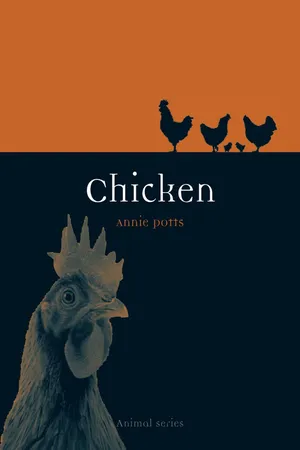
No creature has been subject to such extremes of reverence and exploitation as the chicken. Hens have been venerated as cosmic creators and roosters as solar divinities. Many cultures have found the mysteries of birth, healing, death and resurrection encapsulated in the hen’s egg. Yet today, most of us have nothing to do with chickens as living beings, although billions are consumed around the world every year.
In Chicken Annie Potts introduces us to the vivid and astonishing world of Gallus gallus. The book traces the evolution of jungle fowl and the domestication of chickens by humans. It describes the ways in which chickens experience the world, form families and friendships, communicate with each other, play, bond and grieve. Chicken explores cultural practices like egg-rolling, the cockfight, alectromancy, wishbone-pulling and the chicken-swinging ritual of Kapparot; discovers depictions of chickenhood in ancient and modern art, literature and film; and also showcases bizarre supernatural chickens from around the world including the Basilisk, Kikimora and Pollo Maligno. Chicken concludes with a detailed analysis of the place of chickens in the world today, and a tribute to those who educate and advocate on behalf of these birds.
Numerous beautiful illustrations show the many faces (and feathers and combs and tails) of Gallus, from wild roosters in the jungles of Southeast Asia to quirky Naked-Necks and majestic Malays. There are chickens painted by Chagall and Magritte, chickens made of hair-rollers, and chickens shaped like mountains. The reader of Chicken will encounter a multitude of intriguing facts and ideas, including why the largest predator ever to walk the earth is considered the ancestor of the modern chicken, how mother hens communicate with their chicks while they’re still in the egg, why Charlie Chaplin’s masterpiece required him to play a chicken, whether it’s safe to take eggs on a sea-voyage, and how ‘chicken therapy’ can rejuvenate us all.
This book will fascinate those already familiar with and devoted to the Gallus species, and it will open up a whole new gallinaceous world for admirers of the intelligent and passionate chicken.
eBook - ePub
Chicken
About this book
Information
Topic
Sciences biologiquesSubtopic
Biologie1 From T. rex to Transylvanian
Naked Necks
PREHISTORY
The discovery in 1861 of the fossilized remains of the archaeopteryx first led palaeontologists to speculate that birds evolved from dinosaurs. The archaeopteryx, thought to have lived in Jurassic Bavaria around 147 million years ago, possessed rudimentary feathers and wings. We now know that other dinosaurs also grew feathers; some, like modern-day birds, were warm-blooded and hollow-boned. Advances in genetic research suggest that the ancestry of birds is much more closely and complexly connected to the carnivorous theropods than any other dinosaurs.1 The humble chicken may in fact be the nearest living relative of the largest and most notorious predatory dinosaur, Tyrannosaurus rex: in 2007 protein traces recovered from the soft tissue of a 68-million-year-old T. rex femur bone were observed to match most closely those of the Gallus (chicken) species.2
The direct ancestor of the chicken (the ‘pre-chicken’) evolved somewhat later, probably around 50 million years ago. Fossils of Gallus are relatively scarce and have mainly been found in southern Europe. Fossil discoveries here imply that the ancestors of today’s jungle fowl dispersed into warmer territories during periods of glaciation; when temperatures increased and glaciers retreated these subpopulations spread north and eventually reunited – the length of time apart resulting in the evolution of different species or subspecies. Evidence of prehistoric Gallus species surviving into historic Europe has not been found, possibly because these birds died out during subsequent glaciation or were made extinct by predators (including humans). Those species of jungle fowl we know today are therefore probably descended from prehistoric populations that took refuge during glaciation in what is now the region of South-East Asia. They would have been prevented from travelling north by the Himalayas, therefore evolving in relative isolation. Other Gallus subpopulations may have evolved in the Far East: there are archaeological signs of domesticated chickens in China several thousand years before their domestication in India. Moreover, domestic chicken breeds in Asia are sufficiently different from others to indicate separate evolutionary backgrounds.3
JUNGLE FOWL
The wild jungle fowl, from which the domestic chicken descends, belongs to the order Galliformes, suborder Galli, family Phasianidae (which also includes pheasants, partridges, peafowl, quail, francolins and monals). Subfamilies of Phasianidae are distinguished according to the manner of tail moulting. Chickens belong to the second subfamily (Phasianinae), in which moulting is centripetal (the pattern of tail-feather loss occurs from the outside to the centre).
Phasianids are generally territorial ground-dwelling non-migratory birds. They tend to have shortish wings, solid legs and short, strong beaks. Males are larger than females, possess spurs, and have brightly coloured plumage and facial ornaments such as wattles and combs. Hens are often described as drab in comparison, but their less eye-catching plumage camouflages them when they are nesting on the ground to incubate eggs. These birds are reasonably powerful short-range flyers, which allows speedier escape from predators and safer roosting in trees at dusk.
The four recognized species of modern wild jungle fowl include the red (Gallus gallus), the Sri Lanka (Gallusg. lafayetii), the green (Gallusg. varius) and the grey (Gallusg. sonneratii). Red, grey and Sri Lanka jungle fowl prefer tropical or subtropical forest habitats, while the green tends to live near the seashore or by scrubland bordering cultivated land. The grey inhabits western and southern India, while the Sri Lanka lives naturally only where its name suggests. The unusual green jungle fowl, found in Java and islands eastward, where it occupies different habitats from the red, is thought to be the most primitive of the four, boasting sixteen tail feathers and short hackle feathers, whereas the other species possess fourteen tail feathers and long pointed hackle feathers.
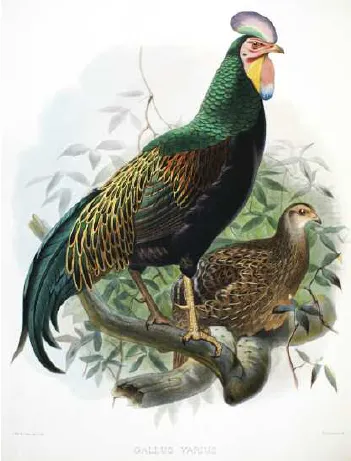 | Gallus gallus varius, the green jungle fowl; a hand-coloured lithograph from Daniel Giraud Elliot, A Monograph of the Phasianidae (Family of Pheasants) (1872). |
There are no subspecies of grey, green or Sri Lanka jungle fowl, but several subspecies of red jungle fowl exist: the Cochin-Chinese red (G. g. gallus), located in Thailand, Laos, Cambodia and south Vietnam; the Indian red (G. g. murghi) of north and north-east India, Nepal and Bangladesh; the Burmese (G. g. spadiceus), found in south-west China, Myanmar, Malaysia, north Sumatra and Thailand (except in the east); the Javan red (G. g. bankiva), located in south Sumatra, Bali and Java; and the Tonkinese red (G. g. jabouillei) of south-west China and north Vietnam.4 These five distinct subspecies of red jungle fowl are unable to interbreed with each other but they are capable of successfully mating with domestic chickens.
Wild and domesticated red jungle fowl were introduced to Kenya, the Philippines and other Pacific islands in Micronesia, Melanesia and Polynesia (forced introductions to Australia, New Zealand and North America were not successful). Red jungle fowl were also brought to Hawai’i around 700 years ago by colonizing Polynesians; today families of feral chickens can be seen roaming the streets, forests and even the beaches of Kauai.
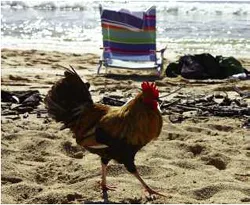 | A wild rooster wandering among tourists on Poipu Beach, Kauai, Hawai’i. |
DOMESTICATION
Domestication of the chicken is thought to have occurred around 8,000 to 10,000 years ago.5 Charles Darwin believed that the red jungle fowl of South-East Asia was the direct and single ancestor of the domestic chicken; but while modern genetic research verifies this species’ important role as a progenitor of domestic chickens (to the extent that G. g. domesticus is recognized as a subspecies of red jungle fowl, rather than a separate species),6 debate continues as to the involvement of multiple hereditary and geographical origins.7 Some scientists hypothesize several domestication events occurring independently across various regions in Southern Asia and involving inter-species hybridization within the genus Gallus. The theory of multiple progenitors is supported by the yellow leg and skin colour of many domestic chickens, which depends on a gene deriving not from the red jungle fowl but from the grey.8
The earliest remains of domestic chickens (distinguished from wild fowl remains by their larger skeletal size) are at least 7,500 years old and have been found in north-east China in sixteen Neolithic sites along Huang He (Yellow River), and in the Indus Valley in Pakistan. Chickens were most likely first taken north from their origins in South-East Asia to China, where they became established by 6000 BC. They were then transported eastwards, as shown by evidence of their presence in Russia, Turkey and eastern Europe around 3000 BC. The global transportation of chickens continued into Spain by 1200 BC and then to north-west Europe by 500 BC: the earliest records of domestic chickens in Britain can be dated to around 55 BC. It is presumed that chickens were introduced to North America around 1,600 years later.9
As early as 1500 BC depictions of chickens emerge in Egyptian hieroglyphic art. A rooster is visible in a scene in the tomb of Rekhmara (c. 1500 BC), and chicken symbolism has also been identified in Tutankhamen’s tomb (c. 1400 BC). Interestingly, chickens then disappear from North African graphic records until around 650 BC. Fourth-century Greek records state that Egyptians had mastered poultry husbandry and had been practising artificial incubation of chicks for many years. The giant incubators invented by the ancient Egyptians – possibly to sustain the masses of labourers involved in the construction of pyramids – were capable of hatching up to 15,000 eggs at one time. The eggs were warmed by fires and turned at regular intervals by attendants. The ancient Chinese also created incubators (using fires or rotting manure), perhaps to provide eggs for the builders of the Great Wall of China.10 Thus behind our most wondrous human monuments, it seems, there roosts the chicken.
In sub-Saharan Africa the earliest chicken remains – found in Mali, Nubia, the East African Coast and South Africa – have been dated to around AD 500, leading archaeologists to speculate that chickens came to Africa via the Nile Valley, or through early Graeco-Roman east coast trade.11
Similarly, the spread of jungle fowl from South-East Asia to the Mediterranean may have occurred via commercial (or military) contacts. The Indian practices of cockfighting and chicken husbandry (for meat and eggs) were probably passed on to the Persian invaders in 400 BC, who in turn transferred them to the Romans and Greeks. The Romans practised caponizing and force-feeding of chickens, and also knew about animal husbandry principles of ‘hybrid vigor [and] sperm competition’.12 They produced two dual-purpose breeds for entertainment (cockfighting) and food, and two other breeds used solely for competitive fighting.
| Terracotta bust of an ancient Greek deity holding a rooster and an egg, c. 370–350 BC. | 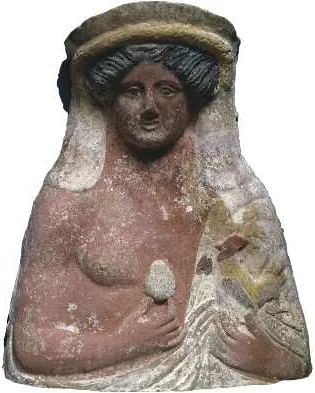 |
The islands of the Pacific also have an ancient history involving chickens. In the eighteenth century James Cook noticed chickens on the Easter Islands, New Caledonia and elsewhere in the Pacific. The Tahitians claimed chickens were made at the same time as humans by the god Taarva and had always lived amongst them. Hawai’ians told Cook the legend of a gigantic bird who, upon settling on the water, laid an egg that opened to produce the island of Hawai’i.
Debate continues over ...
Table of contents
- Front Cover
- Half Title
- Title Page
- Copyright
- Contents
- 1 From T. rex to Transylvanian Naked Necks
- 2 Chicken Wisdom
- 3 Chickenlore
- 4 Popular Chickens
- 5 Gallus graphicus
- 6 Meat Chicks and Egg Machines
- Epilogue: Appreciating Chickens
- Timeline of the Chicken
- References
- Select Bibliography
- Associations and Websites
- Acknowledgements
- Photo Acknowledgements
- Index
Trusted by 375,005 students
Access to over 1.5 million titles for a fair monthly price.
Study more efficiently using our study tools.
Frequently asked questions
Yes, you can cancel anytime from the Subscription tab in your account settings on the Perlego website. Your subscription will stay active until the end of your current billing period. Learn how to cancel your subscription
No, books cannot be downloaded as external files, such as PDFs, for use outside of Perlego. However, you can download books within the Perlego app for offline reading on mobile or tablet. Learn how to download books offline
Perlego offers two plans: Essential and Complete
- Essential is ideal for learners and professionals who enjoy exploring a wide range of subjects. Access the Essential Library with 800,000+ trusted titles and best-sellers across business, personal growth, and the humanities. Includes unlimited reading time and Standard Read Aloud voice.
- Complete: Perfect for advanced learners and researchers needing full, unrestricted access. Unlock 1.5M+ books across hundreds of subjects, including academic and specialized titles. The Complete Plan also includes advanced features like Premium Read Aloud and Research Assistant.
We are an online textbook subscription service, where you can get access to an entire online library for less than the price of a single book per month. With over 1.5 million books across 990+ topics, we’ve got you covered! Learn about our mission
Look out for the read-aloud symbol on your next book to see if you can listen to it. The read-aloud tool reads text aloud for you, highlighting the text as it is being read. You can pause it, speed it up and slow it down. Learn more about Read Aloud
Yes! You can use the Perlego app on both iOS and Android devices to read anytime, anywhere — even offline. Perfect for commutes or when you’re on the go.
Please note we cannot support devices running on iOS 13 and Android 7 or earlier. Learn more about using the app
Please note we cannot support devices running on iOS 13 and Android 7 or earlier. Learn more about using the app
Yes, you can access Chicken by Annie Potts in PDF and/or ePUB format, as well as other popular books in Sciences biologiques & Biologie. We have over 1.5 million books available in our catalogue for you to explore.