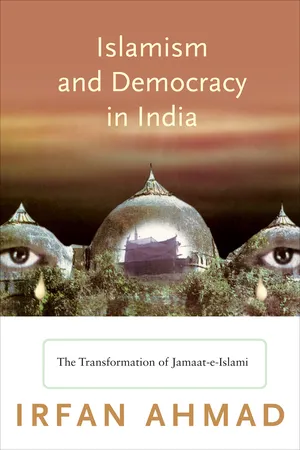
Jamaat-e-Islami Hind is the most influential Islamist organization in India today. Founded in 1941 by Syed Abul Ala Maududi with the aim of spreading Islamic values in the subcontinent, Jamaat and its young offshoot, the Student Islamic Movement of India or SIMI, have been watched closely by Indian security services since September 11. In particular, SIMI has been accused of being behind terrorist bombings. This book is the first in-depth examination of India's Jamaat-e-Islami and SIMI, exploring political Islam's complex relationship with democracy and providing a rare window into the Islamist trajectory in a Muslim-minority context.
Irfan Ahmad conducted extensive ethnographic fieldwork at a school in the town of Aligarh, among student activists at Aligarh Muslim University, at a madrasa in Azamgarh, and during Jamaat's participation in elections in 2002. He deftly traces Jamaat's changing position in relation to India's secular democracy and the group's gradual ideological shift toward religious pluralism and tolerance. Ahmad demonstrates how the rise of militant Hindu nationalism since the 1980s--evident in the destruction of the Babri mosque and widespread violence against Muslims--led to SIMI's radicalization, its rejection of pluralism, and its call for jihad.
Islamism and Democracy in India argues that when secular democracy is responsive to the traditions and aspirations of its Muslim citizens, Muslims in turn embrace pluralism and democracy. But when democracy becomes majoritarian and exclusionary, Muslims turn radical.
- 329 pages
- English
- PDF
- Available on iOS & Android
eBook - PDF
About this book
Information
Publisher
Princeton University PressYear
2009Print ISBN
9780691139203
9780691139197
eBook ISBN
9781400833795
Table of contents
- Cover
- Title
- Copyright
- Dedication
- Contents
- List of Illustrations and Tables
- Preface and Acknowledgments
- Notes to the Reader
- Abbreviations
- Introduction
- PART I. Fieldwork and Historical Context
- PART II. Zigzags to Allah’s Kingdom
- PART III. Opposition and Negotiation
- Conclusion
- Appendixes
- Notes
- Glossary of Urdu-Hindi Terms
- Bibliography
- Index
Trusted by 375,005 students
Access to over 1.5 million titles for a fair monthly price.
Study more efficiently using our study tools.
Frequently asked questions
Yes, you can cancel anytime from the Subscription tab in your account settings on the Perlego website. Your subscription will stay active until the end of your current billing period. Learn how to cancel your subscription
No, books cannot be downloaded as external files, such as PDFs, for use outside of Perlego. However, you can download books within the Perlego app for offline reading on mobile or tablet. Learn how to download books offline
Perlego offers two plans: Essential and Complete
- Essential is ideal for learners and professionals who enjoy exploring a wide range of subjects. Access the Essential Library with 800,000+ trusted titles and best-sellers across business, personal growth, and the humanities. Includes unlimited reading time and Standard Read Aloud voice.
- Complete: Perfect for advanced learners and researchers needing full, unrestricted access. Unlock 1.5M+ books across hundreds of subjects, including academic and specialized titles. The Complete Plan also includes advanced features like Premium Read Aloud and Research Assistant.
We are an online textbook subscription service, where you can get access to an entire online library for less than the price of a single book per month. With over 1.5 million books across 990+ topics, we’ve got you covered! Learn about our mission
Look out for the read-aloud symbol on your next book to see if you can listen to it. The read-aloud tool reads text aloud for you, highlighting the text as it is being read. You can pause it, speed it up and slow it down. Learn more about Read Aloud
Yes! You can use the Perlego app on both iOS and Android devices to read anytime, anywhere — even offline. Perfect for commutes or when you’re on the go.
Please note we cannot support devices running on iOS 13 and Android 7 or earlier. Learn more about using the app
Please note we cannot support devices running on iOS 13 and Android 7 or earlier. Learn more about using the app
Yes, you can access Islamism and Democracy in India by Irfan Ahmad in PDF and/or ePUB format, as well as other popular books in Social Sciences & Religion, Politics & State. We have over 1.5 million books available in our catalogue for you to explore.