A robust defense of a poetic genius
Ab? Tamm?m (d. 231 or 232/845 or 846) is one of the most celebrated poets in the Arabic language. Born in Syria to Greek Christian parents, he converted to Islam and quickly made his name as one of the premier Arabic poets in the caliphal court of Baghdad, promoting a new style of poetry that merged abstract and complex imagery with archaic Bedouin language. Both highly controversial and extremely popular, this sophisticated verse influenced all subsequent poetry in Arabic and epitomized the "modern style" (bad??), an avant-garde aesthetic that was very much in step with the intellectual, artistic, and cultural vibrancy of the Abbasid dynasty.
In The Life and Times of Ab? Tamm?m, translated into English for the first time, the courtier and scholar Ab? Bakr Mu?ammad ibn Ya?y?al-??l? (d. 335 or 336/946 or 947) mounts a robust defense of "modern" poetry and of Ab? Tamm?m's significance as a poet against his detractors, while painting a lively picture of literary life in Baghdad and Samarra. Born into an illustrious family of Turkish origin, al-??l? was a courtier, companion, and tutor to the Abbasid caliphs. He wrote extensively on caliphal history and poetry and, as a scholar of "modern" poets, made a lasting contribution to the field of Arabic literary history. Like the poet it promotes, al-??l?'s text is groundbreaking: it represents a major step in the development of Arabic poetics, and inaugurates a long line of treatises on innovation in poetry.
An English-only edition.
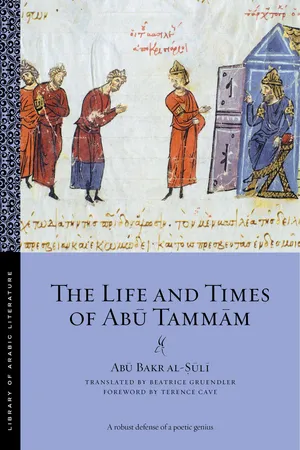
- 296 pages
- English
- ePUB (mobile friendly)
- Available on iOS & Android
eBook - ePub
The Life and Times of Abū Tammām
About this book
Information
Topic
HistoriaSubtopic
Historia de Oriente MedioIn the name of God, full of compassion, ever compassionate

THE SUPERIORITY OF ABŪ TAMMĀM
29
His name was Ḥabīb ibn Aws of Ṭayy and he was of pure Arabian descent. He was born in a village called Jāsim, which will be mentioned in the accounts below,58 God willing.
30
I cite Muḥammad ibn Yazīd ibn ʿAbd al-Akbar al-Mubarrad the Grammarian as follows:
The poet ʿUmārah ibn ʿAqīl came to Baghdad, and people flocked to him. They recorded his poetry, studied it with him, and showed him their own poetry for comment. One day, someone said, “There is a poet who some claim is the very best, while others claim the opposite.” ʿUmārah said, “Recite some of his verse to me.” So they recited the following:
She took protection in tears from her anguish at tomorrow’s separation.
Every bed turned into thorns for her.
What saved her from the throes of death
was that my turning away was reluctant, and not by choice.
Compassion made tears of blood
run down rosy cheeks.
She is a full moon, her dear face is enough for everyone she meets,
so she need not endear herself …
Then the reciter stopped, and ʿUmārah said, “Let’s have more!” So he continued:
But I possess no amassed wealth
to call my own, just a few scattered things
Nor did the days grant me restful slumber
to enjoy, only slumber chased …
“Excellent!” said ʿUmārah, “Your poet has outdone all previous poets who used this motif, though much has been composed with it, to the point of making exile appealing. Go on!” The reciter continued:
If a man lingers too long at home, it shows
on his face—so travel and refresh it!
People like the sun more, I know,
for not shining upon them perpetually.59
ʿUmārah said, “By God, he’s perfect! If good wording, beautiful motifs, sustained intent, and balanced speech constitute true poetry, then this poet of yours is the very best. And if poetry is something else, well then I just don’t know!”
31
I cite Muḥammad ibn Mūsā l-Barbarī, who said:
I heard ʿAlī ibn al-Jahm talk about Diʿbil and call him ungrateful, curse him, and malign features of his poetry. Muḥammad added: ʿAlī used to lie about Abū Tammām and invent stories about him, even though, by God, he meant nothing to Abū Tammām and did not have any ties to him. ʿAlī began to describe Abū Tammām, and someone said, “By God, if Abū Tammām were your brother you could not praise him better.” “Even though he is not my real brother,” ʿAlī said, “he is my brother in refinement, faith, and affection. Didn’t you hear him address me as follows:
If a brother, recently met, skimps on affection,
ours is an ancient brotherhood we share, night and day
Or if the water of companionship alters,
ours, sweet, drips from a single cloud60
Or if a family bond is broken,
refinement is like a father to us.”61
32
I once heard Abū Isḥāq al-Ḥarrī (God show him mercy) talk about ʿAlī and relate an account about him and Abū Tammām—which I believe to be this one, or another along the same lines, though I do not remember it very well, nor can I find it; I think I wrote it down in one of my hadith books. I heard Abū Isḥāq say, “ʿAlī ibn al-Jahm is one of the most accomplished men. It is said, ‘His knowledge of poetry is even superior to his poetry.’”
Consider then his high regard for Abū Tammām, given ʿAlī’s preeminence in poetry and knowledge of it; and consider ʿUmārah ibn ʿAqīl’s high regard for Abū Tammām, when scholars say, “ʿUmārah formed the last of the rearguard of poets.”
33
ʿAlī’s knowledge of poetry is further confirmed by what ʿAbd Allāh ibn al-Ḥusayn ibn Saʿd said. ʿAbd Allāh said that al-Buḥturī told him:
ʿAlī ibn al-Jahm sent me an invitation to his home, which I accepted. We talked at length about the poetry of the Moderns. When Ashjaʿ al-Sulamī came up, ʿAlī said, “He misses.” He repeated this several times. I didn’t understand the phrase, but I shied from asking what he meant. When I left, I thought about the phrase. I looked into the poetry of Ashjaʿ al-Sulamī, and saw that his verse was largely bland and devoid of even one outstanding verse. This is exactly what ʿAlī meant, that Ashjaʿ came up with verses without hitting a superb one, the same way one says “He misses” about an archer who shoots without hitting anything. Al-Buhturī added: ʿAlī ibn al-Jahm was a connoisseur of poetry.
34.1
I cite Abū Bakr Hārūn ibn ʿAbd Allāh al-Muhallabī, who said:
We were at one of Diʿbil...
Table of contents
- Cover
- Title Page
- Copyright
- Dedication
- Contents
- Letter from the General Editor
- About this Paperback
- Abbreviations
- Foreword
- Acknowledgments
- Introduction
- Note on the Text
- Notes to the Introduction
- Al-Ṣūlī’s Epistle to Abū l-Layth Muzāḥim ibn Fātik
- The Life and Times of Abū Tammām
- Notes
- Glossary of Names and Terms
- Bibliography
- Further Reading
- Index
- About the NYU Abu Dhabi Institute
- About the Translator
- The Library of Arabic Literature
Trusted by 375,005 students
Access to over 1.5 million titles for a fair monthly price.
Study more efficiently using our study tools.
Frequently asked questions
Yes, you can cancel anytime from the Subscription tab in your account settings on the Perlego website. Your subscription will stay active until the end of your current billing period. Learn how to cancel your subscription
No, books cannot be downloaded as external files, such as PDFs, for use outside of Perlego. However, you can download books within the Perlego app for offline reading on mobile or tablet. Learn how to download books offline
Perlego offers two plans: Essential and Complete
- Essential is ideal for learners and professionals who enjoy exploring a wide range of subjects. Access the Essential Library with 800,000+ trusted titles and best-sellers across business, personal growth, and the humanities. Includes unlimited reading time and Standard Read Aloud voice.
- Complete: Perfect for advanced learners and researchers needing full, unrestricted access. Unlock 1.5M+ books across hundreds of subjects, including academic and specialized titles. The Complete Plan also includes advanced features like Premium Read Aloud and Research Assistant.
We are an online textbook subscription service, where you can get access to an entire online library for less than the price of a single book per month. With over 1.5 million books across 990+ topics, we’ve got you covered! Learn about our mission
Look out for the read-aloud symbol on your next book to see if you can listen to it. The read-aloud tool reads text aloud for you, highlighting the text as it is being read. You can pause it, speed it up and slow it down. Learn more about Read Aloud
Yes! You can use the Perlego app on both iOS and Android devices to read anytime, anywhere — even offline. Perfect for commutes or when you’re on the go.
Please note we cannot support devices running on iOS 13 and Android 7 or earlier. Learn more about using the app
Please note we cannot support devices running on iOS 13 and Android 7 or earlier. Learn more about using the app
Yes, you can access The Life and Times of Abū Tammām by Abū Bakr al-Ṣūlī, Beatrice Gruendler in PDF and/or ePUB format, as well as other popular books in Historia & Historia de Oriente Medio. We have over 1.5 million books available in our catalogue for you to explore.