This is the first field guide to the birds of this fascinating region, and a companion to Birds of East Africa by two of the same authors.
The Horn of Africa has the highest endemism of any region in Africa, and around 70 species are found nowhere else in the world. Many of these are confined to the isolated highlands of Ethiopia and Eritrea, but a large number of larks specialise in the arid parts of Somalia and adjoining eastern Ethiopia, whilst the island of Socotra has its own suite of endemic species. The region is also an important migration route and wintering site for many Palearctic birds.
Over 200 magnificent plates by John Gale and Brian Small illustrate every species that has ever occurred in the five countries covered by the guide, and the succinct text covers the key identification criteria. Special attention is paid to the voices of the species, and over 1000 up-to-date colour distribution maps are included.
This long-awaited guide is a much-needed addition to the literature on African birds and an essential companion for birders visiting the region.
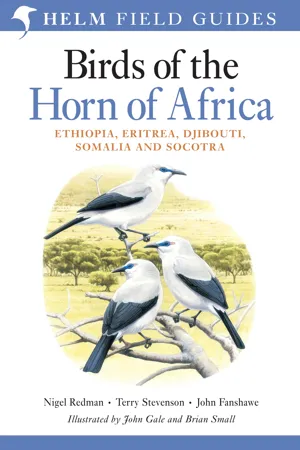
eBook - PDF
Field Guide to Birds of the Horn of Africa
Ethiopia, Eritrea, Djibouti, Somalia and Socotra
- 530 pages
- English
- PDF
- Available on iOS & Android
eBook - PDF
Field Guide to Birds of the Horn of Africa
Ethiopia, Eritrea, Djibouti, Somalia and Socotra
About this book
Information
Table of contents
- Cover
- Half-title
- Title
- Copyright
- Contents
- INTRODUCTION
- ACKNOWLEDGEMENTS
- HOW TO USE THIS BOOK
- BIRD IDENTIFICATION
- BIRD TOPOGRAPHY
- GLOSSARY
- GEOGRAPHY, CLIMATE AND HABITATS
- IMPORTANT BIRD AREAS
- ORGANISATIONS AND WEBSITES
- SPECIES ACCOUNTS
- PLATE 1: OSTRICHES
- PLATE 2: ALBATROSSES AND PETRELS
- PLATE 3: SHEARWATERS AND PETRELS
- PLATE 4: STORM-PETRELS
- PLATE 5: TROPICBIRDS AND FRIGATEBIRDS
- PLATE 6: BOOBIES
- PLATE 7: PELICANS AND GREBES
- PLATE 8: CORMORANTS, DARTER AND FINFOOT
- PLATE 9: BITTERNS AND NIGHT HERONS
- PLATE 10: SMALLER HERONS
- PLATE 11: EGRETS
- PLATE 12: LARGE HERONS
- PLATE 13: HAMERKOP AND MAINLY WHITE STORKS
- PLATE 14: MAINLY BLACK STORKS
- PLATE 15: GIANT STORKS AND SHOEBILL
- PLATE 16: IBISES
- PLATE 17: SPOONBILLS AND FLAMINGOS
- PLATE 18: LARGE RESIDENT WATERFOWL
- PLATE 19: WHISTLING DUCKS, PYGMY-GEESE AND SHELDUCKS
- PLATE 20: OTHER RESIDENT WATERFOWL
- PLATE 21: RESIDENT AND MIGRANT DABBLING DUCKS
- PLATE 22: MIGRANT DABBLING DUCKS
- PLATE 23: DIVING DUCKS
- PLATE 24: KITES AND SECRETARYBIRD
- PLATE 25: FISH-EATING RAPTORS AND LAMMERGEIER
- PLATE 26: SOLITARY VULTURES
- PLATE 27: LARGE PLAINS VULTURES
- PLATE 28: SNAKE EAGLES
- PLATE 29: HARRIERS
- PLATE 30: CHANTING GOSHAWKS AND LIZARD BUZZARD
- PLATE 31: OPEN COUNTRY SPARROWHAWKS
- PLATE 32: WOODLAND AND FOREST SPARROWHAWKS
- PLATE 33: WOODLAND AND FOREST HAWKS
- PLATE 34: HONEY-BUZZARDS AND BUZZARDS
- PLATE 35: BUZZARDS
- PLATE 36: LARGE BROWN EAGLES I
- PLATE 37: LARGE BROWN EAGLES II
- PLATE 38: HAWK-EAGLES
- PLATE 39: ATYPICAL EAGLES AND HARRIER-HAWK
- PLATE 40: LARGE EAGLES
- PLATE 41: BROWN KESTRELS
- PLATE 42: GREY FALCONS AND PYGMY FALCON
- PLATE 43: MEDIUM-SIZED DARK FALCONS
- PLATE 44: MEDIUM AND LARGE DARK FALCONS
- PLATE 45: LARGE FALCONS
- PLATE 46: GUINEAFOWL AND SMALLER GAMBIRDS
- PLATE 47: MONTANE FRANCOLINS
- PLATE 48: RED-WINGED AND SAVANNA FRANCOLINS
- PLATE 49: QUAILS AND BUTTONQUAIL
- PLATE 50: FLUFFTAILS AND BLACK CRAKE
- PLATE 51: CRAKES
- PLATE 52: RAILS AND GALLINULES
- PLATE 53: COOTS AND MOORHENS
- PLATE 54: CRANES
- PLATE 55: BUSTARDS I
- PLATE 56: BUSTARDS II
- PLATE 57: JACANAS, PAINTED-SNIPE AND PHALAROPES
- PLATE 58: LARGE BLACK AND WHITE SHOREBIRDS
- PLATE 59: THICK-KNEES
- PLATE 60: COURSERS
- PLATE 61: PRATINCOLES AND EGYPTIAN PLOVER
- PLATE 62: SMALLER RESIDENT AND MIGRANT PLOVERS
- PLATE 63: SMALLER MIGRANT PLOVERS
- PLATE 64: LARGE WETLAND LAPWINGS
- PLATE 65: LARGE DRY COUNTRY LAPWINGS
- PLATE 66: MIGRANT PLOVERS, RUFF AND TURNSTONE
- PLATE 67: SANDPIPERS I
- PLATE 68: SANDPIPERS II
- PLATE 69: SANDPIPERS III
- PLATE 70: SANDPIPERS IV
- PLATE 71: GODWITS AND CURLEWS
- PLATE 72: SNIPES
- PLATE 73: SKUAS
- PLATE 74: SMALLER GULLS
- PLATE 75: LARGE WHITE-HEADED GULLS
- PLATE 76: DARK-HOODED GULLS
- PLATE 77: LARGER TERNS
- PLATE 78: SMALLER TERNS
- PLATE 79: PELAGIC TERNS AND SKIMMER
- PLATE 80: MARSH TERNS AND BLACK-NAPED TERN
- PLATE 81: SANDGROUSE
- PLATE 82: GREEN AND BRONZE-NAPED PIGEONS
- PLATE 83: LARGE PIGEONS
- PLATE 84: WOOD DOVES AND NAMAQUA DOVE
- PLATE 85: RING-NECKED DOVES
- PLATE 86: LAUGHING AND TURTLE DOVES, AND LEMON DOVE
- PLATE 87: PARROTS AND LOVEBIRDS
- PLATE 88: TURACOS AND ALLIES
- PLATE 89: CRESTED CUCKOOS AND KOEL
- PLATE 90: GREY CUCKOOS
- PLATE 91: BLACK AND SHINING CUCKOOS
- PLATE 92: COUCALS AND YELLOWBILL
- PLATE 93: BARN OWLS AND MEDIUM-SIZED OWLS
- PLATE 94: SCOPS OWLS AND OWLETS
- PLATE 95: EAGLE-OWLS, FISHING OWL AND LITTLE OWL
- PLATE 96: NIGHTJARS I
- PLATE 97: NIGHTJARS II
- PLATE 98: NIGHTJARS III
- PLATE 99: WHITE-RUMPED AND LARGE SWIFTS
- PLATE 100: PLAIN SWIFTS
- PLATE 101: SLIM SWIFTS AND SPINETAILS
- PLATE 102: MOUSEBIRDS AND TROGONS
- PLATE 103: WATERSIDE AND WETLAND KINGFISHERS
- PLATE 104: WOODLAND KINGFISHERS
- PLATE 105: SMALLER KINGFISHERS
- PLATE 106: RESIDENT BEE-EATERS
- PLATE 107: MAINLY MIGRANT BEE-EATERS
- PLATE 108: BEE-EATERS AND ROLLERS
- PLATE 109: BLUE AND CHESTNUT ROLLERS
- PLATE 110: WOOD-HOOPOES
- PLATE 111: HOOPOES AND SCIMITARBILLS
- PLATE 112: DRY BUSH HORNBILLS
- PLATE 113: WOODLAND HORNBILLS AND GROUND-HORNBILLS
- PLATE 114: TINKERBIRDS AND BUSH BARBETS
- PLATE 115: WOODLAND BARBETS
- PLATE 116: GROUND BARBETS
- PLATE 117: HONEYGUIDES
- PLATE 118: WRYNECKS AND LARGER WOODPECKERS
- PLATE 119: SMALLER WOODPECKERS
- PLATE 120: BUSH LARKS I
- PLATE 121: BUSH LARKS II
- PLATE 122: BUSH LARKS III AND LONG-CLAWED LARKS
- PLATE 123: SHORT-TOED AND HOOPOE LARKS
- PLATE 124: OTHER LARKS
- PLATE 125: MASKED LARKS AND SPARROW-LARKS
- PLATE 126: MARTINS
- PLATE 127: SWALLOWS WITH RUFOUS OR GREY RUMPS
- PLATE 128: BLUE-AND-WHITE SWALLOWS AND SAW-WINGS
- PLATE 129: WAGTAILS I
- PLATE 130: WAGTAILS II
- PLATE 131: LONGCLAWS AND PIPITS I
- PLATE 132: PIPITS II
- PLATE 133: CUCKOOSHRIKES AND HYPOCOLIUS
- PLATE 134: PITTAS AND BULBULS
- PLATE 135: GREENBULS AND BROWNBULS
- PLATE 136: ROBIN-CHATS
- PLATE 137: MIGRANT NIGHTINGALES AND REDSTARTS
- PLATE 138: SCRUB ROBINS AND PALM-THRUSH
- PLATE 139: STONECHATS AND AFRICAN WHEATEARS
- PLATE 140: PALEARCTIC WHEATEARS
- PLATE 141: ENDEMIC AND MIDDLE EASTERN WHEATEARS
- PLATE 142: DULL RESIDENT CHATS
- PLATE 143: WHITE-WINGED CHATS AND BLUETHROAT
- PLATE 144: THRUSHES AND ROCK THRUSHES
- PLATE 145: THRUSHES
- PLATE 146: BRADYPTERUS AND GRASS WARBLERS
- PLATE 147: LOCUSTELLA AND LARGE ACROCEPHALUS WARBLERS
- PLATE 148: ACROCEPHALUS WARBLERS
- PLATE 149: CHLOROPETA AND HIPPOLAIS WARBLERS
- PLATE 150: CAMAROPTERA, WREN-WARBLER AND EREMOMELAS
- PLATE 151: CROMBECS AND BUFF-BELLIED WARBLER
- PLATE 152: PHYLLOSCOPUS WARBLERS
- PLATE 153: SYLVIA WARBLERS I
- PLATE 154: SYLVIA WARBLERS II
- PLATE 155: SYLVIA WARBLERS, PARISOMAS AND HYLIOTAS
- PLATE 156: SMALL STREAKED CISTICOLAS
- PLATE 157: SMALL RUFOUS-CROWNED AND STOUT CISTICOLAS
- PLATE 158: STREAK-BACKED AND PLAIN-BACKED CISTICOLAS
- PLATE 159: CISTICOLAS, PRINIAS AND ALLIES
- PLATE 160: APALISES AND ALLIES
- PLATE 161: MELAENORNIS AND BRADORNIS FLYCATCHERS
- PLATE 162: SMALL BROWN AND GREY FLYCATCHERS
- PLATE 163: MISCELLANEOUS MONARCHS AND FLYCATCHERS
- PLATE 164: BATISES AND WATTLE-EYES
- PLATE 165: BABBLERS
- PLATE 166: CHATTERERS, BABBLERS AND CATBIRD
- PLATE 167: TITS AND CREEPER
- PLATE 168: PENDULINE-TITS AND WHITE-EYES
- PLATE 169: SUNBIRDS I
- PLATE 170: SUNBIRDS II
- PLATE 171: SUNBIRDS III
- PLATE 172: SUNBIRDS IV
- PLATE 173: SUNBIRDS V
- PLATE 174: RESIDENT SHRIKES
- PLATE 175: MIGRANT SHRIKES
- PLATE 176: MIGRANT SHRIKES AND PUFFBACKS
- PLATE 177: BOUBOUS AND BUSH-SHRIKES
- PLATE 178: TCHAGRAS AND ROSY-PATCHED BUSH-SHRIKE
- PLATE 179: COLOURFUL BUSH-SHRIKES, BRUBRU AND NICATOR
- PLATE 180: WHITE-CROWNED SHRIKE AND HELMETSHRIKES
- PLATE 181: ORIOLES
- PLATE 182: DRONGOS AND DISTINCTIVE CROWS
- PLATE 183: CROWS AND RAVENS I
- PLATE 184: CROWS AND RAVENS II, AND PIAPIAC
- PLATE 185: OXPECKERS AND STARLINGS
- PLATE 186: LARGE RED-WINGED STARLINGS
- PLATE 187: GLOSSY BLUE STARLINGS
- PLATE 188: RUFOUS-BELLIED AND PALE STARLINGS
- PLATE 189: BICOLOURED STARLINGS
- PLATE 190: SPARROWS I
- PLATE 191: SPARROWS II
- PLATE 192: PETRONIAS AND SPARROW-WEAVERS
- PLATE 193: SOCIAL WEAVERS AND BUFFALO WEAVERS
- PLATE 194: PLOCEUS WEAVERS I
- PLATE 195: PLOCEUS WEAVERS II
- PLATE 196: PLOCEUS WEAVERS III
- PLATE 197: PLOCEUS WEAVERS, GROSBEAK WEAVER AND CUCKOO FINCH
- PLATE 198: QUELEAS AND RED-HEADED WEAVER
- PLATE 199: BISHOPS
- PLATE 200: WIDOWBIRDS
- PLATE 201: PYTILIAS AND TWINSPOTS
- PLATE 202: CORDON-BLEUS, GRENADIER AND CRIMSONWINGS
- PLATE 203: FIREFINCHES
- PLATE 204: WAXBILLS
- PLATE 205: WAXBILLS, SILVERBILLS AND QUAILFINCHES
- PLATE 206: MANNIKINS AND CUT-THROAT FINCH
- PLATE 207: WHYDAHS
- PLATE 208: WHYDAHS AND INDIGOBIRDS
- PLATE 209: CANARIES
- PLATE 210: SEEDEATERS I
- PLATE 211: SEEDEATERS II AND FINCHES
- PLATE 212: TRUMPETER FINCH AND BUNTINGS I
- PLATE 213: BUNTINGS II
- CHECKLIST OF THE BIRDS OF THE HORN OF AFRICA
- APPENDIX 1: SPECIES ENDEMIC TO THE HORN OF AFRICA
- APPENDIX 2: HYPOTHETICAL SPECIES
- APPENDIX 3: LARGE WHITE-HEADED GULLS
- REFERENCES AND FURTHER READING
- INDEX
- SOUNDS, SOUND RECORDISTS AND LOCALITIES
Trusted by 375,005 students
Access to over 1.5 million titles for a fair monthly price.
Study more efficiently using our study tools.
Frequently asked questions
Yes, you can cancel anytime from the Subscription tab in your account settings on the Perlego website. Your subscription will stay active until the end of your current billing period. Learn how to cancel your subscription
No, books cannot be downloaded as external files, such as PDFs, for use outside of Perlego. However, you can download books within the Perlego app for offline reading on mobile or tablet. Learn how to download books offline
Perlego offers two plans: Essential and Complete
- Essential is ideal for learners and professionals who enjoy exploring a wide range of subjects. Access the Essential Library with 800,000+ trusted titles and best-sellers across business, personal growth, and the humanities. Includes unlimited reading time and Standard Read Aloud voice.
- Complete: Perfect for advanced learners and researchers needing full, unrestricted access. Unlock 1.5M+ books across hundreds of subjects, including academic and specialized titles. The Complete Plan also includes advanced features like Premium Read Aloud and Research Assistant.
We are an online textbook subscription service, where you can get access to an entire online library for less than the price of a single book per month. With over 1.5 million books across 990+ topics, we’ve got you covered! Learn about our mission
Look out for the read-aloud symbol on your next book to see if you can listen to it. The read-aloud tool reads text aloud for you, highlighting the text as it is being read. You can pause it, speed it up and slow it down. Learn more about Read Aloud
Yes! You can use the Perlego app on both iOS and Android devices to read anytime, anywhere — even offline. Perfect for commutes or when you’re on the go.
Please note we cannot support devices running on iOS 13 and Android 7 or earlier. Learn more about using the app
Please note we cannot support devices running on iOS 13 and Android 7 or earlier. Learn more about using the app
Yes, you can access Field Guide to Birds of the Horn of Africa by Nigel Redman,Terry Stevenson,John Fanshawe,Brian Small,John Gale in PDF and/or ePUB format, as well as other popular books in Biological Sciences & Zoology. We have over 1.5 million books available in our catalogue for you to explore.