This book proposes a principled approach to the regulation of dispute resolution. It covers dispute resolution mechanisms in all their varieties, including negotiation, mediation, conciliation, expert opinion, mini-trial, ombud procedures, arbitration and court adjudication. The authors present a transnational Guide for Regulating Dispute Resolution (GRDR). The regulatory principles contained in this Guide are based on a functional taxonomy of dispute resolution mechanisms, an open normative framework and a modular structure of regulatory topics. The Guide for Regulating Dispute Resolution is formulated and commented upon in a concise manner to assist legislators, policy-makers, professional associations, practitioners and academics in thinking about which solutions best suit local and regional circumstances.
The aim of this book is to contribute to the understanding and development of the legal framework governing national and international dispute resolution. Theory, empirical research and regulatory models have been taken from the wealth of experience in 12 jurisdictions: Austria, Belgium, Denmark, England and Wales, France, Germany, Italy, Japan, the Netherlands, Norway, Switzerland and the United States of America. Experts with a background in academia, practice and law-making describe and analyse the regulatory framework and social reality of dispute resolution in these countries. On this basis the authors draw conclusions about policy choices, regulatory strategies and the practice of conflict resolution.
This title is included in Bloomsbury Professional's International Arbitration online service.
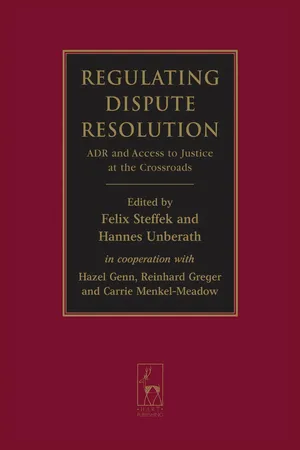
eBook - PDF
Regulating Dispute Resolution
ADR and Access to Justice at the Crossroads
- 490 pages
- English
- PDF
- Available on iOS & Android
eBook - PDF
Regulating Dispute Resolution
ADR and Access to Justice at the Crossroads
About this book
Information
Table of contents
- Preliminary Pages
- Preface
- Contents Summary
- Detailed Contents
- Contributors
- Abbreviations
- Part 1: Fundamental Issues
- 1. Guide for Regulating Dispute Resolution (GRDR): Principles
- 2. Guide for Regulating Dispute Resolution (GRDR): Principles and Comments
- 3. Principled Regulation of Dispute Resolution: Taxonomy, Policy, Topics
- Part 2: Regulation of Dispute Resolution
- 4. Regulation of Dispute Resolution in Austria: A Traditional Litigation Culture Slowly Embraces ADR
- 5. Regulation of Dispute Resolution in Belgium: Workable Solutions?
- 6. Regulation of Dispute Resolution in Denmark: Mediation, Arbitration, Boards and Tribunals
- 7. Regulation of Dispute Resolution in England and Wales: A Sceptical Analysis of Government and Judicial Promotion of Private Mediation
- 8. Regulation of Dispute Resolution in France: Evolutions and Challenges
- 9. Regulation of Dispute Resolution in Germany: Cautious Steps towards the Construction of an ADR System
- 10. Regulation of Dispute Resolution in Italy: The Bumps in the Road to Successful ADR
- 11. Regulation of Dispute Resolution in Japan: Alternative Dispute Resolution and its Background
- 12. Regulation of Dispute Resolution in the Netherlands: Does Regulation Support or Hinder the Use of ADR?
- 13. Regulation of Dispute Resolution in Norway: Vertical and Horizontal Regulatory Strategies
- 14. Regulation of Dispute Resolution in Switzerland: Mediation, Conciliation and Other Forms of ADR in Switzerland
- 15. Regulation of Dispute Resolution in the United States of America: From the Formal to the Informal to the 'Semi-formal'
Trusted by 375,005 students
Access to over 1.5 million titles for a fair monthly price.
Study more efficiently using our study tools.
Frequently asked questions
Yes, you can cancel anytime from the Subscription tab in your account settings on the Perlego website. Your subscription will stay active until the end of your current billing period. Learn how to cancel your subscription
No, books cannot be downloaded as external files, such as PDFs, for use outside of Perlego. However, you can download books within the Perlego app for offline reading on mobile or tablet. Learn how to download books offline
We are an online textbook subscription service, where you can get access to an entire online library for less than the price of a single book per month. With over 1.5 million books across 990+ topics, we’ve got you covered! Learn about our mission
Look out for the read-aloud symbol on your next book to see if you can listen to it. The read-aloud tool reads text aloud for you, highlighting the text as it is being read. You can pause it, speed it up and slow it down. Learn more about Read Aloud
Yes! You can use the Perlego app on both iOS and Android devices to read anytime, anywhere — even offline. Perfect for commutes or when you’re on the go.
Please note we cannot support devices running on iOS 13 and Android 7 or earlier. Learn more about using the app
Please note we cannot support devices running on iOS 13 and Android 7 or earlier. Learn more about using the app
Yes, you can access Regulating Dispute Resolution by Felix Steffek, Hannes Unberath, Felix Steffek,Hannes Unberath in PDF and/or ePUB format, as well as other popular books in Law & Arbitration, Negotiation & Mediation in Law. We have over 1.5 million books available in our catalogue for you to explore.