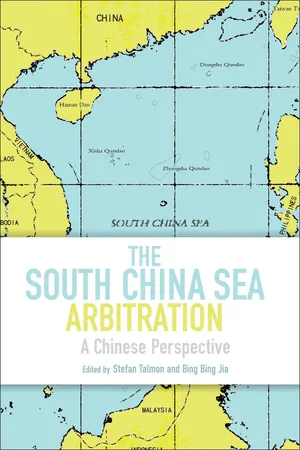
On 22 January 2013, the Republic of the Philippines instituted arbitral proceedings against the People's Republic of China (PRC) under the United Nations Convention on the Law of the Sea (UNCLOS) with regard to disputes between the two countries in the South China Sea (South China Sea Arbitration). On 19 February 2013, the PRC formally expressed its opposition to the institution of proceedings, making it clear from the outset that it will not have any part in these arbitral proceedings and that this position will not change. It is thus to be expected that over the next year and a half, the Tribunal will receive written memorials and hear oral submissions from the Philippines only. The Chinese position will go unheard. However, the Tribunal is under an obligation, before making its award, to satisfy itself not only that it has jurisdiction over the dispute, but also that the claims brought by the Philippines are well founded in fact and law (UNCLOS Annex VII, Article 9).This book aims to offer a (not the) Chinese perspective on some of the issues to be decided by the Tribunal and thus to assist the Tribunal in meeting its obligations under the Convention. The book does not set out the official position of the Chinese government, but is rather to serve as a kind of amicus curiae brief advancing possible legal arguments on behalf of the absent respondent. The book does not deal with the merits of the disputes between the Philippines and the PRC, but focuses on the questions of jurisdiction, admissibility and other objections which the tribunal will have to decide as a preliminary matter. The book will show that there are insurmountable preliminary objections to the Tribunal deciding the case on the merits and that the Tribunal would be well advised to refer the dispute back to the parties in order for them to reach a negotiated settlement.The book brings together scholars of public international law from mainland China, Taiwan and Europe united by a common interest in the law of the sea and disputes in the South China Sea.
This title is included in Bloomsbury Professional's International Arbitration online service.
eBook - PDF
The South China Sea Arbitration
A Chinese Perspective
- 274 pages
- English
- PDF
- Available on iOS & Android
eBook - PDF
The South China Sea Arbitration
A Chinese Perspective
About this book
Information
Table of contents
- Preliminary Pages
- Preface
- Contents
- List of Abbreviations
- Contributors
- Table of Cases
- Table of Treaties
- Table of National Instruments
- 1. Introduction
- I. The Disputes between the Philippines and China in the South China Sea
- II. The South China Sea Arbitration
- 2. The South China Sea Arbitration: Is There a Case to Answer?
- I. Introduction
- II. Default of Appearance in Historical Perspective
- III. The Consequences of Default of Appearance
- IV. Possible Preliminary Objections to the Philippines' Claims
- V. The Politics of Arbitration
- VI. Conclusion
- 3. Issues of Jurisdiction in Cases of Default of Appearance
- I. Introduction
- II. Default of Appearance and Ensuing Duties of the Tribunal
- III. The Requirement of a Dispute between the Parties
- IV. The Requirement that the Disputes Concern the Interpretation or Application of the Convention
- V. Disputes Removed from Compulsory Jurisdiction under Article 298 UNCLOS
- VI. Conclusion
- 4. The Issue of Admissibility in Inter-State Arbitration
- I. Introduction
- II. Primary Obligation to Negotiate: Article 281(1) UNCLOS
- III. Defects of Certain Claims
- IV. Abuse of Rights/Procedure
- V. Estoppel
- VI. Conclusion
- 5. Jurisprudential Tenability of the Philippines v China Arbitration on South China Sea Disputes?
- I. Introduction
- II. What are the Philippines' Claims against China?
- III. China's Reasons for Refusing the Philippines' Arbitration Request
- IV. Chinese Policy toward Resolution of the South China Sea Disputes
- V. Future of the Arbitration
- VI. Conclusion
- Annex I: Selected Documents Relevant to the South China Sea Arbitration
- Annex II: Select Bibliography on the South China Sea Disputes
- Annex III: Glossary of Place Names
- Bibliography
- Index
Trusted by 375,005 students
Access to over 1.5 million titles for a fair monthly price.
Study more efficiently using our study tools.
Frequently asked questions
Yes, you can cancel anytime from the Subscription tab in your account settings on the Perlego website. Your subscription will stay active until the end of your current billing period. Learn how to cancel your subscription
No, books cannot be downloaded as external files, such as PDFs, for use outside of Perlego. However, you can download books within the Perlego app for offline reading on mobile or tablet. Learn how to download books offline
Perlego offers two plans: Essential and Complete
- Essential is ideal for learners and professionals who enjoy exploring a wide range of subjects. Access the Essential Library with 800,000+ trusted titles and best-sellers across business, personal growth, and the humanities. Includes unlimited reading time and Standard Read Aloud voice.
- Complete: Perfect for advanced learners and researchers needing full, unrestricted access. Unlock 1.5M+ books across hundreds of subjects, including academic and specialized titles. The Complete Plan also includes advanced features like Premium Read Aloud and Research Assistant.
We are an online textbook subscription service, where you can get access to an entire online library for less than the price of a single book per month. With over 1.5 million books across 990+ topics, we’ve got you covered! Learn about our mission
Look out for the read-aloud symbol on your next book to see if you can listen to it. The read-aloud tool reads text aloud for you, highlighting the text as it is being read. You can pause it, speed it up and slow it down. Learn more about Read Aloud
Yes! You can use the Perlego app on both iOS and Android devices to read anytime, anywhere — even offline. Perfect for commutes or when you’re on the go.
Please note we cannot support devices running on iOS 13 and Android 7 or earlier. Learn more about using the app
Please note we cannot support devices running on iOS 13 and Android 7 or earlier. Learn more about using the app
Yes, you can access The South China Sea Arbitration by Stefan Talmon, Bing Bing Jia, Stefan Talmon,Bing Bing Jia in PDF and/or ePUB format, as well as other popular books in Law & International Law. We have over 1.5 million books available in our catalogue for you to explore.