eBook - ePub
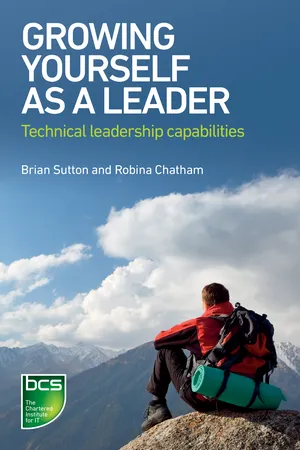
Growing Yourself As A Leader
Technical Leadership Capabilities
- 106 pages
- English
- ePUB (mobile friendly)
- Available on iOS & Android
eBook - ePub
About this book
The development of technical leadership capabilities is often overlooked as a training requirement in organisations but these are key to business success.
In this book, management experts Brian Sutton and Robina Chatham describe six management techniques to help you develop your leadership capabilities and grow as a leader. With real life examples, tips and mini exercises, you'll also boost your soft skills as you progress your personal and professional development.
Information
1 BUILDING PERSONAL MASTERY
The focus of this chapter is on techniques you can use to go beyond being just good at your job and become truly outstanding; to be all you can be. To achieve this, you will need to become much more deliberate in choosing and working on things you want to improve, and you will also need to tune your senses to acquire feedback from every possible source and then use this feedback as a learning mechanism. Through learning, you get better at what you do and you also develop the personal courage to strive to be great at things that you currently believe are beyond your ability.
WHY IS THIS IMPORTANT?
When we talk of personal mastery we are describing the process of developing true expertise in a field.
It is natural to aspire to be an expert, but in looking for role models people often look outside their profession for inspiration about how people achieve mastery. For example, when you look at top artists or sportsmen or sportswomen it is easy to think that such expertise is a step too far for you. In many cases that may be true to an extent, but it is not the whole story. Almost all top performers share the following common traits:
• They practise intensively and in a very focused and deliberate way. On average, the evidence appears to suggest that it takes about 10,000 hours of practice over a period of around 10 years to reach elite performance.1
• They study with devoted and talented teachers and coaches who are dedicated to developing people.
• They are encouraged and supported in their development by their family and friends.
Rather than be disillusioned or daunted by the sheer scale of effort put in by these role models, you should draw comfort from these statistics. These experts achieved brilliance through hard work and focused deliberate practice. If they can do it, so can you. But what is the difference between deliberate practice and the routine consolidation of your skills that you engage in every day of the week?
There is an old adage that says:
Practice makes perfect.
The reality is that practice just makes you better at doing what you are already doing and more certain that what you are doing is right. Without appropriate feedback and reflective thought, you can never hope to get truly better at doing anything.
Within the context of learning by doing in the workplace, you can think of the process in the following way; you take action, observe the results, reflect on why things turned out the way they did, and then you think about how you can modify your actions or approach next time to get different or better results.
This is termed the learning loop and was articulated neatly by David Kolb in 1983.2 In order for you to learn, experience has to be backed up by reflection which, in turn, allows you to make generalisations and formulate concepts that can then be applied to new situations.
The thing that makes Kolb’s learning loop work is feedback – information that you receive from the real world that helps you understand how things are playing out. Feedback is a critical element for learning and growth.

If you want to achieve personal mastery at anything, you need to look for feedback on your current performance and then reflect on what that feedback is telling you.
Everything you do is an opportunity to learn and grow, but unless you get feedback you will never be able to take full advantage of these precious learning opportunities.
THE IMPACT OF THE ISSUE
There is a world of difference between being busy and being productive. Our organisations are full of busy people, people running on autopilot as they repeat with little thought the same tasks in the same way. Often enjoyment and fulfilment drain away and all that is left is getting through another day without actually screwing up. It need not be like this: you do have a choice. You can spend your days reacting to things as they hit you; if you do this you will inevitably have a sense that the world is happening to you and is outside of your control. Or you can adopt a more creative mindset and seek to create the future you want by the choices and actions you take today and every day.
If you choose to take a hand in creating your own future you will need to, first of all, imagine what that future could be, in terms of:
• what it would look and feel like;
• what you would be able to achieve if you could make it real;
• what you would need to put in place in order to get there.
This is, in effect, building a personal vision. Your vision needs to be challenging; ideally it should appear to lie just outside your possible grasp and it should be something that is going to take significant and sustained effort to achieve. If you are not heading somewhere significant and exciting you will just drift – most of the people in the workplace today are drifting. Drifters seldom get promoted and are highly unlikely to get to do the exciting and interesting jobs. You need to be driven and you need to be driving relentlessly towards a goal.
Comparing your personal vision to the current reality will highlight the gaps – the things that you need to change or improve in order to make progress. Some of the skills and abilities you need will be new to you or will feel awkward or uncomfortable, whilst others may need a little polishing. The key is to be selective and focus on one thing at a time.

Expertise is realised as a result of lots of small but significant improvements to lots of seemingly insignificant things rather than one big improvement to one thing.
The reason that many people find it so difficult to improve in the workplace is because they do not have a vision that drives them to a new level. They don’t know how to apply themselves in a way that can yield results. They often don’t have someone to inspire, guide and sustain them in their quest for excellence and mastery and, critically, they expect results too soon. The problem with shooting for the stars is that at the first setback it is tempting to give up or lower the goal, to say: ‘Well, that was unrealistic. Perhaps I ought to attempt something a little less challenging.’ Never give up or lower your goals. You may not achieve them all but the people who you admire and who succeed are the sorts of people who will strive relentlessly to achieve their goal. For them, failure is not an option.

If you fail to achieve your goal, don’t lower it – change your approach to achieving it.
Once you start to work on improving your skills you will nee...
Table of contents
- Front Cover
- Half Title
- BCS, THE CHARTERED INSTITUTE FOR IT
- Title Page
- Copyright Page
- Contents
- List of figures
- About the authors
- Foreword
- Acknowledgements
- Preface
- 1. BUILDING PERSONAL MASTERY
- 2. UNLOCKING YOUR OWN CREATIVE POTENTIAL
- 3. DEVELOPING YOURSELF THROUGH MENTORING AND COACHING OTHERS
- 4. PLAYING THE POLITICAL GAME WHILST MAINTAINING INTEGRITY
- 5. MANAGING YOUR OWN TIME
- 6. KEEPING POSITIVE WHEN THINGS ARE GOING WRONG
- Bibliography
- Index
- Back Cover
Trusted by 375,005 students
Access to over 1.5 million titles for a fair monthly price.
Study more efficiently using our study tools.
Frequently asked questions
Yes, you can cancel anytime from the Subscription tab in your account settings on the Perlego website. Your subscription will stay active until the end of your current billing period. Learn how to cancel your subscription
No, books cannot be downloaded as external files, such as PDFs, for use outside of Perlego. However, you can download books within the Perlego app for offline reading on mobile or tablet. Learn how to download books offline
Perlego offers two plans: Essential and Complete
- Essential is ideal for learners and professionals who enjoy exploring a wide range of subjects. Access the Essential Library with 800,000+ trusted titles and best-sellers across business, personal growth, and the humanities. Includes unlimited reading time and Standard Read Aloud voice.
- Complete: Perfect for advanced learners and researchers needing full, unrestricted access. Unlock 1.5M+ books across hundreds of subjects, including academic and specialized titles. The Complete Plan also includes advanced features like Premium Read Aloud and Research Assistant.
We are an online textbook subscription service, where you can get access to an entire online library for less than the price of a single book per month. With over 1.5 million books across 990+ topics, we’ve got you covered! Learn about our mission
Look out for the read-aloud symbol on your next book to see if you can listen to it. The read-aloud tool reads text aloud for you, highlighting the text as it is being read. You can pause it, speed it up and slow it down. Learn more about Read Aloud
Yes! You can use the Perlego app on both iOS and Android devices to read anytime, anywhere — even offline. Perfect for commutes or when you’re on the go.
Please note we cannot support devices running on iOS 13 and Android 7 or earlier. Learn more about using the app
Please note we cannot support devices running on iOS 13 and Android 7 or earlier. Learn more about using the app
Yes, you can access Growing Yourself As A Leader by Brian Sutton,Robina Chatham in PDF and/or ePUB format, as well as other popular books in Business & Management. We have over 1.5 million books available in our catalogue for you to explore.