At the core of both art and science we find the twin forces of probability and uncertainty. However, these two worlds have been tenuously entangled for decades. On the one hand, artists continue to ask complex questions that align with a scientific fascination with new discoveries, and on the other hand, it is increasingly apparent that creativity and subjectivity inform science's objective processes and knowledge systems.
In order to draw parallels between art, science and culture, this publication will explore the ways that selected art works have contributed to a form of cultural pedagogy. It follows the integration of culture and science in artists' expressions to create meaningful experiences that expose the probabilities and uncertainties equally present in the world of science.
To propel and maintain us moving forward into concepts of agency in the Epicurean swerve, we might employ the concepts of ‘vitalism’1 or ‘entelechy’2 that holds that there is an inherent life within various natural materials, which allows for and appreciates the cognitive comprehension of matter as a performative agent.3 The performative ‘spin’ (to appropriate the quantum analogy into a creative one) is at the heart of the matter here – along with vibration, rhythm and material patterns, it is as fundamental to the physical world (indeed it is the fundament per se) as it is to creativity and consciousness. Like Schrödinger’s cat, we are compelled to understand materiality as being both alive and dead simultaneously. A non-human object like a cup takes on a humanness by virtue of its function; it becomes a semi-alive companion that exists in the space where it is not affirmed.
It follows that all possible futures emerge out of an undetermined past. This is something we could know implicitly (self-evidently) if we were possessed by a higher dimensional consciousness. Within our narrow vision, all we can hope to witness is the flickering of possible futures behind the glare of the one we create. In this sense, modelling and rationalizing the world is a kind of foresight or divination, whereby our potential futures emerge from the unknowable yet-to-be and take first cautious and underdeveloped steps in the present.
The prolific and popular role of scientific storytelling (popular science) in today’s world means that we are more aware of the importance of the vibratory character of existence. Yet, this coalescence of creativity and science (for better or worse) has a long lineage. Based on the work preceding the Solvay conference, the Italian Futurists sought to give visual form to new concepts of matter emerging at the time and concerning the newly discovered quantum world. This world is elucidated in the writings of Henri Bergson and the technical images of Étienne-Jules Marey4 by drawing together a conception in seeing the totality of space and the object world as an exemplar of contributing fields of energy.
We can draw further relationships between Marey’s chronophotography of movement and the Atomic Force Microscope’s visualization of atoms. The moments in time when the invisible worlds become visible seem to spark universal assimilation of an expression of movement by common interest. To either extol or challenge the mechanization of visualizing the invisible is the question here. The late nineteenth-century concept of ‘ether’ as an invisible, nonmaterial and infinite space filling the void between things becomes a tangible influence in Marey’s photographs, revealing a confluence between scientific storytelling and artistic world-modelling. Marey’s photographs utilized the fabric black velvet as defining an analogous and relativistic pictorial expression of blackness to emphasize the space between. The movement of the subject was captured by the camera in front of the low light emitted from the blackness of the velvet. What was then seen in the photograph were traces of the subject coalescing within the fabric to form a physical representational space of ether.5
The Italian Futurists showed us in the early 1900s the initial stages of how concepts being explored within physics were being investigated through art simultaneously. The courage to visualize the invisible, but foundational, material world is seen in the work of Futurist artists who drew on Marey’s photographs, as well as Bergson’s theories.6 Giacomo Balla, Umberto Boccioni, Gino Severini and Carlo Carrà all attempted to reveal in their work the imperceptible forces of the atomic world. They sought to explore and represent (albeit in what we now understand as traditional mediums) new ideas about time, space and motion as being inclusive of one another; perceptible but not visible. Boccioni was making the most sensational contribution to this project in his attempts to articulate a new visual language of matter.7 The state of making such profound works was not solely driven by physics but was part of a total experience of critiquing a mechanistic age. Fearful of the old and intoxicated with the new, the Futurists were testing out creative possibilities of visual expression against a backdrop of revolutionary scientific advancement.
Measurement and control
Measurement is continually challenged in the speculative nature of the quantum universe. Eight years after Einstein’s theory of relativity, and fourteen years before Werner Heisenberg articulated and formulated his quantum uncertainty principle, Duchamp poetically demonstrated the problem of measurements in his work 3 Standard Stoppages (1913–14). The contestable nature of measurement is clearly defined in Duchamp’s artwork, which demonstrates the artist’s intuitive vision and disregard for the classical picture of the world. In this experiment, Duchamp took three pieces of yarn, each a metre long, and dropped them onto a length of Prussian blue canvas. Each time the yarn was dropped, it formed a different wave; each piece of string expressed a new and random version of the length of a metre. These different random waves were marked up and cut out of wood to form three correlate templates, which were each resultantly different lengths. The metre had been a standard measurement since its introduction in France in 1793; Duchamp successfully interrogated the absolute certainty of classically defined units of measurements. 3 Standard Stoppages was a reflection of its time as a critique of measurement.
Duchamp’s experiment literally touches on the influence of gravity and time and impacts Newton’s laws of motion. The certainty of the Newtonian world was unravelling by the evolving problem of measurement at the atomic level. Physicists during Duchamp’s time were questioning the legacy of the classical world. The instruments of measurement created in 3 Standard Stoppages can be seen as representational of the uncertainty principle and superposition,8 with the metre outcome being in multiple states at the same time.
In an interview with Katherine Kuh, when asked which of his works he finds most important, Duchamp stated:
As far as date is concerned I’d say the Three Stoppages [3 stoppages étalon] of 1913. That was really when I tapped the mainspring of my future. In itself it was not an important work of art, but for me it opened the way – the way to escape from those traditional methods of expression long associated with art. I didn’t realize at that time exactly what I had stumbled on. When you tap something you don’t always recognize the sound. That’s apt to come later. For me the Three Stoppages was a first gesture liberating me from the past.
(Kuh 1962: 81)
Duchamp’s artistic provocation sought to liberate artists so that they might explore those new territories that were being opened up by the sciences. The quantum and the atomic, Duchamp realized, needed to be co-opted and contextualized in a comparative study with what artists had already historically accomplished in the confrontation of measurement. This emerging confrontational trend can be seen as one that expresses at its core both scientifically inspired ontology (being) and epistemology (knowing). In many respects, Duchamp and those kindred artists were making Schrödinger’s cat – thought experiment – pre-actively into an artwork.
To quote Lewis Feuer:
The arts were probably the most readable barometer of the revolt against determinism during the war and post war period. This was especially evident in the turbulent emotional assertions of the Dadaist movement. Here, almost as if in a pure laboratory culture, was the emotional nucleus of the rebellion against causality, order, and logic.
(Feuer 1974: 183–84)
The act of drawing out and critiquing the world through mark-making is an experimental methodology for understanding our existence. Duchamp’s work is insightful because it challenges orthodox classical models and in doing so reveals the probabilistic nature of quantum. Without knowing it, Duchamp was tapping into the fundamental uncertainty borne of the quantum wave/particle duality in his reproach and critique of inherited standards of measurement. A new non-deterministic atomic behaviour creates a special kind of unpredictability for the neutrons, photons and electrons to be understood as being part of the unmeasurable quagmire at the foundation of nature. Marcel Duchamp captured the twilight of the classical idols succinctly, using yarn to create diagrammatical linear elements to be reused as an uncertainty wave for reference in subsequent paintings.9
There is never just one sole event that leads to the discovery of a particular affect. The development of chance or probability challenged the quantifiable world to realize that simultaneous occurrences of a particular problem are not only possible but also necessary. The artistic movements of Expressionism, Cubism, Futurism, Constructivism, Dada and Surrealism all included artists who were looking at questions that pertained to physics, yet did so often without recognizing it; certainly, physics and chemistry were not the sole focus of their intentions. Picasso’s interest in primitive masks, for example, was not simply the result of oriental imaginings; his interest in them was, in part, fuelled by the ongoing race to represent four-dimensional space (a fact that is well documented by Arthur I. Miller10 and Linda Dalrymple Henderson11).
The Solvay rupture
The Solvay International Conference was a highly significant series, initially instigated by Belgian industrialist Ernest Solvay in 1912. The most famous of the conference series (that last took place in 2014) was the ‘Fifth Solvay International Conference on Electrons and Photons’ (October 1927) where the world’s most notable physicists discussed quantum mechanics. Here, the legendary Bohr–Einstein debate began on the probabilistic nature of quantum mechanics. The conference was where Einstein, dissatisfied with Heisenberg’s uncertainty principle, infamously made reference to suggest that ‘God did not play dice’, to which Bohr supposedly retorted ‘stop telling God what to do’.12 Whether this story is true or not, it points out the immense differences that were generated between the classical and quantum worlds. This particular conference was the culmination of a shift in thinking that would have major causal effect across the world.
Located in Brussels, this conference was where the most notable physicists, including Niels Bohr, Paul Dirac, Albert Einstein, Louis de Broglie, Werner Heisenberg, Max Planck and Erwin Schrödinger, were challenging prevailing givens within physics and chemistry.
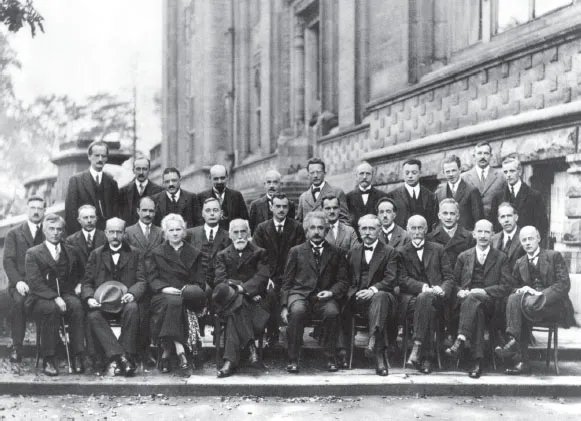
Werner Heisenberg’s paper ‘On the Perceptual Content of Quantum Theoretical Kinematics and Mechanics’ (1927) articulated and defined what we now know as the uncertainty or indeterminacy principle; a principle that holds that if you can measure the velocity of an atomic particle, you cannot measure its position in space on account of the physical fact of the wave–particle duality of all matter. The history of the events that followed the 1927 Solvay conference is complex but might be summarized or threaded together by what we would now call a deconstructivist trend – although it was a trend not to combat the validity of scientific processes, but to combat the fact of scientific certainty. In other words, the 1927 Solvay conference (Fig. 1) seeded a sense of doubt and stressed the importance of the latent uncertainty that undermines our ability to measure anything with absolute objectivity.
This uncertainty was the basis for the famous Copenhagen Interpretation,13 created to define a means by which the ambiguity that surrounded the findings of Heisenberg and Bohr could be contextualized. The Interpretation made a role for probabilities in measuring an event that does not have definite properties, which meant that the experiment was always reduced to one probability for a classical outcome. It was this decision of the Copenhagen Interpretation for the uncertainty of the wave-particle duality in physics to exist as though two unmeasurable sides of the same coin. This created the fertile grounds for uncertainty to exist as the essential core of quantum theory.
Albert Einstein, Boris Podolski and Nathan Rosen (EPR) developed a theory in 1935 which disputed the Heisenberg theory of uncertainty. Later, in 1964, at CERN in Geneva, John Bell developed a paper that hypothesized a way to prove or disprove quantum mechanics, creating a fundamental construct that enabled physicists to finally come to terms with certainty/uncertainty as a physical fact of the universe. Bell’s hypothesis was to capture reality in the act of happening.14 Einstein famously called quantum mechanics ‘spooky action at a distance’.15 1927 thus serves as an important historical junction in the development of our understanding of the physical universe. Since then, within scientific and creative fields alike, there has been space for the impossible, unpredictable, unplanned and random to play an essential role as part of intuition and inquiry aimed at making sense of what it is to be in and of this world.
Figure 1: The Fifth Solvay International Conference, 1927. Back (left to right): Auguste Piccard, Émile Henriot, Paul Ehrenfest, Édouard Herzen, Théophile de Donder, Erwin Schrödinger, J. E. Verschaffelt, Wolfgang Pauli, Werner Heisenberg, Ralph Fowler, Léon Brillouin. Middle: Peter Debye, Martin Knudsen, William Lawrence Bragg, Hendrik Anthony Kramers, Paul Dirac, Arthur Compton, Louis de Broglie, Max Born, Niels Bohr. Front: Irving Langmuir, Max Planck, Marie Curie, Hendrik Lorentz, Albert Einstein, Paul Langevin, Charles-Eugène Guye, CTR Wilson, Owen Richardson. ETH-Bibliothek Zürich, Bildarchiv. Photographer: Benjamin Couprie, 1927.
The path of ‘uncertainty’ precipitated in 1927 was nevertheless met with resistance from the orthodox scientific community. 1927 saw institutional conflict emerge between the two philosophical camps of inquiry – between certainty and uncertainty. This conflict persisted even after Bell’s theory of 1964. In 1982, when the technology was available, Alain Aspect, Jean Dalibard and Gérard Roger created the actual experiment inspired by Bell to see if the world we live in is probabilistic (speculative) or classical (local realism), where the world has definite things and only interacts with neighb...
Table of contents
Cover Page
Title page
Copyright Page
Contents
Acknowledgments
Foreword
Introduction
Chapter 1
Chapter 2
Chapter 3
Chapter 4
Chapter 5
Conclusion
References
Author’s Biography
Index
Frequently asked questions
Yes, you can cancel anytime from the Subscription tab in your account settings on the Perlego website. Your subscription will stay active until the end of your current billing period. Learn how to cancel your subscription
No, books cannot be downloaded as external files, such as PDFs, for use outside of Perlego. However, you can download books within the Perlego app for offline reading on mobile or tablet. Learn how to download books offline
Perlego offers two plans: Essential and Complete
Essential is ideal for learners and professionals who enjoy exploring a wide range of subjects. Access the Essential Library with 800,000+ trusted titles and best-sellers across business, personal growth, and the humanities. Includes unlimited reading time and Standard Read Aloud voice.
Complete: Perfect for advanced learners and researchers needing full, unrestricted access. Unlock 1.4M+ books across hundreds of subjects, including academic and specialized titles. The Complete Plan also includes advanced features like Premium Read Aloud and Research Assistant.
Both plans are available with monthly, semester, or annual billing cycles.
We are an online textbook subscription service, where you can get access to an entire online library for less than the price of a single book per month. With over 1 million books across 990+ topics, we’ve got you covered! Learn about our mission
Look out for the read-aloud symbol on your next book to see if you can listen to it. The read-aloud tool reads text aloud for you, highlighting the text as it is being read. You can pause it, speed it up and slow it down. Learn more about Read Aloud
Yes! You can use the Perlego app on both iOS and Android devices to read anytime, anywhere — even offline. Perfect for commutes or when you’re on the go. Please note we cannot support devices running on iOS 13 and Android 7 or earlier. Learn more about using the app
Yes, you can access Quantum Art & Uncertainty by Paul Thomas in PDF and/or ePUB format, as well as other popular books in Art & Art General. We have over one million books available in our catalogue for you to explore.