![]()
Chapter 1
Prologue: Innovation Management
Jon-Arild Johannessen, Nord University, Norway and Kristiania University College, Norway
Hanne Stokvik, Nord University, Norway
Learning goals
- In this chapter, you will learn how to develop a new type of leadership in the knowledge economy, the innovation leader.
- The objective of the chapter is to develop the elements necessary for creating innovation leadership in organizations.
- Evaluation: The learning goals are evaluated through the reader tasks 1–13.
Introduction
The literature on leadership has traditionally viewed a leader as a person who has a formal leadership position, and who, by the authority of his/her leadership position, leads an organization toward goals that have been set. However, in the global knowledge economy, leadership has become more and more a question of promoting entrepreneurial actions in order to create creative energy fields that can generate enthusiasm and motivate the front line in relation to creativity and action (see Hamel, 2007; Taylor & Labarre, 2007; Westland, 2016). This requires a different type of leadership than before, which we will call “innovation leadership.” Innovation leaders are the people in organizations who rouse enthusiasm and generate creative energy fields. These innovation leaders focus on organizations being able to create their own markets and future, without having to adapt to situations created by others (Ackoff & Emery, 2007; Kim & Mauborgne, 2005). This development of new leaders is described by Isaksen and Tidd (2006, p. xvi) as follows: “leadership needs to be conceived of as something that happens across functions and levels.”
Organizations are increasingly required to use all the creative diversity that exists throughout the organization (see Jensen, 2017; Westland, 2016). In our view, organizations need innovation leaders who can generate creative energy fields and set off the spark that ignites the flame of innovation, in turn generating a creative new element capable of taking an organization into areas where competition does not always drain its organization’s resources (see Kim & Mauborgne, 2005). These innovation leaders focus on new products and services that are both unique and temporally outside the competitive zone. The reason they are outside the competitive zone is because the innovations in question are difficult to imitate. This may be regarded as a form of temporary competition-free zones, where an organization can profit from creative interaction. When referring to these competition-free zones Kim and Mauborgne (2005) use the expression “blue ocean strategy.”
Leadership should draw upon the creative potential that is spread throughout an organization, across functions and formal levels of leadership. Innovation leaders need to prepare organizations for changes that will come in the future, in part by generating creative energy fields that take the organization into temporary competition-free zones. To achieve this requires new ways of thinking and assumes that innovation leaders are able to act as independent entrepreneurs. Consequently, reflection concerning entrepreneurial action is vital. We also need the outlines of a theory on the development of creative energy fields in an organization, so that we can understand and act with a strategic compass for leadership, rather than relying too much on trial and error.
The distinction between leadership and administration related to innovation is not necessarily a fruitful one. We need creativity, both when we want to do things better and when we want to improve the way things are done. Making a distinction between leadership and administration can easily lead thoughts and acts to focus on the distinction between creativity and productivity. We not only need a creative organization but also a focus on productivity. One is not necessarily the cause of the other—they should rather be viewed as complementary. Consequently, our perspective here is that of a holistic integrated model where leadership and administration coordinate and balance each other, promoting creativity, innovation, productivity, and change.
In this way, a climate is created where entrepreneurial action promotes the development of creative energy fields. The following is the question we discuss here: How can we develop a new type of leadership in the knowledge economy, “innovation leadership”?
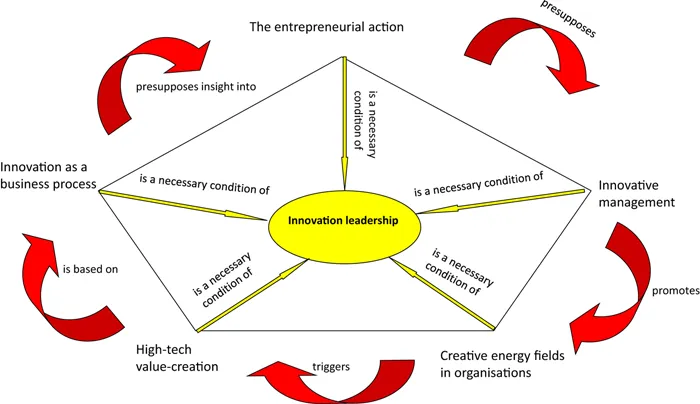
We have illustrated this explanation in Fig. 1, which also shows how the chapter is organized.
Fig. 1: Innovation Leadership: Strategies for Creativity and Innovation in Organizations.
The entrepreneurial action
The entrepreneurial action is based on fundamental experiences and intuition that has been developed on the basis of these experiences. Entrepreneurial action is vision driven and follows a clear goal. The entrepreneurial strategy “is both deliberate and emergent, deliberate in its broad lines and sense of direction, emergent in its details so that these can be adapted en route” (Mintzberg, Ahlstrand, & Lampel, 1998, p. 125). The entrepreneurial action which constitutes and provides guidance for the entrepreneurial strategy is based upon the entrepreneur’s fundamental experiences, perspectives, and ways of viewing things (Lewis & Malmgren, 2018).
Each entrepreneur’s actions are largely based on the lack of information concerning all the possible outcomes. This creates uncertainty regarding an individual entrepreneurial action. On the other hand, it also creates scope for the class of entrepreneurial actions. Risk can be calculated in relation to the class of entrepreneurial actions, not the individual entrepreneurial action. This distinction between the uncertainty concerning a particular entrepreneurial action and the risk concerning the class of entrepreneurial actions was first described by Frank Knight in 1921. In order to understand the entrepreneurial action in a strategic perspective, it is important to understand the distinction between risk and uncertainty. If this distinction is not made, then risk and uncertainty become synonymous concepts. This lack of distinction can then result in an organization setting limits on their willingness to transform strategy into innovation leadership based on the entrepreneurial actions.
Entrepreneurial action for creative destruction
The entrepreneurial action is fundamentally an action that aims to change something, to create something new (Bessant, 2017; Schumpeter, 1950, p. 84). This is a creative process which simultaneously destroys activities and processes in the economy. In this context, it is helpful to consider Schumpeter’s concept of creative destruction which results from the creative entrepreneur’s actions. However, there is a time lag between the creative entrepreneurial action and the destructive processes which it sets off. The destruction is made evident by the fact that the entrepreneurial action renders existing businesses superfluous, thus eliminating them. The entrepreneur is at greatest risk of failing during the time lag period.
The point here is that the class of creative entrepreneurial actions knocks out both existing businesses and many of the creative entrepreneurial initiatives. When the dust settles on the battlefield, many stalled creative initiatives and destroyed established businesses are revealed. This creative destruction devours not only its own children, like any revolution, but also those who were victims of the revolution. In this way, the entrepreneurial action also greatly affects society in general, rather than just the economy and the technology-driven parts of the system.
In Schumpeter’s understanding, the entrepreneurial action that involves creative destruction constitutes the dynamics of the capitalist system. It is these dynamics which, according to Schumpeter, enables the capitalist system to move forward. From this perspective, sometimes it is necessary to take one step back in order to move two steps forward. The step back is represented by the time lag between the creative entrepreneurial action and the destructive consequences of these actions (Bessant, 2017). The two steps forward are represented by the new developments that emerge from the ashes, when the entrepreneurial actions have manifested themselves.
The entrepreneurial action may be understood as the engine of the economic system. It operates out of entrepreneurial ideas and burning ambitions that reveal themselves in commitment and creativity.
The strategic problem for established enterprises is that they have largely relegated entrepreneurial action to the dustbin of history and their own back corridors. Hamel (2007, p. 3) asks the following question: “How will tomorrow’s most successful companies be organized and managed?” He answers, “[by] becoming a management innovator” (Hamel, 2007, p. 215); Hamel’s answer, “management innovation,” may be interpreted as one that involves substantial use of entrepreneurial actions. Hamel (2007, pp. 215–216) shows through practical examples that this is also possible with large, established companies such as GE, IBM, Procter & Gamble, and Whirlpool, to name a few.
Innovative leadership
To lead people who are expected to be creative and innovative requires a special type of leadership or leadership style, say Mumford, Scott, Goddis, and Strange (2002). We will call this style innovative management, as distinguished from creative leadership. Creative leadership is concerned with leading creative people, while innovative management is concerned with bringing out the creativity in everyone who works for an organization (Jensen, 2017; Westland, 2016).
As the pace of change has increased, complexity has also increased and turbulence in the world at large has also become the norm; in consequence, new models of leadership have emerged. These models refer back to the classical leadership models that were valid for another period (Blake & Mouton, 1985).
The central focus of the new leadership models is the following question: What factors promote the successful leader? Through their research, Bennis and Nanus (1985) found up to four dimensions in response to this question: vision, purpose, confidence, and creativity. Kouzes and Posner (1995) conducted a major study and found five similar characteristics common to successful leaders:
- They challenge the process in the business.
- They develop a shared vision.
- They focus on cooperation.
- They plan and highlight small positive results on the road to a greater result.
- They provide feedback and encourage people who have achieved something positive, no matter how small it is.
Characteristics for skilled leadership
In his research, Collins (2001) found five levels characteristic of skilled leadership. The first level is the leader’s talent, knowledge, skills, and good work habits; the second level is an effective team; the third level is competent project managers; the fourth level is the effective leader, who develops a common vision and stimulates the implementation of challenging standards. However, it is the fifth level that separates successful from unsuccessful organizations, according to Collins. Fifth level leaders demonstrate a high degree of humility combined with a strong will to achieve the goals they have set for themselves. Hamel (2007), Gratton (2007) and Taylor and Labarre (2007), Lewis and Malmgren (2018) together with Collins (2001), may be said to follow the tradition that interprets leadership as something that concerns everyone working in an organization.
What a system is designed to do
To introduce changes without the organization following in step after the last change initiative leads to spasmodic organizations without a common purpose or focus. The only thing that happens in such organizations is that more and larger pockets of resistance to change develop (Lewis & Malmgren, 2018).
To force an organization to adopt new concepts that come sailing in from the consultant’s drawing board does not lead to fundamental behavioral changes in an organization. Tidd, Bessant, and Pavitt (2005) have shown this for quality circles; benchmarking; BPR (business process reengineering); and lean-agile ERP (enterprise resource planning). To imi...